Against RICO?

Alternate title: The problems with State and federal RICO laws

The original Racketeer Influenced and Corrupt Organizations (RICO) Act was enacted by the Congress in 1970. (Thirty-three States, as well as Puerto Rico and the U.S. Virgin Islands, have also adopted local RICO laws.) Putting aside the oft-overlooked question of whether the Congress has the constitutional authority to punish purely local acts of racketeering, below are some additional critiques of these State and federal laws:

  1. “Debate Rages Over the Long Arm of RICO” by Scot J. Paltrow (Los Angeles Times, 13 Aug. 1989).
  2. “Law as a Weapon: How RICO Subverts Liberty and the True Purpose of Law” by William L. Anderson and Candice E. Jackson (The Independent Review, Vol. 9, 2004).
  3. “RICO Overreach: How the Federal Government’s Escalating Offensive against Gangs Has Run Afoul of the Constitution” by Matthew H. Blumenstein (Vanderbilt Law Review, Vol. 62, Summer 2009).
  4. “45 Years, 45 Days: How the RICO Law Violates Liberty” (Reason Magazine, 8 Aug. 2013).
  5. “The Checkered Past (and Present) of the RICO Act” by Regan Jarvis (Juris Magazine, 17 Nov. 2021).

Bonus link: “Appeals court rules in favor of pair challenging Arizona civil forfeiture as unconstitutional” by Perry Vandell (Arizona Central, 6 Oct. 2021).
Posted in Uncategorized | Leave a comment

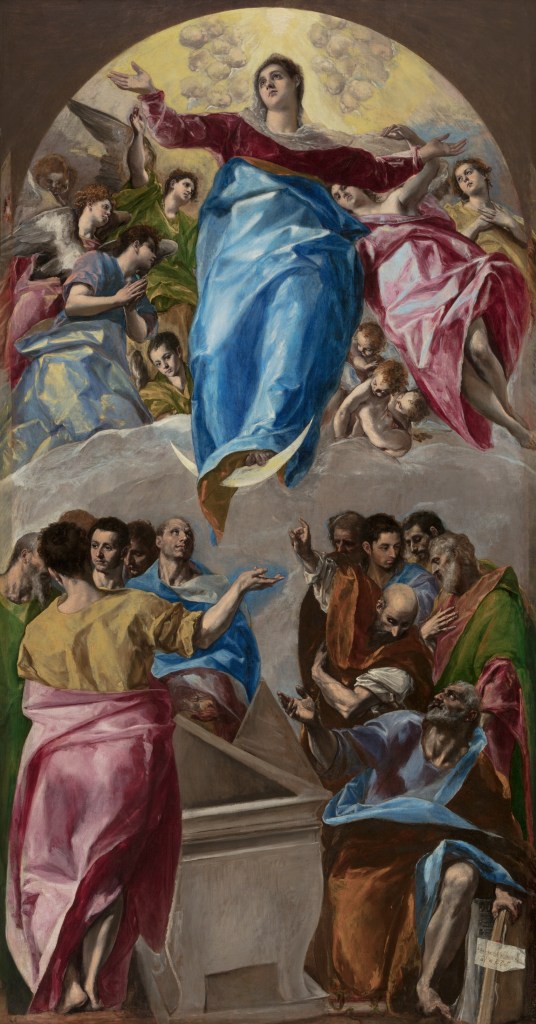
Feast of Assumption

Today (15 August) is a Holy Day for Catholics and Orthodox Christians: the Feast of the Assumption of the Blessed Virgen Mary; look it up! To commemorate this occasion, I am posting below a screenshot of El Greco’s first major Spanish commission and first large public work: “The Assumption of the Virgin.”

Posted in Uncategorized | Leave a comment

Preview of my new ChatGPT-inspired *academic activity* survey

Hello! I am a college professor who teaches an undergraduate survey course in business law and ethics. Among other things, my home institution requires faculty to assign an “academic engagement activity” during the first week of the semester. Ordinarily, I assign a three-part academic activity consisting of a graded survey, an essay question on law and strategy, and an ice-breaker in which students post their profile pictures and introduce themselves. This fall, however, I have decided to completely redesign my business law course in order focus on new A.I. platforms like the popular ChatGPT (here, for example, is an early draft of my new syllabus), so I have created a new survey, which I have posted below the fold:

Continue reading →
Posted in Uncategorized | 2 Comments

Monday map: superheroes of NYC

Alternate title: Census of New York City Superhereos

A Map of Superheroes in NYC & The Areas They Protect
Hat tip: u/Hockputer09
Posted in Uncategorized | Leave a comment

Sunday song: So much trouble in the world

Posted in Uncategorized | Leave a comment

Disgraced dean Moshe Porat update

Oh, how the mighty have fallen! Moshe Porat is the disgraced former Dean of the Fox School of Business at Temple University who was convicted of committing wire fraud for falsifying data to boost the ranking of his school’s online MBA program in U.S. News and World Report. (See my post from 7 December 2021, which I am reblogging below.) Porat’s 2021 conviction was just affirmed by a federal appeals court on August 7, 2023! Here is the court’s decision.

Posted in Uncategorized | Leave a comment

Does Section 230 protect ChatGPT?

Some say it does; others, however–like my colleague and new friend Matt Perault, the director of the Center on Technology Policy at the University of North Carolina (Chapel Hill)–say no, it does not! Either way, this is a novel question of law. (By way of background, Section 230 of the Communications Decency Act, the digital “Magna Carta of the Internet” (see here and here), makes it difficult, if not impossible, to sue Internet platforms like Facebook, Instagram, etc. for any content that is posted on those platforms by a third party, such as reader comments on a blog, tweets on Twitter, posts on Facebook, photos on Instagram, or reviews on Yelp. If a Yelp reviewer were to post something defamatory about a business, the owner of the business could sue the reviewer for libel, but thanks to Section 230, he couldn’t sue Yelp.)

Posted in Uncategorized | Leave a comment

Elo rating algorithm update

I am reblogging below Ken Regan’s informative post “Should These Quantities Be Linear?“, via Gödel’s Lost Letter and P=NP:

Drastic proposals for revamping the chess rating system Jeff Sonas is a statistician who runs a consulting firm. He also studies skill at chess. He …

Should These Quantities Be Linear?
Posted in Uncategorized | Leave a comment

In Memoriam: Harry Frankfurt

Professor Frankfurt died last month at 94. Among other things, his beautiful extended essays on love, truth, and bullshit are still worth reading … and will, I believe, be read for many more years to come.

It is impossible for someone to lie unless he thinks he knows the truth. A person who lies is thereby responding to the truth, and he is to that extent respectful of it. - Harry Frankfurt
Posted in Uncategorized | Leave a comment

Defamation or fraud?

Oh, the irony! Alleged fraudster Francesca Gino has not only filed a lawsuit against her university for gender discrimination; she is also suing a trio of scholarly bloggers–Uri Simonsohn, Joe Simmons, and Leif Nelson, the academic authors of the “Data Colada” blog who first exposed Gino’s fraudulent research methods–for defamation! (See here, for example, or better yet, download and read Gino’s 100-page complaint for yourself.) Truth is a complete defense to a claim of defamation, but the burden of proof will be on the defendants to prove their allegations of research fraud are true, so we will be following this case very closely. In the meantime, why has no one criminally charged or sued in civil court the putative fraudster herself for her alleged acts of data fraud? By way of example (see here), back in 2015 I proposed extending the common law of fraud to journals and to “social scientists” who publish fake research studies. Simply put, until courts begin imposing legal liability–civil and criminal–on authors and journals for publishing fake studies, we can expect many more cases of data fraud in the future.

psst
Posted in Uncategorized | 1 Comment