Some thoughts on the SEA conference

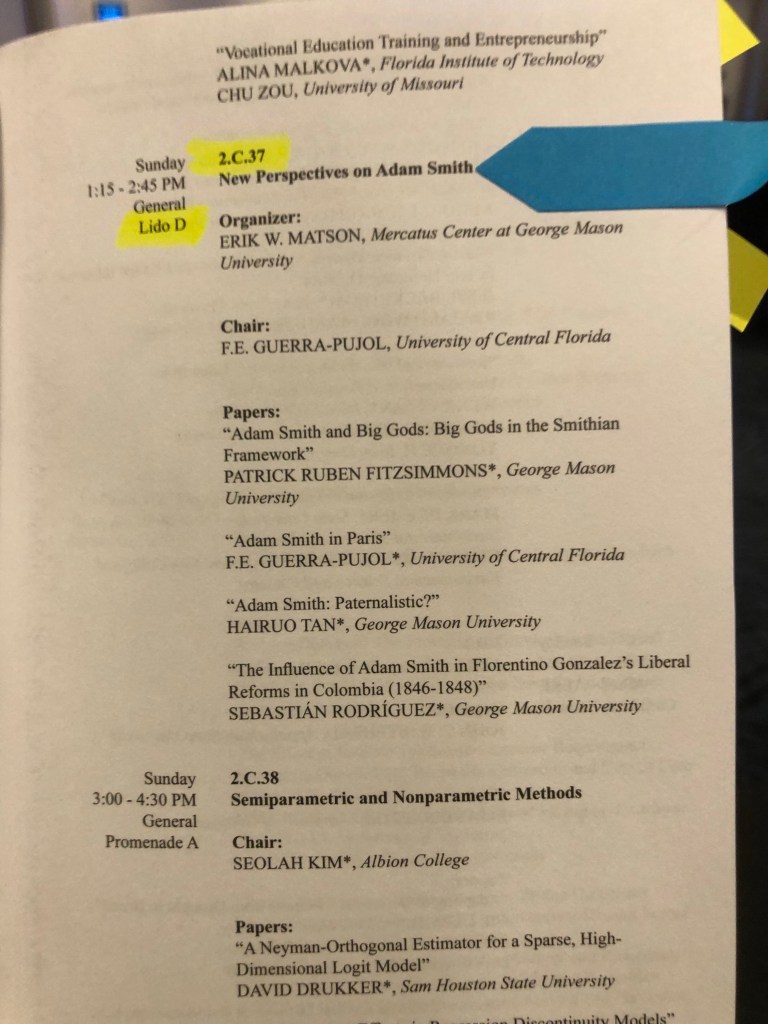
(SEA stands for the Southern Economics Association.) This was the most insane conference I have ever attended. To the point, the conference program was printed in a tiny 10-point font (see, for example, page 137 of the program pictured below) and ran to 200-plus pages, and the morning panels began at 7:45 in the morning, with over 30 concurrent panels to choose from in each session! My main complaint, however, is that the economists of SEA refuse to apply market principles to their own conference. They charge a flat fee to attend the massive three-day conference (like a socialist version of Disneyland) instead of offering a la carte pricing, where one pays for the number of panels one actually attends (like a capitalist state fair, where one must pay for each ride). Memo to the SEA: do better!

Posted in Uncategorized | Leave a comment

Monday Latin music: Todo de ti

Posted in Uncategorized | Leave a comment

Shout out to Henry Thompson

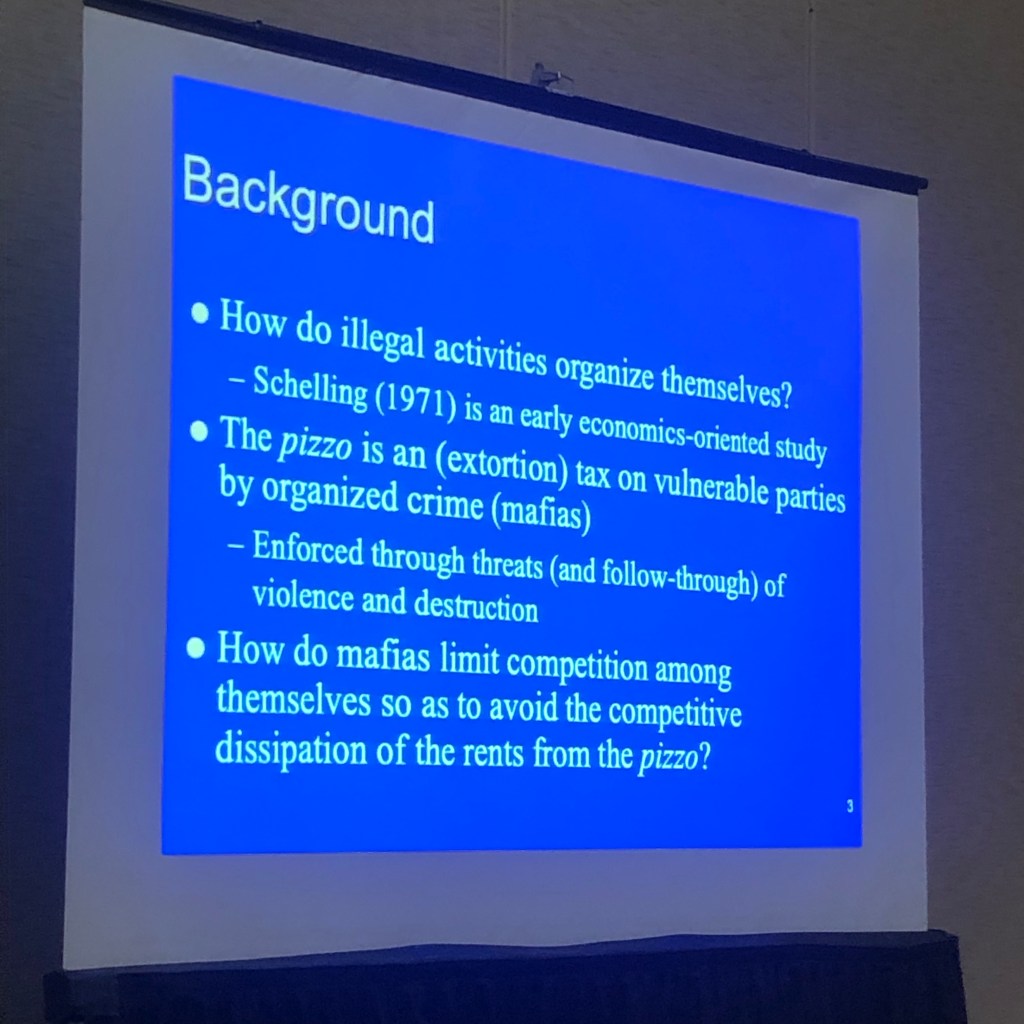
I will be leading a panel on “New Perspectives on Adam Smith” at the annual meeting of the Southern Economic Association later today. Thus far, my favorite talk has been Henry Thompson’s on “The Organization of Extortion”, which explores the law and economics of criminal protection rackets. Alas, Professor Thompson’s extortion paper is not yet posted to SSRN, so in the meantime, here is his previous work on “Cosa Nostra Courts“.

Posted in Uncategorized | Leave a comment

Weekend Update

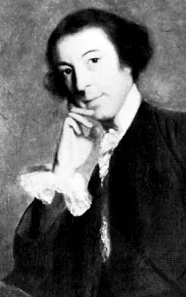
I am reblogging my previous post (see below) as I have been busy preparing a month-by-month outline and TED-talk-like presentation of Adam Smith’s 1766 sojourn in Paris. Among other things, I have also added two new sections to part one of my work on Adam Smith in Paris. One of the new sections is devoted to Adam Smith’s travel companions in Paris: Duke Henry (Henry Scott), the 3rd Duke of Buccleuch (whose 1760 portrait is also posted below), and his younger brother Hew Campbell Scott. The other new section surveys Smith’s reputation among the philosophes of Paris. I will post excerpts from both new sections soon …

File:Henry Scott, 3rd Duke of Buccleuch.jpg

F. E. Guerra-Pujol's avatarprior probability

(With apologies to SNL stars Michael Che and Colin Jost.) I will be attending the 92nd Annual Meeting of the Southern Economic Association (SEA) this weekend, where I will be moderating a panel on “New Perspectives on Adam Smith” (see the full SEA schedule here). I was also invited to present my work on Adam Smith’s ten-month visit to Paris in 1766. I have made significant additions and revisions to part one of my “Adam Smith in Paris” manuscript, beginning with the title. It is now titled: “Through the Eyes of Horace Walpole: Adam Smith in Paris (February to April, 1766).” I will survey the other substantive changes I have made to my work in my next few posts.

View original post

Posted in Uncategorized | Leave a comment

Weekend Update

(With apologies to SNL stars Michael Che and Colin Jost.) I will be attending the 92nd Annual Meeting of the Southern Economic Association (SEA) this weekend, where I will be moderating a panel on “New Perspectives on Adam Smith” (see the full SEA schedule here). I was also invited to present my work on Adam Smith’s ten-month visit to Paris in 1766. I have made significant additions and revisions to part one of my “Adam Smith in Paris” manuscript, beginning with the title. It is now titled: “Through the Eyes of Horace Walpole: Adam Smith in Paris (February to April, 1766).” I will survey the other substantive changes I have made to my work in my next few posts.

Posted in Uncategorized | 1 Comment

Assorted links (Keynesian beauty contest edition)

As a follow-up to my previous post, I am posting a few additional links (in chronological order) regarding Keynesian beauty contests:

  1. A Historical Note on the Beauty Contest“, a 2012 paper by Christoph Bühren, Björn Frank, and Rosemarie Nagel (via ZBW).
  2. Keynes’s beauty contest“, a 2015 essay by Richard Thaler (via Chicago Booth Review).
  3. Beauty contests and the term structure“, a 2018 blog post summarizing the findings in this paper by Martin Ellison and Andreas Tischbirek (via VoxEU).
  4. Convergence in a multidimensional randomized Keynesian beauty contest“, a 2018 paper by Michael Grinfeld, Stanislav Volkov, and Andrew R. Wade (via ArXiv).
  5. The Keynesian beauty contest revisited“, a 2022 paper by Robert Marx and Marco Lehmann-Waffenschmidt (via Science Direct).
  6. Bonus link: “Economic Classroom Experiments/Guessing Game” (via Wikiversity).
Posted in Uncategorized | 1 Comment

Schraub’s critique of my truth markets idea

As I mentioned in my previous post, I recently presented my Hayekian-inspired “truth markets” idea (see here and here) at the annual Loyola ConLaw Colloquium. After my talk, my colleague and friend David Schraub made an insightful observation. According to Schraub, the price of a belief contract won’t reflect the truth value of the conspiracy theory or fake news story being bet on and thus won’t converge on the “right” answer; instead, the price will track underlying beliefs among bettors about the beliefs of others. For Schraub, if we are placing bets not on their own beliefs (first-order bets) but rather on their beliefs about what others think (second-order bets), then all our bets are effectively “arbitrary” (Schraub’s term, not mine).

To illustrate this point, Professor Schraub referred to a multi-player number game known as “guess 2/3 of the average“. In this game, each player secretly chooses a real number between 1 to 100. The winner is the player who chooses the number that is closest to 2/3 of the average of the sum of everyone’s choices. Given this set-up, Schraub posed the following question to me: How is a someone’s belief that a player in this game will pick the number ‘31’ or ‘57’ and different from my proposed market in belief contracts?

As an historical aside, Schraub’s critique also reminds me of John Maynard Keynes’ psychological critique of stock market investors in Chapter 12 of his classic work on The General Theory of Employment, Interest and Money:

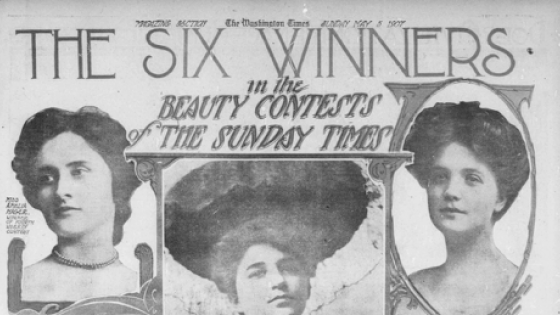
… professional investment may be likened to those newspaper competitions in which the competitors have to pick out the six prettiest faces from a hundred photographs, the prize being awarded to the competitor whose choice most nearly corresponds to the average preferences of the competitors as a whole; so that each competitor has to pick, not those faces which he himself finds prettiest, but those which he thinks likeliest to catch the fancy of the other competitors, all of whom are looking at the problem from the same point of view.

For Keynes, the optimal strategy in this beauty contest game is not pick the six faces that you, the contestant, may personally find the most attractive. To win, you must pick the faces that you think other people will find most attractive:

It is not a case of choosing those which, to the best of one’s judgment, are really the prettiest, nor even those which average opinion genuinely thinks the prettiest. We have reached the third degree where we devote our intelligences to anticipating what average opinion expects the average opinion to be. And there are some, I believe, who practise the fourth, fifth and higher degrees.

In reply, I am tempted to cite Hayek and be done with it. After all, Keynes is wrong: in the real world stock market prices do, in fact, reflect the underlying financial value of the companies whose stocks are being traded. (See here for example.) Also, contra Schraub, his artificial number game example does indeed have a rational or game-theoretic solution; see here and here. But that said, one could argue in counter-reply that my truth market idea is qualitatively different from a traditional market, since people would be trading “belief contracts”, i.e. people would placing bets on whether a conspiracy is true or false. I will therefore give Schraub’s Keynesian-inspired critique further thought and report back soon.

ellison10may.png
Posted in Uncategorized | 10 Comments

Truth market feedback

I presented my Hayekian-inspired “truth markets” idea (see here and here) at the annual Loyola (Chicago) ConLaw Colloquium earlier this month (Saturday morning of 5 November). By way of background, my truth market would operate as a “retrodiction market” and would specialize in conspiracy theories, fake news, etc. On this market, people could buy or sell belief contracts, allowing them to bet on the truth values of their favorite conspiracy theories, for example. With enough bettors representing a wide variety of views, the price of each belief contract should reflect the truth value of the conspiracy theory being bet on.

Lucky for me, I received a lot of excellent comments during the Loyola colloquium. Here, I will share some of this feedback with my loyal followers. To begin with, Enrique Armijo, a law professor at Elon University, brought to my attention a series of essays published by the Knight First Amendment Institute on “Lies and the Law,” including an essay by my co-panelist (!) Helen Norton on “Distrust, Negative First Amendment Theory, and the Regulation of Lies.” Likewise, David Sloss, a law professor at Santa Clara University, brought to my attention a book by Yochai Benkler, Robert Faris, and Hal Roberts on Network Propaganda: Manipulation, Disinformation, and Radicalization in American Politics (Oxford U Press, 2018). As it happens, Professor Sloss is also the author of Tyrants on Twitter: Protecting Democracies from Information Warfare (Stanford U Press, 2022). Suffice it to say, I will study these works closely and report back soon.

For his part, Mark Graber, a law professor at the University of Maryland, identified two functions of betting markets: (1) profit seeking, such as the market for grain futures, and (2) entertainment or enjoyment, such as a placing a bet on one’s favorite sports team. He then placed my proposed “truth market” in the second category and expressed concern with the possibility of market manipulation, providing the following example: Dan Snyder placing a large bet on whether he will be forced by the NFL to sell the Washington Football Team. (As an aside, my tentative reply is so what? If Snyder places a huge bet to move the market price in his preferred but false direction, other bettors will spot this opportunity and place more rational bets at Synder’s expense!)

Most of my commentators, including Jon Garon (Nova), Kyle Langvardt (Nebraska), and David Sloss (Santa Clara), also expressed concern about the fact that my truth markets would never close but remain open indefinitely. Some of these scholars suggested the creation of a non-governmental body, such as a third-party, independent fact-checker, who would decide on the accuracy of the beliefs being bet on. (Alas, my reply here is that such an expert entity is a non-starter. Who would pick these experts, and who would trust their judgements?) The most serious objection to my truth market proposal, however, was put forward by David Schraub, a law professor at Lewis & Clark University. I will describe his objection in my next post.

Yes, please!
Posted in Uncategorized | 1 Comment

This day in legal history

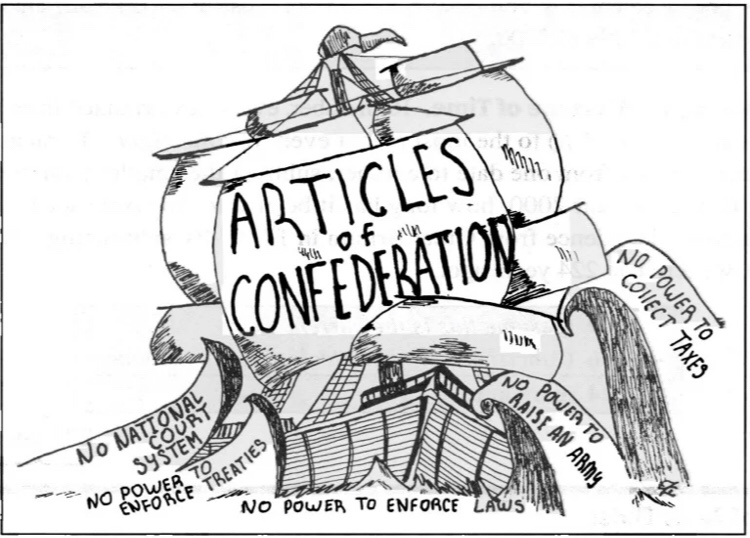
On this day (15 November) in 1777, after 16 months of parliamentary debate, the Continental Congress approved the short-lived and inherently-flawed Articles of Confederation. (What many of my conservative friends often forget is that the old Articles of 1777 created a loose confederation of sovereign States along with a weak central government, leaving most of the power with the States. The current Constitution was designed, in large part, to remedy this deficiency.)

Posted in Uncategorized | Leave a comment

Recap of my review of Klein & Clark

What is the relationship between law and liberty? Below is a recap of my four-part review of Daniel Klein and Michael Clark’s important work on “Direct and Overall Liberty“:

  1. Reply to Klein and Clark (part 1): I begin my review by providing brief overview of Klein and Clark’s analysis of liberty and identify two logical flaws with their theoretical framework.
  2. Reply to Klein and Clark (part 2): Here, I explain why all laws involves coercion (restriction of someone’s liberty) and why these harms are a reciprocal problem.
  3. Review of Klein and Clark (part 3): Next, I survey Klein and Clark’s 11 categories of governmental actions and show how each one involves reciprocal harms.
  4. Review of Klein and Clark (conclusion): Lastly (for now; see below), I conclude my review of Klein and Clark’s analysis of liberty with three final observations.

I will write up a full version of my critique (and of my alternative approach to law and liberty) over Thanksgiving in order to address each one of their 11 categories separately. In the meantime, I will revisit my work on belief contracts and truth markets in the next day or two.

Posted in Uncategorized | Leave a comment