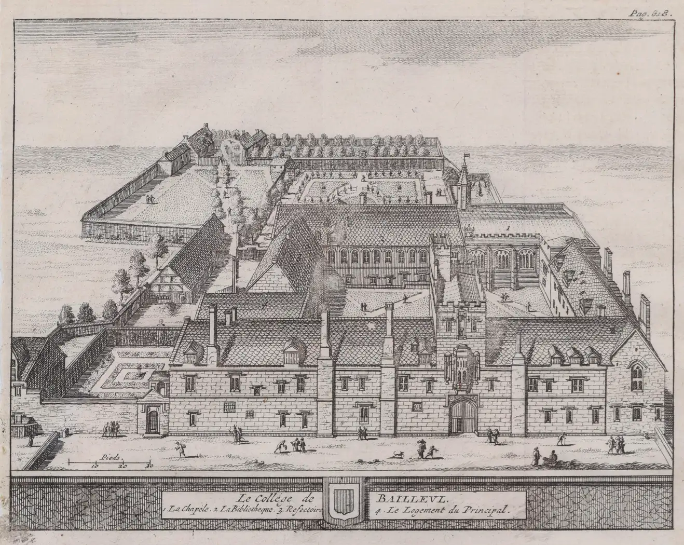
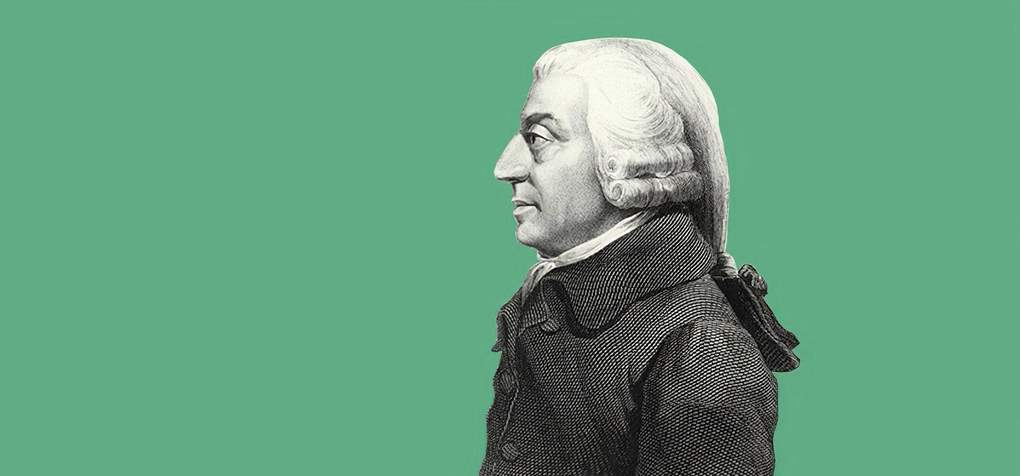
Of all the Adam Smith enigmas or unsolved mysteries that I identified in a previous post (see here), perhaps the most significant and underexplored one is Smith’s fateful decision to renounce his religious vocation and leave Oxford at the age of 23 (sometime in the summer of 1746) without a degree. At the time, the young Adam Smith was attending Balliol College on a Snell Exhibition he had won in 1740, and as a Snell student, he was entitled to 11 years of funding to pursue his undergraduate and graduate studies at Oxford. So, what happened? Why did Adam Smith “ditch” Oxford, so to speak? And did this decision, perhaps the most momentous inflection point in the Scottish scholar’s life, have anything to do with his views on religion?
By way of background, the Snell Exhibition was a special scholarship established in the 17th century that to this day is awarded to a small number of students from Scotland attending the University of Glasgow. (For a detailed history of the Snell Foundation and the Snell Exhibition award, see W. Innes Addison, The Snell Exhibitions: from the University of Glasgow to Balliol College, Oxford, published in 1901.) Among other things, Snell students were awarded an annual stipend and entitled to study at Balliol College for up to 11 years, but in the 17th and 18th centuries one of the conditions of this award was that one had to join the clergy upon completing one’s studies at Oxford. For his part, Adam Smith was elected a Snell exhibitioner on 4 March 1740 and then matriculated at Balliol College on 7 July 1740. The young Smith remained at Oxford for the next seven years of his life–specifically, until 15 August 1746, according to university records. (See Addison 1901, p. 43.)
As it happens, during this span of time (i.e. the seven years from July 1740 to August 1746 that Smith studied at Oxford) no less than seven or eight other students from Scotland — and perhaps as many as nine or ten — had been awarded Snell Exhibitions and had then obtained their degrees at Balliol College, and furthermore, many of Smith’s contemporary Snell classmates would eventually become clergymen upon completing their Snell exhibitions. In addition, all of these Snell students had attended the University of Glasgow, so the young Adam Smith may have personally known some of them from his early student days at Glasgow, where Smith studied from 1737 to 1740.
Specifically, during Smith’s three academic years at Glasgow (1737/38, 1738/39, and 1739/40) two cohorts of Glasgow students were awarded Snell Exhibitions: a future Lieutenant-General, Stewart Douglas (b?–1795), and a future royal chaplain, Andrew Wood (c1715–1772), both of whom were elected Snell exhibitioners on 25 October 1738, as well as the future moral philosopher and political economist Adam Smith (1723–1790) and one Charles Suttie (c1723–d?) (about whom little is known), who were elected on 4 March 1740. (See Addison 1901, pp. 42-44.) Of these four Glasgow classmates and Snell awardees, however, only three went on to study at Oxford: Smith, Suttie, and Wood. The fourth Snell awardee, Stewart Douglas, never matriculated at Balliol College. (See ibid., at p. 42: “There is no trace of [Stewart Douglas] having ever been at Balliol College ….”)
Although we do not know how close Adam Smith was to either Wood or Suttie (the other two Snell students who studied at Oxford along with Smith in the 1740s), we do know that Andrew Wood had matriculated at Balliol College on 5 December 1738, obtained his B.A. in 1742 and M.A. in 1745, and then vacated his Snell Exhibition in 1749, upon the expiration of his 11-year award. (See Addison 1901, p. 42.) In addition, we know that Wood took Holy Orders in the Church of England after completing his studies and that he was later appointed Chaplain to the King in 1760. (Ibid.). What about Charles Suttie? All we know about Suttie is that he had matriculated at Balliol College on 14 July 1740–just one week after Smith had matriculated there–and more intriguing yet, we also know that Suttie had vacated his Snell Exhibition in 1745–just one year before Smith decided to vacate his! (See Addison 1901, p. 44.) Did Smith decide to follow Suttie’s lead, or was the timing of their departures from Oxford just a coincidence? Alas, we do not know why Suttie vacated his Snell Exhibition or what became of him after 1745. (Ibid.)
In addition to Andrew Wood and Charles Suttie, as many as seven or eight other Scottish students from the University of Glasgow may have also been enrolled at Balliol College during Adam Smith’s tenure there. Do the identity and biographical details of these other Snell students shed any light on Adam Smith’s time at Oxford? Stay tuned; I will further explore this possibility in my next post on Tuesday, April 18.