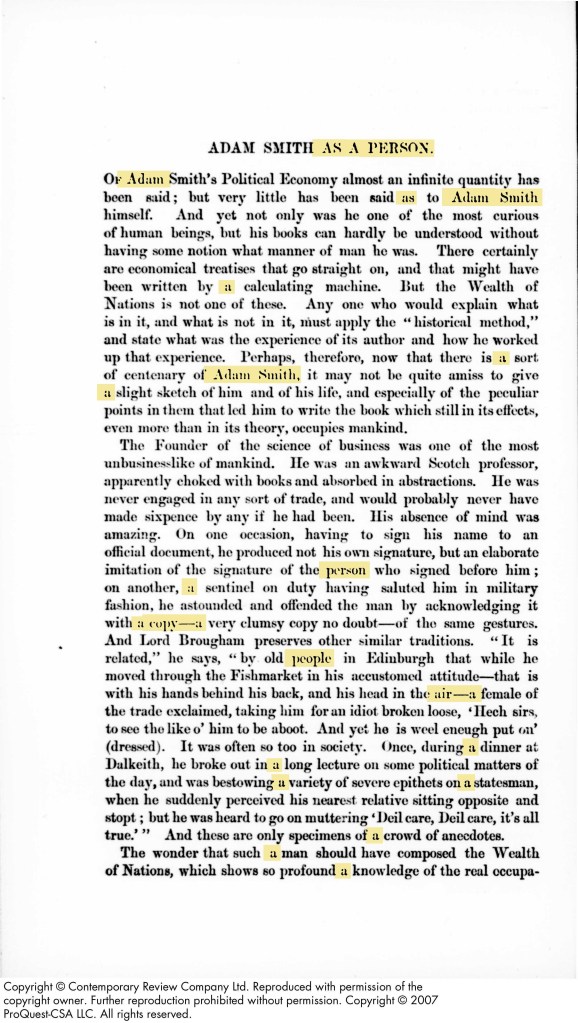
What is the best way to describe or visualize the law? As I mentioned in a previous blog post, it was the legal historian F. W. Maitland (1898, p. 13) who first compared law to a “seamless web” (see here). His 1898 essay A Prologue to a History of English Law begins with the following timeless sentence: “Such is the unity of all history that any one who endeavors to tell a piece of it must feel that his first sentence tears a seamless web.” But Maitland’s metaphor is not the only one out there. I came across two additional visualizations of law this weekend when I was reading a 2022 chapter on Law and Society in Eighteenth Century Scottish Thought by Peter Stein: the law as a large flowing river like the Nile (Stein 2022, p. 158) and the law as an ancient castle (ibid., p. 165).
The river Nile metaphor appears in Lord Kames’ Historical Law-Tracts (Kames 1758, pp. ix-x), which was first published in Edinburgh in 1758 and is available here for your reference. By way of background, Henry Home, Lord Kames (1696–1782), was an influential Scottish judge, a prolific man of letters, and one of Adam Smith’s early patrons, and his Historical Law-Tracts is considered one of the earliest contributions of the Scottish Enlightenment. In the preface to this historical work, Lord Kames compares law to the river Nile, and he also compares a student of law to a sailor crossing the Delta, who “loses his way among the numberless branches of the Egyptian river”:
“I have often amused myself with a fanciful resemblance of law to the river Nile. When we enter upon the municipal law of any country in its present state, we resemble a traveller, who, crossing the Delta, loses his way among the numberless branches of the Egyptian river. But when we begin at the source, and follow the current of law, it is in that case no less easy and agreeable; and all its relations and dependencies are traced with no greater difficulty than are the many streams into which that magnificent river is divided before it is lost in the sea.”
For its part, the ancient castle metaphor appears in Volume 1 of the Memoirs of the Life of Sir Walter Scott (Lockhart 1837, pp. 58–59), which is available here. Among other things, Walter Scott (1771–1832) was a Scottish historian, novelist, and playwright, and in his memoirs he acknowledges David Hume, Baron Hume of Ninewells as the source of this metaphor. Baron Hume was the philosopher David Hume’s nephew(!) and the Professor of Scots Law at the University of Edinburgh from 1786 to 1822. According to Scott, who attended Baron Hume’s law lectures in person and copied out his lecture notes twice in his own hand, it was Hume who first described law as an “ancient castle, partly entire, partly ruinous, partly dilapidated, patched and altered during the succession of ages by a thousand additions and combinations ….” Sir Walter Scott also uses this castle metaphor to describe Baron Hume’s teaching style and Hume’s intellectual contribution to the study of Scottish law:
“[My] Scotch Law lectures were those of Mr. David Hume [the nephew of the famous philosopher], who still continues to occupy that situation with as much honor to himself as advantage to his country. I copied over his lectures twice with my own hand, from notes taken in the class; and when I have had occasion to consult them, I can never sufficiently admire the penetration and clearness of conception which were necessary to the arrangement of the fabric of law, formed originally under the strictest influence of feudal principles, and innovated, altered, and broken in upon by the change of times, of habits, and of manners, until it resembles some ancient castle, partly entire, partly ruinous, partly dilapidated, patched and altered during the succession of ages by a thousand additions and combinations, yet still exhibiting, with the marks of its antiquity, symptoms of the skill and wisdom of its founders, and capable of being analyzed and made the subject of a methodical plan by an architect who can understand the various styles of the different ages in which it was subjected to alteration. Such an architect has Mr. Hume been to the law of Scotland, neither wandering into fanciful and abstruse disquisitions, which are the more proper subject of the antiquary, nor satisfied with presenting to his pupils a dry and undigested detail of the laws in their present state, but combining the past state of our legal enactments with the present, and tracing clearly and judiciously the changes which took place, and the causes which led to them.”
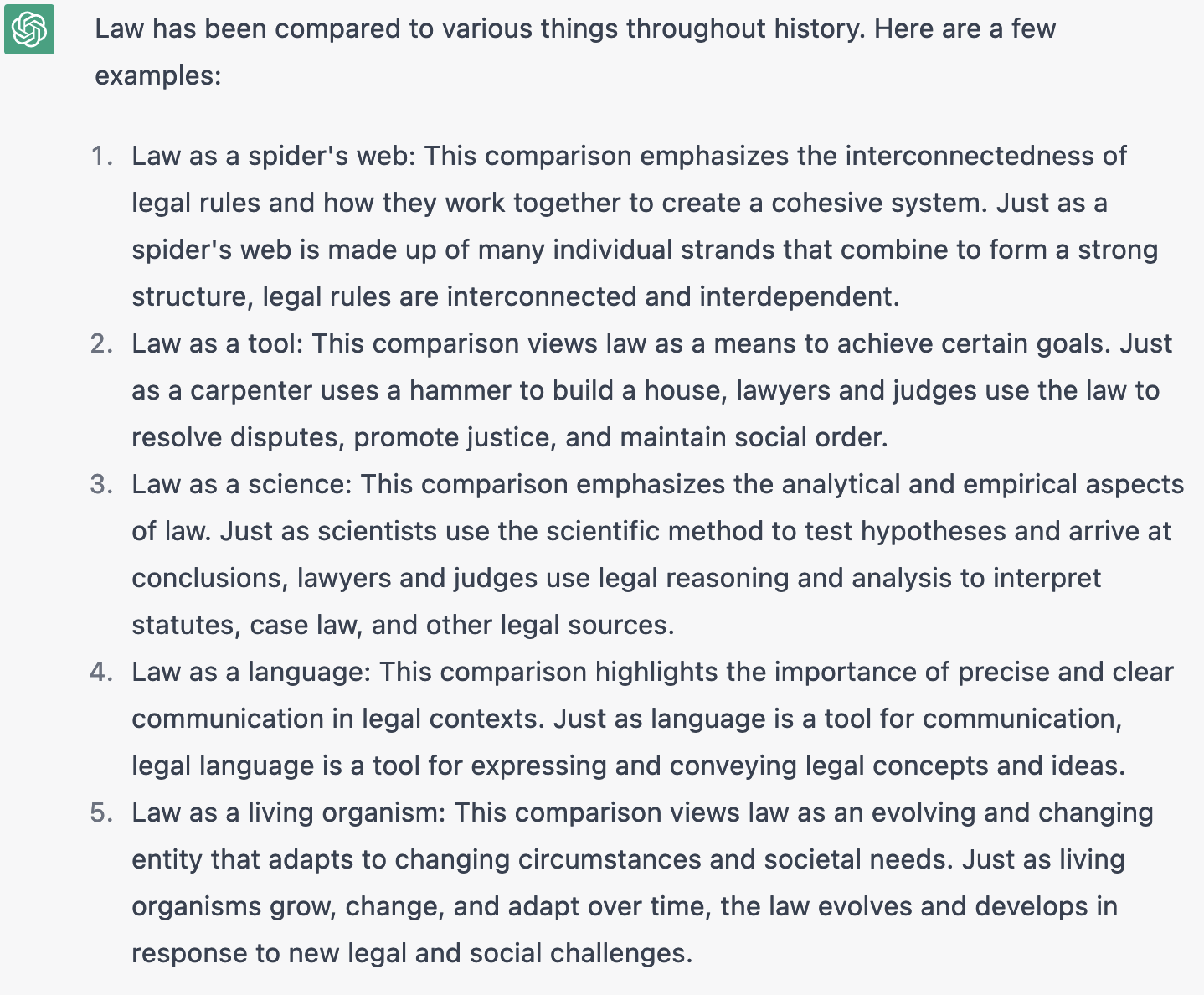
In addition to these three metaphors, ChatGPT regurgitated several others (see screenshot below). So, which metaphor do you like best?
P.S.: Aside from ChatGPT, below the fold is a bibliography of the scholarly works I have cited in this blog post:
Continue reading