Review of Klein and Clark (part 3)

As I mentioned in my previous two posts, as part of their framework for determining whether a proposed law, regulation, or public policy is pro-liberty or anti-liberty, Daniel Klein and Michael Clark identify 11 types of government action in their 2010 paper on “Direct and Overall Liberty.” Here, I am reproducing their taxonomy in its entirety below (the labels in bold are Klein and Clark’s), along with an illustration or brief description of each category:

1. Thoreauvian coercion (pp. 50-52): protesting an unjust law by breaking that law (e.g. Rosa Parks)
2. Coercive hazard (pp. 52-54): paternalistic laws designed to protect people from risky situations, such as seat belt and helmet laws
3. Disarming or defusing private coercion (pp. 54-55): laws that regulate or forbid the ownership of weapons
4. Controlling pollution (pp. 55-56): air and water pollution laws
5. Restrictions to prevent rip-offs (p. 56): laws against counterfeiting, consumer protection laws, occupational licensure, etc.
6. Subsidizing against coercive taboos (pp. 56-58): the example Klein and Clark give here is public funding of stem-cell research
7. Taxing to fund liberal enlightenment (p. 58): public schools, student loans, etc.
8. Coercively tending the moral foundations of liberty (pp. 58-59): paternalistic laws designed to promote traditional values (e.g. Nancy Reagan’s “Just Say No” P.R. campaign against drug use)
9. Logrolling for liberty (pp. 59-61): party politics
10. Stabilizing the second-best (pp. 61-63): adopting an illiberal policy at time T1 to avoid a worst outcome at time T2
11. Military actions (pp. 63-64): use of military force overseas to topple dictators and promote freedom overseas (e.g. the war effort to defeat Nazi Germany in the 1940s or the illegal U.S. invasion of Panama in 1989 to arrest strongman Manuel Noriega)

If I read Klein and Clark’s paper correctly, the purpose of this comprehensive taxonomy is to narrow down which areas of government action are more likely to lead to restrictions of our overall liberty–or conversely, produce greater levels of liberty overall. Although this taxonomy is somewhat quirky, I want to make a larger point here: there is a common thread that ties together all these disparate categories. Specifically, what all 11 areas have in common is the use of government coercion (or the threat of such coercion) to remedy a harm.

Working backwards, i.e. starting with item #11 (military actions), the harm to be avoided might consist of some perceived threat overseas, such as radical militants plotting to commit acts of terrorism against innocent civilians. Next, with item #10 (stabilizing the second best), the worst outcome to be avoided might be the possibility of a violent insurrection. With item #9 (logrolling for liberty), by contrast, the harm is having to accept the bitter with the sweet; for example, a politician who reluctantly supports an anti-liberty policy (such as authorizing the sale of F-15s to Saudi Arabia) in order to get a pro-liberty law enacted (school vouchers).

Moving on: with item #8 (coercively tending the moral foundations of liberty), the harm to be avoided are the inevitable evils that might result when “people have too much freedom” (to quote Klein and Clark). Additionally, with item #7 (taxing to fund liberal enlightenment), the harm to be avoided is citizens’ lack of appreciation of the benefits of liberty, and similarly, with item #6 (subsidizing against coercive taboos), the harm to be counteracted are attitudes about certain taboos (such as stem-cell research or human cloning) that “lend themselves to coercive governmental actions.” (Klein & Clark 2010, p. 56.) Likewise, the next four areas (items #2, #3, #4, and #5) also involve the prevention or reduction of harms. With item #5 (restrictions to prevent rip-offs), the harms to be avoided are scams against the public, while with item #4 (controlling pollution), the harms in play are various forms of pollution, such as carbon emissions, toxic waste, lead poisoning, etc. With item #3 (disarming or defusing private coercion), the harm to be avoided is the possibility of dangerous weapons falling into the wrong hands, and lastly, with item #2 (coercive hazards), the harms at stake are risky behaviors, like riding a motor bike without a helmet.

[That leaves item #1 (Thoreauvian coercion). Although, as Klein and Clark concede, this area involves “actions by private parties” (p. 51), not the government, protests against unjust laws are often inspired by harms perpetrated by the government itself. In the case of Rosa Parks, for example, the harm was racial segregation in public transportation, a system of apartheid enforced by municipal laws and the local police.]

Now that we have identified the common thread tying together all 11 areas of Klein and Clark’s taxonomy of governmental actions, the two concerns I raised in my previous post (see here) can come into sharper focus. To the point: if my intellectual hero Ronald Coase (pictured below) is right, i.e. if harms are a reciprocal problem, then any governmental action designed to prevent or reduce an existing harm will itself create a new set of harms. Why is Coase’s insight relevant to debates about liberty? I will explain why in my next post.

Ronald Coase and the Misuse of Economics
Posted in Uncategorized | 1 Comment

Reply to Klein and Clark (part 2)

I mentioned in my previous post how much I enjoyed reading this 2010 paper on “Direct and Overall Liberty” by Daniel Klein and Michael Clark. At the same time, I also identified two logical flaws with their framework: (1) the coercive nature of all governmental actions, and (2) the reciprocal nature of harms. Here, I will flesh out both objections in greater detail.

By way of background, one of the most influential ideas in classical liberal political philosophy is John Stuart Mill’s harm principle. In summary, Mill claims that people should be free to act however they wish unless their actions cause harm to somebody else. In other words, coercion is justified only to prevent harm to others. (For reference, I shall call this familiar argument the “libertarian” or “classical liberal” conception of liberty.) A logical or self-reference problem, however, arises when we apply this classical liberal principle to the government itself, since all governmental actions are coercive. (After all, a law, by definition, restricts the liberty of those who would prefer not to comply with the law.) That is my first objection above.

My second objection (and the more serious one) is that harms are ultimately a reciprocal problem, a counter-intuitive insight that can be traced back to a pair of papers written by an obscure British economist at the time, Ronald Coase: one in 1959 (“The Federal Communications Commission”), the other in 1960 (“The Problem of Social Cost”), both of which are reprinted in Coase’s beautiful book The firm, the market, and the law, the cover of which is pictured below. In summary, before Coase, the conventional view among economists was that government restrictions on liberty are justified only to curb so-called “negative externalities”, i.e. situations involving harms to third parties, such as air pollution, loud noises, and radio signal interference, just to name a few. Coase, however, ripped the logic of this conventional economic wisdom to shreds in a single sentence in his social cost paper:

The traditional approach has tended to obscure the nature of the choice that has to be made [between A, the wrongdoer or the person causing the harm, and B, the victim of the putative harm]. The question is commonly thought of as one in which A inflicts harm on B and what has to be decided is, How should we restrain A? But this is wrong. We are dealing with a problem of a reciprocal nature. The real question that has to be decided is, Should A be allowed to harm B or should B be allowed to harm A? The [correct solution] is to avoid the more serious harm

In other words, negative externalities are a reciprocal problem: one side is always going to suffer harmful effects no matter what the government does or fails to do. To take Coase’s original example (factory smoke), if the government adopts a laissez faire industrial policy and permits the owner of a factory to emit smoke, the downwind neighbors will be harmed. By contrast, if the government decides to prioritize the environment by enacting a law to prohibit the factory from polluting the air, then it is the owner of the factory who will be harmed. (In fact, it is not just the owner of the factory who will be harmed but also all consumers who wish to purchase the products produced by the factory.)

Furthermore, to say that the owner of the factory has a moral or legal right or liberty interest to use the factors of production free from government intervention is not dispositive because one could just as well argue that the neighbors have a moral or legal right or liberty interest to clean air or to good health. However we frame the problem–as one involving property rights in the factors of production or rights to good health–the problem remains reciprocal. The liberty interests of one of the parties will be hindered however the government responds to this situation!

In reply, Klein and Clark might try to sweep my reciprocal harm objection under the rug, so to speak. After all, “negative externalities” are just one type of a wide variety of policy areas (11 categories in all!) that they identify in their paper–namely, the category they label “controlling pollution.” In reality, however, the logic of Coase’s reciprocal harm insight applies to all 11 of Klein and Clark’s categories! I will explain why in my next post.

The Firm, the Market, and the Law, Coase
Posted in Uncategorized | 2 Comments

Reply to Klein and Clark (part 1)

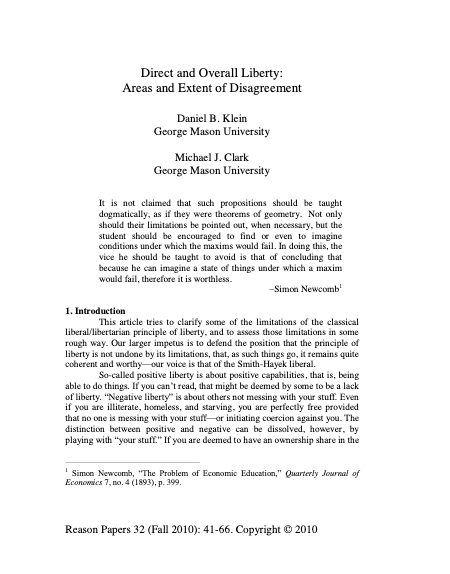
I recently stumbled upon this 2010 paper on “Direct and Overall Liberty” by Daniel B. Klein and Michael J. Clark, the first page of which is pictured below. How did I not discover their excellent paper before? Among other things, the authors identify 11 types of laws, regulations, and policies and provide a general framework for determining whether, on balance or “overall”, a proposed governmental action is pro-liberty or anti-liberty by comparing and contrasting two key variables: (a) the direct or immediate effects on liberty of the proposed measure, and (b) its indirect or long-term effects. (The authors also anticipate some objections to their framework and respond to additional objections in a follow-up paper they wrote in 2012. See here.)

To the point, the main contribution of both papers is to show how, in many real-life scenarios, the direct and indirect effects on liberty of any given governmental action might diverge or come into conflict (“the possibility of disagreement between direct and overall liberty is real”), thus making it difficult–if not impossible, I might add–to determine whether a proposed law, regulation, or policy is pro-liberty or anti-liberty on balance. Despite this indeterminacy, Klein and Clark conclude that we can safely ignore the indirect effects of most governmental actions by applying the following rebuttable presumption to such actions: a law, regulation, etc. should be presumed to be anti-liberty overall whenever the direct or immediate effects of that measure are anti-liberty.

Alas, I hate to be “that guy”, but there are two logical flaws with Klein and Clark’s framework. One is that most if not all laws, whatever their subject matter, are coercive by their very nature and thus restrict liberty in one form or another. As a result, we cannot safely ignore the indirect effects of laws. The other (more significant) problem, however, is what the late great Ronald Coase referred to as the “reciprocal” nature of harms, including the harm of restrictions on liberty. In brief, even if we are somehow able to predict what the indirect or wider effects of a proposed law will be in the future (a big “if” given the problem of uncertainty), someone’s liberty is always going to be reduced or hindered regardless whether the law is enacted or not. I will further elaborate this key Coasean point in my next post.

Posted in Uncategorized | 2 Comments

Ronald Coase and Vito Corleone

I have posted a revised and enlarged draft of my essay “Coase and the Corleones” to SSRN. This short work will be published next year in Joshua Heter and Richard Greene’s forthcoming book: The Godfather and Philosophy: We’re Gonna Make’em an Argument They Can’t Refute (Open Court), which you can pre-order here.

F. E. Guerra-Pujol's avatarprior probability

The Godfather premiered fifty years ago in March of 1972. In honor of the 50th anniversary of the wide domestic release of this classic film, I just posted an essay to SSRN titled “Coase and the Corleones“. By way of background, one of the most influential ideas in legal, moral, and political philosophy is John Stuart Mill’s harm principle, i.e. the notion that people should be free to do or say whatever they wish unless their actions or words cause harm to somebody else. The work of Ronald Coase, however, shows us why the harm principle is logically incoherent. Aside from the difficulty of defining what counts as a harm, the main problem with the harm principle is that harms are often reciprocal in nature. That is, most harms are, logically speaking, either the direct or indirect result of both the wrongdoer’s and the victim’s decisions. In my…

View original post 26 more words

Posted in Uncategorized | 2 Comments

Music Monday: Waka Waka

I am posting two versions of this beautiful song: one by Shakira; the other by Honeyfox.

Posted in Uncategorized | Leave a comment

Disingenuous Interpretation

I have been attending the 13th annual Constitutional Law Colloquium at the Loyola (Chicago) Law School this weekend. Among my favorite talks thus far is “Disingenuous Interpretation” by my new colleague and friend Michael Smith, who teaches law at the University of Idaho. His paper is not yet posted on SSRN, but he has blogged about some of the ideas in his paper here. (Professor Smith has also graciously provided me a copy of his draft paper, so I will be blogging about his work on constitutional interpretation soon; in the meantime, check out his 2020 paper “Shooting Fish.”)

Posted in Uncategorized | Leave a comment

Postcards from Chicago

My wife and I are attending the 13th annual Constitutional Law Colloquium at the Loyola Law School in Chicago; below are some snapshots of our trip:

Posted in Uncategorized | 1 Comment

Truth Markets, Part 2: Belief Contracts

I outlined my proposal for a “truth market” in my previous post. A truth market would trade in belief contracts. Each belief contract would be structured as a simple “belief statement” with two discrete choices: True(T) or False(F). The belief statement could refer to a disputed news story (e.g. fake news) or to a popular or persistent conspiracy theory. Consider, for example, the many conspiracy theories regarding the assassination of President John F. Kennedy on November 22, 1963. Was there a conspiracy to assassinate President Kennedy, or did Lee Harvey Oswald act alone?

If there were a truth market, anyone could post a belief statement such as “Lee Harvey Oswald was part of a conspiracy to assassinate JFK.” In the alternative, the belief statement could be more specific: “The Secret Service was part of a conspiracy to assassinate JFK” or “Fidel Castro ordered the assassination of JFK.” The creative possibilities are endless (see here, for example), but to keep it simple, let’s stick with the first example: “Lee Harvey Oswald was part of a conspiracy to assassinate JFK.” People who believe that Oswald did not act alone–that he was, in fact, a member of an anti-Kennedy conspiracy–could buy T contracts. Conversely, people who believe the official version (e.g. the Warren Commission’s lone gunman theory) could buy F contracts.

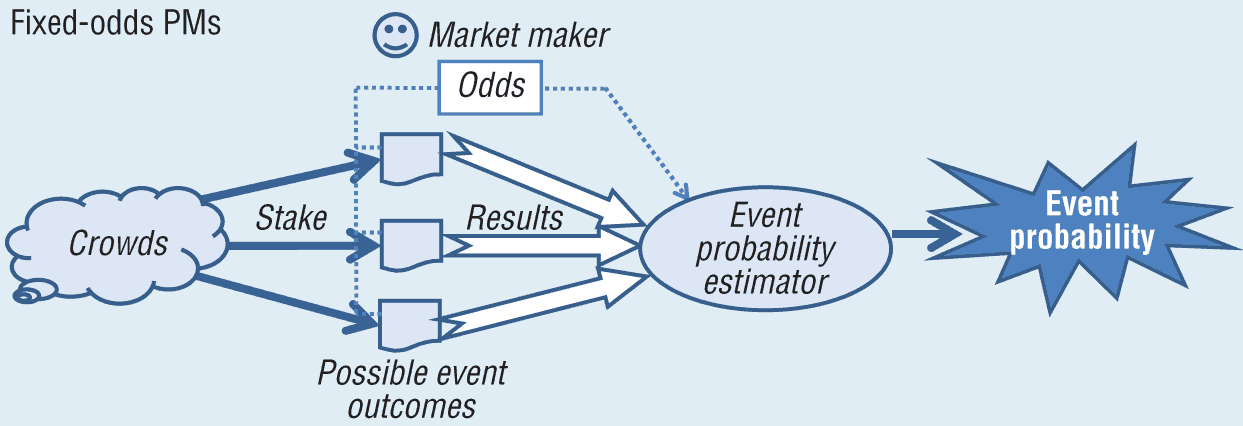
In a well-functioning truth market, the price of each belief contract (T or F) should reflect the betting market’s aggregate answer to the belief or conspiracy theory being bet on–i.e., whether the belief in the JFK conspiracy will turn out to be more likely true or false. (See, e.g., Wolfers & Zitzewitz, Interpreting prediction market prices as probabilities, NBER Working Paper #12200 (April 2006) For a less technical explanation, see here.) If more bettors are convinced that Oswald was part of a conspiracy, the price of a T contract will rise; by contrast, if more bettors believe that Oswald acted alone, the price of an F contract will rise. Either way, anyone who disagrees with the current consensus about a disputed conspiracy theory or disputed news story would have a profit motive to participate in the market.

But what about liquidity? Would people want to bet on conspiracy theories or fake news? Alas, without a sufficient number of market participants, it is less likely that the prices of these belief contracts will reflect the true probabilities of the various beliefs being bet on. Also, even if my truth market were highly liquid, with lots of bettors, one could argue that the truth of X belief should not depend on the number of people who are willing to bet on that belief.

Accordingly, next week I will address this crucial objection and propose some ideas for making truth markets more appealing to actual bettors.

Prediction Markets Are About To Be A Big Deal - BitEdge
Posted in Uncategorized | 6 Comments

Truth Markets

Thus far, I have blogged about the twin dangers of false information (fake news, conspiracy theories, etc.) and censorship (secret algorithms, arbitrary “content moderation” policies, DHS surveillance, etc.). But how can we combat false information without resorting to censorship? I hereby propose the creation of a new truth market. In summary, my proposed truth market, which is inspired by the work of F. A. Hayek, would operate like an ordinary betting market–but instead of placing bets on the outcome of future events (like an upcoming football match or basketball game), bettors would place wagers on their beliefs about past events. Or in the alternative, why can’t we extend an existing prediction market platform like Kalshi to cover conspiracy theories, fake news, and the like?

By way of background, here is how the Kalshi market works: users can post any question about a future event that others can bet on, so long as the question has a discrete outcome, like Yes or No. (By way of example: “Will Donald Trump be indicted before Thanksgiving?“) Once a question is posted on the Kalshi platform, people can then buy “event contracts”: Yes contracts or No contracts, depending on whether they believe the answer to the question will be Yes or No. Each event contract, in turn, is priced between $0 and $1 (as long as the sum of one Yes contract and one No contract equals $1), and the price of the contracts at any given time will fluctuate depending on the overall demand for Yes contracts and No contracts. The price for a Yes contract, for example, will be higher if more people are buying Yes contracts, and vice versa, lower if more people are buying No contracts. Buyers can also trade or sell their contracts like any other financial security, and when the market closes, the buyers who guessed the correct outcome get to collect $1 for each winning contract; the losers get nothing.

So, why can’t we replace Kalshi’s prospective event contracts with retrospective “belief contracts“? The main difference between the Kalshi model and my proposed truth market is that traditional betting markets must close by a specified date. But we don’t need a close date or final resolution in principle, especially about events that have already occurred, like a popular conspiracy theory or a disputed news report. Instead, we could leave the market for belief contracts open indefinitely in order to allow people to post questions about past events and to bet on their beliefs about such events. By keeping the betting market open indefinitely, the price of any given “belief contract” will track belief or non-belief in the conspiracy or in the disputed story. A bettor will stay in the market for belief X (where X is a conspiracy theory, disputed news report, etc.) if he thinks the price of belief in X will increase, or he will opt out if he thinks it will fall.

I will say more about the mechanics of these “beliefs contracts” in my next post. In the meantime, I will conclude with the following observation. By monetizing beliefs, bettors will have an incentive to seek new information that not only supports their wagers but is also likely to persuade other bettors, thereby advancing the search for truth. As long as there is yet-to-be-discovered evidence that may be convincing to some bettors, some conspiracy theories and fake news should move toward resolution without the need for an omniscient arbiter.

Who Was Friedrich Hayek? What Was His Economic Theory?

Posted in Uncategorized | 4 Comments

Could gambling save democracy? (part 2)

I am reblogging this post from earlier this week (see below) because, in the interim, two intrepid reporters at The Intercept broke this insane story: Truth Cops. To the point, the Department of Homeland Security is actively monitoring the social media accounts of U.S. citizens and is colluding with Big Tech firms to censor what the DHS deems to be false information. Crazy, right? By contrast, in place of the current system–censorship combined with secret surveillance–I have proposed an alternative approach: a “truth market” where people can openly place bets on the probable truth values of conspiracy theories and fake news. I will discuss the details of my truth market in my next post …

F. E. Guerra-Pujol's avatarprior probability

Is the proliferation of “fake news” and conspiracy theories a threat to democracy? If so, how should we deal with such dangerous ideas and falsehoods? Broadly speaking, there are two general approaches to this problem: one is the Mark Zuckerberg solution, i.e. some combination of censorship (content moderation) and secret computer algorithms; the other is the Elon Musk method, i.e. laissez faire principles and free speech absolutism (everyone is free to post whatever they want).

Which approach do you prefer? Zuckerberg’s or Musk’s? For my part, I won’t dwell on the pros and cons of either approach, except to make the following general observation: neither the Zuckerberg solution nor the Musk method is designed to help us distinguish truth from lies in a reliable manner. One big problem with the Zuckerberg/censorship approach, for example, is that we cannot always determine ahead of time which conspiracy theories are true…

View original post 140 more words

Posted in Uncategorized | Leave a comment