Derek Thompson, a staff writer at The Atlantic (see here) and the host of the “Plain English” podcast (here), has assembled an eclectic group of scientists, entrepreneurs, CEOs, and artists to exchange ideas on a wide variety of topics at a day-long “Progress Summit” in Los Angeles, California on 12/13. I will be attending in person and will report back in the next day or two. In the meantime, pictured below is the first part of the agenda as well as the conference logo. (FYI: The full agenda is available here, and there is also a virtual attendance option.)
Today 12/12 is the feast day of Our Lady of Guadalupe, so I am posting a brief ballad in her honor, the song “Indita”. The version posted below is sung by Miriam Solis, who was born in Guadalajara, the birthplace of Mariachi music. Solis sings traditional Mexican “ranchera” songs (rancheras are rural folk ballads that originated in Mexico); here is a link to her YouTube channel.
I am reblogging this 6 December 2022 post (see below) by my fellow francophile Sheree featuring some of Ernest Hemingway’s favorite European watering holes; via “View from the Back“.
It sometimes seems that wherever we go we’re following in the footsteps of one Ernest Hemingway, particularly when it comes to bars! The Nobel Prize–winning author could not only write, but drink way better than most. From his time in places like Paris, South of France, Havana, Lima, Venice and the United States, Hemingway loved a drink. From the fanciest hotel bars to dirtiest dives – as long as the drinks were good – he was eager to indulge.
Here, we take a look at some of Hemingway’s favourite bars around the world where our paths might have crossed!
The Ritz (Paris, France)
The Ritz, which we recently visited, is so closely tied to the author – who set part of The Sun Also Rises (1926) here – that a bar here is named after him. Hemingway famously liberated the hotel from German forces in 1944, racking up a…
But what should we replace the penalty kick phase in football (soccer) with, you may riposte? Glad you asked! I found this proposal by Jim Pagels (via Forbes). Below is an extended excerpt
At the conclusion of regulation, there will be the following extra time sessions, with golden goal (i.e. the game ends following a score) in effect:
10 minutes of 11-on-11 (Team A starts with ball)*
10 minutes of 10-on-10 (Team B starts with ball)
10 minutes of 9-on-9 (Team A starts with ball)
10 minutes of 8-on-8 (Team B starts with ball)
10 minutes of 7-on-7 (Team A starts with ball)
10 minutes of 6-on-6 (Team B starts with ball)
10 minutes of 5-on-5 (Team B starts with ball)
10 minutes of 4-on-4 (Team A starts with ball)
10 minutes of 3-on-3 (Team A starts with ball)
10 minutes of 2-on-2 (Team B starts with ball)
Fewer men on the field would result in more wide-open spaces, increasing the likelihood of a goal—a goal scored via passing and soccer-related team play against a team of defenders rather than via the artificial, foreign situation of a single player kicking a stationary ball from point-blank range on a single defender.
*If a team had been playing with 10 men during regulation, then that will only be enforced for the first extra time session, which would be 11-on-10. After that, only the team with 11 would remove a player, and it would be even strength for every session until a goal is scored. It’s simply too big a punishment to play a man down when you get to 8-on-7 situations, and having played all that time in regulation and the first period of extra time a man down seems like more than penalty enough.
Alternative title: Review of Katherine Mangu-Ward’s “The case for space billionaires” and Mike Riggs’s essay on space insurance
This week, I have devoted most of my blog to several new essays about outer space that were published in the December 2022 issue of Reason magazine. Today, I will conclude my series with “The Case for Space Billionaires” by Katherine Mangu-Ward, who is the editor in chief at Reason, and “As Private Space Travel Grows, so Will the Insurance Market” by Mike Riggs, Reason‘s deputy managing editor.
Let’s start with Ms Mangu-Ward’s excellent essay, which responds to two well-worn objections to the efforts of “space billionaires” and their private companies to commercialize outer space. One objection is what Mangu-Ward calls “the ‘there are problems here on Earth’ complaint”. The other objection is what I shall call “the Bernie Sanders’s argument”: space billionaires like Amazon’s Jeff Bezos, Virgin’s Richard Branson, and Tesla’s Elon Musk are able to invest in space because they are not paying their fair share in taxes.
Mangu-Ward easily refutes the first objection by noting how small the commercial space industry is relative to the rest of the economy. She links to this infographic prepared by Space Investment Quarterly, which shows that the total private investment in the space industry is about $264 billion, or in the words of Mangu-Ward: “Not chump change, but also not enough to definitely end poverty, injustice, or other terrestrial troubles ….” For my part, I would add the following observation. If these space critics were serious about reducing poverty and income inequality, they could start in their own backyards, so to speak, by calling for the repeal of onerous zoning laws and occupational licensure restrictions.
What about the other objection: Bernie Sanders’s tax argument? Here, Mangu-Ward simply concedes that Bezos, Branson, and Musk don’t pay their fair share in taxes, but then presents a kind of thought-experiment in their defense. Imagine that these space billionaires did pay more money in taxes; let’s say $X more. Who do you think would more wisely or effectively spend those $X: Bernie Sanders or the space billionaires? Q.E.D.!
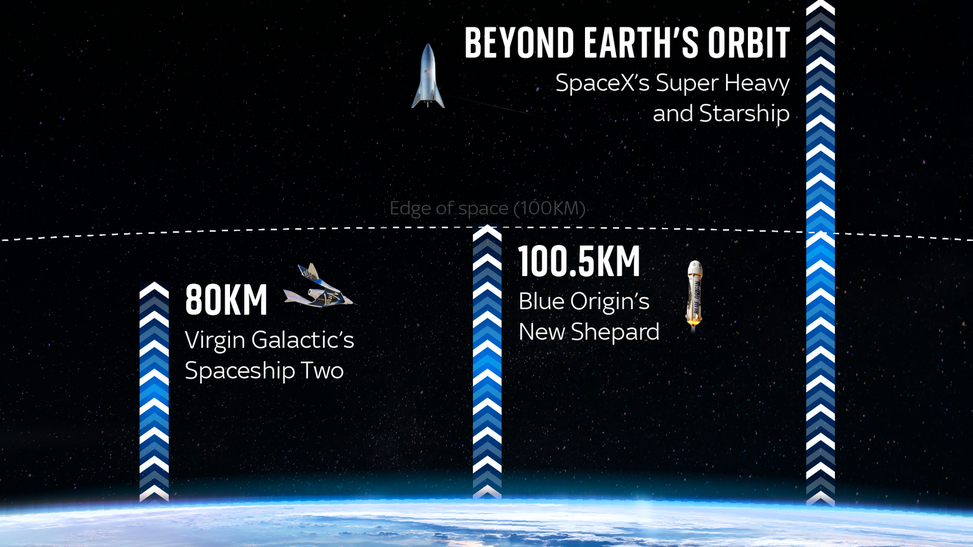
In addition to responding to these standard objections, Mangu-Ward also mounts a compelling defense of the private space sector in general and of Bezos et al. specifically. Among other things, she highlights the benefits of competition: “The billionaires are not duplicating each other’s efforts, each is building different tech to pursue different goals.” See, for example, the image pictured below. Moreover, as Mangu-Ward correctly notes, this characteristic of competitive marketplaces–i.e. Schumpeterian creative destruction–“has served us well when it comes to cars, snacks, and phones, so it’s no surprise [creative destruction] would happen in the space sector as well once entrepreneurial private actors are involved.”
Another benefit of competition is that open markets tend to expand economic opportunities by creating demand for new products and services. Here is where Mike Riggs’s essay on space insurance, the shortest piece in Reason’s December 2022 collection of outer space essays, comes into play. As Riggs notes, liability insurance for space flight did not exist during the original Apollo lunar missions of the 1960s and early 1970s. Today, however, space insurance “is now close to standard.” Citing this report prepared by the Aerospace Corporation, Riggs observes that as of 2018 about 2/3rds of all man-made satellites launched into orbit carried some form of insurance.
Why is this insurance market example so illuminating? Because the best argument in defense of billionaires (space or otherwise) is that well-functioning markets generally make everyone better off, one of the most original insights made by Adam Smith when he published The Wealth of Nations in 1776. In the spirit of Adam Smith’s invisible hand theorem, I will close with my favorite sentence of Mangu-Ward’s essay: “The beauty of functioning markets … is that sometimes they take one person’s frivolous dream and make it come true for tens or hundreds or millions of people who, it turns out, share the same dream.”
Alternative title: Review of Rebecca Lowe’s “Space is an opportunity to rethink property rights”
Thus far, I have reviewed several essays from the December 2022 issue of Reason magazine on various aspects of outer space. My favorite piece by far, though, is the essay by independent scholar Rebecca Lowe, which is titled “Space is an opportunity to rethink property rights”. (FYI: here is a short bio of Dr Lowe.)
In brief, what I loved the most about this essay is that it grapples with the following controversial question head on: Should we extend property rights to outer space? Dr Lowe begins by describing the existing legal framework: the Outer Space Treaty of 1967, which has been ratified by all the major spacefaring nations of the world, and the 2020 Artemis Accords, which are still gathering steam. (Neither Russia nor China have joined the Artemis Accords.)
Among other things, the Outer Space Treaty (or OST, for short) appears to prohibit state ownership of outer space. Article 2 of the 1967 treaty (see here) explicitly prohibits “national appropriation” of outer space. (“Outer space, including the moon and other celestial bodies, is not subject to national appropriation by claim of sovereignty, by means of use or occupation, or by any other means.”) The terms “national appropriation” and “use or occupation”, however, are nowhere defined in the OST.
The Artemis Accords, by contrast, attempt to modify the scope of the OST by excluding space mining from the definition of national appropriation. (Specifically, Section 10 of the Artemis Accords (see here, page 4) states that “the extraction of space resources does not inherently constitute national appropriation under Article II of the Outer Space Treaty.”) Alas, while this provision might be a step in the right direction, it does not go far enough. What about space settlements, like NASA’s proposed lunar outpost (see here) or China’s future moonbase (here)? Or what about the dwindling supply of geostationary and non-geostationary orbits in an increasingly “crowded and contested frontier” (see here, for example)?
In any case, as Lowe herself notes, it is not clear whether the OST prohibits private firms from claiming property rights in outer space. Treaties obligate nation-states, not individuals. Either way, after surveying the existing legal framework, Dr Lowe proposes a novel and intriguing solution for outer space governance; or to paraphrase the Star Trek motto, she goes where few men have dared to go before. In summary, she takes an important “classical liberal” idea–Lockean property rights based on “justified acquisition” or first possession–and then modifies this tried-and-tested idea to make it workable for outer space. To simplify, Dr Lowe would allow individuals and private firms to rent plots of land on the moon on a temporary basis–a novel proposal that could be extended to other scarce space resources like geostationary and non-geostationary orbits!
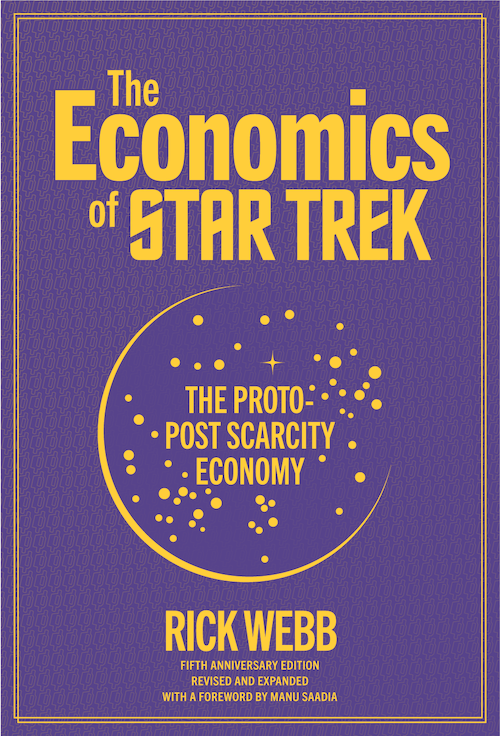
But who would collect these rents, and how would their value be calculated? In the alternative, if we are going to champion property rights in outer space (a big “if” given the letter and spirit of the Outer Space Treaty), why not try Coasian auctions instead? As it happens, Dr Lowe’s excellent essay includes a link to a far more detailed “white paper” she wrote earlier this year; see here or here. In her report, she spells out the details of her “land value tax model” based on the innovative ideas of Henry George, a political economist who proposed to replace existing systems of taxation with a single tax on landlords, the “land value tax“. Suffice it to say that I will study Lowe’s 71-page white paper during the Christmas break. In the meantime, I propose the following thought experiment in defense of Lockean property rights in outer space. What if Adam Smith could time travel and visit the fictional world depicted in the popular series Star Trek? What would Smith think? (For some possible answers, see here as well as Rick Webb’s beautiful book, pictured below, on The Economics of Star Trek.)
Note: I will conclude my series of reviews in my next post.
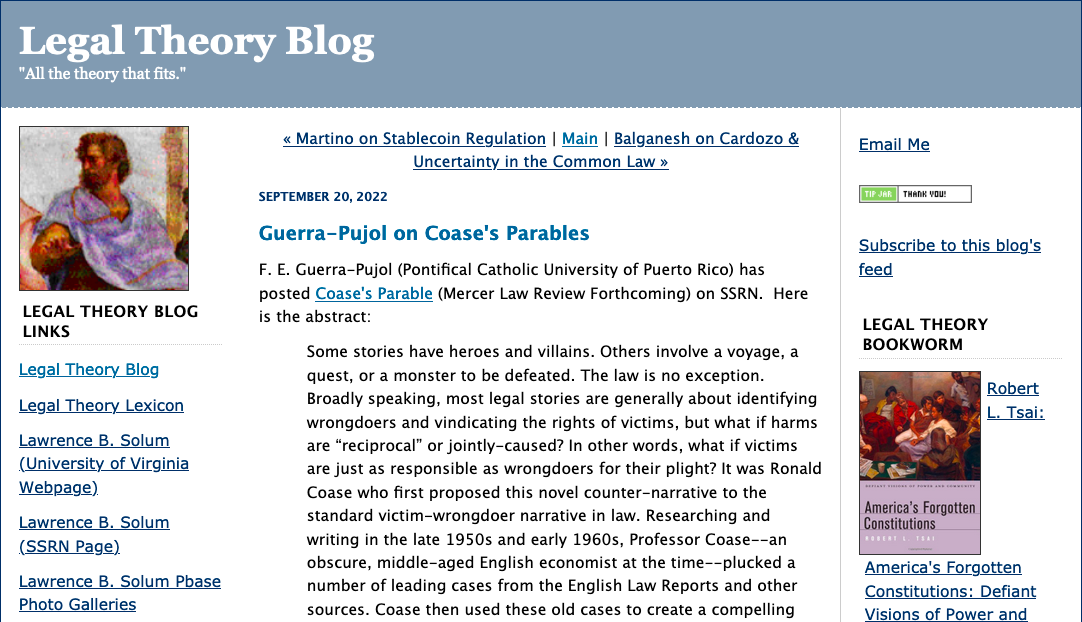
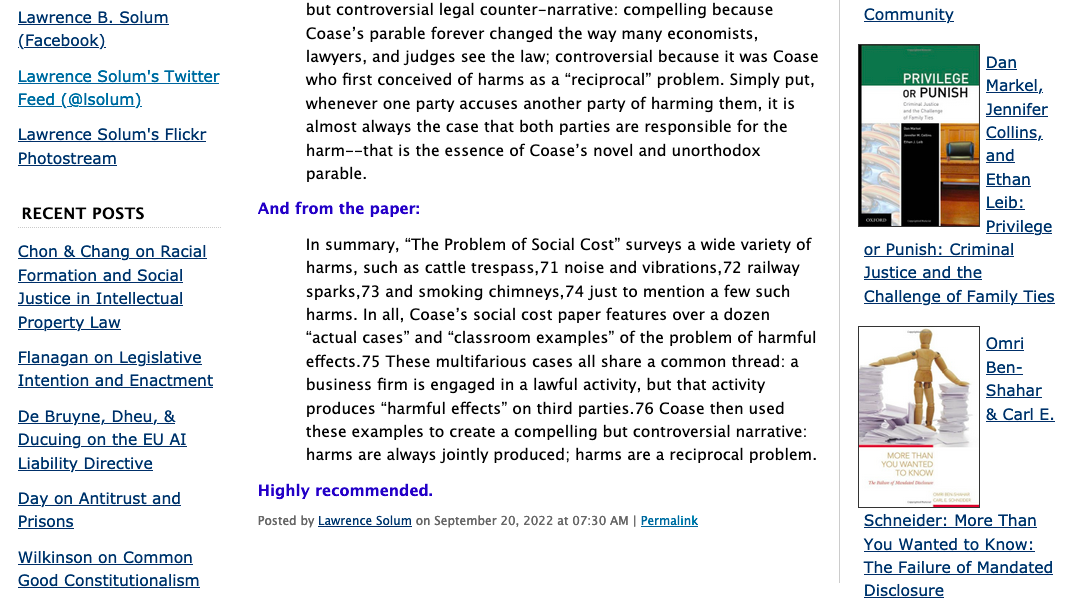
I just noticed that Larry Solum, an eminent and highly-regarded contemporary legal scholar, recently shouted out my forthcoming paper “Coase’s Parable” on his influential Legal Theory Blog: see here or below. Although some (but not all!) of my previous work (see here, for example) has been featured on Professor Solum’s scholarly blog before, this is the first time that one of my papers was stamped “Highly Recommended“. Suffice it to say I am super-elated for this recognition, especially coming from Professor Solum! Now, back to grading …
Alternate title: Review of Joe Lancaster’s “Who owns the satellites orbiting the Earth?”
Hello again! I am still reviewing several new essays about outer space that were published in the December 2022 issue of Reason magazine. Today, I will review “Who owns the satellites orbiting the Earth?” by Joe Lancaster, an assistant editor at Reason.
Although this particular piece is one of the shortest in this collection of outer space essays, Mr Lancaster’s report is very informative and should be read first because it surveys the main types of spacecraft that orbit the Earth today. To the point, Lancaster identifies four different categories of man-made satellite systems: state-owned satellites, geostationary and non-geostationary satellites, and Earth-observation satellites. But how many spacecraft overall are in outer space right now? Building on Mr Lancaster’s report, I will try to tabulate a rough census, so to speak, of the satellite population in each category and add the following observations as follows:
1. Satellites in non-geostationary orbit
By way of background, non-geostationary satellites can be launched into two different orbits: Low-Earth Orbit (LEO), altitudes that are generally between 200 to 2,000 kilometres above the Earth, or Medium-Earth Orbit (MEO), altitudes between 8,000 and 20,000 kilometres–and this category is by far the largest one: there are literally thousands of small non-geostationary satellites in outer space right now. (For reference, check out this survey of non-geostationary satellite systems via ArXiv.) It’s also worth noting that, since these satellites move across the sky during their orbit around the Earth, a fleet of small satellites (called “constellations”) is required to provide continuous communications coverage on Earth.
Among other things, I learned from Lancaster that the largest player in this category is Starlink, which is owned by SpaceX. As of August 2022, for example, SpaceX had launched over 3,000 Starlink satellites in orbit. According to Lancaster, the Federal Communications Commission has decided that SpaceX cannot have more than 12,000 in operation at any one time, but the company hopes to raise this cap to 42,000! (In addition, Lancaster notes that Amazon plans to launch more than 3,200 broadband satellites into non-geostationary orbit. For more information, see Amazon’s Project Kuiper.)
2. Satellites in geostationary orbit
By contrast, satellites in geostationary orbit appear fixed in the sky when observed from the ground because they orbit the Earth at the same speed the planet rotates. (Also, their orbits are the furthest from us: 35,786 kilometres above the Earth to be exact.) I learned from Lancaster that two of the earliest private sector pioneers in this category are DirecTV and Dish Network. DirecTV, for example, maintains a fleet of over a dozen geostationary satellites suspended over 22,000 miles from the Earth, while Dish Network operates 11 such satellites. Other players include Intelsat, which began as a government-owned enterprise and recently emerged from bankruptcy protection, and Viasat, which operates five geostationary satellites, providing home Internet and in-flight Wi-Fi.
3. Earth-observation satellites
Most Earth-observation satellites are in low-Earth orbit (see item #1 above) and are used for both military and civilian purposes: spying, meteorology, cartography, etc. (see here, for example). According to this 2021 report, there are some 950 Earth-observation satellites in all, with the largest number belonging to two U.S.-based companies: Planet Labs and Spire Global. (Combined, Planet Labs and Spire Global own and operate over 300 Earth observation satellites!) For his part, Lancaster singles out Maxar Technologies, which owns more than 80 of the Earth-observation satellites currently in orbit. (As an aside, the data generated by Maxar’s satellites was used to create Apple Maps.) In addition, Lancaster also mentions Capella Space, which launched two Earth-observation satellites in January 2021. Their spacecraft collect topographical data from all over the world, multiple times per day, and provide 24-hour all-weather Earth observation.
4. State-owned satellites
Lancaster actually begins his survey with “State operators” because state-owned satellites, which are used for spying, map-making, and climate research, still comprise a large fraction of the total number of Earth-observation satellites in orbit today. (According to this 2021 report, for example, the Chinese Ministry of National Defense owns 71 such satellites, while the U.S. National Reconnaissance Office owns 39. By comparison, Russia’s Ministry of Defense owns 19 satellites, and India’s Space Research Organization owns 17.) I, however, prefer to conclude with this category because state-owned spacecraft appear to comprise a smaller and smaller portion of the overall population of satellites.
Where should the center of the world be located? I posted this circa-1947 map on my blog on Pearl Harbor Remembrance Day 2017 (see here) and again in 2020 (here). It’s one of my favorite maps so I am posting it again this year to mark this somber occasion. Also, here is a direct link to the map.
Alternate title: Review of Eric Berger’s “We are going to the Moon”
As I mentioned in a previous post, this week I am reviewing several new essays on the theme of outer space published in the December 2022 issue of Reason magazine. Today, I will review the longest essay in this special collection: Eric Berger’s piece “We are going to the Moon”.
The Good. The best part of this essay is its overview of the commercial space industry as well as its brief history of SpaceX’s success. (Among other things, Mr Berger is the author of the excellent book Liftoff, which describes the meteoric rise of SpaceX from a struggling startup to a major player in the commercial space industry, so he is a credible source.)
The Bad. Toward the middle of his essay, Berger cites a group of unnamed lunar advocates (most likely lobbyists for traditional space contractors) who claim that “NASA has unfinished business on the moon and that the agency should return there on a sustained basis–not just for flags and footprints, but for eventual settlement.” Really? What about the risk-reward tradeoffs? Alas, Berger never explains why we should send men back to the moon; i.e. he never makes a positive case for doing what has already been done.
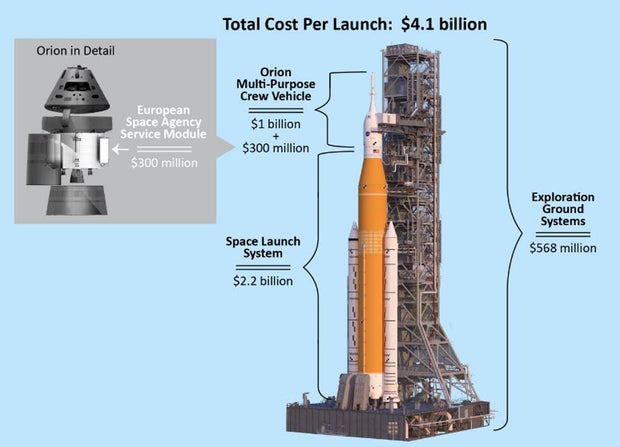
The Ugly. When discussing NASA’s new Artemis program toward the end of his essay, Mr Berger defends Artemis instead of calling it out for what it is: a costly and unsustainable space age boondoggle costing over $4 billion per launch! (See here, for example.) Given his ample knowledge of the advantages of reusable booster rockets and of the wasteful methods of traditional space contractors, who “have strong incentives to protect a status quo that benefits their bottom lines through long-term cost-plus contracts”, Mr Berger should know better!