The map below purports to show the number of troops under direct NATO command in Central Europe — “only” 40,000! — and how these forces are distributed among the eight Central European member-nations of the NATO alliance (hat tip: u/kg177). My question, however, is this: is 40,000 men for such a vast region too little or too much?
You may have heard of “Murphy’s Law” before (see item #1 below), but did you know that there are at least four five different formulations of this famous law? Via Roger’s Bacon, here are the first four:
1. Murphy’s Law – “Anything that can go wrong will go wrong.”
2. Murphy’s Second Law – “Nothing is as easy as it looks.”
3. Murphy’s Third Law (also known as Hofstadter’s law) – “Everything takes longer than you think it will (even when you account for Murphy’s Third Law).”
4. Murphy’s Fourth Law – “If there is a possibility of several things going wrong, the one that will cause the most damage will be the one to go wrong.” (Corollary: if there is a worse time for something to go wrong, it will happen then.)
Bonus: Murphy’s Fifth Law (hat tip: Sheree) — “It will cost twice as much as anticipated.”
The data visualization below, which is especially timely given Putin’s recent threats (bluffs?) to use nuclear weapons, is part of a larger series of “bar chart races” that Frank Jacobs (Big Think) has compiled for us. Check out the entire series here. In the meantime, Happy Saint Patrick’s Day!
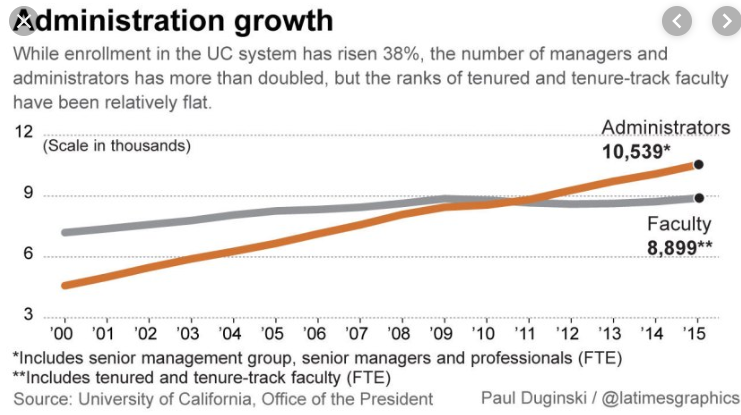
I have been meaning to blog about this perverse situation for years now and never got around to it, until today. According to this 2017 report by Caroline Simon in Forbes: “The ratio between administrators and faculty continues to shrink: … the number of faculty and staff per administrator declined roughly 40% at most types of colleges and universities between 1990 and 2012, now averaging around 2.5 faculty per administrator.” By way of example, check out this 2018 report by Darik Draplin in The College Fix: “Ohio State employs 88 diversity-related staffers at a cost of $7.3M annually.” Is this state of affairs true of other public and private universities? (See, for example, the chart below, which covers the University of California system, which has ten major campuses across the Golden State.) Either way, 87 of those 88 positions could have been actual instructors or researchers! (Also, how many of these diversity administrators are themselves diverse?)


















 prior probability