
Horace Walpole’s journal entry for Monday, February 17 (1766) provides a glimpse of the ancien regime; it reads: “At night to Prince of Conti’s public night, great concert, Jéliotte and Mlle Fel sung. 4 great tables at supper, served by his guards, pharaoh, biribis, whisk, and berlan.”[1] Who was this prince, and did either Smith or Duke Henry attend his lavish soiree on the 17th?
The Prince of Conti, Louis François de Bourbon (1717–1776), was one of the most affluent and well-connected noblemen of the metropolis, a kind of aristocratic Gatsby in the last years of the Old Regime. Ernest Campbell Mossner (1980, pp. 458-459) describes the Prince of Conti thus: “Louis-François de Bourbon, Prince of Conti, was a remarkable man. A brave and skilful [sic] generalissimo of the French Army in Italy, he had won the battle of Coni in 1744 and retired from the Army three years later. He held the confidence of Louis XV in maintaining secret diplomatic missions throughout Europe until 1755, when he was ousted by the intrigues of Mme de Pompadour. Immediately he assumed the leadership of the opposition and earned the King’s appellation of ‘my cousin the advocate.’”[3] In his personal life, the Prince of Conti was a “handsome man” who “lived handsomely and lavishly,”[4] and “his reputation as a libertine was almost unapproaced; but he permitted himself only one principal mistress at a time.”[5]
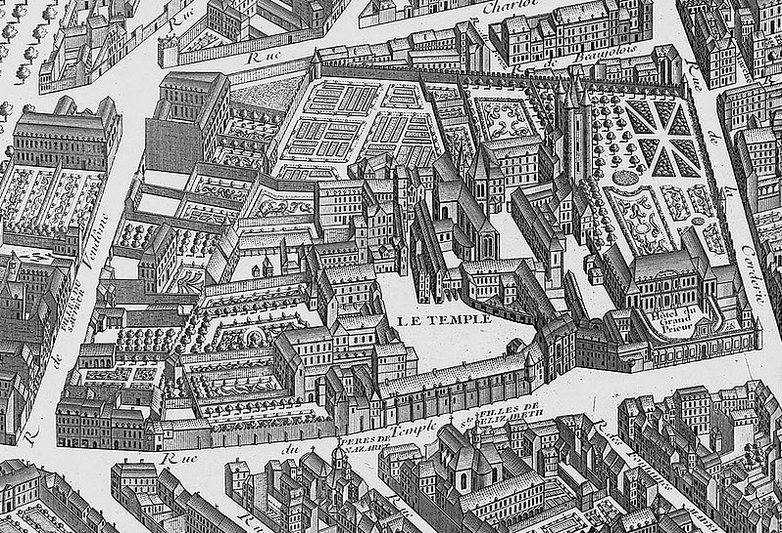
According to Mossner, it was on Mondays that the Prince of Conti hosted sumptuous suppers for up to 50 to 100 people at his luxurious place of residence, a compound called the Temple, an old fortress dating back to the 13th century.[2] Located in the Marais district of the French metropolis, the Temple was one of the most opulent and palatial private compounds in all of Paris (see map below). In the words of Mossner again (1980, p. 459): “As Grand Prior of Malta, the Prince of Conti maintained as his Paris residence the Temple, situated north of the Seine in the eastern extremity of the old city. Within the fortified walls of the spacious enclosure, the original thirteenth-century square and turreted edifice of the Knights Templars was surrounded by more modern buildings. One of the smaller of these, facing north on the rue Notre-Dame-de-Nazareth and with a simple garden on the south, was assigned to [his mistress] Mme de Boufflers. An elegant and spacious town-house, elevated somewhat above the others, was reserved for the Prince himself.”[6]
Furthermore, it was at the Temple that the Prince of Conti “entertained, on a scale rivalling that of the Royal Palace, with theatre-parties, grand assemblies, and intimate soirees. For the Temple had its own theatre, its grand assembly room, and its small salon. All were decorated with white wainscoting, with facings and casings of pressed copper, and with high glass windows offering a vivid contrast to the austerity of the ancient fortress.”[7] The Prince of Conti also maintained a vast and celebrated art collection, housed in a special gallery at the Temple, which he had amassed during the last twenty years of his life. Among other works of art, his collection included the 1764 painting English Tea Served in the Salon des Glaces at the Palais du Temple by Michel Barthélemy Ollivier, showing the infant Mozart at the clavichord.[8]
In short, if Smith and Duke Henry had already arrived in Paris on Saturday, February 15, then this “public night” and “great concert” at the “Prince of Conti’s” was a social call that they would surely have not wanted to miss.
Either way, the Temple would later play an important role in the French Revolution, as the fortress in this Temple complex was converted into a prison during the French Revolution. [See, e.g., Curzon 1888.] In fact, the most prominent members of the French royal family were all jailed at the Temple during the Revolution, including King Louis XVI, who was imprisoned at the Temple from 13 August 13, 1792 until January 21, 1793, the day he was guillotined at the Place de la Révolution, and Marie Antoinette, who was imprisoned in the Temple’s tower from August 13, 1792 to 1 August 1, 1793.[9] Today, a garden known as the Square du Temple is located on the site of the old Temple complex in the 3rd arrondissement of Paris.[10]
Did Adam Smith himself see what was coming, a world-changing revolution that would destroy the old order? In fairness to Smith, it is unlikely that anyone saw a revolution coming in 1766, but at the same time, how could the glaring contrast between the many unemployed or hungry workers of the poorer quarters of Paris and the lavish lifestyle of aristocrats like the Prince of Conti have escaped Smith’s notice?
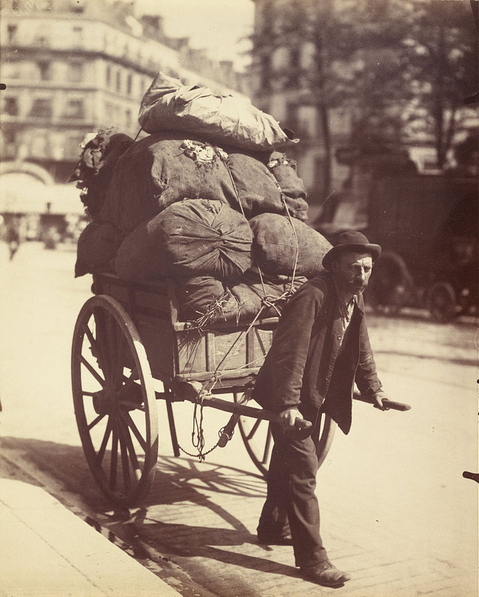
Compared to the annual income of 50,000 livres that the Prince of Conti received from the Knights Templars,[11] an unskilled male worker in Paris at the time earned about twenty to thirty sous a day (there were twenty sous in a livre), while a skilled mason could earn fifty sous. For reference, in the 18th century the minimum rent for an attic room in Paris was thirty to forty livres a year, while rent for two rooms was a minimum of sixty livres, and a four-pound loaf of bread cost eight or nine sous.[12] At the time, most working-class Parisians were concentrated in the crowded maze of streets in the center of the city, the Île de la Cité,[13] just a few minutes from the Temple on foot. Many of these working-class Parisians toiled as tanners and dyers on the Left Bank of Paris, near the Bièvre River, and in thousands of small workshops and furniture shops in the eastern neighborhood of the Faubourg Saint-Antoine.[14]
Whether or not Smith took notice of these disparities, thousands of unskilled men and women from the poorer regions of France would continue to flood these neighborhoods of Paris in the years before 1789. Moreover, it is this sharp contrast between the haves and have-nots, between the beggars and princes of Paris, that must have in some small way motivated Smith’s transformation from a moral philosopher to a political economist, from a mere theorist concerned with virtue to a pragmatist concerned with real world affairs.












 prior probability
