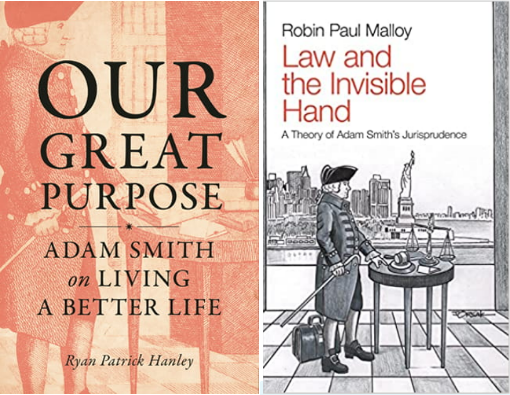
Since my rediscovery of Adam Smith’s Theory of Moral Sentiments in August of 2020 (shout out to Sarah Skwire for inviting me to join her virtual Smith reading group back then!), I have devoted a number of in-depth blog posts to a pair of new books on the ideas of Smith, one by Ryan Patrick Hanley (Our Great Purpose: Adam Smith on Living a Better Life); the other by Robin Paul Malloy (Law and the Invisible Hand: A Theory of Adam Smith’s Jurisprudence). I have since combined these posts into a single, short review of both Hanley and Malloy’s works and uploaded it to SSRN (see here). My double review is titled “Do Grasshoppers Dream of Impartial Spectators?” Enjoy!
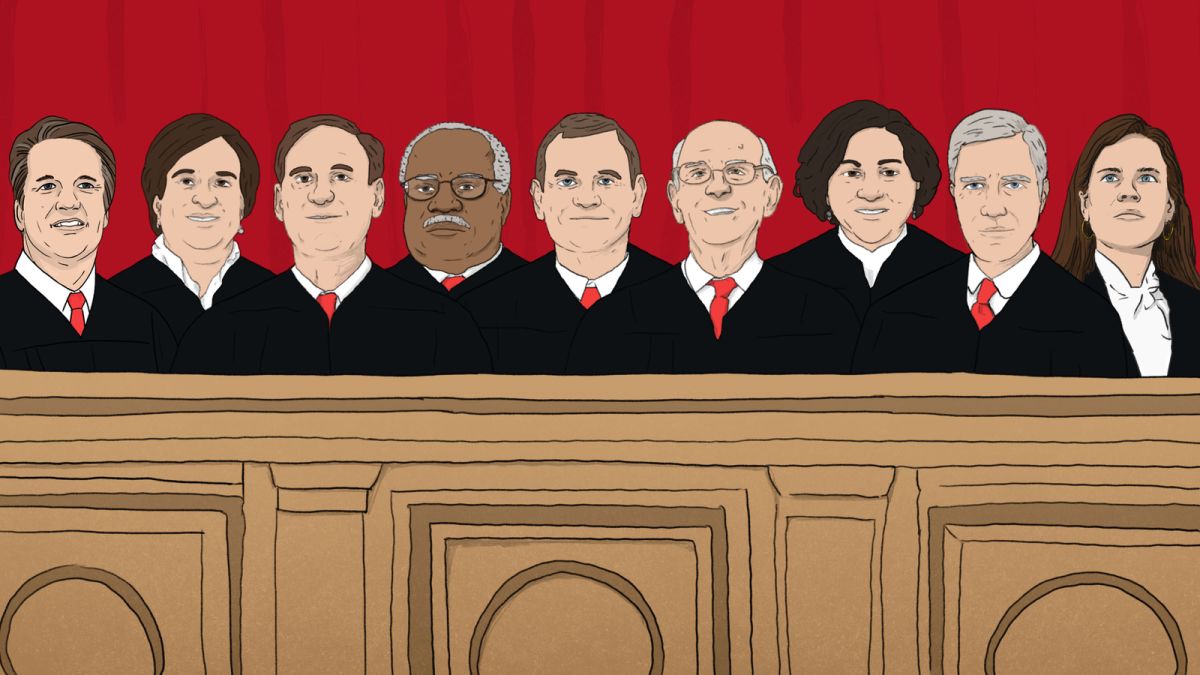
I will conclude my three-part series in praise of the Dobbs leak by making a modest proposal. In brief, my proposal is this: Supreme Court judges should, as a matter of course, always release their draft opinions in any case in which one or more members of the Court are considering whether to overrule a previous precedent. Think about it for a moment. Stare decisis, or the common law doctrine of binding precedent, is central to the “rule of law”, since judges are thereby required to apply and uphold their own rules in future cases, absent some special circumstances (see image below). Stare decisis is also what makes the third branch so special. Members of Congress and the president, for example, are not bound by their previous decisions, but judges generally are. Accordingly, judges who are willing to overrule their courts’ previous precedents should be required to give the public some notice or warning of their destabilizing intentions, right?
Here, I will reply to Mark Movsesian’s essay “Why the Dobbs Leak Is Dangerous“, an op-ed that was published in First Things on May 5, 2022. (I am late to this party because on that day my wife and I were in Plaza Garibaldi in Mexico City celebrating our 10th wedding anniversary.) In summary, for Movsesian, a law professor at St John’s University and a former SCOTUS law clerk, the leak was bad for the following two reasons, one Kantian, the other consequentialist: (1) because the motives of the leaker were bad, and (2) because, regardless of the leaker’s motives, the leak will produce bad consequences.
The first argument is the lamest and weakest of the two. Why? Because Professor Movsesian himself has no idea what the true motives of the leaker were. According to Movsesian, the leaker was either a “conservative” agent trying to keep Alito’s anti-abortion majority intact or a “progressive” proxy trying to intimidate one of the anti-abortion jurists into changing their vote. Either way, however, my response is, So what? The fact that we can assign such diametrically opposed motives to the SCOTUS leaker shows just how irrelevant the leak is in the greater scheme of things.
This observation takes us to the second of Professor Movsesian’s two arguments. In brief, Movsesian claims that the leak does matter, that it will somehow “destroy” SCOTUS as an institution. Specifically, Movsesian’s argument is that, by leaking an entire draft opinion, the leaker will cause the justices to “feel less secure about the confidentiality of their deliberations and think twice about what they put in their drafts.” Really? Is that all you got? Putting aside the fact that maybe the Supreme Court should be taken down a notch or two (Exhibit A: Bush v. Gore), that is exactly why the leak was probably, on balance, a good thing. Simply put, in cases involving hotly-contested political issues, we want our judges to be more careful and more cognizant of their decisions. That is, maybe we want our judges to “think twice” about whether they should be deciding political cases at all. (Exhibit B: the Dred Scott case, which led to a civil war.)
So, instead of impugning the motives of the SCOTUS leaker or accepting the need for secrecy at face value, we should be thanking the leaker for exposing the machinations of SCOTUS judges to the wider public. (I will conclude this series with “a modest proposal” in my next post.)
Alternative title: Transparency and openness for thee but not for me
I was in Mexico City when an entire draft opinion in one of the Supreme Court (SCOTUS)’s abortion cases was leaked to the public (see here), so I am a little late to this party, but I have been wanting to chime in for two months now. In brief, the leak was denounced by the usual suspects (see here, for example), and the chief justice even called the leak “a betrayal” and ordered the Supreme Court marshal to conduct an internal investigation. I, however, want to offer a different perspective. To the point, I want to defend the leak and heap praise on Alito’s mysterious leaker. After all, in this particular case the leak did not threaten “national security” (whatever that means). More generally, if SCOTUS is going to continue deciding political cases and continue insisting (falsely, by the way) that it has the “final” word on questions of constitutional law, then why should SCOTUS judges (I refuse to call them “justices”) get to operate in total secrecy after oral arguments? On the contrary, I would argue that in cases involving politics (abortion, affirmative action, gun control, etc.) the public has some right to know what SCOTUS judges are up during their deliberations. SCOTUS is not an oracle; it is a branch of the federal government, a branch that has given itself the counter-majoritarian power of “judicial review,” a power that is nowhere to be found in the text of the Constitution. (To be continued …)
File under: Annals of liberal law professor hypocrisy. Bonus material: check out this video by Johnny Harris calling out additional forms of progressive hypocrisy.
Via the Drudge Report, I just learned that Latin music star Ricky Martin was the subject of a domestic abuse restraining order in Puerto Rico (see here). The identity of the person who requested this order, however, is protected under Puerto Rico’s sweeping domestic violence law, so my 2006 paper on “Domestic Violence, Strategic Behavior, and Ideological Rent-Seeking“, might (or might not) be relevant to this case. (As an aside, Ricky Martin’s “La Copa de la Vida” is my favorite World Cup theme song of all time.)
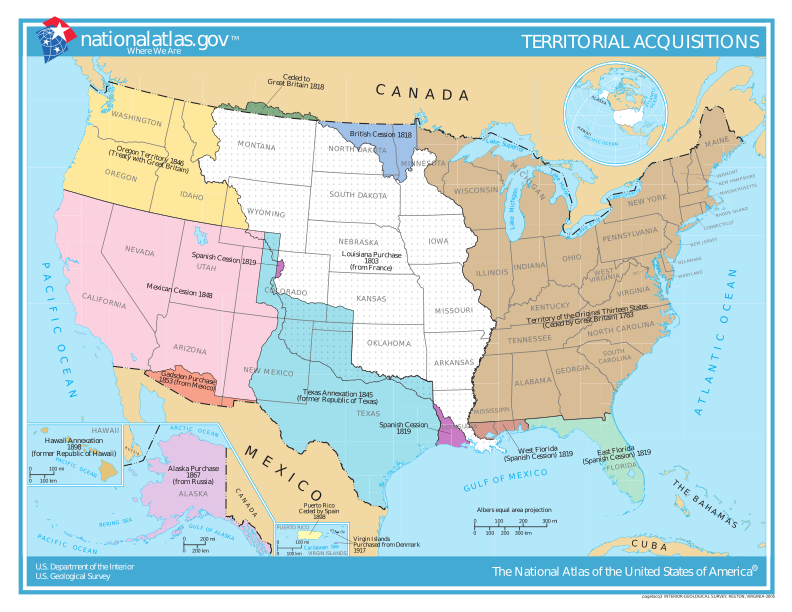
On this day (July 4) in 1803, the terms of the treaty between the United States and France for the purchase and sale of Louisiana — the Vente de la Louisiane or “Louisiana Purchase“, a treaty that quite possibly changed the course of world history — are announced to the public: $15 million for 828,000 square miles west of the Mississippi River.
Model this! Tyler Cowen and Alex Tabarrok are still my favorite bloggers, by far. To see why, below are links to my top-ten entries for the month of June from their Marginal Revolution blog, an eclectic and wide-ranging repository of information that they still somehow manage to update multiple times a day:
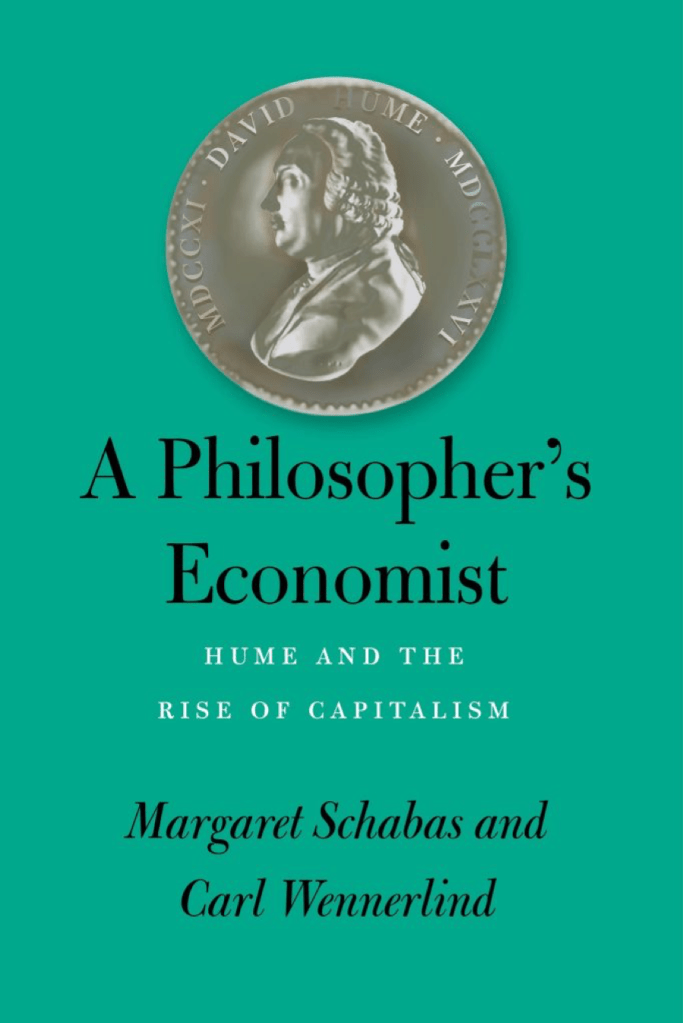
I am busy proofreading a textbook (Business Law & Strategy, 2nd edition) and putting the finishing touches on the first part of my “Adam Smith in Paris” manuscript, which I will be presenting later this month at the Universidad de los Andes in Bogota, Colombia, so there is just one book (the cover of which is pictured below) in my reading basket for the month of July.