Alternative Title: Review of Chapter 12 of Law and the Invisible Hand
I will conclude my review of Robin Paul Malloy’s Law and the Invisible Hand by recommending his book to my loyal readers. In brief, Professor Malloy’s beautiful book is not only a thoughtful and well-written tome; it also poses an eternal question — the relationship between law and liberty — and offers a new and original solution to this timeless dilemma.
To the point, Malloy concludes his book by identifying three features that all successful societies have in common (pp. 147-152): (1) they promote the common interest, i.e. they find ways of balancing self-interest and the common good; (2) they advance justice through the rule of law, i.e. they protect the security of persons and property, regulate harms, and guarantee procedural due process; and (3) they promote free markets, i.e. allow for decentralized decision-making. In addition, according to Malloy, these three goals or values also correspond with Adam Smith’s theory of justice or “market jurisdprudence” (Malloy’s apt term).
But there are two big problems with Malloy’s picture. Putting aside the fact that this “market jurisprudence” is just one interpretation or version of Smith’s theory of justice (since Smith himself never developed a theory of justice), one problem is that general terms like “common interest” and “rule of law” are always too vague or open-ended to be of any real value. The other problem (and the more serious one, in my view) is that the three goals in Malloy’s laundry list are often in direct conflict with each other. After all, how many times have markets been curtailed or regulated in the name of the public interest or common good? Although the rule of law can promote voluntary exchange by defining property rights and enforcing contracts, the police power is also just as often misused to protect monopolies and stifle free markets.
The ultimate problem for Malloy’s Smithian theory of justice is this: how do we find the right balance between law and liberty? That is, how do we allow markets to flourish, so that people and firms are free to make and buy what they want, while at the same time protecting health, safety, and welfare as well as minimizing harmful effects to third parties? Most of the time, however, we brush this tension aside by invoking one of several forms sophistry. Some try to distinguish liberty from “libertinage” (a hopeless task in a world of pluralistic lifestyles and values). Others invoke rhetorical chants like “well-ordered liberty” (an oxymoron if there ever was one). Still others repeat formulaic incantations or mystical slogans like “your liberty to swing your arm ends where my nose begins” or John Stuart Mill’s idea that law and coercion are justified only to prevent harm to others (a superficially appealing idea that collapses of its own weight once we realize that restrictions on liberty are themselves harms).
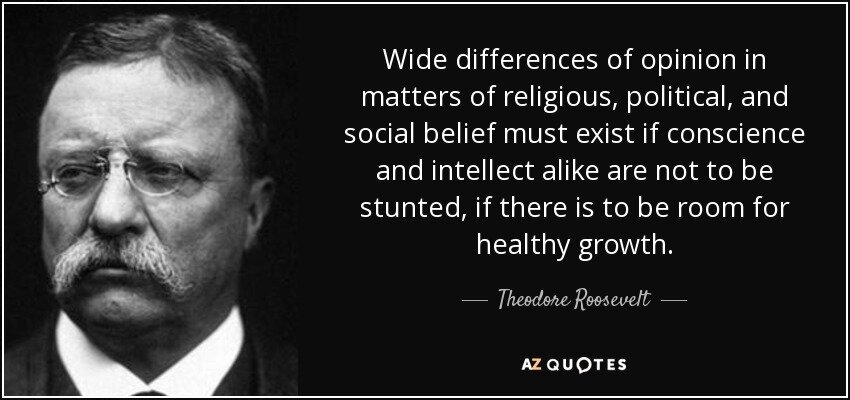
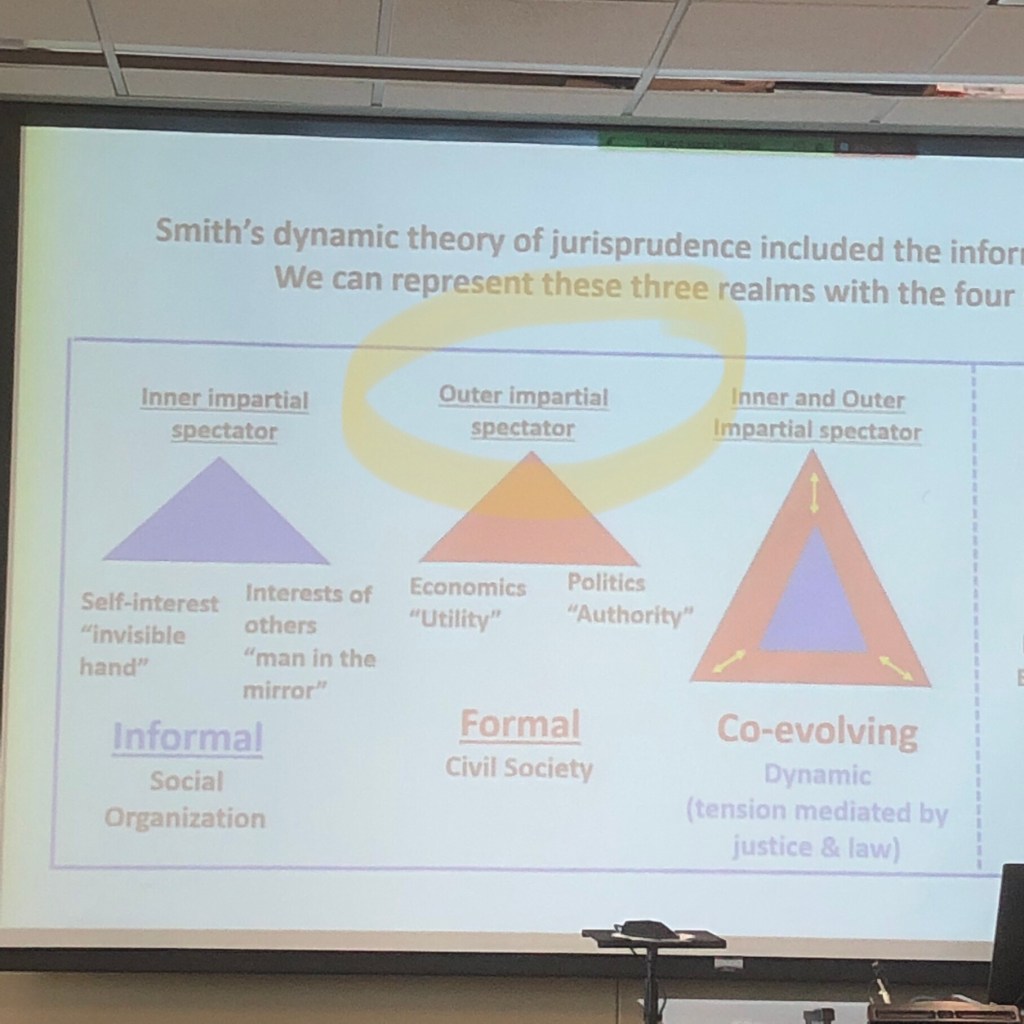
To his credit, Malloy offers an ingenious and Smithian-inspired solution to this timeless dilemma. For Malloy, it’s the impartial spectator, not the invisible hand, that offers a way out. In summary, Malloy takes the impartial spectator from Smith’s Theory of Moral Sentiments and expands his jurisdiction to include conflicts about law, politics, and economics. But is Malloy’s solution a workable one? Alas, here is where Malloy and I part ways. Although I am willing to award Malloy bonus points for creativity, his solution not only won’t work in domains like law and politics; it would be a bad thing if it did work in those domains! (See, for example, the quote by Teddy Roosevelt below.) For starters, the impartial spectator is supposed to judge or evaluate your actions from a neutral observer or disinterested third-person point of view, but once we leave the domain of ethics and enter the domain of politics, what is preventing this “spectator” from becoming a rabid fan of your team or tribe? And once the spectator becomes a fan, he can just as easily be misused to justify or root for your actions or those of your team.
It takes a theory to beat a theory, as academics like to say, so at the risk of sounding naive, I will conclude my review with a Smithian observation: why not just trust the invisible hand? In fact, why not extend Smith’s invisible hand metaphor to the marketplace of ideas by allowing our “impartial” spectators to take sides and root for our teams, which he is bound to do anyways? Either way, instead of placing so much hope in Smith’s spectator (a tool that is doomed to fail in the domains of law, politics, and economics, domains where the existence of differences of opinion is actually a sign of a free and vibrant society), maybe we should place more trust in Smith’s invisible hand, the invisible hand of The Wealth of Nations, the invisible hand of decentralized decision-making and spontaneous order–in short, the invisible hand of freedom and prosperity!
The beauty and elegance of Smith’s invisible hand metaphor is that it doesn’t require some external talisman for society to succeed. In place of imaginary spectators or dangerous men of system, we only need the invisible hand. Of course, at a minimum, the invisible hand won’t work without well-defined property rights and the freedom to exchange those rights as well as a strong-enough sovereign to protect and enforce these rights and transfers. What else does the invisible hand need to produce high levels of prosperity and liberty? This, after all, is the question that Adam Smith himself was asking when he wrote The Wealth of Nations, so this is the question that we too should be asking today. In any case, Smith never completed his promised book about law and justice; maybe he didn’t have more to say.





 * Full disclosure: I drafted this blog post on my Apple iPhone 5s. That I was able to access the Internet, link to various sources, and track down and post a picture — in a matter of minutes and on such a small and portable device — is remarkable.