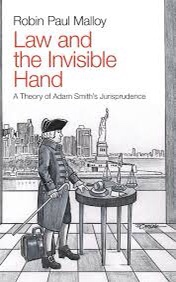
As I mentioned in a previous post, I have decided to review Robin Paul Malloy’s Law and the Invisible Hand. (Note and full disclosure: I was going to review Better Call Saul and Philosophy, a collection of essays published last month, but I have decided to prioritize Professor Malloy’s work because I haven’t received my copy of the “Better Call Saul” book yet, while Malloy graciously gave me a copy of his beautiful book when we met at the History of Economics Society last weekend.) So, let’s get started with Chapters 1 and 2 of Malloy’s new book, shall we?
Professor Malloy not only quickly introduces his readers to the most compelling and memorable metaphors that appear in Adam Smith’s writings (see p. 5), such as the invisible hand, the impartial spectator, and the man in the mirror; he (Malloy) also identifies perhaps the single-most important question of all time, a paradox that Smith himself spent a lifetime trying to solve: how is it possible to reconcile the pursuit of private self-interest while at the same time promoting the common good?
For my part, however, although I commend Prof Malloy for putting this key question center stage, I am highly skeptical of his attempted solution: his mystical and multiple invocations of the ideal of “justice.” In Malloy’s own words (p. 3, footnote omitted), for example, “Smith subordinated concerns for self-interest to the requirements of justice because he understood that justice was the most important pillar on which civil society rested.” (Malloy repeats this same argument in different ways in Chapter 2 as well.) To the point, Malloy’s justice thesis has a fatal flaw, for what is Adam Smith’s theory of justice? Alas, Smith never developed one, since he ended up abandoning the book he was writing on law and justice in order to write The Wealth of Nations. (Malloy himself acknowledges this embarrassing omission on page 7 of his introduction.)
The best we can do, then, is to try to guess what Smith’s theory of justice — had he ever decided to develop one — might have looked like, and in fairness to Malloy and to his ambitious project, we do have some material to help us make this guess. Among other things, we have Smith’s 1759 treatise on moral philosophy, The Theory of Moral Sentiments, to which he made significant revisions in subsequent editions. We also have Smith’s “Lectures on Jurisprudence,” a set of lecture notes transcribed by one of Smith’s students, and we have the last part of The Wealth of Nations (Book V), which talks about the administration of justice and the proper role of government generally.
As such, like a good Bayesian, I will try to keep an open mind as I read the remaining 10 chapters of his book. Even if we are unable to reconstruct Smith’s theory of justice, this effort is still a worthwhile one, for the tension between the public interest and the private pursuit of self-interest is not only a major theme in Smith’s writings; it is also very much relevant in our times–think of climate change, the proliferation of “fake news” on social media, and NIMBY-hypocrisy, just to name a few contemporary challenges.