Smith in the City: Colbert de Castle-Hill

Note: After a one-week hiatus due to my travels, I am now resuming my series “Adam Smith in the City of Lights.”

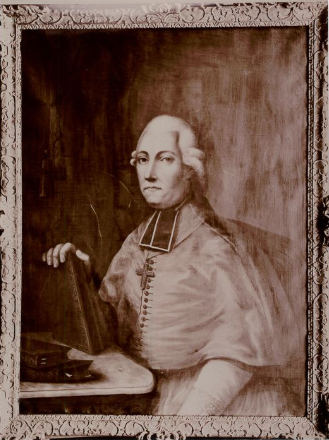
Smith’s closest friend and confidante in France was Seignelay Colbert de Castle-Hill (1736-1811), the Abbé Colbert, whose portrait (circa 1781) is pictured below.[1]. Although he was born in Scotland, near the small town of Inverness,[2] he had emigrated to France at a young age in 1746, the year his father had died.[3] The young Colbert then enrolled in the Scots College in Paris in 1747,[4] became an ordained priest in 1762,[5] and was appointed a Vicar General for the diocese of Toulouse.[6] The provincial town of Toulouse, where Smith and his pupil Duke Henry began their Grand Tour, is where the Abbé Colbert and Adam had first met in March of 1764.[7]

At that time, Colbert was one of Smith and Duke Henry’s few contacts in the south of France; he even travelled with Smith and Duke Henry to Bordeaux and to other places in the South of France and would thus become Smith’s “chief guide and friend” during this stage of his travels.[8] Moreover, as it happens, Colbert and Smith coincided in the French capital during the first part of Smith’s stay in Paris (February to April, 1766), for Colbert’s name appears multiple times in Horace Walpole’s travel journal. As such, Colbert and Smith must have continued their friendship during this time, perhaps at the salons of the leading ladies of Paris. In a letter addressed to Smith and Duke Henry dated September 1766, Colbert writes:

“And you, Adam Smith, Glasgow philosopher, high-broad Ladies’ hero and idol, what are you doing my dear friend? How do you govern the Duchess of Anville and Madame de Boufflers, where your heart is always in love with Madame Nicol and with the attractions as apparent as hidden of this lady of Fife that you loved.” [Quoted in Alcouffe & Massot-Bordenave 2020, p. 260.]

With the exception of the “lady of Fife,” whose identity remains a mystery,[9] two other ladies are identified in Colbert’s letter by name, including the “Duchess of Anville,” Madame de Boufflers, and Madame Nicol. The Duchess of Anville could refer either to Marie-Louise Nicole Elisabeth de La Rochefoucauld 1716-1797, Duchesse d’Enville, the widow of Jean Baptiste Frédéric de La Rochefoucauld de Roye, Due d’Anville,[10] or perhaps to Elisabeth Louise de La Rochefoucauld (1740–1786), who was the “[g]rand-daughter of La Rochefoucauld (the author of the ‘Maximes’) and faithful friend of Turgot.”[11] For her part, Madame de Boufflers refers to Marie Françoise Catherine de Beauvau-Craon (1711–1786), mistress to the Prince of Conti[12] and friend of David Hume[13] and one of the leading ladies of Paris at the time, but who was “Madame Nicol”? According to Alcouffe and Moore, she might refer to the spouse of Jacques Nicol de Montblanc, Capitoul elected in 1763,” who “had received in his Chateau the Duke of Fitz-James during his conflict with the Parlement.”[14]

Regardless of who these women were and regardless of the precise nature of their relationship to Adam Smith–secretly amorous or purely Platonic–the jocular and intimate tone of Colbert’s letter suggests camaraderie and close connections, or in the words of Alain Alcouffe and Philippe Massot-Bordenave, the letter “is probably a private correspondence between friends who have established trust.”[15] This letter may also provide some indication of Smith’s circle of friends in Paris, such as Madame de Boufflers and the Duchess of Anville. What other French ladies did Adam Smith meet at this time?

Continue reading →
Posted in Uncategorized | 1 Comment

Rue Jacob, Paris, circa 1867

I will resume my “Adam Smith in the City of Lights” series in my next post. In the meantime, check out this website, which features an 1867 photograph of rue Jacob (pictured below), which used to be the rue du Colombier, the street where Adam Smith lived during most of his nine-month sojourn in Paris in 1766.

Marville : rue Jacob
Source: Musée Carnavalet
Posted in Uncategorized | Leave a comment

Adam Smith in Paris

As I mentioned in my previous post, my Adam Smith in Paris paper, which retraces Smith’s steps in the French capital from mid-February to mid-April 1766, is now divided into three sections: (1) date of arrival, (2) the first fortnight, and (3) the next 40 days. Below is a color-coded visualization of part 3 of the paper:

Posted in Uncategorized | Leave a comment

Adam Smith Update

I extended my travels and am without my laptop and my research files, so I will resume my “Smith in the City of Lights” series upon my return later this week. In the meantime, I have posted an updated version of my Adam Smith paper on SSRN, available here. The paper is now divided into three sections as follows:

1. Date of arrival and first impressions of Paris (Feb. 15, 1766)

2. The first fortnight (Feb. 15 to Feb. 29–yes, 1766 was a leap year!)

3. The next 40 days (March 1 to April 9–the 9th being the last time Smith is mentioned in Horace Walpole’s journal)

Posted in Uncategorized | Leave a comment

Postcards from OKC

I travelled to Oklahoma City this weekend to visit my son Kleber and loved the place!

Posted in Uncategorized | 2 Comments

Better Call Saul and Philosophy

That is the title of this new book, the cover of which is pictured below, which was published last week by Open Universe. My contribution to this collection of Saul Goodman-inspired essays is called “Breaking Bad Promises” (Chapter 22). (An ungated draft of my chapter is available here, via SSRN.) Shout out to my colleagues Joshua Heter and Brett Coppenger, who are the editors of this excellent work.

Amazon.com: Better Call Saul and Philosophy (Pop Culture and Philosophy,  8): 9781637700266: Heter, Joshua, Coppenger, Brett: Books

Posted in Uncategorized | 3 Comments

Smith in the City: Le Monde

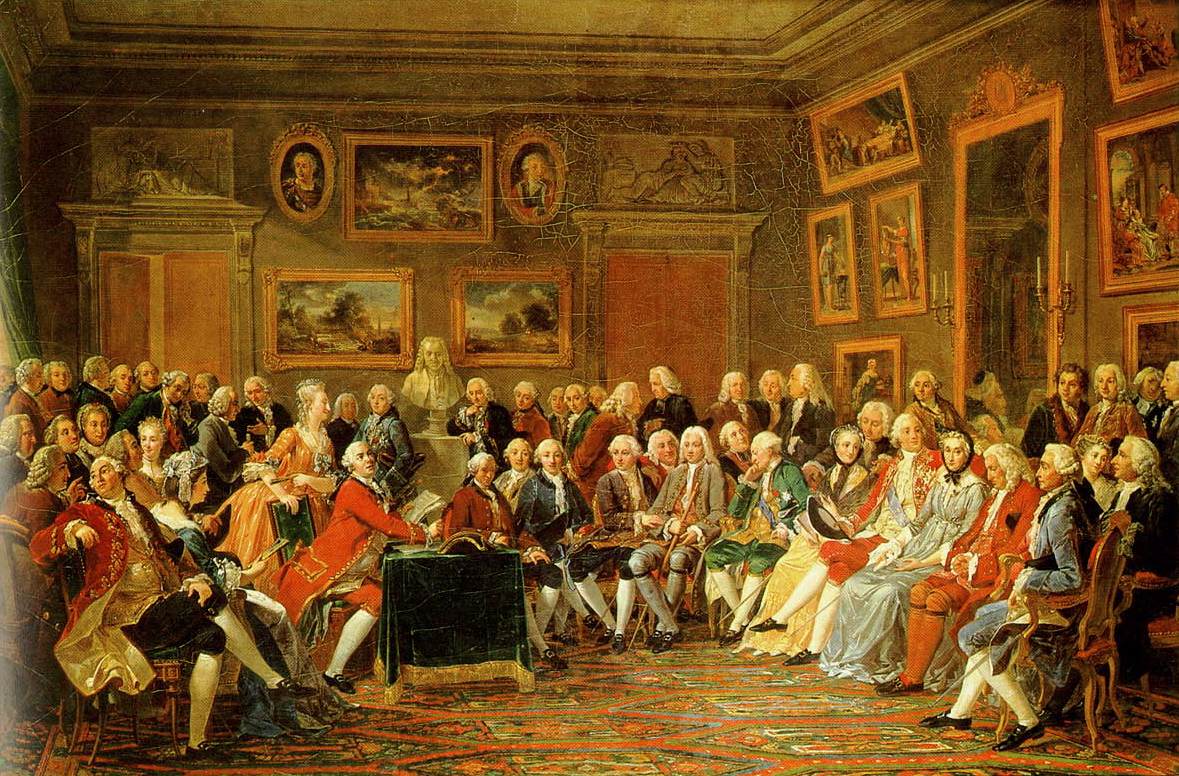
Among the many people Horace Walpole encountered on Wednesday, March 26 was Smith’s close friend and confidant, the Abbé Colbert, for Walpole’s journal entry for that day reads: “To Mme d’Usson, Duke of Buccleuch etc. Abbé Colbert, and M. de Barbantane, and Mme de Gacé there.”[1] Does the “etc.” in this entry refer just to Duke Henry’s younger brother (Hew Campbell Scott), or does it also include his tutor Adam Smith? Either way, Walpole’s entry contains an eclectic assembly of French aristocrats, members of le monde who must have also been in Smith’s social circle in Paris. (As an aside, this bygone world is recreated in a famous oil painting titled “Reading of Voltaire’s tragedy of the Orphan of China in the salon of Marie Thérèse Rodet Geoffrin in 1755” by Anicet Charles Gabriel Lemonnier, circa 1812, which is pictured below.)

The two women in this group, “Madame d’Usson” and “Madame de Gacé,” are cases in point. “Madame d’Usson,” for example, most likely refers to Margarethe Cornelia van de Poll (1726-1793),[2] who was married to Pierre Chrysostome d’Usson-Bonac (1724-1782), the Comte de Usson.[3] According to Wilmarth Sheldon Lewis, the editor of Horace Walpole’s correspondence, Margarethe Cornelia van de Poll was a wealthy woman, with an income of 100,000 florins (about £8000), and she a cousin by marriage of the Duke of Richmond, who was Britain’s ambassador to France from November 1765 to April 1766.[4]

“Madame de Gacé” most likely was Diane-Jacqueline-Louise-Josèphe de Clermont-d’Amboise (1733-1804), the widow of Marie François d’Auguste de Matignon, the Comte de Gacé (1731-1763). She remarried in 1766, marrying Pierre Charles Etienne Maignard, the Marquis de La Vaupalière, who was first second lieutenant of the King’s musketeers. [5] In 1769, this Parisian power couple would move to a hôtel particulier at 85 rue du Faubourg Saint-Honoré, now known as the Hôtel de La Vaupalière. [6] For his part, “M. de Barbantane” may refer to Joseph Balthazard de Puget (1723-1811), marquis de Barbentane, a captain of the King’s cavalry who was appointed ambassador to Tuscany in 1766.[7]

But of all these high society types, the closest one to Adam Smith–the one who knew Smith most intimately–was the Abbé Colbert. I will have more to say about Colbert when I resume my “Smith in the City” series on Tuesday, May 31.

File:Salon de Madame Geoffrin.jpg
Continue reading →
Posted in Uncategorized | Leave a comment

Smith in the City: The Sèvres Porcelain Manufactory

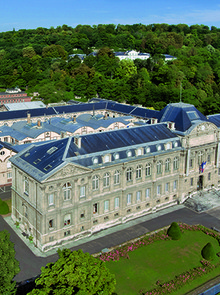
On Tuesday, March 25, Adam Smith’s pupils Duke Henry and Hew Campbell Scott most likely visited a porcelain manufactory in Sèvres, a small town located west of Paris, for Horace Walpole’s journal entry for that day reads: “To manufacture at Sevè with Lady George, Mrs Ker, Duke of Buccleuch and Mr Scot.”[1] (The reference to the “manufacture at Sevè” must be to the Manufacture nationale de Sèvres (pictured below), a royal workshop established by Louis XV in the 1750s,[2] while “Lady George, Mrs Ker” must refer to Lady Louisa Kerr, the wife of Lord George Lennox. For their parts, “Duke of Buccleuch and Mr Scot” refer to Smith’s pupils, Duke Henry and Hew Campbell Scott, the duke’s younger brother.)

Did Adam Smith visit this porcelain manufactory as well? Either way, a number of world-famous workshops in 18th-century France enjoyed royal monopolies to produce luxury goods, including jewelry, furniture, snuff boxes, watches, porcelain, carpets, silverware, mirrors, and tapestries, among other things. The crown directly oversaw several royal manufacturers, including those of fine dishes (Sèvres), tapestries (Gobelins and Beauvais), and carpets (Savonnerie manufactory).[3] The manufactory at Sèvres was thus not just any commercial enterprise; it was a world-famous workshop with a royal monopoly to produce fine dishes and other porcelain goods. [See generally Préaud & Scherf 2015; see also Battie 1990.]

The Sèvres Porcelain Manufactory was originally founded in Vincennes in 1740 and then moved to Sèvres in 1756, after a new manufactory was built between 1753 and 1756 by the architect Laurent Lindet. [See generally Lechevallier-Chevignard 2013; see also Zarucchi 2016.] This new building was 130 meters long and four floors high. The ground floor contained clay reserves and storerooms of raw materials, and the first (second) floor contained the ovens and the workshops of the moulders, plasterers, sculptors, and engravers. Sculptors, turners, repairers, and packers worked on the second (third) floor, and the painters, gilders, and makers of animals and figures worked in the loft of the building. There was also a central pavilion surmounted by a pediment with a clock from the old royal glass-makers on the fourth level, with two long wings terminating in corner pavilions at each end. In front of the pavilion was a public courtyard, which was enclosed by a wrought-iron fence. This courtyard was decorated twice a month to entertain visitors to the building.

Although Smith was apparently not among the members of Walpole’s party to visit Sèvres on March 25, one aspect of Paris that must have caught the moral philosopher’s attention was the market in luxury goods, a growing market with political and moral implications.[4] By way of example, the word “luxury” appears only six times in Smith’s 1759 treatise The Theory of Moral Sentiments; by contrast, “luxury” or “luxuries” appear over 60 times in The Wealth of Nations. Moreover, Adam Smith devotes considerable space to monopolies and luxury goods in different parts of The Wealth of Nations. Book 1 of his magnum opus contains an extended analysis of monopolies, while Book 5 adopts a broad definition of luxury goods. Smith also defends the imposition of taxes on luxury goods in Book 5. Perhaps his time in Paris, the capital of luxury, in some small part led to Smith’s transformation from a moral philosopher to a political economist.

Sèvres - Manufacture et Musée nationaux - Accueil
Continue reading →
Posted in Uncategorized | 2 Comments

Smith in the City: “Duke Henry”

Horace Walpole’s journal entry for Monday, March 24 reads: “Dined at Duke of Buccleuch’s with several English.” [Lewis 1939, p. 309.]

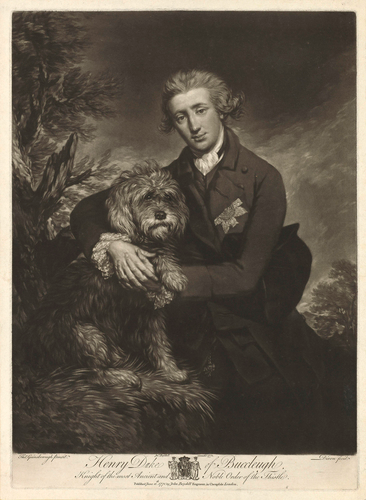
The Duke of Buccleuch here refers to Smith’s pupil, Duke Henry, the future 3d Duke of Buccleuch, whose portrait is pictured below. At the time, Adam Smith was serving as Duke Henry’s private tutor and chaperone, a position that Smith had held since January of 1764, when they first set off for France on their grand tour. But why had Smith given up the tranquility of the University of Glasgow, where he held the Chair of Moral Philosophy, to serve as a “mere” tutor to a junior nobleman? As it happens, the position of tutor, at least in this particular case, was perhaps an even more prestigious posting, for Duke Henry, a direct descendant of King Charles II of England and King Henry IV of France, was not just any nobleman; he was born into one of the wealthiest and most prestigious families in Scotland, and upon coming of age in September of 1767, Smith’s pupil would become one of Scotland’s largest landowners. [For an in-depth biography of the Third Duke of Buccleuch, as well as a portrait and family tree, see Alcouffe & Massot-Bordenave 2020, pp. 28-34; for a short biography of Duke Henry, see Valentine 1970, Vol. 2, p. 773.]

It was Duke Henry’s stepfather, Charles Townshend, a prominent political figure in Britain until his death in 1767, who had offered the position of Duke Henry’s private tutor to Adam Smith as early as 1759, shortly after the publication Smith’s first great work, The Theory of Moral Sentiments. The plan was for Smith to accompany Duke Henry on a grand tour of Europe as soon as the young duke completed his studies at Eton, and Townshend offered Smith a lifetime salary of £300 per annum, more than double Smith’s salary as a Glasgow professor. Simply put, it was an offer Smith could not refuse. Smith himself did not hesitate in accepting Townshend’s offer.

In finally setting off for France in January of 1764, the father of modern economics and the young duke were following a well-established tradition, for the “Grand Tour” was a rite of passage of the sons of elite British families, “the ‘crown’ of [their] education.” [See Cohen 2001, p. 129; see also Brodsky-Porges 1981, p. 178, quoting Ogilvie 1939.] Michèle Cohen (1992, 2001) has explored the educational and cultural ideals of the “Grand Tour” and has identified many deep “contradictions and ambiguities” of these European tours by young British aristocrats, and the sexual aspect of these tours should also not go unnoticed. [See, e.g., Chapter 5 of Black 2011, which is titled “Love, Sex, Gambling, and Drinking.” See also Black 1981, p. 660 & p. 666, n.7; Black 1983, pp. 413-414; Cohen 1992, pp. 255-256.]

Perhaps it was these many contradictions and ambiguities of these grand tours that turned Smith against this aristocratic tradition. In Book V of The Wealth of Nations, for example, in the subsection titled “Of the Expense of the Institutions for the Education of Youth,” Smith delivers a scathing indictment of this institution:

"In England it becomes every day more and more the custom to send young people to travel in foreign countries immediately upon their leaving school, and without sending them to any university. Our young people, itis said, generally return home much improved by their travels. A young man who goes abroad at seventeen or eighteen, and returns home at one and twenty, returns three or four years older than he was when he went abroad; and at that age it is very difficult not to improve a good deal in three or four years. In the course of his travels he generally acquires some knowledge of one or two foreign languages; a knowledge, however, which is seldom sufficient to enable him either to speak or write them with propriety. In other respects he commonly returns home more conceited, more unprincipled, more dissipated, and more incapable of any serious application either to study or to business than he could well have become in so short a time had he lived at home. By travelling so very young, by spending in the most frivolous dissipation the most precious years of his life, at a distance from the inspection and control of his parents and relations, every useful habit which the earlier parts of his education might have had some tendency to form in him, instead of being riveted and confirmed, is almost necessarily either weakened or effaced. Nothing but the discredit into which the universities are allowing themselves to fall could ever have brought into repute so very absurd a practice as that of travelling at this early period of life. By sending his son abroad, a father delivers himself at least for some time, from so disagreeable an object as that of a son unemployed, neglected, and going to ruin before his eyes." [The Wealth of Nations, Glasgow edition, pp. 773-773 (para. 36).]

Given these dangers and temptations, how did Smith or counteract them? Perhaps this was the main reason why Smith had chosen to begin Duke Henry’s grand tour in Toulouse–a small provincial town in the south of France where they ended up spending 18 months–instead of a more cosmopolitan metropolis like Paris or Rome. [See generally Alcouffe & Massot-Bordenave 2020.] So, what did Smith do to counteract these dangers and temptations, especially during the Paris phase of Duke Henry’s grand tour. Smith and his pupils now found themselves in Paris, the capital of luxury.

Source: Royal Trust Collection
Posted in Uncategorized | Leave a comment

Smith in the City: Games of chance at the Foire Saint Germain

Horace Walpole’s journal for Saturday, March 22 reads: “With Lady [Louisa Kerr] and Lord George [Lennox], Mr and Mrs Carr, Duke of Buccleuch, Mr Scot, and Mr Nicholson to the Foire St-Germain, and supped afterwards at Lord George’s.”[1]

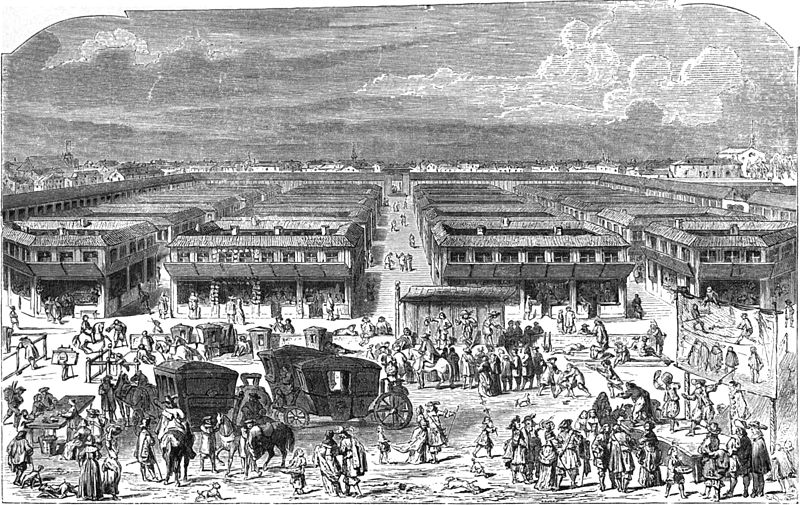
Did Walpole leave out Adam Smith? Or did Smith leave his pupils, Duke Henry [“Duke of Buccleuch”] and the duke’s younger brother Hew Campbell Scot [“Mr Scot”], under the care of Walpole to attend the Foire St-Germain? Either way, the fair of Saint-Germain (pictured below), along with the fairs of Saint-Laurent and Saint-Ovide, were the principal centers of popular entertainment in Paris throughout most of the eighteenth century.[2] These fairs were originally begun in the Middle Ages by monks to accommodate pilgrims who were congregating on certain feast days to honor relics; the monks then rented stalls to merchants to sell food and wares and eventually permitted entertainers to perform.[3] The Saint-Germain fair, however, was the oldest and most “fashionable” of the three major fairs.[4]

The Saint-Germain fair ran from February 3 until Palm Sunday.[5] In 1766, Palm Sunday fell on March 23, so Walpole and his party visited the fair on its next-to-last day. What did they see there? Historian Robert M. Isherwood (1981, p. 25, footnotes omitted) describes the Saint-Germain fair thus:

"It comprised two huge markets 130 steps long and 100 wide, covered by a magnificent timbered roof built in the sixteenth century at the instigation of the abbe of Saint-Germain. The composer Charles Favart called this roof 'one of the marvels of Paris.' Beneath it a series of nine unpaved streets, lined with boutiques, crisscrossed the fair. Established on the site of the old hotel of the kings of Navarre, the whole terrain was sunken, forming what one observer called 'a mere hole in the middle of the faubourg....' The ground, much lower than it is today, was in some places six to eight feet deeper than the surrounding land. Visitors complained about the narrow passageways that had to be crossed to gain access to the fair. The danger of being hit by carriages descending into what Louis-Sebastien Mercier called 'this narrow gorge' did not deter thousands of people from attending the fair every day."[6]

Moreover, the fairs attracted people from all walks of life and all social orders. According to Isherwood (1981, p. 27, footnotes omitted), for example:

"Typically, the fairs were clogged with soldiers, beggars, guardsmen, prostitutes, clerks, lackeys, students, shopkeepers, porters, and petits-maîtres. Everyone mingled in a jangling din of shouts, insults, and banter amid a cacaphony of whistles, tambourines, flutes, and street cries. 'It was a continual ebb and flow of people who pushed each other from one side to the other,' wrote Charles Sorel. 'It seemed that that day had been chosen by all the people of low rank in Paris to come there. . .  One heard those who suffered from the discomfort screaming from every direction, and in vain pregnant women imagined that they would be more spared than others; one could not have lightened their burden if one had wished to.' For Joachim Nemeitz, who wrote an instructional guide for visitors to Paris, everyone at Saint-Germain moved 'helter-skelter, masters with valets and lackeys, thieves with honest people. The most refined courtesans, the prettiest girls, the subtlest pickpockets are as if intertwined together. The whole fair teems with people from the beginning to the end.'"[7]

If Adam Smith did visit the Saint-Germain fair and rub shoulders against this mix of humanity, he would have seen a wide variety of foods and merchants. In the words of Isherwood (1981, pp. 25-26, footnotes omitted):

“A sumptuous array of food products was sold at Saint-Germain including pastry, spiced breads, jams, waffles, fruit, candy, wine, liqueur, tisane, beer, and eau de vie. The merchants who had stalls in the fair, some from Paris but many from Amiens, Rheims, Beauvais, and other communities, included wigmakers, engravers, linen sellers, cask makers, coopers, druggists, cabinetmakers, and locksmiths. The seventeenth-century writer Charles Sorel declared that the fair 'was a place of joy and even debauchery where one must certainly sell merchandise which would serve intemperance and vanity.'”[8]

Also, among the many popular forms of entertainment on display at these fairs were games of chance. According to Isherwood (1981, p. 26, footnote omitted), for example: “Although ordinances were issued repeatedly against it, gambling also provided merchants with a source of revenue. A few at Saint-Germain earned several hundred livres a day by running dice games, lotteries, spinning wheels, cards, and skittles in their boutiques.”[9] Moreover, since the boutiques with gambling were usually packed with people, “they were favorite haunts of pickpockets who were adept at cutting off the backs of men’s coats or women’s dresses.”[10]

Although Adam Smith does not mention any of the fairs of Paris by name in The Wealth of Nations, he does discuss the psychology of lotteries in Chapter 10 of Book 1 of his magnum opus, anticipating the work of Amos Tversky and Daniel Kahneman by three centuries:

"The over-weening conceit which the greater part of men have of their own abilities is an ancient evil remarked by the philosophers and moralists of all ages. Their absurd presumption in their own good fortune has been less taken notice of. It is, however, if possible, still more universal. There is no man living who, when in tolerable health and spirits, has not some share of it. The chance of gain is by every man more or less overvalued and the chance of loss is by most men undervalued, and by scarce any man, who is in tolerable health and spirits, valued more than it is worth.

"That the chance of gain is naturally overvalued, we may learn from the universal success of lotteries. The world neither ever saw, nor ever will see, a perfectly fair lottery; or one in which the whole gain compensated the whole loss; because the undertaker could make nothing by it. In the state lotteries the tickets are really not worth the price which is paid by the original subscribers, and yet commonly sell in the market for twenty, thirty, and sometimes forty per cent advance. The vain hope of gaining some of the great prizes is the sole cause of this demand. The soberest people scarce look upon it as a folly to pay a small sum for the chance of gaining ten or twenty thousand pounds; though they know that even that small sum is perhaps twenty or thirty per cent more than the chance is worth. In a lottery in which no prize exceeded twenty pounds, though in other respects it approached much nearer to a perfectly fair one than the common state lotteries, there would not be the same demand for tickets. In order to have a better chance for some of the great prizes, some people purchase several tickets, and others, small share in a still greater number. There is not, however, a more certain proposition in mathematics than that the more tickets you adventure upon, the more likely you are to be a loser. Adventure upon all the tickets in the lottery, and you lose for certain; and the greater the number of your tickets the nearer you approach to this certainty."[11]

In other words, if Adam Smith did visit the Saint-Germain fair, he probably did not partake of any of the games of chance being offered there. Either way, Saturday, March 22 would have been the last day of the Saint-Germain fair, as the next day was Palm Sunday. How did Adam Smith spend his Sundays in Paris, at the altar of God at one of the many chapels of the metropolis or at the altar of reason at the salon of the Baron d’Holbach?

Continue reading →
Posted in Uncategorized | Leave a comment