Nineteen children and two teachers were killed yesterday at a school in Texas; below are some of the victims (clockwise from top left): Irma Garcia, Xavier Lopez, Amerie Jo Garza, Eva Mireles, Uziyah Garcia, Annabell Guadalupe Rodriguez.
Why aren’t the manufacturers, distributors, and sellers of firearms legally liable when their products are used to kill innocent children? Because a federal law called “The Protection of Lawful Commerce in Arms Act,” which is codified at 15 U.S. Code, §§ 7901–7903, and which should have never been enacted in the first place, protects gun manufacturers and dealers from being held liable when crimes have been committed with their products. It’s time to repeal that law.
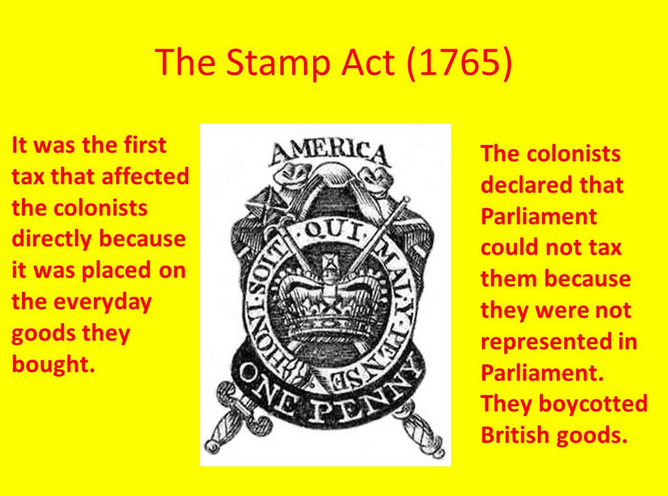
As I mentioned in my previous post, Adam Smith was in France when the infamous Stamp Act was approved in the summer of 1765 and later repealed in the spring of 1766. As it happens, Smith refers to the Stamp Act and devotes considerable space to the topic of stamp taxes in The Wealth of Nations, going as far as to acknowledge that stamp duties are one of the major sources of public revenue. In Chapter 3 of Book 5, of his magnum opus (“Of Public Debts”), for example, Smith writes: “The land-tax, the stamp-duties, and the different duties of customs and excise constitute the four principal branches of the British taxes.”[1]
The original Stamp Act, which had been enacted in 1765, was a formidable piece of tax legislation, 13,000 words in all, spread across 63 sections, each marked by a Roman numeral.[2] Nearly every piece of paper would henceforth require a tax stamp: real estate transactions, wills and other legal documents, newspapers, broadsides, almanacs, bills of sale, liquor licenses, even playing cards. The courts could not open without them nor would ships be allowed to sail. Ominously, the penalty for making counterfeit stamps was death “without benefit of clergy.” The Stamp Act, however, was enormously unpopular in Britain’s North American colonies.[3] And it would define the most fundamental issue of political economy of the era, one that would lead to the American Revolution of 1776: the role of consent in political affairs and the slogan “no taxation without representation.”[4]
Opposition to the Stamp Act of 1765 was not just limited to the overseas colonies. Merchants and manufacturers in Britain also opposed the Stamp Act as matter of expedience, since trade was likely to decline due to the imposition of stamp duties on their exports to the colonies. For example, in Chapter 7 of Book 4 of The Wealth of Nations, in the subsection titled “Of the Advantages which Europe has derived from the Discovery of America, and from that of a Passage to the East Indies by the Cape of Good Hope,” Smith writes:
The expectation of a rupture with the colonies, accordingly, has struck the people of Great Britain with more terror than they ever felt for a Spanish armada, or a French invasion. It was this terror, whether well or ill grounded, which rendered the repeal of the Stamp Act, among the merchants at least, a popular measure. In the total exclusion from the colony market, was it to last only for a few years, the greater part of our merchants used to fancy that they foresaw an entire stop to their trade; the greater part of our master manufacturers, the entire ruin of their business; and the greater part of our workmen, an end of their employment.[5]
In fact, a resolution to repeal the Stamp Act was introduced in the House of Commons on February 21, 1766, while Adam Smith was residing in Paris, and the repeal was eventually approved by a vote of 276 to 168.[6] At eleven o’clock on the morning of March 17, 1766, while Smith was in Paris, merchants in London approved a petition to King George III to accept Parliament’s vote repealing the Stamp Act and then boarded 50 coaches and traveled as a caravan to the House of Lords. The King gave his royal assent the next day, March 18, 1766, but the reprieve was short lived because Parliament enacted the Townshend Acts in 1767, which reiterated its right to tax the colonies. The Stamp Act was thus the beginning, not the end, of a new political and economic crisis.
For what it is worth, Smith himself recognizes this conundrum in Chapter 3 of Book 5, of The Wealth of Nations (“Of Public Debts”):
By extending the British system of taxation to all the different provinces of the empire inhabited by people of either British or European extraction, a much greater augmentation of revenue might be expected. This, however, could scarce, perhaps, be done, consistently with the principles of the British constitution, without admitting into the British Parliament … a fair and equal representation of all those different provinces, that of each province bearing the same proportion to the produce of its taxes as the representation of Great Britain might bear to the produce of the taxes levied upon Great Britain.[7]
The problem, according to Smith, was that the “private interest of many powerful individuals [and] the confirmed prejudices of great bodies of people seem, indeed, at present, to oppose to so great a change such obstacles as it may be very difficult, perhaps altogether impossible, to surmount.”[8] Nevertheless, be that as it may, Smith devotes a considerable part of Book 5 of The Wealth of Nations exploring “how far the British system of taxation might be applicable to all the different provinces of the empire, what revenue might be expected from it if so applied, and in what manner a general union of this kind might be likely to affect the happiness and prosperity of the different provinces comprehended within it.”[9] Although Smith will not “pretend[] to determine whether such a union be practicable or impracticable,”[10] for Smith “Such a speculation can at worst be regarded but as a new Utopia, less amusing certainly, but not more useless and chimerical than the old one.[11]
What other amusing speculations did Smith entertain during his sojourn in Paris?
Let’s pick up where we left off, with Horace Walpole’s journal entry for Thursday, March 20, which reads: “Mr Young, Mr Lyttelton, Duke of Buccleuch and Mr Smith came. To shops.”[1] What shops would they have visited? And where were these shops located? Also, who were “Mr Young” and “Mr Lyttelton”?
We have already mentioned Duke Henry, but who were Young and Lyttelton? Alas, there is just one reference to a “Mr. Young” in Walpole’s letters. In a letter from Walpole to “James Crawford, Esq.” dated March 6, 1766,[1] Walpole writes: “I think there is nothing else very new: Mr. Young puns and Dr Gem does not: Lorenzi blunders faster than one can repeat[;] Voltaire writes volumes faster than they can print, and I buy china faster than I can pay for it.”[2] The name “Mr Young,” however, appears nowhere else in Walpole’s journal or letters and is too common a name for me to further investigate.[3]
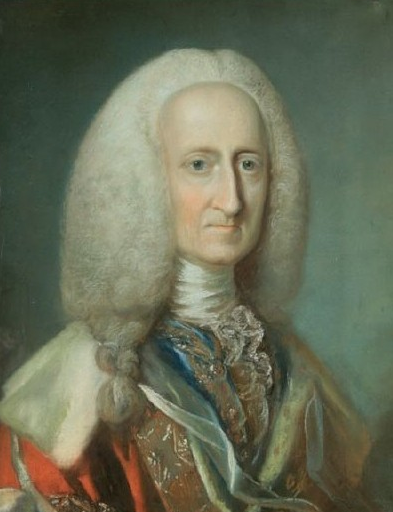
“Mr Lyttelton,” however, most likely refers to George Lyttelton (1709–1773), the 1st Baron Lyttelton, whose portrait is pictured below (left). Like Walpole, Lyttelton was a man of many talents and interests: a poet and prolific author,[4] a Fellow of the Royal Society (elected 1744), a Member of Parliament (MP) for Okehampton from 1735 to 1756,[5] and the chancellor of the Exchequer (1755–56).[6] (Lyttelton was also a patron of the arts and was a friend of Alexander Pope in the 1730s and of Henry Fielding in the 1750s. Fielding even dedicated his novel Tom Jones to Lyttelton.) Moreover, like Duke Henry, he was educated at Eton and had afterwards gone on a grand tour of Europe, visiting the continent with his tutor. It was during this time that he started publishing his early works in both poetry and prose.[7]
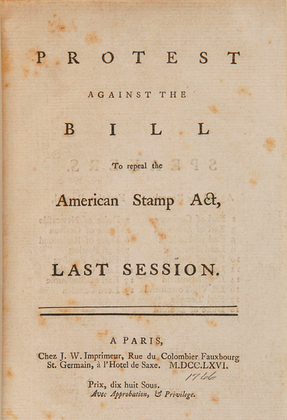
But what was Lyttelton doing in Paris? Perhaps he was there for the same reason Walpole was, to avoid politics. Although Lyttelton never again held office after 1757,[8] he had been invited to lead the treasury the previous year (1765), but he declined to join the new government.[9] Or perhaps Lyttelton’s presence in Paris was part of a secret campaign in defense of the Stamp Act–which had just been repealed in March of 1766–for there is evidence that he may have published a pamphlet in 1766 in support of the Stamp Act, “Protest against the bill to repeal the American stamp act, of last session,” the cover page of which is pictured below (right) and which was supposedly published at “Chez J.W. imprimeur, rue du Colombier, Fauxbourg St. Germain, à l’hotel de Saxe.”[10]
Regardless of what Lyttelton was up to in Paris at this time, it is intriguing to imagine Smith and Lyttelton meeting somewhere in the City of Lights, discussing the repeal of the Stamp Act, the most controversial piece of legislation of its time. As it happens, Smith refers to the Stamp Act and devotes considerable space to the topic of stamp taxes in The Wealth of Nations, going as far as to acknowledge that stamp duties are one of the major sources of public revenue. I shall review Adam Smith’s analysis of the original Stamp Act of 1765, the most controversial piece of legislation of its time, in my next post.
I will resume my “Smith in the City” series in the next day or two. In the meantime, check out the following description of “Paris in the 18th century” via Wikipedia (links in the original): “Paris in the 18th century was the second-largest city in Europe, after London, with a population of about 600,000 people. The century saw the construction of Place Vendôme, the Place de la Concorde, the Champs-Élysées, the church of Les Invalides, and the Panthéon, and the founding of the Louvre Museum.” In addition, the following vignettes on that Wikipedia page also caught my attention:
Les bouillons de Paris
In about 1765 a new kind of eating establishment, called a “Bouillon”, was opened on rue des Poulies, near the Louvre, by a man named Boulanger. It had separate tables, a menu, and specialized in soups made with a base of meat and eggs, which were said to be “restaurants” or ways of restoring oneself. Dozens of bouillons soon appeared on Paris streets.” See Alfred Fierro, Histoire et dictionnaire de Paris (1996), pp. 136-137.
Carriages for hire
“There was no public transportation in Paris in the 18th century; the only way for ordinary Parisians to move around the city was on foot, a difficult experience in the winding, crowded and narrow streets, especially in the rain or at night. The nobles and the wealthy traversed the city either on horseback or in chairs carried by servants. These chairs gradually were replaced by horse-drawn carriages, both private and for hire. By 1750, there were more than ten thousand carriages for hire in Paris, the first Paris taxis.” See Yvan Combeau, Histoire de Paris (2013), pp. 47-48.
Church bells
“In the 18th century, the time of day or night in Paris was largely announced by the church bells; in 1789 there were 66 churches, 92 chapels, 13 abbeys and 199 convents, all of which rang their bells for regular services and prayers; sometimes a little early, sometimes a little late. A clock had also been installed in a tower of the palace on the Île de la Cité by Charles V in about 1370, and it also sounded the hour. Wealthy and noble Parisians began to have pocket watches, and needed a way to accurately set the time, so sundials appeared around the city. The best known-sundial was in the courtyard of the Palais-Royal. In 1750, the Duke of Chartres had a cannon installed there which, following the sundial, was fired precisely at noon each day.” See Fierro (1996), p. 226.
A market in titles of nobility
Louis-Sébastien Mercier described the social hierarchy of Paris in the Le Tableau de Paris (1783): “There are in Paris eight distinct classes; the princes and great nobles (these are the least numerous); the nobles of the robe; the financiers; the traders and merchants; the artists; the craftsmen; the manual workers; the servants; and the bas peuple (lower class).” In reality, the nobility had greatly expanded under Louis XIV, who liberally awarded or sold titles to men who had served the royal government. By 1726, two-thirds of the members of the Estates-General, who largely lived in Paris, had acquired or were in the process of acquiring noble status, and wealthy merchants and financiers were often able to obtain noble status for their families by marrying daughters to members of the old nobility. See Daniel Roche, The People of Paris: An Essay in Popular Culture in the 18th Century (1987), p. 92.
I have been reading the correspondence of Horace Walpole for the years 1765/66 as part of my researches into Adam Smith’s life in Paris. (Walpole’s first visit to Paris coincided with Smith’s second.) Walpole, a prolific and witty letter writer, was a fascinating character in his own right, and I will have more to say about his relationship to Adam Smith during their time in Paris. In the meantime, however, below are three of my favorite quotes from his letters:
“… next to successful enemies, I dread triumphant friends.” (Letter 1034)
“Our ancestors were rogues, and so will our posterity be.” (Letter 1040)
“… though I have little to write, I have a great deal to say.” (Letter 1045)
“Preaching has not failed [to rid the world of sin] …, not because inadequate to the disease, but because the disease is incurable.” (Letter…
Adam Smith may have had an opportunity to visit David Hume’s old stomping grounds, the luxurious Hôtel de Brancas on the rue de l’Université, on Sunday, March 16, for Horace Walpole’s journal entry for that day reads: “To Hôtel de Brancas, Duke of Buccleuch etc. there.”[1] Does the “etc.” in this entry include Adam Smith, who was Duke Henry’s tutor and chaperone at this time?
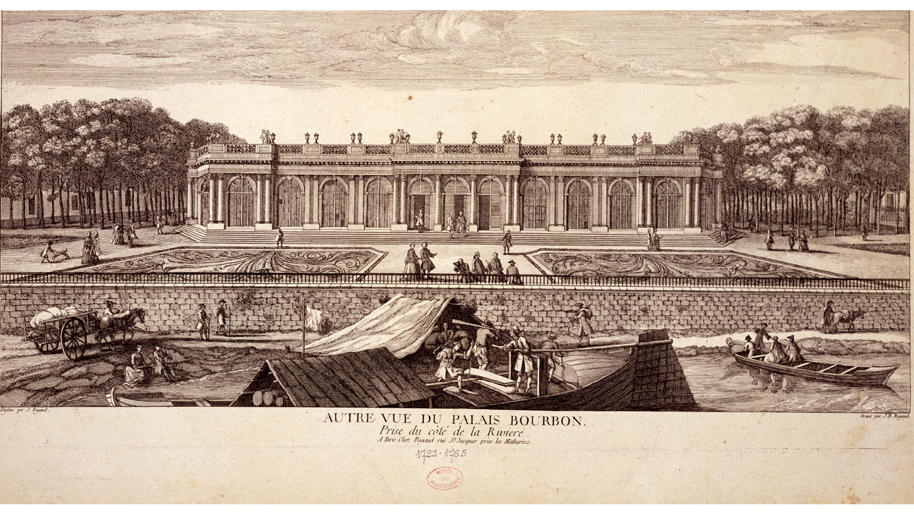
At the time, the Hôtel de Brancas (pictured below) was the British ambassador’s luxurious residence in Paris. It was located on the rue de l’Université, less than two kilometers from the Hôtel du Parc Royal where Adam Smith was lodging at the time,[2] and it was built in an Italian style.[3] Its tranquil gardens extended all the way up to the banks of the Seine, and even today, the gardens of this mansion extend a few hundred yards up to the Quai d’Orsay, a busy thoroughfare on the left bank of the Seine, opposite the Place de la Concorde. (As an aside, Louis-Joseph de Bourbon, the 8th Prince of Condé, acquired the Hôtel de Brancas in 1868, but it was later confiscated by the government during the Revolution.[4] Today, the Hôtel de Brancas is the official residence of the President of the National Assembly (France’s legislature) and is located on 128 rue de l’Université.[5])
Smith would have a good reason to visit the Hôtel de Brancas, for this building was not only the official residence of the British ambassador to France, the epi-center of the English-speaking world in Paris;[6] it was also the former residence of Smith’s intellectual mentor and closest friend, David Hume, who had an apartment and worked at Hôtel de Brancas from March 1764 to November 1765, when Hume was Secretary to Lord Hertford, the British ambassador.[7] (Hume became Charge d’Affaires of the embassy, the de facto ambassador, when his superior, Lord Hertford, who was then the official ambassador, left Paris in August of 1765 to attend to some private matters. Hume was Charge d’Affaires until a new ambassador, the Duke of Richmond, arrived to replace Lord Hertford in November of 1765. It was at that time that Hume moved to the Hôtel du Parc Royal.) Ernest Mossner (1980, p. 490) describes Hume’s apartment at the Hôtel de Brancas thus:
During the first of several months in Paris, Lord Hertford had resided at the Hôtel de Grimberg in the rue St Dominique, but in March 1764, he took the Hôtel de Brancas … at the junction of the rue de l’Université and the rue de Bourbon. This large mansion near the Louvre–“quite a palace” remarked Lady Sarah Bunbury–cost him L500 annually. He had some thoughts of relinquishing after a year but retained throughout his embassy. In it there was a separate apartment for David Hume, certainly the most luxurious that man of letters had ever had.”[8]
As an aside, it’s a shame that Hume and Smith did not get to see each other in Paris in 1766, for Hume departed the City of Lights on January 4, 1766, while Smith did not arrive until February 15. Imagine what their private conversations in the gardens of the Hôtel de Brancas would have been like. (This counterfactual is perhaps the greatest of the unintended consequences of the Rousseau affair, of which I shall have more to say later in this series of blog posts.)
In any case, we don’t know if Adam Smith accompanied Walpole and Duke Henry to the ambassador’s residence on this particular day (Sunday, March 16), or if he had an opportunity to visit Hume’s old apartment there, but he must have visited this place at some point during his residency in Paris. The British ambassador not only resided and conducted his official business here; he also hosted many dinners and receptions at his residence during his tenure as ambassador, and Walpole visited here many times during his sojourn in Paris.
In Chapter 1 of Book 5 of The Wealth of Nations, in the subsection titled “Of the Public Works and Institutions which are necessary for facilitating particular Branches of Commerce,” Smith describes the history of embassies and explains why ambassadors are necessary public expenses:
“Among other nations, whose vigorous government will suffer no strangers to possess any fortified place within their territory, it may be necessary to maintain some ambassador, minister, or counsel, who may both decide, according to their own customs, the differences arising among his own countrymen, and, in their disputes with the natives, may, by means of his public character, interfere with more authority, and afford them a more powerful protection, than they could expect from any private man. The interests of commerce have frequently made it necessary to maintain ministers in foreign countries where the purposes, either of war or alliance, would not have required any. The commerce of the Turkey Company first occasioned the establishment of an ordinary ambassador at Constantinople. The first English embassies to Russia arose altogether from commercial interests. The constant interference which those interests necessarily occasioned between the subjects of the different states of Europe, has probably introduced the custom of keeping, in all neighbouring countries, ambassadors or ministers constantly resident even in the time of peace. This custom, unknown to ancient times, seems not to be older than the end of the fifteenth or beginning of the sixteenth century; that is, than the time when commerce first began to extend itself to the greater part of the nations of Europe, and when they first began to attend to its interests.”[9]
In other words, embassies in foreign nations are a necessary public expense because they help promote commerce and trade among nations.[10] But what happens when a government enacts measures that restrict trade and commerce? This was not just a theoretical question; as I shall explain in my next post, it was a real-time issue that Smith himself would confront during his stay in Paris.
Note: This blog post should have appeared before my previous one, “Jacobites in Paris.” I am posting it here, out of order, for your edification.
Horace Walpole, still recuperating from a serious eye infection, mentions two more individuals by name in his journal entry for Sunday, March 9: “Ditto. Ditto. and Duke of Buccleuch and M. Schuwalof.”[1] As an aside, the first “Ditto” most likely alludes to Walpole’s journal entry for March 7 (“Cold in my eyes”), the day Walpole’s eye became infected, while the second “Ditto” most likely refers to the people who visited him on the previous day, March 8 (“Ditto. Mme Geoffrin, Mr Smith, Mme du Deffand, Lord and Lady George came”). In other words, quite an eclectic collection of individuals visited Walpole during his three-day convalescence: the leading ladies of the salons of Paris, a professor of moral philosophy, the Secretary of the British Embassy in Paris and his beloved wife, a Scottish duke, and a Russian count.
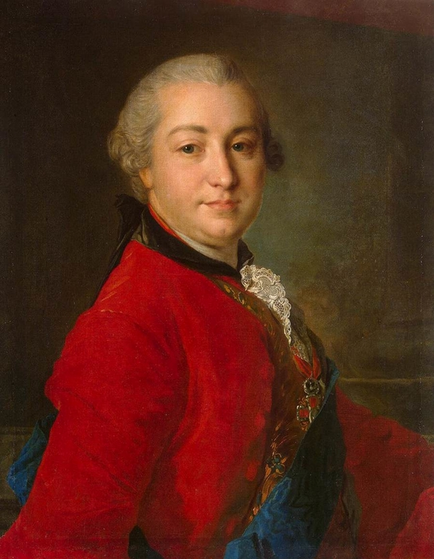
The “Duke of Buccleuch” refers to Smith’s pupil Duke Henry, but who is “M. Schuwalof”? The entry most likely refers to Count Ivan Ivanovitch Schuwalof (1727–1797), whose portrait is pictured below, a diplomat and man of letters from Russia. Although today he is mostly remembered for his love affair with Russian Empress Elizaveta Petrovna,[2] Count Schuwalof was a leading figure of the Russian Enlightenment. Among other things, he was Russia’s first Minister of Education, and he maintained correspondence with the leading philosophes of France, including Helvetius, d’Alembert, Diderot, and Voltaire.[3]
Did Count Schuwalof and Adam Smith meet during this time? If so, what did they discuss? For what it is worth, Book 5 of The Wealth of Nations, in the subsection titled “Taxes upon as Profit of particular Employments” contains the following digression on Russian poll taxes:
Taxes of so much a head upon the bondmen employed in cultivation seem anciently to have been common all over Europe. There subsists at present a tax of this kind in the empire of Russia. It is probably upon this account that poll-taxes of all kinds have often been represented as badges of slavery. Every tax, however, is to the person who pays it a badge, not of slavery, but of liberty. It denotes that he is subject to government, indeed, but that, as he has some property, he cannot himself be the property of a master. A poll-tax upon slaves is altogether different from a poll-tax upon freemen. The latter is paid by the persons upon whom it is imposed; the former by a different set of persons. The latter is either altogether arbitrary or altogether unequal, and in most cases is both the one and the other; the former, though in some respects unequal, different slaves being of different values, is in no respect arbitrary. Every master who knows the number of his own slaves knows exactly what he has to pay. Those different taxes, however, being called by the same name, have been considered as of the same nature.[4]
Who else did Adam Smith meet during his 1766 sojourn in Paris? We know with some degree of certainty that Smith also met one “Gordon”, the long-serving Principal of the venerable Scots College in Paris. (For more information about the Scots College in Paris–and Smith’s possible motive for visiting this seminary–see my previous post, “Jacobites in Paris.” I will resume my “Smith in the City” series with Walpole’s journal entry for Sunday, March 16: “Hume’s Garden.”)
Portrait of Count Ivan Ivanovich Shuvalov (Hermitage Museum)
Horace Walpole’s journal entries for Thursday, March 13 and Saturday, March 15 both refer to Adam Smith and to the Scots College in Paris:
March 13: “Dr Smith and Gordon, Principal of the Scotch College came.”[1]
March 15: “With Dr Smith to the Scots College.”[2]
So, what in the Devil were Horace Walpole and Adam Smith doing at a Catholic seminary in Paris, a place that had historically been “a nest of intrigue for Jacobite schemes”?[3] After all, Smith had no sympathy for the now-lost Jacobite cause,[4] and Walpole was an Englishman. Neither man was openly religious.
As Walpole notes, the director of the Scots College at the time was named Gordon. His full name was John Gordon, and he was Principal of the college from 1752 until his death in 1777.[5] What Gordon, a Catholic priest, and Smith, a former professor of moral philosophy, may have thought of each other is anyone’s guess, but the venerable college Gordon led, the Collegium Scoticum (Latin) or Collège des Écossais (French), had been legally recognized by an Act of the Parlement of Paris on July 8, 1333.[6]
At that time, the college was housed in the rue des Amandiers (now Rue Laplace).[7] After 1665, the Scots College was located in the rue des Fossés-Saint-Victor (now Rue du Cardinal-Lemoine), close to the Sorbonne and almost two kilometers away from the rue du Colombier, where Smith and Walpole were lodging.[8] Brian Michael Halloran describes the façade of the Scots seminary thus: “It has a very impressive facade, being four storeys high, with five windows, each side of the main door, and eleven windows on each of the other floors.”[9]
According to Brian Michael Halloran, “The Scots College Paris has been an enigma to Scottish Catholic historians, sometimes being seen as extremely beneficial to the Scottish Catholic Mission, and at other times regarded as the source of a lot of woes.”[10] Either way, what was Adam Smith doing there? Perhaps Smith just wanted to visit the place in Paris where one of his closest friends and confidants in France had come of age, for the Scots College was the school where Seignelay Colbert of Castlehill, l’Abbé Colbert (1736-1813), had attended.[11] Colbert had entered the college in 1747 at the age of 11 and completed his studies in September of 1761,[12] and Colbert and Smith became close friends during Smith’s 18-month sojourn in Toulouse (1764-65), but I will have much more to say about l’Abbé Colbert in a future blog post.
Horace Walpole’s journal entry for Saturday, March 8 reads: “Ditto. Mme Geoffrin, Mr Smith, Mme du Deffand, Lord and Lady George came.”[1] That is, in addition to Adam Smith, Lord George Lennox, and Lord George’s wife Lady Louisa Kerr, Walpole’s entry for that day mentions two of the most famous Parisian salonnières of the time: “Mme Geoffrin” and “Mme du Deffand.”[2]
As it happens, Walpole spent a considerable amount of time at the salons of these leading ladies during his visit to Paris, and he became an especially close friend of du Deffand. In fact, upon her death in 1780, she left her papers, and her dog Tonton, to Walpole, and her correspondence to Walpole (4 vols.) was first published at Walpole’s Strawberry Hill printing press in 1810.[3]
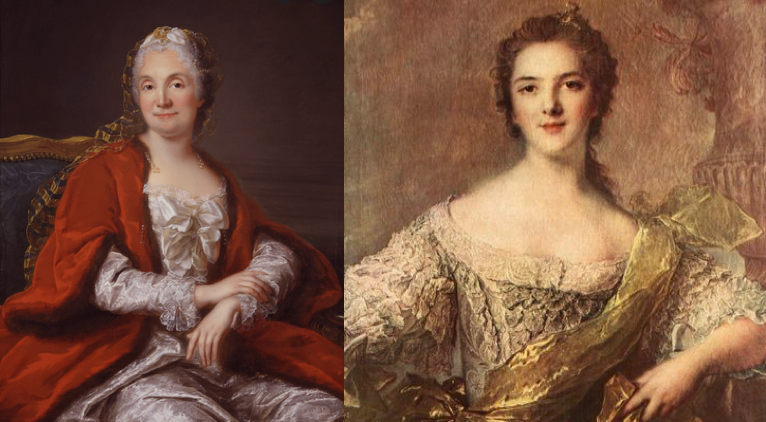
Marie Anne de Vichy-Chamrond, marquise du Deffand (1696?–1780), whose portrait is pictured below (bottom right), was not only a leading salonnière and patroness of the arts; she was a remarkable woman of letters in her own right. In its heyday, her salon, which was located on the rue Saint-Dominique (now the Boulevard Saint-Germain) in her apartments in the Convent of Saint-Joseph, attracted famous diplomats, great ladies, philosophes, and prominent politicians, at least until 1764, when her protégé Jeanne Julie Éléonore de Lespinasse (1732–1776) opened a competing salon of her own just down the street on the rue Saint-Dominique.
Marie Thérèse Rodet Geoffrin (née Rodet; 1699–1777), whose portrait is also pictured below (bottom left), was du Deffand’s great rival in the rarefied world of the Paris salons and was one of the leading female figures and salonnières of the French Enlightenment.[4] From 1750 until her death in 1777, Madame Geoffrin hosted many of the most influential philosophes and Encyclopédistes of her time at her salon on the Rue Saint-Honoré.[5] Among other things, her famed salon was decorated with the large mirrors and glass wares of her family business, the Saint-Gobain company, a glass and mirror manufactory that had obtained a royal privilege to produce mirror and glass goods.[6] In fact, Geoffrin’s family firm was one of the largest companies in Europe, employing twelve hundred workers, and had amassed a working capital of 14 million livres by the 1760s, with annual sales ranging between two and three million livres.[7]
There are, however, two competing views of these famous salons. On the one hand, some scholars emphasize the leading role the salons played in Europe’s literary and intellectual life. In her classic study of the salons of Paris, Dena Goodman writes:
“Geoffrin, who acted as a mentor and model for other salonnières, was responsible for two innovations that set Enlightenment salons apart from their predecessors and from other social and literacy gatherings of the day. She invented the Enlightenment salon. First, she made the one-o’clock dinner rather than the traditional late-night supper the sociable meal of the day, and thus she opened up the whole afternoon for talk. Second, she regulated these dinners, fixing a specific day of the week for them. After Geoffrin launched her weekly dinners, the Parisian salon took on the form that made it the social base of the Enlightenment Republic of Letters: a regular and regulated formal gathering hosted by a woman in her own home which served as a forum and locus of intellectual activity.”[8]
At the same time, other scholars paint a more stuffy and mundane picture of the Paris salons. On this view, the salons were, above all, the social space of Parisian high society, or le monde,[9] and hostesses like Madame Geoffrin and the marquise du Deffand–and presumably their guests as well–would be surprised, if not astonished, to learn that they were participating in an important cultural and literary institution.[10] According to one source, for example, Madame Geoffrin herself “vigoroursly avoided any learned pretensions and aspired above all to be acknowledged by polite society and to conform to the norms of female honnêteté. For her … to receive well-known writers [like, say, Adam Smith or Horace Walpole] constituted one step in the process of entering high society; her salon thus became a fashionable place, a necessary destination for aristocrats who wished to acquire a reputation as men of wit.”[11] If this picture of the Paris salons is accurate, their appeal to such a simple and austere man as Adam Smith is questionable at best.
Which of these opposing pictures of the salons is the correct one? Perhaps both. Maybe most of the salons of Paris were the stuffy and sultry social spaces of le monde, while some of the salons, at least some of the time, were home to the most enlightened and avant-garde intellectual and literary discussions of the Age of Reason. Although there are no references to these salons in The Wealth of Nations, Adam Smith most likely visited Madame Geoffrin’s famed salon, as well as those of the marquise du Deffand and mademoiselle Lespinasse, at some point during his 1766 sojourn in Paris.[12] After all, Smith’s first great work, The Theory of Moral Sentiments, had been well-received in France, and he was thus a minor intellectual celebrity in France at the time–minor, that is, in comparison to David Hume. The leading philosophes, artists, and the salonnières of the Enlightenment were no doubt eager to meet him–and perhaps to hear what he had to say. But even so, the question posed by my “Smith in the City” series is still left unanswered. When did Smith’s transformation from a moral philosopher to a political economist take place? I will address this key question in future blog posts.
Horace Walpole’s journal entry for Monday, March 3 reads: “King [Louis XV] went suddenly to the [Paris] Parliament–packing up and writing letters till late in the evening. Dr Smith and Baron d’Holbach came. To the Temple.”[1]
This pithy entry poses two key questions. Why did Louis XV make a rare appearance in the French capital that day? And what was the nature of the relationship between Adam Smith, a Scottish moral philosopher, and the German-born Baron d’Holbach, an open atheist? [I will focus on the first question here and address Smith’s relationship to d’Holbach later in this series.]
Since 1682, when Louis XIV had moved the seat of his court and government to the Palace of Versailles, making Versailles the de facto capital of France,[2] Paris had become “The Kingless Capital of Enlightenment.”[3] So, the King’s sudden and dramatic appearance in Paris has to be one of the most memorable, and perhaps the most contentious, moments of his long reign.
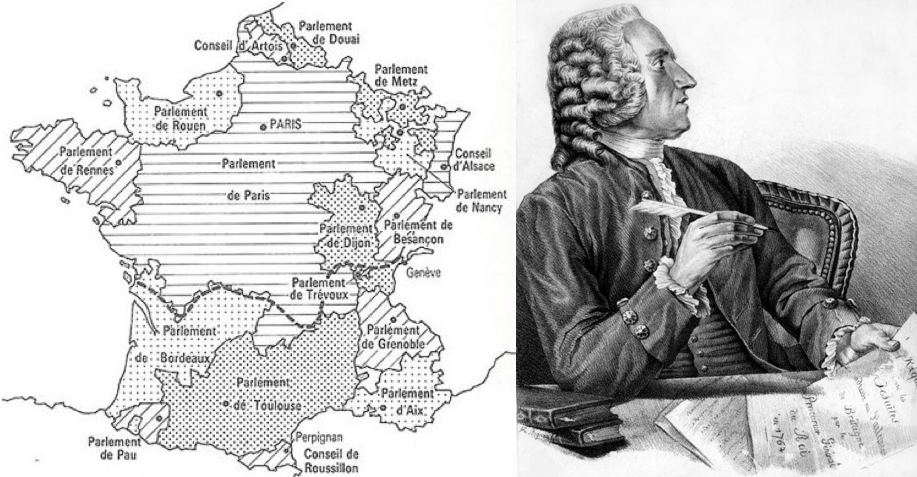
As it happens, the King’s appearance in the French capital on Monday, March 3, 1766 was just one move–a dramatic one to be sure–in a much larger and longer-running power struggle between the crown and the courts known as “the Brittany Affair,” a constitutional and political cause célèbre that, in hindsight, give the Revolution the appearance of inevitability. At the time, the courts of the kingdom were called parlements, and there were 13 such courts in all, one for each region in France. [See map pictured below.] The magistrates of these courts not only had the power to try civil and criminal cases; they also had the authority to register royal edicts.
In theory, a parlement could veto a royal edict by refusing to register it; in reality, however, recalcitrant magistrates ran the risk of imprisonment or exile. Louis XV, for example, had previously exiled the Parlement of Paris on two occasions, in 1732 and in 1753.[4] For France did not have a written constitution and no system of checks and balances, or in the words of one scholar, “The king consulted his ministers and advisers and determined what was best for the kingdom, his agents applied and his judges enforced his decrees throughout the realm, and his subjects obeyed.”[5]
In brief, in November of 1765, just a few weeks before Smith’s arrival in Paris, Louis XV had ordered the arrest of six Breton magistrates–including Louis-René de Caradeuc de La Chalotais (pictured below, right), the procureur général of the Parlement of Brittany–accusing them of conspiracy against the crown. He had also escalated the controversy by appointing a special royal commission to try the six magistrates instead of allowing the judges of the regional court, the Parlement of Brittany, to try their six fellow magistrates. This move, however, constituted a direct attack on the legal rights and privileges of judicial magistrates, who could only be tried by their parliamentary peers, not by an ad hoc royal commission.[6] Furthermore, on February 11, 1766, a few weeks prior to the King’s appearance in the French capital, the Parlement of Paris had unanimously condemned the King’s arrest of the Breton magistrates and declared his royal commission invalid.[7]
The decision of the Parlement of Paris, the most important of the regional courts, to intervene on behalf of the six Breton magistrates, and the appearance of Louis XV in Paris on March 3 thus tested the outer limits of the powers of the courts and converted the Brittany Affair into a high-stakes constitutional controversy, a direct confrontation between the King and the largest and most important of the royal courts. Without prior warning, Louis XV, along with five of his ministers, showed up in person to the Paris Parlement to reaffirm his royal authority and deliver a stinging rebuke of the Paris magistrates.
This improptu session of the parlement became known as le Séance de Flagellation or “the Session of the Scourging” because Louis XV verbally “lashed out” at the magistrates for defying his authority to try the six Breton magistrates. The opening words of his prepared remarks left no room for interpretation: “What happened in my Parlements of Pau and Rennes is of no concern of my other parlements. I have acted with regard to these two courts as my authority required, and I owe an explanation to no one.” After his full reply was read aloud, his ministers ordered the parlement’s condemnation of the King of February 11 to be physically removed from the register of the court.
Given the gravity of this constitutional confrontation and the King’s dramatic appearance on March 3, 1766, Adam Smith must have taken notice of this great political and judicial controversy. Horace Walpole, for example, was following the Brittany Affair quite closely. He mentions or describes this conflict in his travel journal and in his private correspondence on multiple occasions. Could this constitutional conflict have also helped spark Smith’s interest in political economy?
Putting aside the specific constitutional issue at stake in the Brittany Affair–i.e. who judges the judges?–this controversy also presents two competing views of the rule of law and the justification of royal authority. Specifically, was the King more like a benevolent father, a paternal figure responsible for harmonizing the various social groups of his kingdom into a congruous and unified whole, or was he more like a disinterested referee, a neutral umpire responsible for mediating the disparate interests of the different estates of his kingdom?[8] In other words, what kind of body politic should a monarchy try to promote? A paternalistic or organic one, i.e. a hierarchical and stable social order composed of individuals of different ranks and social stations, all of whom are under the crown’s benelovent protection, or a commercial or dynamic society, one “whose members have very few social bonds with one another, where … each man looks only to his particular and exclusive interest ….”[9]
Whatever Smith may have thought about these larger questions, he must have overheard his French hosts discuss the Brittany Affair at length at the famed salons of Paris. I shall turn to the salons in my next few blog posts …