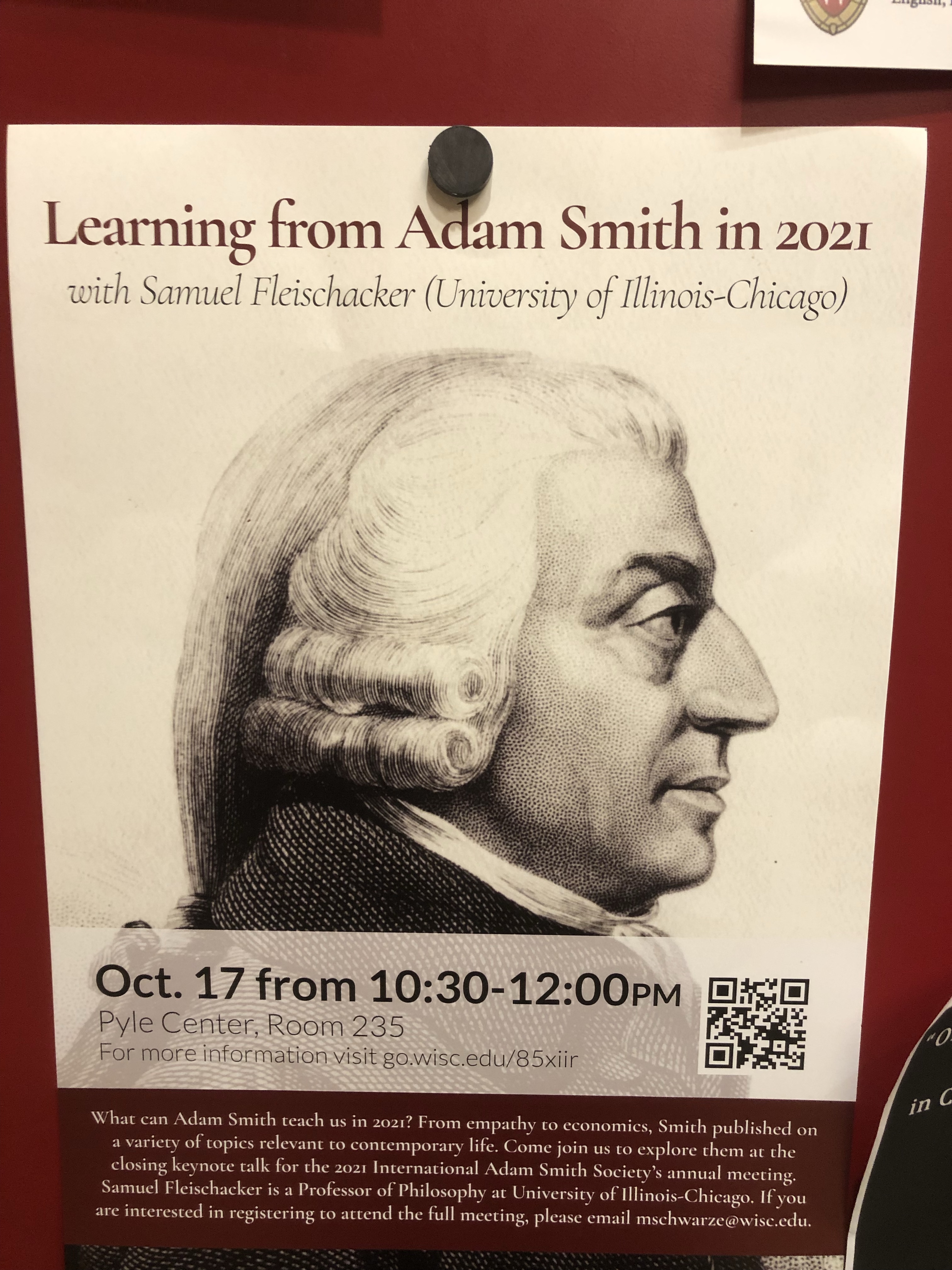
One last postcard from this year’s International Adam Smith Society meeting at the University of Wisconsin. The two pictures in the top row show Professor Dan Klein (front left), Professor Erik Matson (front right), doctoral student Patrick Fitzsimmons (back left) and yours truly (with fedora). The two pictures on the bottom row feature the cast from the movie “Reservoir Dogs.”
I presented my work on “Adam Smith in Love” at the annual meeting of the International Adam Smith Society (IASS), which took place at the University of Wisconsin in Madison. (As an aside, I am currently working on a sequel to my Adam Smith paper, which is tentatively titled “Adam Smith in Paris”, in anticipation of the next meeting of the IASS, to take place at the University of the Andes in Bogota, Colombia in July of 2022.) Suffice it to say that many excellent papers — and two books! — were presented at this year’s conference, but my three favorite presentations were the following:
Toshiaki Ota: “The Roles of Judges in Adam Smith’s Jurisprudence”
Maria Pia Paganelli: “Adam Smith’s Digression on Silver: The Centerpiece of The Wealth of Nations“
Sarah Skwire: “As If: Clueless About the Invisible Hand”
Alas, I have a flight to catch, and in any case, I am unable to provide a direct link to any of these three wonderful works as they have not yet been published, but I will summarize each paper and comment on them over the next few days after I return home to Central Florida …
That is the title of this work of “street sign art” (pictured below from various angles) located in Madison, Wisconsin. This whimsical work of art was created by Portland, Maine-based artist Aaron Stephan and consists of a forest of street signs clustered around a small semi-circular concrete stage across the street from Madison’s Capitol Square. Each street sign bears a word or phrase from poetry, fairy tales, or children’s games, and the blue and green sign colors are meant to evoke lakes and trees. More details are available here via the Wisconsin State Journal.
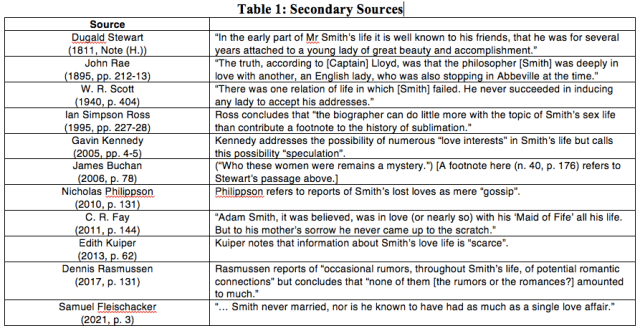
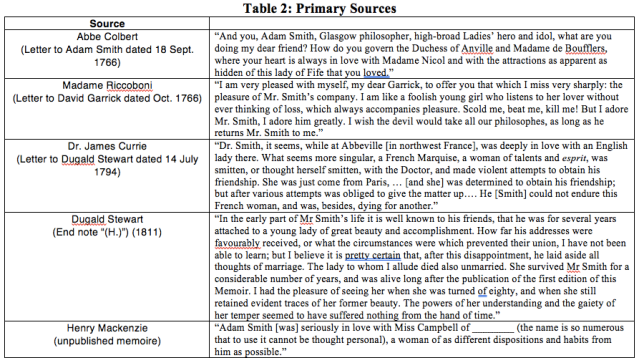
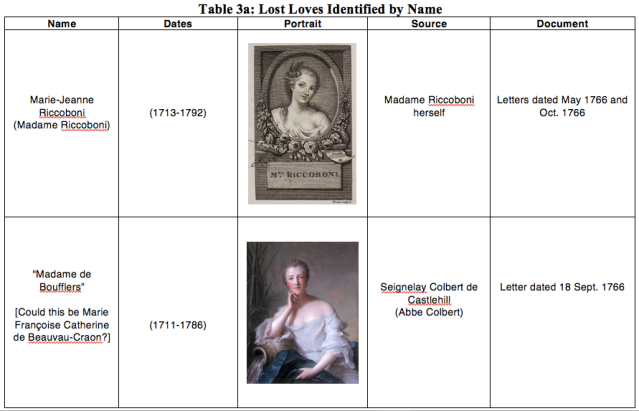
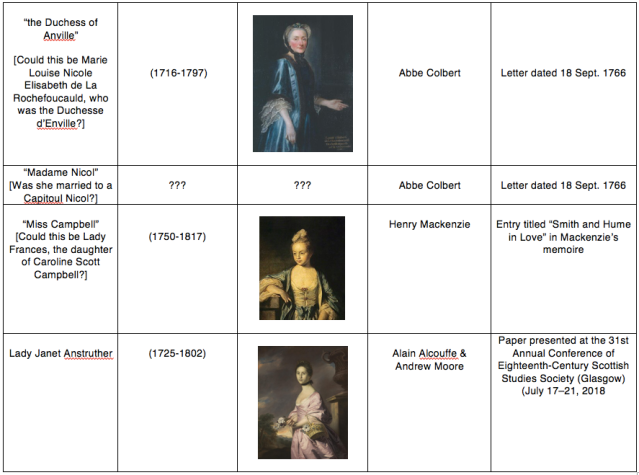
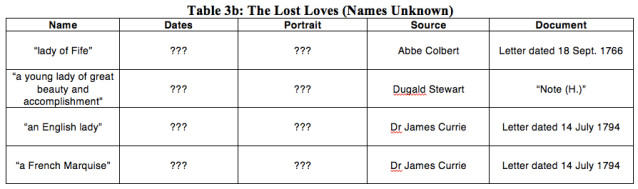
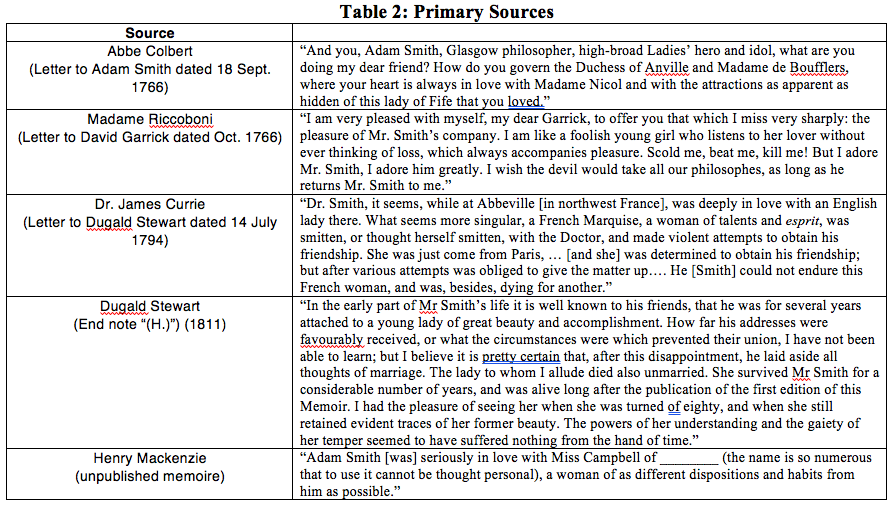
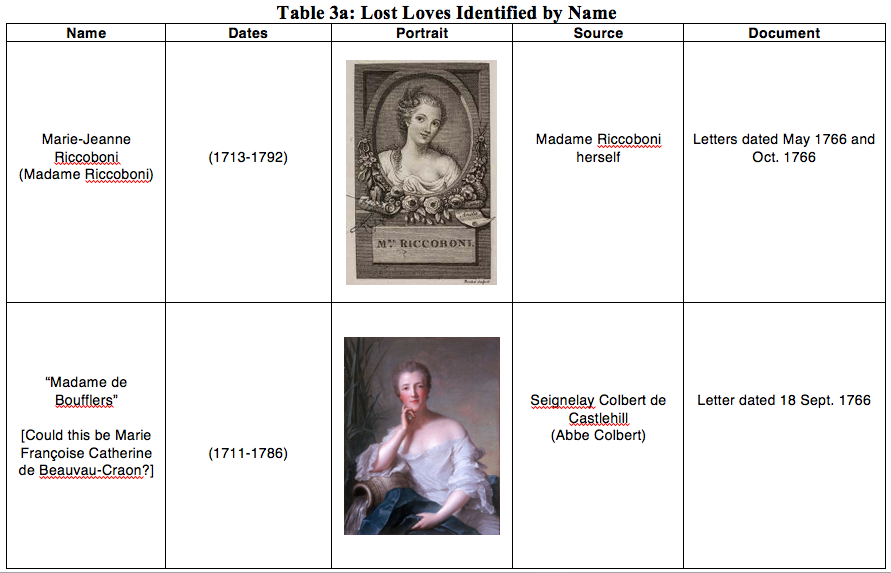
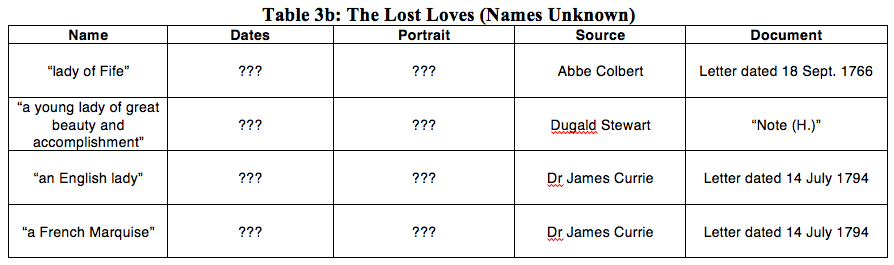
I made some additions and minor revisions to my three Adam Smith tables, so I am reblogging my previous post with the new and revised table. In brief, Table 1 summarizes in chronological order the secondary literature on Adam Smith’s love life, while Table 2 assembles the available evidence (also in chronological fashion). Additionally, based on the evidence set forth in Table 2, Table 3a identifies Smith’s possible lost loves by name. Lastly, Table 3b, by contrast, refers to those possible lost loves whose names are unknown.
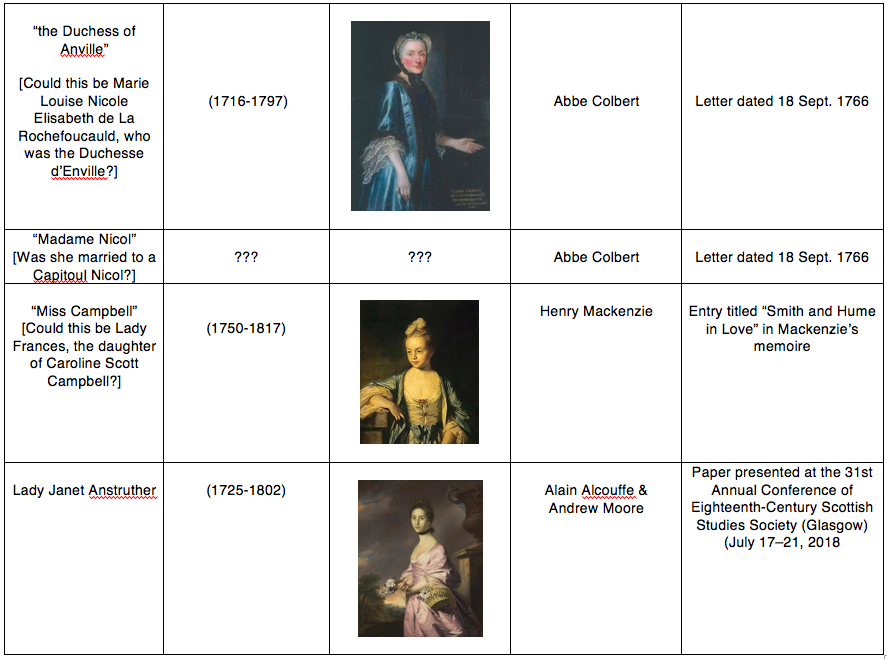
For my talk at the annual conference of the International Adam Smith Society (IASS) on Friday morning, I have decided to systematize my research on Adam Smith’s private life in the following three tables:
For my talk at the annual conference of the International Adam Smith Society (IASS) on Friday morning, I have decided to systematize my research on Adam Smith’s private life in the following three tables:
Based on a short entry in Scottish novelist Henry Mackenzie’s memoire, I identified a seventh possible Adam Smith “lost love” in my previous post, a “Miss Campbell.” Who was she; when did Smith fall in love with her; and what, if anything, became of this romance? For his part, Mackenzie himself implies that “Campbell” was a common last name — a “name so numerous that to use it cannot be thought personal” — so that he is not giving anything way by identifying “Miss Campbell” as the object of Smith’s affections. That said, could Mackenzie’s “Miss Campbell” nevertheless be the same “young lady of great beauty and accomplishment” that Dugald Stewart refers to in his end note — originally Note H; now Note K — in his biography of Smith?
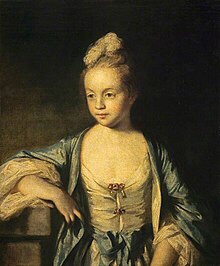
In the alternative, could Mackenzie perhaps be referring to Duke Henry’s younger sister Lady Frances (b. 1750, d. 1817), whose portrait as a little girl is pictured below? Although this is just a conjecture on my part, it is not a far-fetched one for several reasons. To begin with, Lady Frances was the daughter of Caroline Campbell Scott, so she was a “Campbell”. Secondly is Mackenzie’s observation that the woman, whoever she was, was “of as different dispositions and habits from him as possible.” Lady Frances was the daughter of a wealthy aristocratic family, while Adam Smith was an absent-minded professor. Lastly, Adam Smith corresponded with Lady Frances on multiple occasions (at least three letters from Smith addressed to Lady Frances survive), and both lived at Dalkeith House for at least two months during the fall of 1767.
Given these many coincidences (see above), I will further explore the relationship between Lady Frances and Adam Smith in my next blog post …
Thus far in my “Adam Smith in Paris” series, we have identified six possible lost loves in Adam Smith’s life — five of them by name(!):
Marie-Jeanne Riccoboni (b. 1713, d. 1792).
Marie Françoise Catherine de Beauvau-Craon (b. 1711, d. 1786), a/k/a “Madame de Boufflers”;
The “Duchess of Anville“, who may, or may not, be the same person as Marie Louise Nicole Elisabeth de La Rochefoucauld (b. 1716, d. 1797), who was the Duchesse d’Enville and the mother of the Duke de la Rochefoucault. (See, for example, this family tree and this passage from the autobiography of John Adams, especially footnote 3.)
Lady Janet Anstruther (b. 1725, d. 1802).
Madame Nicol.
In addition to these historical individuals, two additional women (who may, or may not, be the same person) are mentioned by various primary sources:
6a. An “English lady” who Adam Smith reportedly fell in love with in the town of Abbeville in northwestern France according to a hearsay report contained in a private letter by Dr James Currie.
6b. The “lady of Fife“, who Adam Smith had loved (past tense) according to his friend, confidant, and travel companion the Abbe Colbert.
Now, what if I told you that there might be a seventh lost love? I will conclude this series of blog posts by considering just such a possibility, so read on …!
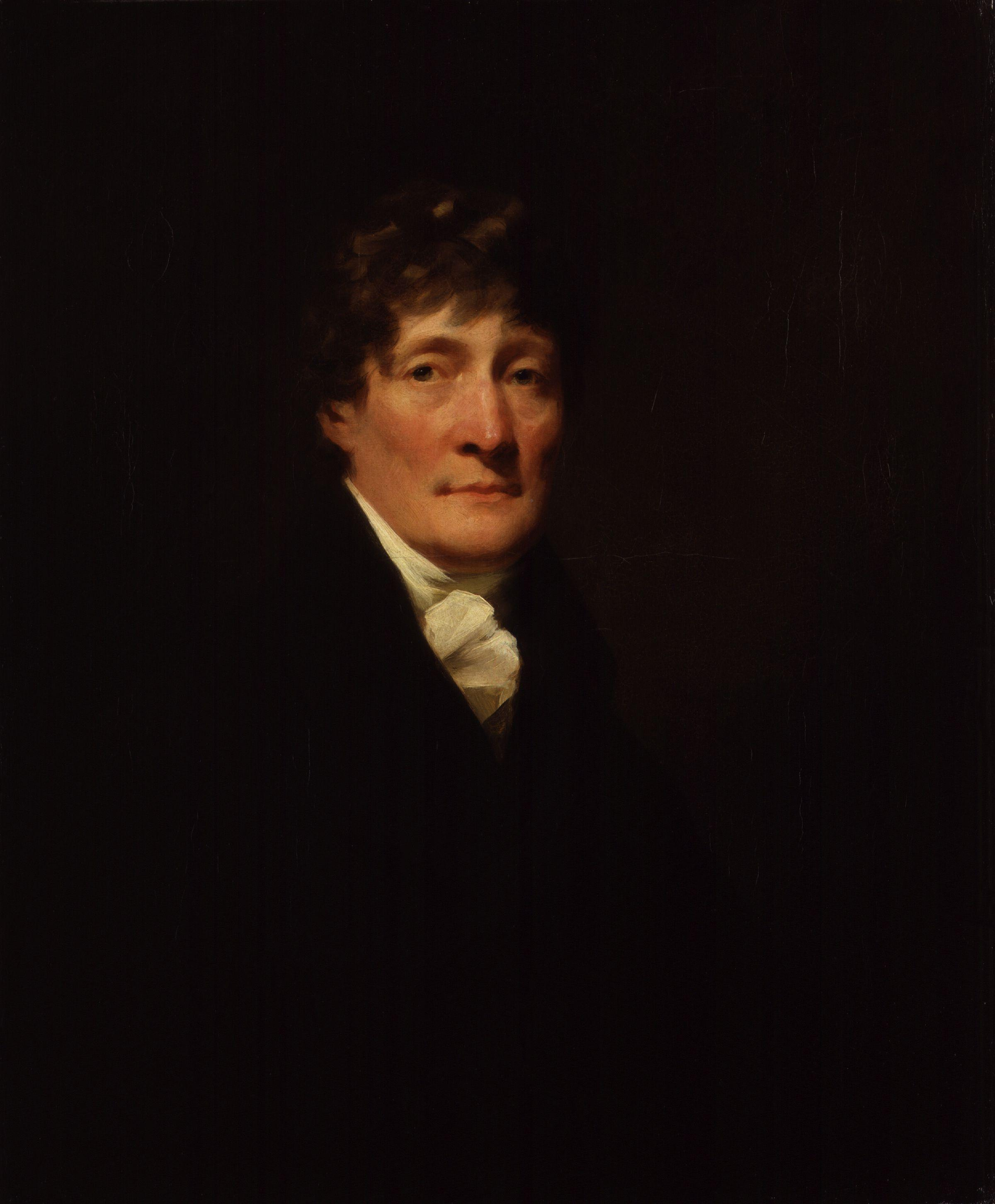
Toward the end of his long and remarkable life, Henry Mackenzie (b. 1745, d. 1831), whose portrait is pictured below, jotted down a series of personal recollections, hoping to have these memories published in a book of “anecdotes and egotisms,” as Mackenzie himself referred to them. (See Fieser (2003), p. 251. As a further aside, Mackenzie’s wide-ranging collection of anecdotes was eventually assembled by Harold William Thompson and published by Oxford University Press in 1927.)
Among other things, Mackenzie’s collection of anecdotes includes a short but intriguing entry with the title of “Smith and Hume in Love.” For the record, the first part of Mackenzie’s brief recollection about Smith is quoted in full below (Mackenzie (1927), p. 176, reprinted in Fieser (2003), p. 255, omission and parenthetical remark both appear in the original):
“Adam Smith [was] seriously in love with Miss Campbell of __ (the name is so numerous that to use it cannot be thought personal), a woman of as different dispositions and habits from him as possible.”
So, who was Henry Mackenzie, and why should we believe him? To begin with, Mackenzie was a distinguished Scottish lawyer and popular novelist. He also co-founded, along with Dugald Stewart, the Royal Society of Edinburgh. Moreover, Mackenzie knew Adam Smith personally and “was much in Smith’s company when he [Smith] lived in Edinburgh in the last twelve years of his life.” (This quote is from Ian Simpson Ross (2010), p. 227.) So, yes, I find Mackenzie to be a credible source.
But more importantly, who was Miss Campbell? I will explore the identity of Miss Campbell in my next post …
Artist Credit andWorks Cited
Artist of the Portrait of Henry Mackenzie: Henry Raeburn.
James Fieser, Early Responses to Hume, vol. 10, Thoemmes Press (2003).
Henry Mackenzie, “Smith and Hume in Love”, in Harold W. Thompson, editor, The Anecdotes and Egotisms of Henry Mackenzie, 1745–1831, p. 176, Oxford University Press (1927 [1831]).
Ian Simpson Ross, The Life of Adam Smith, 2nd ed., Oxford University Press (2010).





















 prior probability