
The government is once again “postponing” the release of the next batch of JFK assassination records. For your reference, here is the official announcement.

The government is once again “postponing” the release of the next batch of JFK assassination records. For your reference, here is the official announcement.
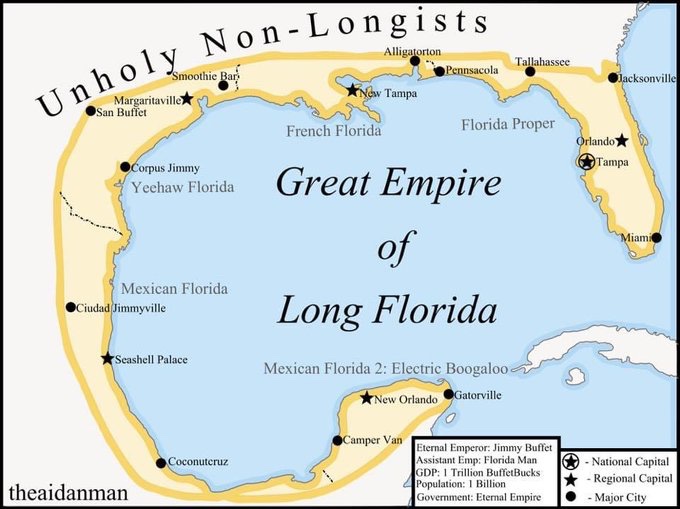
What if we replaced all of Alabama and Mississippi as well as most of Georgia and parts of Tennessee with “Greater Florida”? And what if, instead of sleepy Tallahassee, we made St Augustine, Florida’s oldest city, the capital of this new mega-state?

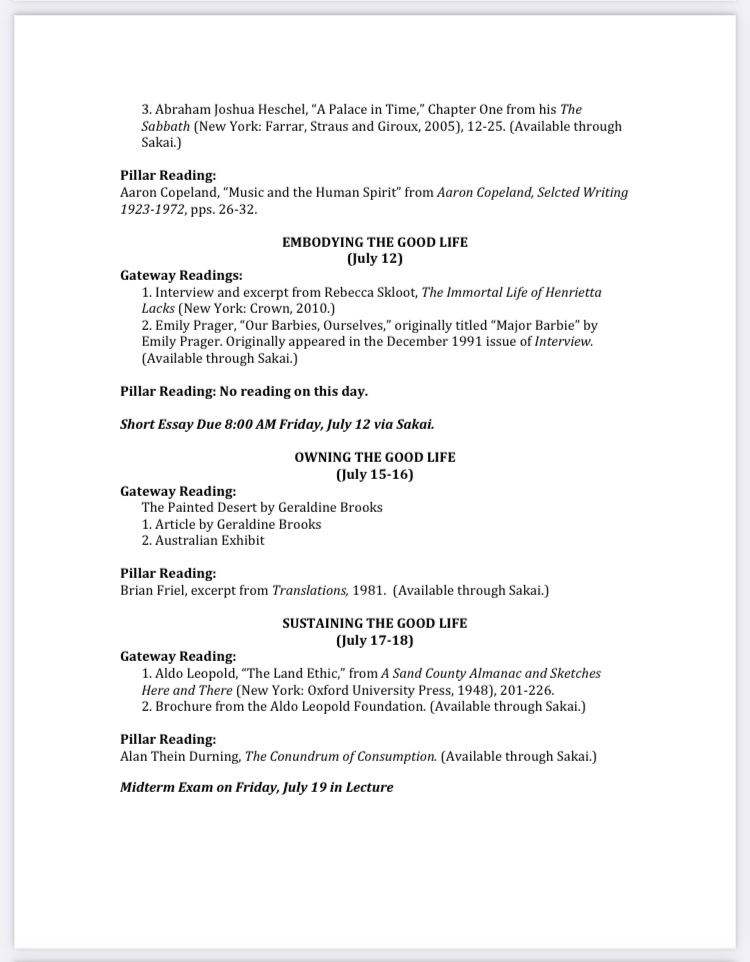
All great college courses are based on thought-provoking questions. This syllabus asks the most important question of all. (Source: University of Florida.)

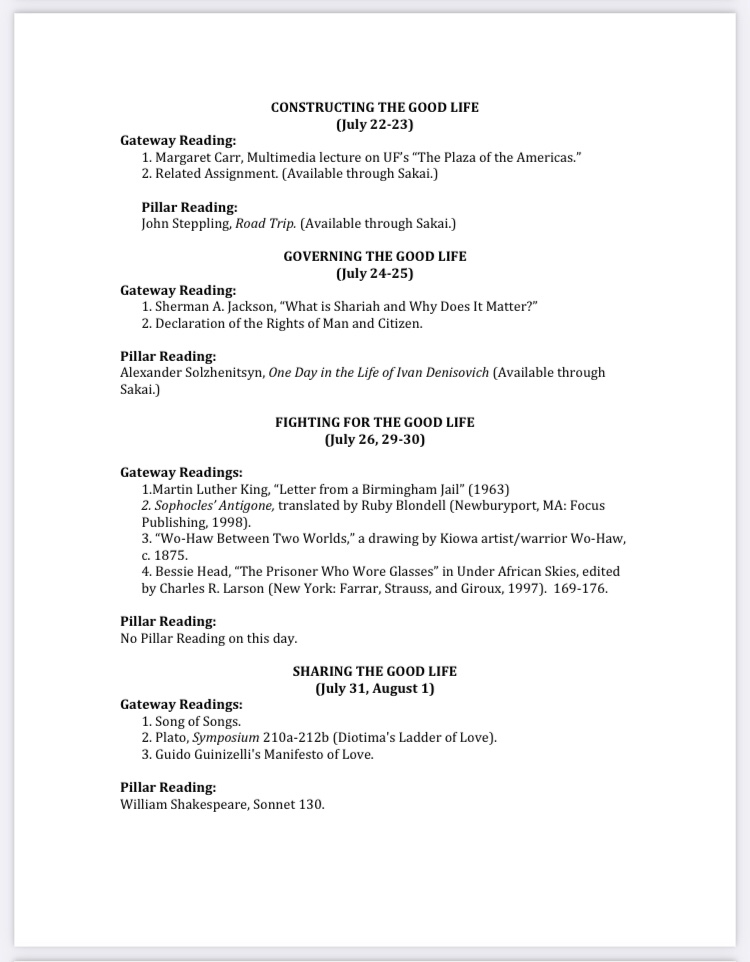
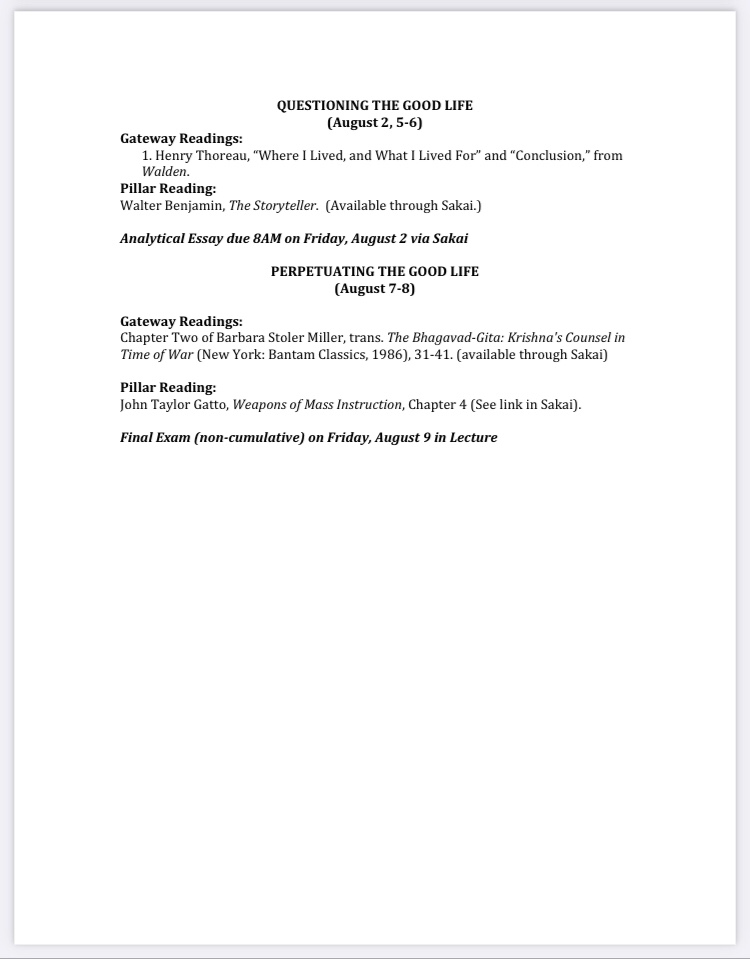
Via Kottke: “The Simpsons Library Instagram account has been documenting all of the books, magazines, and other printed matter that has appeared on the long-running sitcom.”

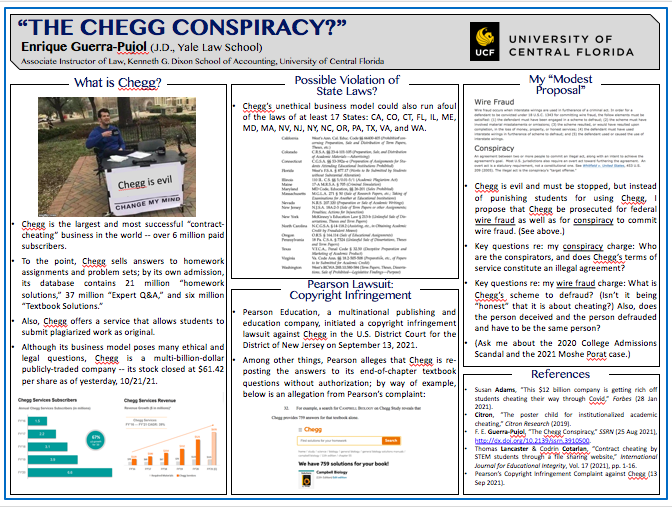
That is the title of my research poster on the law and ethics of Chegg, which I will be presenting at the Florida Statewide Symposium on Best Practices in Undergraduate Research this weekend. (This year, the symposium will take place at the University of Florida in Gainesville; more details about this annual symposium are available here.) Reduced to a screenshot, my massive poster will look like this — click on the image for a better-quality resolution:
Thanks to the careful work of Sarah Skwire, especially her beautiful draft paper “As If: Clueless about the Invisible Hand”, we have seen how people often add the words “as if” to Adam Smith’s original formulation of the invisible hand metaphor, and we have traced the source of this error back to Paul Samuelson’s 1948 textbook on economics, but why does this “as if” error matter?
Simply put, this seemingly-innocent error matters because adding the words “as if” to Smith’s passage changes the entire tenor and meaning of the invisible hand metaphor, or in Skwire’s own words: “when ‘as if’ is added to ‘led by an invisible hand,’ it changes the rhetorical figure from a metaphor to something else.” To be more precise, the phrase “as if” converts Smith’s invisible hand metaphor into a conditional or counter-factual statement.
Why is this problematic? Because a counter-factual statement, by definition, consists of a conditional claim with the following logical structure: “if p were true, then q would be true.” (See generally B. K. Milmed, “Counterfactual Statements and Logical Modality,” Mind, Vol. 66, No. 264 (1957), pp. 453-470, available here.) That is, logically speaking, when when say “if p were true, then q would be true” what we really are saying is that both the antecedent (p) and the consequent (q) are false. As a result, the phrase “as if” injects doubt and uncertainty into the sentence into which these words are added.
To see this, compare Paul Samuelson’s formulation of the invisible hand theory with Adam Smith’s original formulation:
A. What Paul Samuelson thinks Adam Smith said: “[Smith] proclaimed the mystical principle of the ‘invisible hand’: that each individual in pursuing his own selfish good was led, as if by an invisible hand, to achieve the best good of all ….”
B. What Adam Smith really said: “… by directing [our] industry in such a manner as its produce maybe of the greatest value, [we] intend[] only [our] own gain; and [we are] in this, as in many other cases, led by an invisible hand to promote an end which was no part of [our] intention.” [Note to my Millennial & Gen-Z readers — you win: I have changed Smith’s pronouns from “he/his” to “we/our”.]
Do you see the difference in tone and meaning? What Samuelson is basically saying is that Smith’s “invisible hand” is bullshit. Of course, maybe Samuelson is right; maybe the economy is not always guided by Smith’s Panglossian invisible hand, but that is definitely not what the great Adam Smith himself is saying. Instead, Smith is using the idea of a harmonious invisible hand as a metaphor, not as a counter-factual. For Smith, the paradox of people “intending only their own gain” (to paraphrase Smith) and yet producing good outcomes in the aggregate is real.
Now, walk into your local market or grocery store and look around … Isn’t Smith right?
In my previous post, I took the liberty of cutting-and-pasting the introduction of Sarah Skwire’s beautiful draft paper “As If: Clueless About the Invisible Hand.” In brief, Adam Smith’s invisible hand metaphor is probably the most well-known and popular idea in all of economics, and as Dr Skwire notes, most people often restate Smith’s famous metaphor in the following terms:
“Each individual, in pursuing his own good, is led as if by an invisible hand to increase the welfare of others.”
The problem is that the great Adam Smith never used the words “as if” in the original formulation of his invisible hand metaphor! In fact, according to Dr Skwire, it was none other than Paul Samuelson who first put the words “as if” into Smith’s mouth, so to speak. Specifically, on page 36 of the original 1948 edition of his textbook (pictured below), Professor Samuelson (as quoted on page 2 of Skwire’s draft paper; emphasis added) formulates Smith’s invisible hand idea in the following terms:
“Even Adam Smith, the canny Scot whose monumental book, ‘The Wealth of Nations’ (1776), represents the beginning of modern economics or political economy — even he was so thrilled by the recognition of an order in the economic system that he proclaimed the mystical principle of the ‘invisible hand’: that each individual in pursuing his own selfish good was led, as if by an invisible hand, to achieve the best good of all, so that any interference with free competition by government was almost certain to be injurious.”
Samuelson’s popular textbook went through multiple editions — all of them with the words “as if” grafted onto Smith’s invisible hand metaphor — and was highly influential, for it was used to teach economics to several generations of Anglophone students. Okay, so what? Now that we have identified our main culprit, why is this misstatement of Smith’s invisible hand theorem such a problem? I will address this next question in my next blog post …

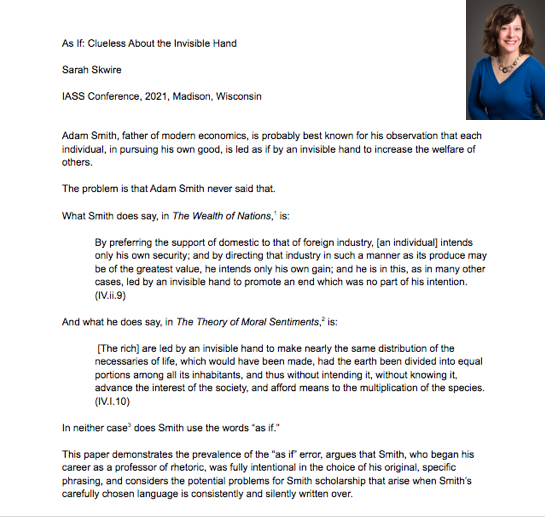
Moving on, the third of my three favorite talks at this year’s International Adam Smith Society (IASS) meeting was Sarah Skwire’s Saturday morning presentation (10/16/21) titled “As If: Clueless About the Invisible Hand“; in fact, I loved Dr Skwire’s beautiful paper so much that (starting tomorrow) I am going to devote my next few blog posts to it. For now, however, check out the introduction to Skwire’s IASS talk, which I am posting below (I have added a picture of Dr Skwire):
“A recent work of text mining of Smith’s works … shows that ‘silver’ is the most relevant word in the Wealth of Nations (followed by expense, tax, profit, rent, corn, colonies).” — Paganelli (draft paper)
As the quote above indicates, another of my favorite talks at this year’s International Adam Smith Society (IASS) meeting was Maria Pia Paganelli’s fascinating presentation on “Adam Smith’s Digression on Silver.” By way of background, the “Digression on Silver” is a long passage that appears at the end of Book I, Chapter 9 of Adam Smith’s magnum opus on The Wealth of Nations (WN). This digression, however, is usually dismissed by scholars as too long, too detailed, or too boring. Professor Paganelli’s contribution is to explain why the Digression on Silver contains Smith’s most powerful argument against mercantilism and should thus be read as the centerpiece of WN!
In summary, mercantilism is a fallacious, zero-sum economic theory that politicians from Joe Biden to Donald Trump continue to espouse in order to justify restrictions on free international trade. According to this now-debunked economic theory, a government should take aggressive steps to ensure that exports (domestic products sold overseas) exceed imports (especially foreign-made finished goods) in order to increase capital inflows and thus accumulate wealth and prosperity. In other words, for mercantilists, the money generated from capital inflows is equated to wealth and prosperity, and mercantilists in Adam Smith’s day believed that when money increased, prices increased, and so did a nation’s wealth.
But according to Professor Paganelli’s careful analysis of Smith’s “Digression on Silver”, Adam Smith attacked the logic of mercantilism in his digression by taking a deeper and critical look at the relationship between the value of silver and the level of wealth. Specifically, Smith asserts, contra the mercantilists, that it was an increase in political stability (i.e. a decline in domestic insurrections and foreign wars) that allowed wealth to grow, which in turn is what caused real prices to decrease and what also simultaneously caused an increase in the quantity of silver that led to an increase in nominal prices.
For Smith, then, the mercantilists’ main error was to focus on nominal prices instead of real prices, leading them to incorrectly attribute a causal relation between the increases in silver and in wealth. Smith, by contrast, showed that the mercantilist correlation between nominal prices and wealth was not causation but just the coincidence of many simultaneous and independent events, or in the eloquent words of Paganelli, “The Digression on Silver leaves mercantilists with nothing: what seems to be is not what is. Money may seem to be wealth, but it is not.”
Note: I will conclude this three-part series in the next day or two with Sarah Skwire’s IASS talk “As If: Clueless about the Invisible Hand.”





Hopefully It’s Interesting.
In Conversation with Legal and Moral Philosophers
PhD, Jagiellonian University
Books, papers, and other jurisprudential things
Ramblings of a retiree in France
BY GRACE THROUGH FAITH
Natalia's space
hoping we know we're living the dream
Lover of math. Bad at drawing.
We hike, bike, and discover Central Florida and beyond
Making it big in business after age 40
Reasoning about reasoning, mathematically.
I don't mean to sound critical, but I am; so that's how it comes across
remember the good old days...
"Let me live, love and say it well in good sentences." - Sylvia Plath
a personal view of the theory of computation
Logic at Columbia University
Just like the Thesis Whisperer - but with more money
the sky is no longer the limit
Technology, Culture, and Ethics
Just like the horse whisperer - but with more pages
Poetry, Other Words, and Cats

 prior probability