Following up on my “Music Monday” and “Twitter Tuesday” blog posts, I have also decided to begin a new series of blog posts on Wednesdays under the general heading “What could go wrong?” Generally speaking, whenever we try to improve the world in some way, it is always worth asking, What are the most likely “unintended consequences” of our proposed change? What follows is a possible example of this general principle. According to this report by Taylor White (via Undark), the first genetically modified mosquitos will be released in the Florida Keys this spring. The goal of this scientific scheme is to reduce the overall population of mosquitos: “When released [genetically-modified] males breed with wild female mosquitoes, the resulting generation does not survive into adulthood ….” Hey, what could go wrong? Hat tip: @kottke.
When I “self-cancelled” myself from Facebook and Twitter for Lent (see here), little did I realize what a great feeling of unadulterated relief I would feel to stay off social media for good. Instead of wasting ungodly amounts of time scrolling down through an infinite loop of mostly unfiltered bullshit, I can devote myself to more scholarly and humane pursuits. Also, as a matter of principle, I do not like how a public figure like Donald J. Trump has effectively been censored by louses like Jack Dorsey and Mark Zuckerberg. President Xi Jinping can use Twitter, but Trump can’t? Please ….
I shared the first of three “Music Monday” blog posts way back in early October 2014. (The other two were on 13 October 2014 and on 8 December 2014.) Since then, YouTube has taken down my first Music Monday video, so I am replacing it here with another favorite song of mine: “Another Night” by Real McCoy. (See also the YouTube link below; for some stupid reason, despite multiple attempts on my part, the “embed” feature is not working for me today.) Also, since music is such a big part of our lives, why not make “Music Monday” a regular feature on this blog?
Does the growing clamor from university administrators for “diversity, equity, inclusion, and justice” include intellectual or ideological diversity? Should it? Either way, we may soon be able to measure the level of “viewpoint diversity” at major public universities in Florida. According to this report in Inside Higher Ed (IHE), a few days ago the Florida Legislature enacted a bill calling for a survey of the political beliefs of public college and university professors in Florida. (More details about this bill are available here.) This bill, which still needs to be signed into law by Governor Ron DeSantis, would require the Florida State Board of Education to ask professors annually about their political beliefs in order to “assess the status of intellectual freedom and viewpoint diversity.” Hat tip: Brian Leiter.
I have always wanted to learn how to play cricket, one of the most popular sports in the world, and now thanks to the magic of Wikipedia as well as this YouTube channel by the amazing Ninh Ly, my wish has been granted! Hat tip: @kottke.
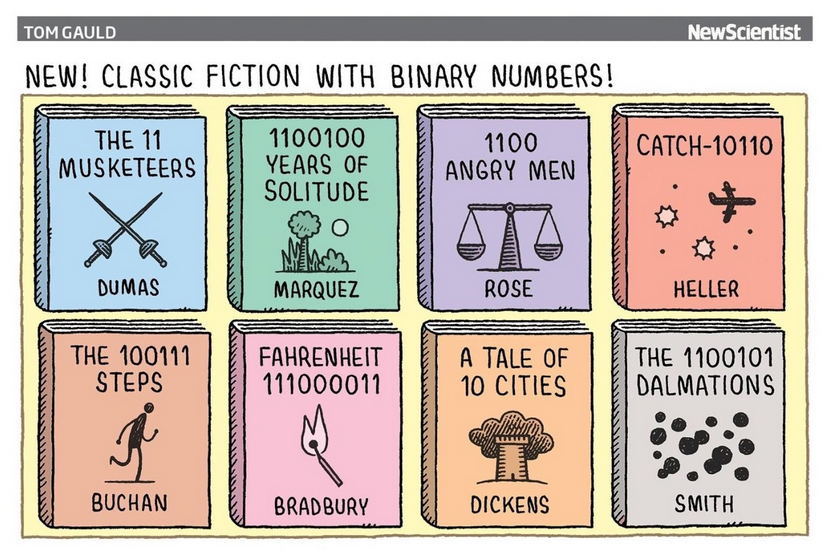
Imagine if the Arabic numerals in your favorite book were replaced with binary numbers … (Via Wikipedia: In mathematics, a binary number is a number expressed in the base-2 numeral system or binary numeral system, which uses only two symbols: typically “0” and “1”.)
Via Keith E. Whittington (Volokh Conspiracy), I just discovered this website titled “Liberty Matters” featuring a series of essays on the theme of liberty.
This is my last blog post in a multi-part series on conspiracy theories
I made a “modest proposal” in my previous post. I proposed the creation of a “Fake News Futures Market.” Because fake news and conspiracy theories can threaten liberal values, my ultimate goal is to create a kind of “early warning detection system” as well as a literal marketplace of ideas through a user-friendly market mechanism that not only assigns credible probability values to each new item of fake news or conspiracy theory but that also updates these probability values in real time. By way of background, my previous mechanism design work has extended the logic of markets to adjudication and jury trials (“The Case for Bayesian Judges,” “Why Don’t Juries Try Range Voting,” and “The Turing Test and the Legal Process”) and to many other novel settings, including politics (“Coase and the Constitution”), moral dilemmas (“Trolley Problems”), and the world of science fiction (“Clones and the Coase Theorem”). I now want to extend my work into the domain of conspiracy theories and fake news generally. To do this, I will have to address the following logistical and legal questions:
Law. A prediction market in conspiracy theories or “fake news futures market” poses a delicate legal question: Would such a market even be legal, or would the bets placed on this market be classified as illegal wagers? The answer to this threshold question often depends on State law (see here, for example). By way of analogy, sports betting is legal or on the way to becoming legal in 42 States (see image below), although as far as I am concerned, why can’t the act of placing a wager on a non-sporting event be considered a speech act, and why shouldn’t betting markets thus be protected under existing Supreme Court interpretations of the First Amendment, at the very least as a form of commercial speech? To make a long story short, I will devote myself to these threshold legal questions during my summer break.
Logistics. What would a “fake news futures market” look like? How would such a platform operate? How much would it cost to place a bet? At this early stage of my research project, I see three possibilities. One is to hand the baton to an already-established prediction market like the Iowa Electronic Markets (IEM). Another possibility is to create a new fake news betting platform with the support of a market-friendly research institution, like the Cato Institute or the Mercatus Center at George Mason University. Yet another possibility is to “go independent” by creating an entirely new and independent platform not affiliated with any existing research institution. (By way of comparison, consider the “Long Bets” website, an independent entity that was initially funded by two grants from Amazon CEO Jeff Bezos.)
Additional design questions (e.g. marketing, advertising, etc.). Lastly, for now, with the legalization of sports betting in many States (see my “Law” section above), the online betting world is becoming hyper-competitive, full of established players like DraftKings as well as many new entrants too numerous to mention here. How could a fake news market differentiate itself from this crowd and attract bettors?
However the above questions are answered, my fake news futures markets fake should resemble existing successful prediction markets, like the IEM or Long Bets, in two ways: it must contain a searchable and comprehensive database of conspiracy theory wagers, and the price of any given bet should reflect the relative truth value of the item of fake news or conspiracy theory being bet on. Again, I will consider these logistical and operational details over my summer break. The larger point I want to make here, however, is that governmental efforts to suppress fake news and conspiracy theories are not only likely to fail; such efforts will further erode and endanger our freedoms. Instead of stifling speech, we should try a different approach: we should allow people to propose–and bet on–as many items of fake news and conspiracy theories as they want to!
Alternative title: James Madison, Meet Mechanism Design
Note: This is my penultimate blog post in a multi-part series on conspiracy theories
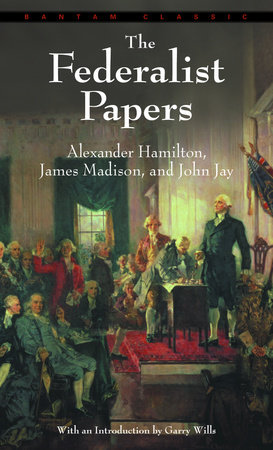
Why are conspiracy theories so popular, and how should we respond to them? I have already spent considerable time and space on this blog trying to answer these questions. In this post, I will propose a new approach, the logic of which can be summed up in the following five words: “James Madison, Meet Mechanism Design.” In Federalist Paper #10 (available here), Madison famously identified the problem of “faction” as a great source of danger to liberal values, even going as far as to call factions a “dangerous vice.” (To the extent modern-day factions like QAnon and others are the source of fake news and conspiracy theories, Madison’s 18th-Century admonition continues to hold true today!) But at the same time, Madison explains in Federalist 10 that efforts to curb factions are always more dangerous than this disease. In Madison’s memorable words:
“Liberty is to faction what air is to fire, an aliment without which it instantly expires. But it could not be less folly to abolish liberty, which is essential to political life, because it nourishes faction, than it would be to wish the annihilation of air, which is essential to animal life, because it imparts to fire its destructive agency.”
By the same token, contemporary proposals to curb fake news and the spread of conspiracy theories–either through direct regulation of social media platforms or through the appointment of a national/federal “reality czar”–are likewise dangerous. Why? Because such “solutions” might stifle or even suffocate the marketplace of ideas. Returning to Madison and Federalist #10, what was Madison’s ingenious solution to the dangerous vice of factions? More factions! Again, in the immortal words of Madison:
“Extend the sphere, and you take in a greater variety of parties and interests; you make it less probable that a majority of the whole will have a common motive to invade the rights of other citizens ….”
In other words, the more factions there are, the more they cancel each other out, making it far more difficult for any one faction to dominate politics. Likewise, perhaps the solution to the problem of fake news is not less fake news but more! Simply put, instead of trying to repress fake news and conspiracy theories and risk shutting down the marketplace of ideas, what if we encouraged people to propose–and bet on–as many items of fake news and conspiracy theories as they want to? From a theoretical perspective, ideas markets have many desirable and classical liberal properties, since such markets incentivize people to seek information and to be precise in their claims. Also, ideas markets are able to efficiently aggregate disparate sources of information and scale well with the number of people and opinions.
I will say more about my proposed “fake news futures market” and conclude my series on conspiracy theories in my next post.














 prior probability