A Modest Proposal: Fake News Futures Market

Alternative title: James Madison, Meet Mechanism Design

Note: This is my penultimate blog post in a multi-part series on conspiracy theories

Why are conspiracy theories so popular, and how should we respond to them? I have already spent considerable time and space on this blog trying to answer these questions. In this post, I will propose a new approach, the logic of which can be summed up in the following five words: “James Madison, Meet Mechanism Design.” In Federalist Paper #10 (available here), Madison famously identified the problem of “faction” as a great source of danger to liberal values, even going as far as to call factions a “dangerous vice.” (To the extent modern-day factions like QAnon and others are the source of fake news and conspiracy theories, Madison’s 18th-Century admonition continues to hold true today!) But at the same time, Madison explains in Federalist 10 that efforts to curb factions are always more dangerous than this disease. In Madison’s memorable words:

Liberty is to faction what air is to fire, an aliment without which it instantly expires. But it could not be less folly to abolish liberty, which is essential to political life, because it nourishes faction, than it would be to wish the annihilation of air, which is essential to animal life, because it imparts to fire its destructive agency.”

By the same token, contemporary proposals to curb fake news and the spread of conspiracy theories–either through direct regulation of social media platforms or through the appointment of a national/federal “reality czar”–are likewise dangerous. Why? Because such “solutions” might stifle or even suffocate the marketplace of ideas. Returning to Madison and Federalist #10, what was Madison’s ingenious solution to the dangerous vice of factions? More factions! Again, in the immortal words of Madison:

Extend the sphere, and you take in a greater variety of parties and interests; you make it less probable that a majority of the whole will have a common motive to invade the rights of other citizens ….”

In other words, the more factions there are, the more they cancel each other out, making it far more difficult for any one faction to dominate politics. Likewise, perhaps the solution to the problem of fake news is not less fake news but more! Simply put, instead of trying to repress fake news and conspiracy theories and risk shutting down the marketplace of ideas, what if we encouraged people to propose–and bet on–as many items of fake news and conspiracy theories as they want to? From a theoretical perspective, ideas markets have many desirable and classical liberal properties, since such markets incentivize people to seek information and to be precise in their claims. Also, ideas markets are able to efficiently aggregate disparate sources of information and scale well with the number of people and opinions.

I will say more about my proposed “fake news futures market” and conclude my series on conspiracy theories in my next post.
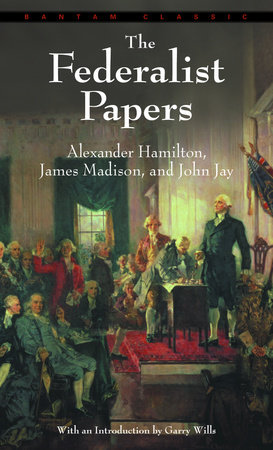
The Federalist Papers by Alexander Hamilton, James Madison and John Jay
Posted in Uncategorized | Leave a comment

Resurrection Sunday

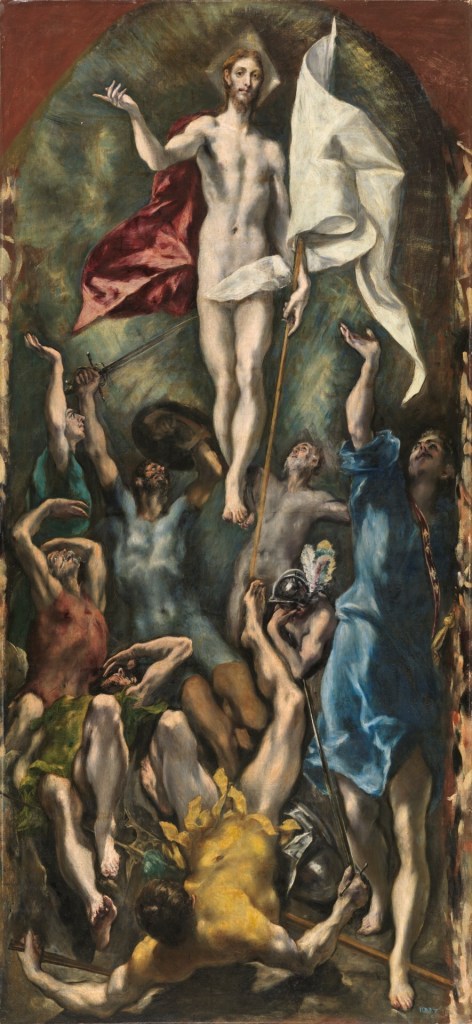
Happy Easter! This 521-year-old painting by El Greco (digital reproduction courtesy of the Museo Nacional del Prado in Madrid) commemorates Jesus’ resurrection. More details about this work of art and El Greco are available here.

El Greco (Museo Nacional del Prado)
Posted in Uncategorized | Leave a comment

Adam Smith in Love update

I will be proposing a “fake news futures market” and begin wrapping up my blog post series on conspiracy theories next week. In the meantime, I want to share two updates about my “Adam Smith in Love” paper:

  1. The final version of the paper has now been published in Econ Journal Watch (EJW) and is available here.
  2. Daniel Klein, the editor-in-chief of EJW, invited me on his podcast to talk about Adam Smith’s love life. A recording of the podcast is available here.
Econ Journal Watch - Home | Facebook
Posted in Uncategorized | 3 Comments

New Lin-Manuel Miranda Musical: “Slamilton”

Alternative title: Alexander Hamilton, Meet Michael Jordan!

April Fools’ Day (again!!)
Posted in Uncategorized | Leave a comment

Magnus Carlsen retires from chess

Alternative title: Happy April Fools’ Day!!!

Posted in Uncategorized | Leave a comment

Three critiques of the marketplace of ideas

Alternative title: A brief survey of the anti-market metaphor literature

Note: This is my 14th blog post in a multi-part series on conspiracy theories

Is there a “marketplace of ideas”, and if so, does this market really work? In my previous two posts I have mentioned how many legal scholars and public intellectuals have rejected the “marketplace of ideas” model. In the context of conspiracy theories, one can see why. After all, if truth is supposed to prevail whenever ideas are shared freely and openly, why are bogus conspiracy theories so popular? Broadly speaking, now that I have surveyed the “anti-market” literature, we can identify three main reasons why some scholars/intellectuals reject the market metaphor:

1. Ideas are not goods.

Although Ronald Coase (1974), an economist, famously concluded that no fundamental difference exists between the “market for goods” and the “market for ideas,” other scholars, by contrast, have rejected the analogy between markets and ideas. Alvin Goldman and James Cox (1996, p. 26), for example, conclude that the marketplace analogy is inapt in the domain of speech because “it is really questionable whether messages are goods or products at all,” while Robert Sparrow and Robert Gooding (2001, p. 48) concur with Goldman & Cox (1996) that “ideas are not commodities of the sort ordinarily bought and sold in markets” and propose an alternative metaphor (pp. 54-55): “the garden of ideas.” Similarly, Brazeal (2011, p. 2) emphasizes “structural dissimilarities between a market in more traditional goods and a market in ideas.”

2. Specific types of speech.

Some scholars/intellectuals have rejected the “marketplace of ideas” metaphor with respect to specific types of speech, such as hate speech and racist speech. David Shih (2017), for example, citing the landmark work of Richard Delgado and Jane Stefancic (1992), focuses on hate speech and racist speech and concludes that the marketplace of ideas “fails” because “we cannot make objective choices about racism.” Why not? Because, according to Delgado & Stefancic (1992, p. 1278, citing Bell, 1987), “racism is woven into the warp and woof of the way we see and organize the world ….” But if this were the case, then everyone must be irredeemably racist, and no amount of public policy reforms could alter their pessimistic conclusion. Alas, Shih, Delgado, and Stefancic’s critique of the market metaphor is self-refuting.

3. Specific types of information environments.

Yet others reject the market metaphor with respect to specific types of “information environments.” Claudio Lombardi (2019), for example, explains how the marketplace of ideas is distorted by the advertising revenue business models of social media platforms like Twitter and Facebook. These platforms treat news as a “product” and readers as “consumers” and distort the marketplace of ideas by lumping reliable sources of news together with fake news. According to Lombardi (2019, p. 201), “Algorithms such as those used by Facebook and Twitter are crafted … to show online content without selecting for the credibility of the source. The watchword is instead the ‘effectiveness’ of a post in generating traffic–a loophole that populist movements have used very effectively.” Lombardi (ibid., pp. 202-203) also falls into the ad hominem trap: “But just as in any other market, trade in ideas may be subject to distortion due to … bounded rationality and cognitive limitations.”

For my part, I am not persuaded by any of these criticisms. Aside from falling into the ad hominem trap, Lombardi’s analysis is already outdated, while Shih’s pessimistic analysis is empirically false. If you don’t believe me, ask “Karen.” Today, when someone is caught on video making a racist statement, they are often “cancelled” and subject to strong censure from many quarters. In any case, in my next post I will propose a new way of dealing with fake news and conspiracy theories: a futures market in fake news or “conspiracy theory prediction market.”

Cartoon credit: Kevin Siers, via politicalcartoons.com

Works Cited

Bell, Derrick A. 1987. And We Are Not Saved: The Elusive Quest for Racial Justice. Basic Books.

Brazeal, Gregory. 2011. How much does a belief cost? Revisiting the marketplace of ideas. Southern California Interdisciplinary Law Journal, 21(1), pp. 1–46.

Coase, Ronald H. 1974. The market for goods and the market for ideas. American Economic Review, 64(2): pp. 384–391.

Delgado, Richard, and Jane Stefancic. 1992. Images of the outsider in American law and culture: can free expression remedy systemic social ills. Cornell Law Review, 77(6), pp. 1258–1297.

Goldman, Alvin I., and James C. Cox. 1996. Speech, truth, and the free market for ideas. Legal Theory, 2 (1), pp. 1–32.

Lombardi, Claudio. 2019. The illusion of a “marketplace of ideas” and the right to truth. American Affairs, Spring 2019, pp. 198–212.

Shih, David. 2017. Hate speech and the misnomer of “the marketplace of ideas.” NPR (May 3, 2017), available at https://www.npr.org/sections/codeswitch/2017/05/03/483264173/hate-speech-and-the-misnomer-of-the-marketplace-of-ideas. [permaCC]

Sparrow, Robert, and Robert Goodin. 2001. The competition of ideas: market or garden? Critical Review of International Social and Political Philosophy, 4(2), pp. 45–58.

Posted in Uncategorized | 2 Comments

I object! (“reality czar” edition)

Note: This is my 13th blog post in a multi-part series on conspiracy theories

As I mentioned at the end of my previous blog post, a rising tide of voices, especially in academia, are calling for direct regulation of social media platforms and other vigorous policy proposals in order to curb the spread of conspiracy theories and other dangerous ideas on the Internet, e.g. QAnon, fake news, etc. Most recently, by way of example, Kevin Roose, a technology columnist for The New York Times, surveyed a group of “experts” about this growing problem. See “How the Biden Administration Can Help Solve Our Reality Crisis,” N.Y. Times, Feb. 2, 2021.

According to Roose, these experts recommend the Biden administration to appoint a cross-agency task force “to tackle disinformation and domestic extremism.” The task force would be led by a “reality czar,” who would coordinate the federal government’s response to conspiracy theories and other forms of “disinformation.” Worse yet, Roose himself agrees with these experts: “I’ve spent the past several years reporting on our national reality crisis, and I worry that unless the [federal government] treats conspiracy theories and disinformation as the urgent threats they are, our parallel universes will only drift further apart, and the potential for violent unrest and civic dysfunction will only grow.”

But who is to judge what constitutes “disinformation”? Do you really trust the government to get this right? If Donald J. Trump, for example, were to win re-election in 2024, who would his “reality czar” be? In any case, even if Roose’s ill-advised and dangerous proposal is never carried out, social media companies are finally beginning to adopt new policies to curb the spread of conspiracy theories. Facebook, for example, has been tweaking its algorithms to slow down the spread of fake news:

Reducing the spread of false news on Facebook is a responsibility that we take seriously. We also recognize that this is a challenging and sensitive issue. We want to help people stay informed without stifling productive public discourse. There is also a fine line between false news and satire or opinion. For these reasons, we don’t remove false news from Facebook but instead, significantly reduce its distribution by showing it lower in the News Feed.” (See here and here.)

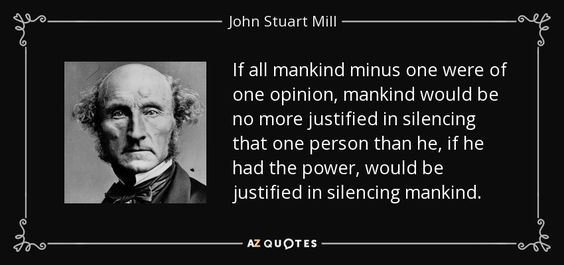
Alas, I object! Simply put, I have a deep philosophical objection to all these private and public calls for action: they stifle speech and suffocate the marketplace of ideas, i.e. the idea that best way to deal with false ideas is with more ideas. According to our classical liberal tradition and John Stuart Mill (see below), the best test of the truth of an idea depends on its direct competition with other ideas, not on the opinion of a censor or a “reality czar” or a secret algorithm or whatever. The rise of conspiracy thinking in the Internet Age, however, is said to pose a direct challenge to this ideal, and a growing chorus of legal scholars and public intellectuals are openly rejecting Mill’s market metaphor. Stay tuned: I will review and respond to this misguided critique in my next blog post …

Posted in Uncategorized | 1 Comment

Economic analysis of conspiracy law

Note: This is my 12th blog post in a multi-part series on conspiracy theories

In this post I will expand on Richard Posner’s economic analysis of conspiracy law on pp. 230-231 of his magnum opus: Economic Analysis of Law (7th edition, 2003). (Full disclosure: along with Milton Friedman and Ronald Coase, Dick Posner, pictured below during his heyday at the University of Chicago, is one of my intellectual heroes.) In summary, Posner identifies three key features of conspiracy law from a “law & economics” perspective:

1. Criminal conspiracies are more dangerous than one-man crimes. Why? Because, according to Posner, conspirators are able to specialize and take advantage of the division of labor–“e.g. posting one man as a sentinel, another to drive the getaway car, another to fence the stolen goods, etc.” (As an aside, the same thing could also be said of civil conspiracies, such as agreements to commit fraud. In both cases, the division of labor and specialization of nefarious tasks among the conspirators make it more likely that the conspiracy will succeed.) This Posnerian insight about the dangers of conspiracies, dangers due to the efficiencies resulting from the division of labor, might explain the special place that conspiracy theories have in popular culture, why such myths are able to capture the public’s imagination.

2. “Conspiracy” is a separate crime. That is, from a purely legal perspective, a conspiracy to commit a criminal act generates criminal liability whether the conspiracy succeeds or not. For Posner, the rationale for this special treatment of conspiracies–i.e. the fact that a conspiracy is a separate offense regardless of whether the conspiracy succeeds–is based on point #1 above: the conclusion that conspiracies are more dangerous than one-man crimes. Again, this Posnerian insight might explain why conspiracy theories are so popular. Even if a particular conspiracy is unlikely to succeed–indeed, even if the conspiracy is entirely fictional–the possibility that a private plan or hidden agreement might exist might be especially alarming to many people. Just as no one likes it when others about you are talking behind your back, no one likes it when some group of individuals are secretly scheming to accomplish some illegitimate end.

3. Posner also mentions that some of the most serious crimes, like the crime of insurrection, can only be committed by conspiracies. Consider the January 6 Capitol Hill riot, for example. On January 6, 2021, thousands of angry Trump supporters marched up to the main U.S. Capitol Building in Washington, D.C., where the Congress was in the process of certifying the Electoral College results of the 2020 presidential contest. Many of the protestors apparently sincerely believed that the 2020 election had been stolen from President Trump, and several hundred protestors stormed the west side of the capitol building and interrupted the counting of the Electoral College votes for several hours. Had the protestors (conspirators?) succeeded in stopping the Electoral College vote count, they might have prevented a peaceful transition of power from Donald J. Trump to Joe Biden.

In other words, we should take conspiracy theories seriously! But how should we respond to conspiracy theorists? Alas, support for the “marketplace of ideas” model of free speech is starting to erode among many legal scholars and other public intellectuals. Worse yet, the “solutions” being proposed by these scholars and intellectuals are far worse than the dangers of conspiracy thinking. In my next few posts I will do three things: I will summarize these proposed solutions and explain why they are bad; I will defend the “marketplace of ideas” metaphor; and I will conclude by proposing my own solution to conspiracy thinking: the creation of a prediction market in conspiracy theories!

Posted in Uncategorized | Leave a comment

The law of conspiracy

Note: This is my eleventh blog post in a multi-part series on conspiracy theories

What separates a legitimate claim of “conspiracy” from a fringe or far-fetched “conspiracy theory” (like the so-called “plandemic”) or a dangerous alternate reality “conspiracy myth” (like the Weimar era stab-in-the-back legend)? After all, conspiracies can be real. In fact, conspiracies occur all the time. Consider, for example, the actress Felicity Huffman and the infamous 2019 College Admissions Scandal. Although, legally speaking, Huffman, along with dozens of other wealthy parents, was charged with mail fraud and honest services fraud, one could argue that she also committed the crime of conspiracy when she paid a third party to arrange for a ringer to take her daughter’s college admissions entrance examination. (By the way, Huffman’s slap-in-the-wrist ten-day jail sentence was way too lenient in my opinion.)

Given the fact that conspiracies are, in fact, quite ubiquitous–and given that my area of expertise is law–, why don’t we try to look at conspiracy theories through the eyes of the common law and the modern crime of conspiracy? Specifically, instead of asking whether a given conspiracy theory is simple or falsifiable or instead of trying to measure the level of orthodoxy of a given discourse, we should be asking the following series of practical or legal-inspired questions:

  • Is there an agreement between two or more conspirators?
  • Who are they and when did they reach this agreement?
  • And is their agreement an illicit or immoral one?

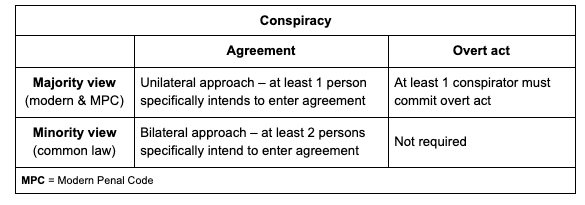
At common law, the crime of conspiracy required an illicit agreement between two or more persons, i.e. an agreement to commit a crime or a civil offense, such as murder or fraud.[1] Under modern conspiracy law, by contrast, an illegal conspiracy requires proof of an illegal agreement as well as an overt act. By way of specific example, consider the general federal conspiracy statute, which is codified at 18 U.S.C. § 371,[2] which defines a conspiracy as follows:

If two or more persons conspire either to commit any offense against the United States, or to defraud the United States, or any agency thereof in any manner or for any purpose, and one or more of such persons do any act to effect the object of the conspiracy, each shall be fined under this title or imprisoned not more than five years, or both. If, however, the offense, the commission of which is the object of the conspiracy, is a misdemeanor only, the punishment for such conspiracy shall not exceed the maximum punishment provided for such misdemeanor.”

In other words, the conspirators must not only intend to achieve the goal of the conspiracy; one or more of the conspirators must also commit an “overt act” in furtherance of the conspiracy.[3] Also, under both the common law and modern conspiracy law, a conspiracy is considered an “inchoate crime”; that is, a conspiracy need not be successful in order to constitute a crime. Why? Because it is the illicit agreement itself that it is illegal, regardless of whether the conspiracy is successfully carried out beyond the commission of an overt act in furtherance of the conspiracy. This special treatment is significant for several reasons; I will explain why in my next post.

Criminal Law Quick Tip: Conspirator v. Accomplice | UWorld Legal
 

[1] Today, this underlying crime or civil offense is referred to by courts as the conspiracy’s “target offense.”

[2] June 25, 1948, ch. 645, 62 Stat. 701; Pub. L. 103-322, title XXXIII, § 330016(1)(L), Sept. 13, 1994, 108 Stat. 2147. In addition to this general conspiracy statute, many other federal statutes contain anti-conspiracy provisions.

[3] The “overt act” itself need not be an unlawful or wrongful act. Either way, this requirement is a statutory requirement, not a constitutional one. See Whitfield v. United States, 453 U.S. 209 (2005).

Posted in Uncategorized | Leave a comment

Two cheers for Alan Turing

I am interrupting my multi-part series of blog posts on conspiracy theories to share this report by James Vincent (via The Verge), which is titled “The UK’s new £50 note celebrates Alan Turing with lots of geeky Easter eggs.” As it happens, I am a huge fan of Alan Turing, and even wrote a paper in his honor, “The Turing Test and the Legal Process“, during one of my trips to Tortola in the British Virgin Islands–shout out to my wife’s generous cousin Omonike Robinson-Pickering for hosting us during our many stays in the BVI. (By the way, a law professor at the University of Houston, Seth Chandler, once wrote a really mean-spirited and vindictive review of my Turing Test paper when I was going up for tenure. I will track down his nasty review and post it here soon.)

Posted in Uncategorized | 1 Comment