I shall close this series of Bayesian blog posts with a confession. Ex ante, before I began building my Bayesian model of the litigation process, I had taken a dim view of the legal game. Given the complexity and ambiguity of substantive as well as procedural rules, the indeterminate nature of most legal standards, and the high levels of strategic behavior by both litigants and judges, I expected my Bayesian model to confirm my negative view of the legal process. Ironically, however, the results of my Bayesian model of the litigation game were very surprising. In essence, my model shows that, regardless of the operative rules of procedure and substantive legal doctrine, a guilty verdict is nevertheless a highly reliable indicator of a defendant’s actual guilt. Specifically, my model demonstrates that when a defendant is found guilty of committing a wrongful act (civil or criminal), there is a high posterior probability that the defendant actually committed such a wrongful act, even when the underlying process of adjudication is random and even when the moving parties are risk-loving or less-than-virtuous!
Note: Because of two other research projects I am currently working on right now–both of which must be completed by April 16–as well as my regular spring semester teaching duties, I will be suspending my series of Bayesian blog posts for the time being. (After April 16, I will resume this series by showing how Bayesian methods can solve the blue bus problem and other evidentiary paradoxes.) In the meantime, I will switch gears, so to speak, and blog about my two ongoing research research projects in the days ahead …
Note: This is my fourteenth blog post in a month-long series on the basics of Bayesian probability and its application to law.
Happy Monday! Let’s now suppose that litigation is still a crapshoot but that plaintiffs and prosecutors are risk-loving or ‘less-than-virtuous’; that is, let’s assume that the moving parties are more willing to gamble than their virtuous colleagues. Specifically, I will assume that the litigation game is 50% sensitive and 50% specific and that plaintiffs and prosecutors are willing to play the litigation game even when they are only 60% certain that the named defendant has committed a wrongful act. Although these assumptions do not appear to be plausible, this permutation of my model, however implausible, may nevertheless provide an instructive counter-factual or hypothetical illustration of my Bayesian approach to litigation.
Note: This is my thirteenth blog post in a month-long series on the basics of Bayesian probability and its application to law.
Suppose that litigation is a crapshoot (to quote my mentor and favorite law school professor John Langbein); that is, what if litigation outcomes are only 50% sensitive and 50% specific? In other words, what if litigation games are completely random? Under this scenario, the process of adjudication is no better than a coin toss. Although this assumption may appear fanciful, as I explained in a previous post (see “Bayes 10“), the randomness of adjudication might be a function of the level of the complexity or the level of ambiguity of the applicable legal doctrines (e.g., assumption of risk) or procedural rules (e.g., res judicata). Simply put (pun intended), the more complex or ambiguous the applicable law is, the more random or arbitrary the outcome of litigation will be.
Note: This is my twelfth blog post in a month-long series on the basics of Bayesian probability and its application to law.
Suppose the litigation game is still highly sensitive and specific as before (i.e., 90% sensitive and 90% specific), but that plaintiffs and prosecutors are risk-loving or less-than-virtuous actors. Specifically, assume that the moving parties are willing to play the litigation game even when they are only 60% certain (instead of 90% certain, as we assumed earlier) that the named defendant has committed a wrongful act. (Such behavior is ‘less-than-virtuous’ in my model because the moving party is less concerned with the defendant’s actual guilt than a risk-averse or virtuous moving party is.) The intuition behind this revised assumption is that, in reality, the litigation game might be played by litigants who are engaged in rent-seeking and self-serving behavior. [1]
Note: This is my eleventh blog post in a month-long series on the basics of Bayesian probability and its application to law.
Suppose the litigation game is 90% sensitive and 90% specific, that is, suppose the process of litigation is able to determine correctly, at least 90% of the time, when a defendant has committed a wrongful act, and suppose further that the process will also determine correctly, again at least 90% of the time, when a defendant has not, in fact, committed a wrongful act. The intuition behind this assumption (non-random adjudication) is that reliable legal procedures will tend to produce just and fair results. See, for example, Henry M. Hart and Albert M. Sacks, The Legal Process (William N. Eskridge and Philip P. Frickey eds, Foundation Press, 1994). [1] Simply put, such a litigation game appears to be a highly accurate one, since it will correctly determine with 90% probability, or nine times out of 10, whether the defendant has or has not committed a wrongful act, an essential precondition before liability may justly be imposed.
Note: This is my tenth blog post in a month-long series on the basics of Bayesian probability and its application to law.
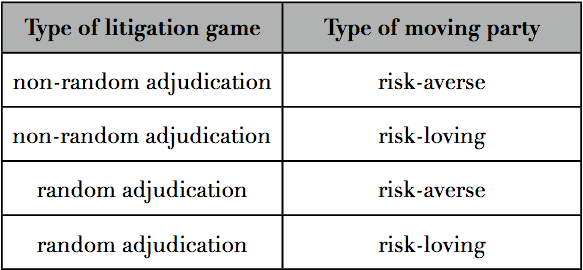
I will now consider four possible scenarios or types of litigation games:
non-random adjudication with risk-averse or ‘virtuous’ moving parties,
non-random adjudication with risk-loving or ‘less-than-virtuous’ moving parties,
random adjudication with risk-averse moving parties, and
random adjudication with risk-loving moving parties.
This schema may thus be depicted in tabular form as follows:
In summary, the adjudication variable in my model refers to the reliability or screening effectiveness of the process of adjudication. Specifically, ‘non-random adjudication’ refers to litigation games that are 90% sensitive and 90% specific, an assumption based on the classic and oft-repeated legal maxim ‘it is better that ten guilty men escape than that one innocent suffer’.
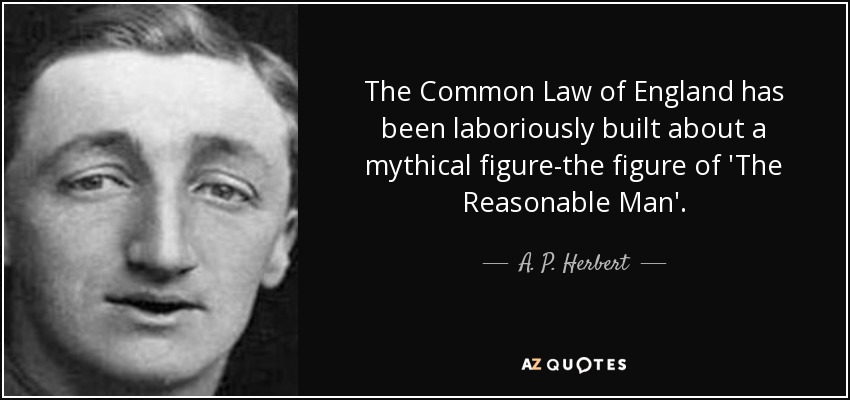
Random adjudication, in contrast to non-random adjudication, occurs when litigation games are only 50% sensitive and 50% specific and thus no more reliable than the toss of a coin. As an aside, it is worth asking, why would the process of adjudication ever produce a ‘random’ outcome in the real world? One possibility is that the level of randomness or unpredictability of adjudication might be a function of the level of complexity or ambiguity of legal rules. Consider, for example, the ‘reasonable man’ standard in tort law: the more complex or ‘open-textured’ the rules of substantive and procedural law are, the more random the litigation game will be. Also, before proceeding, notice that the adjudication variable can never be 100% sensitive nor 100% specific since errors are inevitable in any process of adjudication, regardless of the litigation procedures that are in place.
In addition, the term ‘risk-averse’ or ‘virtuous’, as applied to moving parties, refers to plaintiffs and prosecutors who play the litigation game only when they are at least 90% certain that the named defendant has committed an unlawful wrongful act, while ‘risk-loving’ or ‘less-than-virtuous’ moving parties refers to plaintiffs and prosecutors who are willing to play the litigation game even when they are only 60% certain that the named defendant has committed a wrongful act. Stated colloquially, virtuous plaintiffs are civil plaintiffs who rarely file frivolous claims and criminal prosecutors who rarely abuse their discretion; by contrast, less-than-virtuous moving parties are more willing to gamble on litigation games than their more virtuous colleagues.
In my next post, I will focus on-random adjudication with risk-averse moving parties.
Note: This is my ninth blog post in a month-long series on the basics of Bayesian probability and its application to law.
I am now ready to present a stylized Bayesian model of litigation. To do so, I will have to make a number of simplifying assumptions about the litigation process. First, I will define ‘litigation’ broadly to include both criminal and civil cases. In essence, the litigation game (whether civil or criminal) is a contest in which the moving party, the plaintiff or the prosecutor, attempts to impose civil or criminal liability on the defendant for the commission of an unlawful or wrongful act (whether civil or criminal in nature). And likewise, seen from the defendant’s perspective, litigation is a contest in which defendants attempt to avoid the imposition of liability. My model thus presents litigation as a game with two possible outcomes: ‘positive’ (+) and ‘negative’ (–). Specifically, a ‘positive’ outcome occurs when the moving party successfully imposes civil or criminal liability on the defendant; a ‘negative’ one, when the defendant is able to avoid the imposition of liability. (Secondly, my simple Bayesian model of the litigation game ignores the temporal dimension of adjudication–‘time costs’ and the problem of delay. Instead, I will assume for simplicity that litigation is an instantaneous event, like a coin toss or the roll of a die.)
Having stated my simplifying assumptions, I will now proceed to apply Bayes’ theorem to the litigation process. Recall the statement of Bayes’ rule from one of my previous blog posts (“Bayes 6“):
Pr(A|B) = [Pr(B|A) × Pr(A)] ÷ Pr(B)
Translated into the legal language of litigation, my legal version of Bayes’ rule may now be restated as follows:
In other words, we want to find the posterior probability, Pr(guilty|+), that a defendant will be found liable at trial, given that he or she has actually committed some wrongful act. (As the meme pictured below shows, Bayes’ rule is quite versatile; it can be applied to many other settings.) Ideally, of course, liability should be imposed only when a defendant has actually committed a wrongful act, and conversely, no liability should be imposed on innocent defendants. (In an ideal or perfect legal system, the value for Pr(guilty|+) should be equal to or close one, or stated formally: Pr(A|B) ≈ 1.) But in reality, false negatives and false positives will occur for a wide variety of reasons, such as heightened pleading standards and abuse of discovery in civil actions as well as prosecutorial discretion and prosecutorial misconduct in criminal cases. Stated colloquially, some guilty defendants will be able to avoid the imposition of liability, while some innocent ones will be punished. (See, for example, my “Bayes 3” blog post.)
To sum up, my Bayesian approach to litigation takes into account both (i) the possibility of a false positive (i.e., the imposition of liability when the defendant has not committed any wrongful act) as well as (ii) the possibility a false negative (no liability even though the defendant has, in fact, committed a wrongful act). The purpose of my stylized model, however, is not to explore the many systemic imperfections–procedural or practical or otherwise–in the existing legal system, imperfections contributing to the problem of false positives and negatives. This well-worn path has been explored by many others. (See, for example, Marc Galanter’s classic 1974 paper on ‘Why the “Haves” Come Out Ahead’, reprinted in David Kennedy and William W. Fisher, editors, The Canon of American Legal Thought, Princeton U Press (2006), pp. 495-545.) Instead, the goal of my model is to solve for Pr(guilty|+) and answer the following key question: How reliable is the litigation game, that is, how likely is it that a defendant who is found liable is, in fact, actually guilty of committing a wrongful act?
I will proceed to answer this question in my next post …
In honor of Oliver Wendell Holmes, Jr.–the great North American scholar, jurist, and epistolarian, who was born on this day in 1841–and in keeping with my focus all this month on Bayesian reasoning in law, I am re-posting this blog post from 2014.
Not that Holmes. This one. In our previous blog post (11/14/14), we promised to explain why our defense of Bayesian methods is relevant to law. After all, how is probability theory generally or any of the foregoing specifically — i.e. Hájek’s analysis of the reference class problem, his critique of radical subjectivism, and our critique of Hájek’s critique — relevant to law? In short, probability theory, Hájek’s paper, and our critique of Hájek are relevant to law in many ways.
Consider, for example, the close relation between the reference class problem and legal reasoning, especially the doctrine of binding precedent and the legal principle that “like cases should be treated alike.” A general principle in common law legal systems is that similar cases should be decided the same way so as to give similar and predictable outcomes, and the doctrine of precedent is the mechanism by which this goal…
Note: This is my eighth blog post in a month-long series on the basics of Bayesian probability theory
Thus far, by way of background, I have explained how Bayesian methods help us “test” the accuracy of our judgements, I have explained the logic of Bayes’ theorem (the equation in my “Bayes 6” blog post), and I have defined the technical concepts of sensitivity and specificity (Bayes 7). Here, before presenting my Bayesian model of litigation, I wish to make three more points about Bayesian reasoning:
First, the basic idea behind Bayes’s theorem is the idea that the conditional probability of event A, such as a defendant being found guilty, given the occurrence of another event B, the defendant’s commission of a wrongful act, not only depends on the strength of the relationship between A and B; it also depends on the prior probability of each event. Thus, according to Bayes’s theorem, the probability that a defendant in a civil action will be found liable (for tort, breach of contract, etc.), given that a plaintiff has brought an action against the defendant, will generally depend on two sets of probabilities: (i) the likelihood of the defendant being found liable given the strength of plaintiff’s claim, and (ii) the prior probabilities or success rates of plaintiffs and defendants generally.
Secondly, the probability of some event A conditional on some other event B is not the same as the conditional probability of event B given event A, or stated formally: Pr(A|B) is not equal to Pr(B|A). (See image below.) For example, the probability that a defendant will be found civilly or criminally liable, given that the defendant has committed some wrongful act–such as the commission of a tort, a breach of contract, a crime, etc.–, is not the same as the probability that the defendant’s wrongful conduct will result in liability, given that the plaintiff brings an a civil or criminal action against the defendant.
Lastly, it is also worth noting that Bayesian methods do not rely on any unrealistic assumptions about human rationality (unlike the standard assumptions of game theory or economics), nor does my Bayesian model of litigation require any detailed information about any particular rules of procedure or about substantive legal doctrine. Since such procedural rules and legal doctrines are often unclear, contested, and subject to manipulation, one can begin to appreciate the advantage of the Bayesian approach to civil and criminal litigation. In place of judicial hunches, indeterminate verbal arguments, or the inevitable ‘thrust and parry’ of competing interpretations of imperfect rules and doctrines (Karl Llewellyn, The Common Law Tradition (Little Brown 1960), pp. 522-529), my Bayesian approach to the litigation game attempts to understand the legal process from a probabilistic perspective.
Note: This is my seventh blog post in a month-long series on the basics of Bayesian probability theory.
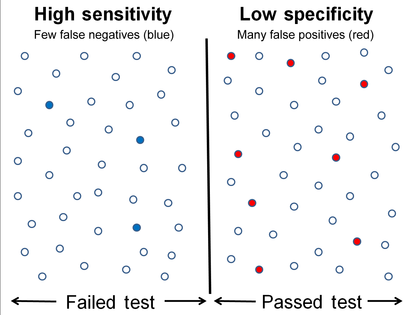
Happy Monday, fellow Bayesians! In this blog post, I will introduce and formally define the technical concepts of ‘sensitivity’ and ‘specificity.’ In the context of my Bayesian model of the litigation game, these concepts refer to the underlying reliability of a civil or criminal trial to distinguish between guilty and innocent defendants as follows:
Sensitivity. For starters, the ‘sensitivity’ of the litigation game—written as Pr(B|A) or, in our model, Pr(+|guilty)—indicates how well a civil or criminal trial is able to correctly impose liability on guilty defendants. In summary, this measure is defined formally as the probability of a positive litigation outcome (i.e., liability imposed on the defendant, which represents a ‘positive’ outcome from the plaintiff’s or prosecutor’s perspective), given that the defendant being tried has actually committed an unlawful wrongful act
Specificity. By contrast, the ‘specificity’ of the litigation game, which may be written as Pr(–|innocent), reflects how well a civil or criminal trial is able to correctly screen out innocent defendants. This measure is defined formally as the probability of a negative litigation outcome (i.e., no liability imposed on the defendant, which represents a ‘negative’ outcome from the perspective of the moving party, plaintiff or prosecutor), given that the defendant has not committed a wrongful act.
The bottom line is this: Sensitivity and specificity are crucial concepts because civil or criminal liability should be imposed only on guilty defendants, i.e., defendants who have in fact committed an unlawful or wrongful act. In my next post, I will make three general points about Bayesian reasoning, and in my next few posts after that, I will present my Bayesian model of litigation outcomes.














 prior probability