Conspiracy theories as language-games

Note: This is my tenth blog post in a multi-part series on conspiracy theories

In this post, I will frame conspiracy theories as a special type of Wittgensteinian “language game.” Although the enigmatic Ludwig Wittgenstein himself used the technical term “language-game” to convey many different ideas, one of his key language-game insights is the special relationship between the domain of language–the way in which we talk to one another in different contexts–and the domain of games, including both games of skill and games of luck. Specifically, Wittgenstein draws an analogy between languages and games–between “speaking” and “playing”–and he concludes that languages are like games in that both are rule-governed activities. That is, whether one is speaking a language or playing a game, the rules of a language are analogous to the rules of a game because, in both cases, one is engaged in an activity that is governed by general rules and social conventions.

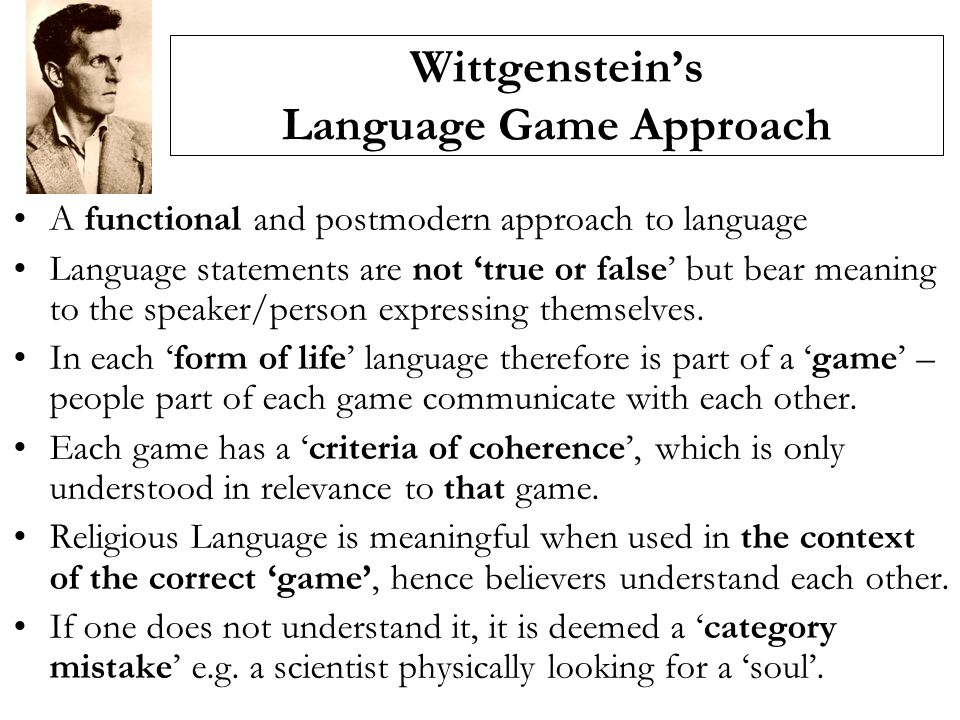
For Wittgenstein, saying something in a language is like making a move in a game; That is, the meaning of words, concepts, sentences, etc. depends on the language game in which such words, concepts, etc. are being used. Among other things, Wittgenstein gives the example of the word “water.” This word could be used as a request or an order, i.e. to ask someone to bring the speaker a glass of water. Or it could be used as an answer to a question. It could even be used as part of a code by members of a secret society. However the word “water” is used, it has no meaning apart from its use within a language game. (See slide below.) In Paragraph 23 of the Philosophical Investigations, for example, Wittgenstein presents a long laundry list of examples to illustrate “the multiplicity of language-games”:

  • Giving orders, and obeying them –
  • Describing the appearance of an object, or giving its measurements –
  • Constructing an object from a description (a drawing) –
  • Reporting an event –
  • Speculating about an event –
  • Forming and testing a hypothesis –
  • Presenting the results of an experiment in tables and diagrams –
  • Making up a story; and reading it –
  • Play-acting –
  • Singing catches –
  • Guessing riddles –
  • Making a joke; telling it –
  • Solving a problem in practical arithmetic –
  • Translating from one language into another –
  • Asking, thinking, cursing, greeting, praying.

So, why not add “conspiracy theories” and “alternate realities” and “political myths” to this already extensive list of language games? Although we can only wonder what Wittgenstein himself would have thought of this possibility, it turns out that conspiracy theories and conspiracy thinking generally seem to resemble many of the specific language-games in Wittgenstein’s long list, such as speculating about an event, making up a story, or reporting an event, depending on the use a specific conspiracy theory is being put to.

Furthermore, this language-game lens is intriguing for several additional reasons. To begin with, we avoid the ad hominem trap I mentioned in one of my previous posts; i.e. we don’t need to diagnose or otherwise impugn the mental health of conspiracy theorists. Instead, we ask a completely different question, What are the rules of the conspiracy theory game? Also, although the rules of language-games are “socially constructed,” to borrow the contemporary term of art from our previous post, the Wittgensteinian approach is arguably not self-refuting in the same way discourse theories are. Why not? Because one is not bound by the internal rules of the language-game that is one is studying as an observer. Instead, one is just trying to figure what those rules are. (In other words, we can study conspiracy theories using this Wittgensteinian lens without having to believe in them.)

Yet, aside from clarifying the different uses of the phrase “conspiracy theory” (see Wittgenstein’s laundry list above), what else, if anything, is gained by comparing conspiracy theories to a language game? Alas, the Wittgensteinian sketch of conspiracy theories presented here poses many more questions than it answers. After all, if a conspiracy theory is like a game, a game with its own internal logic and its own set of rules, what are these rules? What does this internal logic consist of? Although these questions are certainly worth considering, I will take an entirely different and new approach in my next set of blog posts starting next week. Specifically, instead of getting bogged down in the internal logic of conspiracy theories–a game that, in my opinion, is not worth playing–, I will examine such myths from an Anglo-American “common law” perspective. After all, “conspiracy” is a common-law crime, so our traditional legal norms and rules might shed some light on this sordid and shadowy corner …
Language Games Offside!. Language Game Theory – Ludwig Wittgenstein An  Austrian general said to someone: 'I shall think of you after my death, if  that. - ppt download
Image credit: Jayson Weaver
Posted in Uncategorized | 2 Comments

The social construction of conspiracy theories

Alternative title: Conspiracy theories, discourse, and power

Note: This is my ninth blog post in a multi-part series on conspiracy theories

I sincerely apologize in advance for this blog post. Personally, I am not a big fan of sociology or of “social constructionism.” Nevertheless, that said, for purposes of completeness–of leaving no conspiracy-theory stone unturned, so to speak–I am going to put on my post-modern social construction hat today. More to the point, I will argue that many, if not most, conspiracy theories, especially far-fetched ones, are social constructs. That is to say, the secret machinations and alternate realities that these theories purport to describe don’t really exist, except in the minds of the conspiracy theorists themselves. Accordingly, what if we were to extend discourse theory or “Foucauldian discourse analysis” to conspiracy theories?

Discourse theory refers to an entire family of research techniques and qualitative methods of linguistic analysis. (See bottom image by Susan Herring.) In summary, however, it suffices to say that the central focus of discourse theory, as developed by such intellectual giants as Michel Foucault and Jacques Derrida (both of whom are also pictured below), is on the non-linear relationships between language, knowledge, and power. To oversimplify, for Foucault, Derrida, and their post-modern followers the term “discourse” refers to the many different ways in which we express knowledge and embody power relationships. On this Foucauldian view, then, conspiracy theories are just a special type of socially constructed discourse: a subversive form of social knowledge existing alongside many other competing forms of knowledge.

Further, this Foucauldian view of conspiracy theories contains an epistemologically novel and revolutionary insight, one that is especially relevant to the murky and shadowy world of secret plots and concealed cabals: truth is a subjective and contested concept. That is, “truth” is rarely, if ever, an absolute value; the truth is always up for grabs. (Compare the notion, which is popular today, of “my truth.”) The focus of discourse theory is thus on who is doing the speaking because a given “truth” (my truth or yours?) will often depend on who the speaker is, not just on what he is saying. On this Foucauldian view, the shadowy and subversive nature of most conspiracy theories are features, not bugs.

More importantly, given the subjective and contested nature of truth, the probability or truth value of any given conspiracy theory is beside the point. What really matters is the identity of the people or social groups who happen to believe in that theory as well as the reasons for their subjective beliefs, however fanciful or far-fetched those beliefs are. In other words, instead of asking, Is X Conspiracy Theory true?, we should be asking an entirely different set of questions:

  • Which individuals or groups believe in X Conspiracy Theory?
  • What are the reasons for or logical structure of these subjective beliefs?
  • And, most importantly, what power relationships do these beliefs embody?

Although these types of research questions are certainly fruitful ones, post-modern discourse analysis and social constructionism generally share a fatal flaw: they are self-refuting! After all, if truth and reality are socially constructed, mere forms of discourse, then so too are the results of discourse analysis and social construction theory! In my next post, I will introduce and discuss another way out of this trap: the idea of a Sprachspiel or “language-game,” a concept that appears many times in Ludwig Wittgenstein’s seminal work, Philosophical Investigations.

Screen Shot 2021-03-25 at 6.03.16 AM

Five discourse analysis paradigms Issues Phenomena Procedures | Download  Table
Posted in Uncategorized | 1 Comment

Conspiracy theories as memes?

Note: This is my eighth blog post in a multi-part series on conspiracy theories

What if conspiracy theories were in reality a type of cultural replicator or “meme” in the Richard Dawkins’ sense of the term? Dawkins, an evolutionary biologist who was the first to propose a “memetic” theory of cultural evolution in his book The Selfish Gene (1989, pp. 192-201), coined the word “meme” to describe the smallest unit of cultural transmission. According to Dawkins: “Just as genes propagate themselves in the gene pool by leaping from body to body via sperms or eggs, so memes propagate themselves in the meme pool by leaping from brain to brain via a process which, in the broad sense, can be called imitation.”

By way of illustration, textbook examples of such cultural memes include “tunes, ideas, catch-phrases, clothes fashions, ways of making pots or building arches.” (See Dawkins (1989), p. 192.) So, based on Dawkins’ memetic theory of cultural evolution, one could argue that conspiracy theories themselves are just another type of cultural meme, one that propagates itself in the meme pool of human culture by leaping from brain to brain via a process of imitation. After all, once a memorable conspiracy theory like the Weimar stab-in-the-back myth is created, it often assumes a life of its own and starts to spread like wildfire.

In The Selfish Gene, Dawkins identifies three essential features of all successful “replicators”: longevity, fecundity, and copying-fidelity. Whether we are describing biological replicators like genes or cultural ones like memes, for evolution to occur the replicator must live long enough to make sufficient copies of itself, and these copies must be high-quality ones. From a meme’s perspective–i.e. not from the perspective of any particular person who falls for a given conspiracy theory, but from the perspective of the individual meme itself–the successful propagation of any given meme or conspiracy theory does not depend on its underlying truth value; instead, successful propagation of a meme depends on its ability to replicate or make copies of itself.

Moreover, one of the advantages of this meme’s-eye view of conspiracy theories is that it explains why far-fetched and fringe theories are more likely to propagate in the meme pool of human brains. (In other words, it is not good enough to say that conspiracy theories and other memes have psychological appeal. What we really need to know is why conspiracy theories have such psychological appeal. Cf. Dawkins 1989, p. 193.) Simply put, the more “crazy” or shocking a given conspiracy theory is, the more likely it is to grab the attention of a person’s brain and to spread to other brains, since people are more likely to share memorable memes than run-of-the-mill ones.

Nevertheless, Dawkins’ “meme’s-eye” view of conspiracy theories poses a vexing question. What makes far-fetched or fringe conspiracy theories more memorable or more likely to spread in the first place? After all, just as more plausible scientific theories have generally replaced less plausible ones in the domain of the natural sciences–think of astronomy gradually replacing astrology or alchemy giving way chemistry–why doesn’t this trend carry over into the domain of memes? Another weakness with Dawkins’ meme’s-eye view–aside from the question of the ontological status of memes!–is that Dawkins’ approach assumes that people are just passive receptacles of memes. In reality, we have some agency in this matter: we get to decide which conspiracy theories to believe in! Accordingly, I will describe an alternative approach to conspiracy theories–an approach based on the work of Michel Foucault, who was one of the most influential intellectuals of the 20th Century–in my next post.

We hate memes, pass it on… – Neuroanthropology
Image credit: Greg Downey
Posted in Uncategorized | 3 Comments

Conspiracy Theory Interlude

Note: This is the seventh blog post in a multi-part series on conspiracy theories

Is there a fruitful way of studying conspiracy theories, one that is not ad hoc or that doesn’t pre-judge conspiracy believers as somehow mentally defective? Thus far, I have summarized the ideas of Ross Douthat and Franz Neumann in my last few blog posts and have found their approaches to conspiracy theories wanting. In brief, I disagree with Douthat’s Quixotic attempt to subject conspiracy theories to rational analysis, and I equally dislike the ad hominem nature of Neumann’s psychological focus as well. But my critiques of Douthat and Neumann pose a deeper theoretical dilemma: if conspiracy theories are generally impossible to falsify, how can we possibly refrain from offering psychological diagnoses of conspiracy theorists?

I have given this deep conspiracy-theory dilemma a lot of thought. Instead of subjecting conspiracy to rational methods (Douthat’s Razor) or describing conspiracy believers as deranged, irrational, or mentally ill (Neumann’s Trap), I see several possible ways of avoiding the fallacies into which Douthat, Neumann, and so many others have fallen victim to. Specifically, we could apply Richard Dawkins’ original “meme’s-eye” view of cultural evolution to conspiracy theories, or in the alternative, we could frame conspiracy theories as a form of Foucauldian “discourse” or as a Wittgensteinian “language-game”–a separate linguistic domain, as pervasive and ineradicable like religion, but with its own logic and rules. I will follow these intriguing approaches, and see where they take us, in my next few blog posts …

Image credit: Zohar Lazar (The New Yorker)
Posted in Uncategorized | Leave a comment

Neumann’s tempting ad hominem trap

Note: This is the sixth blog post in a multi-part series

Why do so many people fall for far-fetched conspiracy theories? In my previous post I introduced Franz Neumann’s theory of successful conspiracy theories, which appears in his classic essay “Anxiety and Politics.” Among other things, Neumann identifies the “intensification of anxiety through manipulation” as one of the reasons why people believe in conspiracies. Following Neumann’s lead, contemporary researchers of conspiracy theories tend to emphasize psychological explanations of conspiracy theories. One study (Goertzel, 1994), for example, concludes that “belief in conspiracies [is] correlated with anomia,” while another study (Oliver & Wood, 2014) concludes that “the likelihood of supporting conspiracy theories is strongly predicted by a willingness to believe in other unseen, intentional forces and an attraction to Manichean narratives.” Similarly, another study (van Prooijen & Douglas, 2017) examines the link between “societal crisis situations” and “belief in conspiracy theories” and blames “fear, uncertainty, and the feeling of being out of control” for “increasing the likelihood of perceiving conspiracies in social situations.” Yet another study, a comprehensive survey of the literature (Douglas, et al., 2020), concludes that conspiracy beliefs are due to “a range of psychological, political, and social factors.”

What all of these studies of conspiracy theories have in common, beginning with Neumann, is their focus on human psychology. For Neumann, for example, “anxiety” is what allegedly makes people more likely to buy into a conspiracy theory, like the infamous Stab-in-the-Back Myth during the Weimar Republic era. In Neumann’s own words (footnotes omitted):

“Germany of 1930–33 was the land of alienations and anxiety. The facts are familiar: defeat, shame, unfinished revolution, inflation, depression, non-identification with the existing political parties, non-functioning of the political system …. The inability to understand why man should be so hard pressed stimulated anxiety, which was made into nearly neurotic anxiety by the National Socialist policy of terror and its propaganda of anti-semitism.”

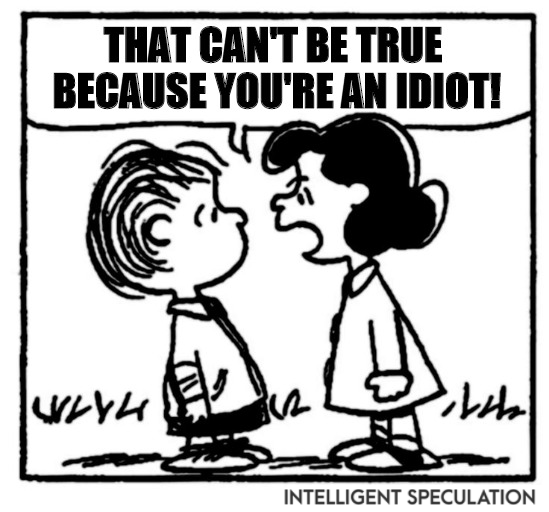
Although this explanation certainly sounds plausible, why did anxiety rear its ugly head in Germany and not in other countries? Why were Germans more anxious than, say, Americans, Spaniards, or Frenchmen? The underlying problem with these psychological explanations, including Neumann’s, is that they fall into what I like to call “the ad hominem trap.” (This fallacy occurs when, instead of addressing the merits of someone’s argument or position, we attack one’s appearance, one’s moral character, or some other irrelevant personal attribute, like one’s mental faculties. See the cartoon below for an illustration of this fallacy.)

Simply put, following Neumann’s lead, contemporary researchers often resort to finding some psychological fault or mental defect as the underlying source of conspiracy thinking. Ironically, however, blaming people’s mental states for holding fringe beliefs is itself a textbook example of the ad hominem fallacy.

Before going any further, it is worth asking why so many eminent scholars commit this egregious and embarrassing fallacy whenever they turn their attention to conspiracy theories? Why do so many research studies fall into this facile and tempting trap, questioning the intelligence or rationality of people who believe in conspiracy theories? Perhaps it is the result of researchers’ general inability to cast aside their own personal or normative views about conspiracy theories, or in the words of one scholar (Streicher, 2020, p. 281), “the academic treatment of [conspiracy theories] has frequently been characterized by the preconceived notion of conspiracy theories as morally ‘wrong’ ….” Or perhaps their falling into this fallacious trap is due to simple sociological factors. After all, most scholars have PhD’s or other advanced academic degrees, so how can anyone blame them for “looking down” on conspiracy theorists from their Ivory Tower perches, for seeing such gullible dupes as mentally-unhinged simpletons or irrational ignorami?

I, however, reject such ad hominem arguments out of hand. Instead of falling into the ad hominem trap, what if we were to take a more sympathetic view of conspiracy theorists and conspiracy believers? Specifically, regardless of one’s mental state, what is it about conspiracy theories that many people find so appealing? I will sketch several possible answers in my next few posts …

Ad Hominem — Critical Thinking | Intelligent Speculation

WORKS CITED

Goertzel, Ted. 1994. Belief in conspiracy theories. Political Psychology, 15(4), pp. 731-742.

Oliver, J. Eric, and Wood, Thomas J. 2014. Conspiracy theories and the paranoid style(s) of mass opinion. American Journal of Political Science, 58(4), pp. 952-966.

Streicher, Alois. 2020. “Truth under attack, or the construction of conspiratorial discourses after the Smolensk plane crash.” In “Truth” and Fiction: Conspiracy Theories in Eastern European Culture and Literature, Peter Deutschmann, et al., eds., pp. 279-299. Bielefeld, Germany and London: transcript Verlag.

van Prooijen, JanWillem, and Douglas, Karen M. 2017. Conspiracy theories as part of history: the role of societal crisis situations. Memory Studies, 10(3), pp. 323-333.

Posted in Uncategorized | Leave a comment

Neumann’s Test

Alternative Title: Why do we like to believe in conspiracy theories?

Note: This is the fifth blog post in a multi-part series

When are conspiracy theories real? Last week, in my previous set of blog posts, I presented (and rebutted) Ross Douthat’s four-part test for deciding which conspiracy theories to believe in or keep an open mind about. This week, I will ask a different question. This week, I will ask, why are people so gullible as to believe in so many far-fetched conspiracy theories in the first place?

It turns out that scholars and researchers from many different fields–including law, political science, philosophy, psychology, and sociology–have been fascinated by this very question and have attempted to answer it through a wide variety of theoretical lenses. But as far as I am concerned, the best place to start is still with Franz Neumann (1900-1954), who is pictured below, and his classic essay on “Anxiety and Politics,” which was published posthumously in 1957 in a book edited by the great Herbert Marcuse: The Democratic and Authoritarian State: Essays in Political and Legal Theory, pp. 270-300 (Glencoe, Illinois: The Fress Press). I begin with Neumann because of his background and intellectual pedigree. Also, as a German, he must have been intimately familiar with the Stab-in-the-Back Myth and how it was exploited by the Nazis to win votes. (For your reference, here is his Wikipedia page.)

In his essay “Anxiety and Politics,” Neumann identifies three features that all shadowy conspiracy theories or alternate realities have in common: “intensification of anxiety through manipulation, identification, [and] false concreteness.” The first of these elements–anxiety–refers to the psychological aspect of alternate realities: who is most likely to fall for a conspiracy theory? The last two elements–identification and false concreteness–refer to the content or internal logic of any given conspiracy theory: the identity of the conspirators and their nefarious goals. In my next post, I will use the World War I Stab-in-the-Back Myth to illustrate each one of these three features.

Franz Neumann (1900-1954)
Posted in Uncategorized | Leave a comment

Conspiracies and Religion

Alternative Title: Douthat’s Achilles’ Heel

(Note: This is the fourth blog post in a multi-part series.)

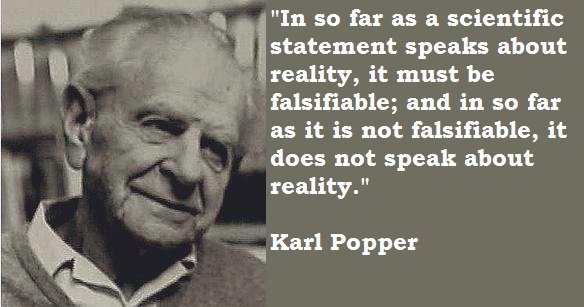
When are conspiracies real? We have been reviewing Ross Douthat’s recent New York Times column on this question, “A Better Way to Think about Conspiracies,” which contains a multi-part test for deciding which alleged conspiracies to keep an open mind about. Aside from simplicity and stochastic selectivity, Douthat also tells us to “avoid theories that seem tailored to fit a predetermined conclusion.” This key criterion appears to be inspired by Sir Karl Popper’s famous falsifiability principle. (Professor Popper, pictured below, was an influential 20th-Century philosopher of science who introduced the concept of falsifiability in his 1934 book Logik der Forschung, which was further revised and translated into English in 1959 as The Logic of Scientific Discovery.)

In brief, the Popperian concept of falsifiability refers to “testability” or “refutability”: the capacity for some proposition, statement, theory, or hypothesis to be tested and proven wrong, i.e. contradicted by evidence or “falsified.” As a result, conspiracy theories that are designed to confirm our pre-determined conclusions don’t deserve our respect; theories need to be falsifiable before they can be taken seriously. At first glance, Douthat’s version of this falsifiability criterion–which was originally used by Karl Popper to separate science from pseudo-science–would appear be an especially useful technique to distinguish “legitimate” or plausible conspiracy theories from imagined or invented ones. But upon closer inspection, one can make a psychological or “Kuhnian” objection to Popper’s falsifiability principle in the context of conspiracy theories. Such theories are more like religious beliefs: they are often a product of people’s deep-seated intuitions and implicit assumptions about the world, and those intuitions, beliefs, and assumptions are generally impossible to test or “falsify”!

As it happens, Douthat himself concedes in his NY Times essay that “to be a devout Christian or a believing Jew or Muslim is to be a bit like a conspiracy theorist, in the sense that you believe that there is an invisible reality that secular knowledge can’t recognize ….” In other words, religious beliefs, like many conspiracy theories, are usually the product of one’s private intuitions, not rational deliberations. These intuitions often reflect one’s most deeply-held beliefs and thus cannot be tested or falsified in any meaningful sense. To return to my favorite historical example, consider the German “Stab-in-the-Back” Myth from the Weimar Republic era (1919 to 1933). Not only is this conspiracy theory relatively simple and selective; it also solves a major mystery: why did Germany lose WWI? Alas, this myth is not amenable to rational analysis because it is unfalsifiable. If you really believe that the German Army was stabbed in the back by internal enemies, no amount of new evidence will be able to refute this narrative of Imperial Germany’s defeat.

Either way, whether we are in the domain of religion or the domain of politics, the main problem with Douthat’s analysis of conspiracy theories is that all such theories are, by definition, tailored to fit a pre-determined conclusion; that’s what makes it a conspiracy theory! As a result, conspiracy theories and alternate realities are impossible test or otherwise falsify. Like Freudian psychoanalysts or Marxist critics of capitalism, conspiracy theorists will always update their priors in favor of their pre-existing beliefs whenever they are presented with new or additional information. Put another way, no amount of evidence will be able to convince a “true believer” that a particular conspiracy theory or alternate reality is contrived. Perhaps, then, we should take a different approach. Instead of asking which conspirary theories we should keep an open mind about, what if we were to ask a different question. Specifically, what if we asked, Why are conspiracy theories so popular in the first place? I will proceed to address this question in my next set of blog posts starting on Monday, March 22.

Posted in Uncategorized | 8 Comments

Stochastic Conspiracies?

Note: This is the third blog post in a four part series.

When are conspiracies real? We have been reviewing a recent New York Times column on this question, “A Better Way to Think about Conspiracies,” in which Ross Douthat formulates an elaborate four-part test for deciding which alleged conspiracies to keep an open mind about. Two of Douthat’s rules of thumb can be combined into a single global criterion: stochastic selectivity. Specifically, Douthat concludes his essay with the following two guidelines: (1) we should consider taking conspiracy theories more seriously only when “the mainstream narrative has holes,” and (2) just because one particular fringe theory or myth might be true doesn’t mean all of them are.

Alas, Douthat’s stochastic selectivity criterion is neither here nor there. Why? For starters, because even so-called “mainstream” or consensus narratives, will always have gaps or holes in them. A narrative is just a story, and by definition all stories are necessarily incomplete. Furthermore, even a story with a single hole or gap might be called into question, depending on the size of that gap or its nature. The German stab-in-the-back myth of the Weimar Republic era (1919 to 1933), for example, fills a gap in the story of Imperial Germany’s defeat in the First World War. After all, how could one of the best-trained and most well-equipped military forces in the world, an invincible army that was said to be “undefeated on the battlefield,” lose the war? Although the mainstream view today is that Imperial Germany had lost the war by late 1918 because her army was out of reserves and was overwhelmed by the entrance of the United States into the war, there are still significant holes in this story, especially from the perspective of a post-war demoralized German public. After all, the United States’ first major offensive in WWI did not occur until the Battle of Cantigny in mid-1918, and in any case, the German public at that time had no way of knowing the true number of Germany’s reserves, as that number was classified information.

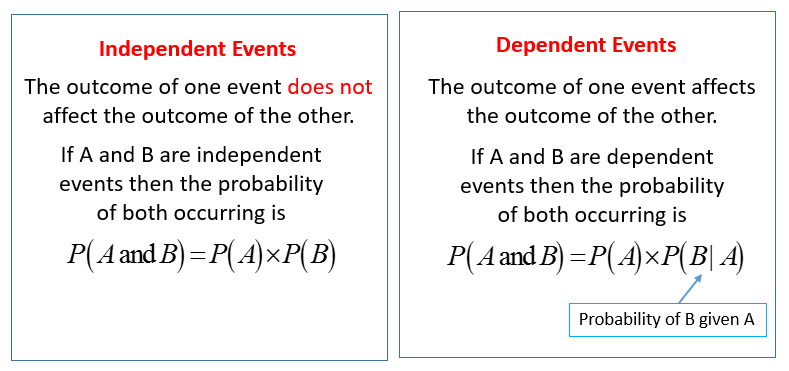
That said, to the extent that two or more imagined conspiracies are stochastically independent, then point #2 appears to be logically sound, since the probability of all such conspiracies being true is the product of their individual probabilities. But (wait for it!) what happens if we are considering overlapping conspiracies, i.e. conspiracies with similar goals or with the same subset of members? Stated formally, what happens when the conspiracies or secret plots under consideration are dependent events instead of independent ones? (Two events are said to be “independent” if knowing that one event has occurred doesn’t change the probability of the other event’s occurrence.) By way of historical example, given the anti-Semitic origins of many interwar European conspiracy theories, many people in Weimar Germany who fell for “The Protocols of the Elders of Zion” hoax might be more likely to believe in stab-in-the-back betrayal myth as well. Either way, whether we classify two or more conspiracies as dependent or independent events, there is a much bigger problem with Douthat’s approach to conspiracy thinking. I shall identify this fatal flaw in my next post.

Dependent Events (video lessons, examples and solutions)
Image credit: Online Math Learning
Posted in Uncategorized | 1 Comment

Ross Douthat’s Razor

Note: This is the second blog post in a four part series.

As I mentioned in my previous post, Ross Douthat’s recent NY Times column on conspiracy thinking, “A Better Way to Think about Conspiracies,” formulates a four-part test for deciding which alleged conspiracies to keep an open mind about, or in Douthat’s own words, “a tool kit for discriminating among different fringe ideas.” Among other things, Douthat recommends: “Prefer simple theories to baroque ones.” This first criterion can thus be restated in Occam’s Razor terms as follows: prefer simpler conspiracy theories to more complex ones. Let’s call this principle “Ross’s Razor.”

In brief, Ross’s Razor tells us that when we are presented with competing explanations of the same event (e.g., Germany’s defeat in World War I; Trump’s loss in 2020 despite winning in Florida and Ohio), we should select the simplest explanation, the explanation with the fewest assumptions. As an aside, this preference for simplicity, though attributed to William of Ockham (1287?–1347), a Franciscan theologian and scholastic philosopher (see image below), may, in fact, go as far back as Aristotle’s treatise Physics, which states, “Nature operates in the shortest way possible.” As a further aside, whether we define simplicity in terms of the number of background assumptions or in terms of how nature or the world operates, I personally prefer to frame the simplicity/parsimony criterion in probabilistic terms, since one of the rationales for this preference for parsimony is a probabilistic one: the idea that the simplest explanation is most likely to be the correct one.

Either way, however, what does “simpler” mean in the domain of alternate realities or conspiracy theories? Does simplicity refer to the number of conspirators? The goal of the conspiracy? The number of steps necessary for the conspiracy to succeed? Worse yet, however we answer the foregoing questions, one of the supreme ironies of many conspiracy theories is that they pass Douthat’s parsimony test with flying colors, especially when it is the truth that is often ambiguous and messy! By way of illustration, consider the German “Stab-in-the-Back” Myth that I mentioned in my previous post. In many ways, this particular conspiracy theory provides a far simpler and parsimonious explanation of Germany’s defeat in World War I than the truth does.

Yes, the German Army was low on reserves, and yes the United States changed the course of the war after the Battle of Cantigny (28 May 1918), but how could the German public know these things at the time? Also, even if the number of German reserves and the number of U.S. troops were publicly-available information, what could be more simpler than to believe that Germany was stabbed-in-the-back by a visible group of traitors, the “November Criminals” who signed the armistice in November of 1918? Simply put (pun intended), it is this tempting yet misleading simplicity that is one of the main attractions of so many fringe conspiracy theories! That said, I will consider the remaining three factors in Douthat’s four-part test in my next few blog posts.

Applying Occam's Razor to your writing - Punchline

Posted in Uncategorized | 1 Comment

When are conspiracies real? Reply to Ross Douthat, part 1

Happy St. Patrick’s Day! Ross Douthat, an influential columnist for The New York Times, recently wrote a fascinating essay titled “A Better Way to Think about Conspiracies.” As it happens, I have always been puzzled by one of the most famous conspiracy theories of all time, the “stab-in-the-back” myth that was popular in Germany during the ill-fated Weimar Republic era (1919 to 1933). How did the Imperial German Army–an army that was said to be “undefeated on the battlefield”–end up losing the First World War (WWI)? According to one popular conspiracy theory at the time, Germany lost WWI because she was “stabbed in the back” by a wide variety of left-wing politicians and intellectuals, who were collectively referred to as “the November Criminals” for agreeing to Germany’s surrender on 11 November 1918. In reality, however, Germany had lost the war because her army lacked sufficient reserves and because the USA had entered the war in full force in mid-1918. So, how did this dangerous myth persist for so long and win over so many hearts and minds?

Now, fast forward to the JFK assassination or, even more recently, to 2020? Did Harvey Lee Oswald act alone? Were the 2020 elections stolen from President Trump? If the JFK plot or Trump’s election fraud claims are just crazy conspiracy theories, why do so many people still believe in them? In short, where do we draw the line between plausible conspiracy theories and far-fetched ones? Here is why Douthat’s conspiracy theory essay is worth reading: he formulates a four-part test for deciding which alleged conspiracies to keep an open mind about, “a tool kit for discriminating among different fringe ideas.” In brief, Douthat’s conspiracy theory test consists of the following four criteria:

  1. “Prefer simple theories to baroque ones.”
  2. “Avoid theories that seem tailored to fit a predetermined conclusion.”
  3. “Take fringe theories more seriously when the mainstream narrative has holes.”
  4. “Just because you start to believe in one fringe theory, you don’t have to believe them all.”

Alas, Douthat’s four-part test is woefully inadequate for several reasons, which I shall discuss in detail in my next few posts. For now, it suffices to say that both the German “stab-in-the-back” myth as well as Trump’s stolen election story–indeed, most of the conspiracy theories mentioned in the chart below–would most likely pass Douthat’s four-part test with flying colors.

Chart: Belief in Conspiracy Theories in the United States | Statista
Posted in Uncategorized | 3 Comments