Bayes 9: the model

Note: This is my ninth blog post in a month-long series on the basics of Bayesian probability and its application to law.

I am now ready to present a stylized Bayesian model of litigation. To do so, I will have to make a number of simplifying assumptions about the litigation process. First, I will define ‘litigation’ broadly to include both criminal and civil cases. In essence, the litigation game (whether civil or criminal) is a contest in which the moving party, the plaintiff or the prosecutor, attempts to impose civil or criminal liability on the defendant for the commission of an unlawful or wrongful act (whether civil or criminal in nature). And likewise, seen from the defendant’s perspective, litigation is a contest in which defendants attempt to avoid the imposition of liability. My model thus presents litigation as a game with two possible outcomes: ‘positive’ (+) and ‘negative’ (–). Specifically, a ‘positive’ outcome occurs when the moving party successfully imposes civil or criminal liability on the defendant; a ‘negative’ one, when the defendant is able to avoid the imposition of liability. (Secondly, my simple Bayesian model of the litigation game ignores the temporal dimension of adjudication–‘time costs’ and the problem of delay. Instead, I will assume for simplicity that litigation is an instantaneous event, like a coin toss or the roll of a die.)

Having stated my simplifying assumptions, I will now proceed to apply Bayes’ theorem to the litigation process. Recall the statement of Bayes’ rule from one of my previous blog posts (“Bayes 6“):

Pr(A|B) = [Pr(B|A) × Pr(A)] ÷ Pr(B)

Translated into the legal language of litigation, my legal version of Bayes’ rule may now be restated as follows:

Pr(guilty|+) = [Pr(+|guilty) × Pr(guilty)] ÷ Pr(+)

In other words, we want to find the posterior probability, Pr(guilty|+), that a defendant will be found liable at trial, given that he or she has actually committed some wrongful act. (As the meme pictured below shows, Bayes’ rule is quite versatile; it can be applied to many other settings.) Ideally, of course, liability should be imposed only when a defendant has actually committed a wrongful act, and conversely, no liability should be imposed on innocent defendants. (In an ideal or perfect legal system, the value for Pr(guilty|+) should be equal to or close one, or stated formally: Pr(A|B) ≈ 1.) But in reality, false negatives and false positives will occur for a wide variety of reasons, such as heightened pleading standards and abuse of discovery in civil actions as well as prosecutorial discretion and prosecutorial misconduct in criminal cases. Stated colloquially, some guilty defendants will be able to avoid the imposition of liability, while some innocent ones will be punished. (See, for example, my “Bayes 3” blog post.)

To sum up, my Bayesian approach to litigation takes into account both (i) the possibility of a false positive (i.e., the imposition of liability when the defendant has not committed any wrongful act) as well as (ii) the possibility a false negative (no liability even though the defendant has, in fact, committed a wrongful act). The purpose of my stylized model, however, is not to explore the many systemic imperfections–procedural or practical or otherwise–in the existing legal system, imperfections contributing to the problem of false positives and negatives. This well-worn path has been explored by many others. (See, for example, Marc Galanter’s classic 1974 paper on ‘Why the “Haves” Come Out Ahead’, reprinted in David Kennedy and William W. Fisher, editors, The Canon of American Legal Thought, Princeton U Press (2006), pp. 495-545.) Instead, the goal of my model is to solve for Pr(guilty|+) and answer the following key question: How reliable is the litigation game, that is, how likely is it that a defendant who is found liable is, in fact, actually guilty of committing a wrongful act?

I will proceed to answer this question in my next post …

BAYES THEOREM
ts Likelihood
BAE'S THEOREM
P(NetflixIchill)P (chill)
P(chillI Netflix) =
Posted in Uncategorized | Leave a comment

Was Holmes a Bayesian?

In honor of Oliver Wendell Holmes, Jr.–the great North American scholar, jurist, and epistolarian, who was born on this day in 1841–and in keeping with my focus all this month on Bayesian reasoning in law, I am re-posting this blog post from 2014.

F. E. Guerra-Pujol's avatarprior probability

Not that Holmes. This one. In our previous blog post (11/14/14), we promised to explain why our defense of Bayesian methods is relevant to law. After all, how is probability theory generally or any of the foregoing specifically — i.e. Hájek’s analysis of the reference class problem, his critique of radical subjectivism, and our critique of Hájek’s critique — relevant to law? In short, probability theory, Hájek’s paper, and our critique of Hájek are relevant to law in many ways.

Consider, for example, the close relation between the reference class problem and legal reasoning, especially the doctrine of binding precedent and the legal principle that “like cases should be treated alike.” A general principle in common law legal systems is that similar cases should be decided the same way so as to give similar and predictable outcomes, and the doctrine of precedent is the mechanism by which this goal…

View original post 458 more words

Posted in Uncategorized | Leave a comment

Bayes 8: three additional features of Bayesian reasoning

Note: This is my eighth blog post in a month-long series on the basics of Bayesian probability theory

Thus far, by way of background, I have explained how Bayesian methods help us “test” the accuracy of our judgements, I have explained the logic of Bayes’ theorem (the equation in my “Bayes 6” blog post), and I have defined the technical concepts of sensitivity and specificity (Bayes 7). Here, before presenting my Bayesian model of litigation, I wish to make three more points about Bayesian reasoning:

First, the basic idea behind Bayes’s theorem is the idea that the conditional probability of event A, such as a defendant being found guilty, given the occurrence of another event B, the defendant’s commission of a wrongful act, not only depends on the strength of the relationship between A and B; it also depends on the prior probability of each event. Thus, according to Bayes’s theorem, the probability that a defendant in a civil action will be found liable (for tort, breach of contract, etc.), given that a plaintiff has brought an action against the defendant, will generally depend on two sets of probabilities: (i) the likelihood of the defendant being found liable given the strength of plaintiff’s claim, and (ii) the prior probabilities or success rates of plaintiffs and defendants generally.

Secondly, the probability of some event A conditional on some other event B is not the same as the conditional probability of event B given event A, or stated formally: Pr(A|B) is not equal to Pr(B|A). (See image below.) For example, the probability that a defendant will be found civilly or criminally liable, given that the defendant has committed some wrongful act–such as the commission of a tort, a breach of contract, a crime, etc.–, is not the same as the probability that the defendant’s wrongful conduct will result in liability, given that the plaintiff brings an a civil or criminal action against the defendant.

Lastly, it is also worth noting that Bayesian methods do not rely on any unrealistic assumptions about human rationality (unlike the standard assumptions of game theory or economics), nor does my Bayesian model of litigation require any detailed information about any particular rules of procedure or about substantive legal doctrine. Since such procedural rules and legal doctrines are often unclear, contested, and subject to manipulation, one can begin to appreciate the advantage of the Bayesian approach to civil and criminal litigation. In place of judicial hunches, indeterminate verbal arguments, or the inevitable ‘thrust and parry’ of competing interpretations of imperfect rules and doctrines (Karl Llewellyn, The Common Law Tradition (Little Brown 1960), pp. 522-529), my Bayesian approach to the litigation game attempts to understand the legal process from a probabilistic perspective.

Posted in Uncategorized | Leave a comment

Bayes 7: sensitivity and specificity

Note: This is my seventh blog post in a month-long series on the basics of Bayesian probability theory.

Happy Monday, fellow Bayesians! In this blog post, I will introduce and formally define the technical concepts of ‘sensitivity’ and ‘specificity.’ In the context of my Bayesian model of the litigation game, these concepts refer to the underlying reliability of a civil or criminal trial to distinguish between guilty and innocent defendants as follows:

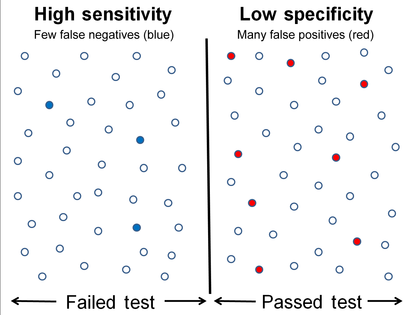
  1. Sensitivity. For starters, the ‘sensitivity’ of the litigation game—written as Pr(B|A) or, in our model, Pr(+|guilty)—indicates how well a civil or criminal trial is able to correctly impose liability on guilty defendants. In summary, this measure is defined formally as the probability of a positive litigation outcome (i.e., liability imposed on the defendant, which represents a ‘positive’ outcome from the plaintiff’s or prosecutor’s perspective), given that the defendant being tried has actually committed an unlawful wrongful act
  2. Specificity. By contrast, the ‘specificity’ of the litigation game, which may be written as Pr(–|innocent), reflects how well a civil or criminal trial is able to correctly screen out innocent defendants. This measure is defined formally as the probability of a negative litigation outcome (i.e., no liability imposed on the defendant, which represents a ‘negative’ outcome from the perspective of the moving party, plaintiff or prosecutor), given that the defendant has not committed a wrongful act.

The bottom line is this: Sensitivity and specificity are crucial concepts because civil or criminal liability should be imposed only on guilty defendants, i.e., defendants who have in fact committed an unlawful or wrongful act. In my next post, I will make three general points about Bayesian reasoning, and in my next few posts after that, I will present my Bayesian model of litigation outcomes.

Sensitivity and specificity - Wikipedia
Sensitivity and Specificity
Posted in Uncategorized | 1 Comment

Hostage Chess

I will continue my series of Bayesian blog posts on Monday; in the meantime, check out this new “hostage chess” website. Hat tip: Brian Leiter. More details about this strategic game are available here, via Wikipedia.

Posted in Uncategorized | Leave a comment

Bayes 6: the logic of Bayesian reasoning

Note: This is my sixth blog post in a month-long series on the basics of Bayesian probability theory.

In this post I present the logic of my Bayesian model of litigation outcomes in algebraic terms as follows:

Pr(A|B) = ([Pr(B|A)] × [Pr(A)]) ÷ Pr(B)

At first glance, this formidable and intimidating formula looks like an impenetrable set of terms, but it can be explained in words and broken down into the following five parts:

(i) The term on the left-hand side of the equation, Pr(A|B), refers to the conditional probability (or posterior probability) of event A, given the occurrence of event B.

(ii) The right-hand side of the equation is a fraction: the numerator contains two parts, Pr(B|A) × Pr(A), while the denominator consists of one term, Pr(B).

(iii) The first term in the numerator, Pr(B|A), refers to the conditional probability of event B, given the occurrence of event A.

(iv) The second term in numerator, Pr(A), refers to the prior probability (or unconditional probability) of event A, that is, the probability of A in the absence of any information about event B.

(v) Lastly, the denominator, Pr(B), is the prior probability (or unconditional probability) of event B in the absence of any information about event A.

In plain words, B or “+” is the probability of a positive litigation outcome from the perspective of the moving party in the litigation game, the plaintiff (in a civil trial) or the prosecutor (in a criminal trial). In other words, the main idea here is that the moving party—the plaintiff or prosecutor, as the case may be—obtains a favorable or positive outcome, which is denoted by the symbol +, when the defendant is found civilly or criminally liable at trial. Our Bayesian model of the litigation game thus poses the following fundamental question: what is the posterior probability that a defendant in a civil or criminal trial will be found liable, given that the defendant has not, in fact, committed any wrongful act? [1]

That is the question we will answer in my remaining blog posts. In the meantime, I will equate the term ‘guilty’ (or the letter ‘A’) with the event that the defendant in a particular litigation game has committed a wrongful or unlawful act, that is, an act for which he should be civilly or criminally liable. [2] In addition, I will equate the term the symbol + (or the letter ‘B’) with the event that the defendant is actually found liable at trial for the commission of a civil or criminal wrongful act. [3]

[1] The term Pr(A) or Pr(guilty) (in contrast to the terms ‘A’ or ‘guilty’) refers to the prior probability in the absence of additional information that this event (i.e., the imposition of civil or criminal liability) has in fact occurred.

[2] In other words, the symbol + and the term ‘positive litigation outcome’ is not meant to convey a pro-plaintiff or pro-prosecutor bias; instead, we use it to indicate a litigation outcome in which civil or criminal liability is imposed on the defendant.

[3] Like the term ‘litigation’, I define ‘wrongful act’ broadly to include both civil wrongs, such as torts and breaches of contract, as well as criminal wrongs, such as homicide and theft.

Posted in Uncategorized | 2 Comments

Bayes 5

Note: This is my fifth blog post in a month-long series on the basics of Bayesian probability theory.

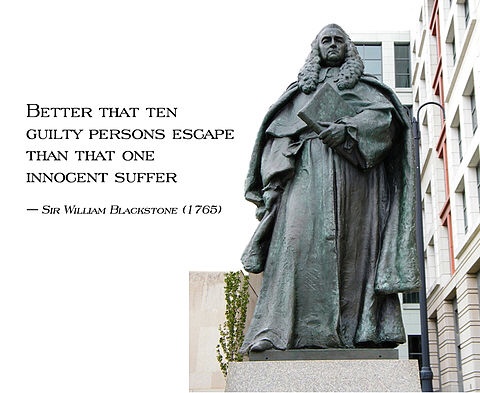
Why do I prefer Bayes over Blackstone? It was over a century ago that the great Oliver Wendell Holmes invited scholars to look at the law through the lens of probability theory when he said: “The prophecies of what the courts will do in fact, and nothing more pretentious, are what I mean by the law.” But Holmes himself and few other scholars have taken up this intriguing invitation. As such, in place of previous approaches to the study of law (e.g. the study of the meaning of words or the canons of statutory interpretation), I will present a non-normative, mathematical approach to law and the legal process in the remainder of this series of blog posts.

Specifically, as I mentioned above, I will turn to Thomas Bayes, not William Blackstone, for inspiration and present a formal Bayesian model of civil and criminal litigation. That is, instead of focusing on the rules of civil or criminal procedure or substantive legal doctrine, we ask and attempt to answer a mathematical question: what is the posterior probability that a defendant in a civil or criminal trial will be found liable, given that the defendant has, in fact, committed a wrongful act? I will present my Bayesian model in my next few posts …

Why 10? Why not 100? Or 1000?
Posted in Uncategorized | Leave a comment

Bayes 4

Note: This is my fourth blog post in a month-long series on the basics of Bayesian probability theory.

I resume by Bayesian blog series by explaining why Bayesian methods are like a meta-test, a way of testing the reliability of one’s tests. How? By allowing us to update and test our priors of a given uncertain event–e.g., whether x has cancer; whether y is a spam message; whether z committed a crime or a tort. In the case of a legal trial, as my last example suggests, the Bayesian approach is a formal method for updating one’s prior beliefs about a defendant’s guilt or innocence. Put another way, Bayesian reasoning is a method for testing the reliability and accuracy of a legal trial: it is a way of testing legal tests.

But how is a legal trial like a test? People often assume that trials are, instead, a search for the truth. The problem with this truth-function interpretation of trials, however, is that truth itself is a probabilistic ideal, not an absolute one, especially when there are different versions or interpretations of the truth. Furthermore, from the perspective of a trial attorney and the litigating parties, a trial is just a risk-taking activity, a game whose main object is to “win,” regardless of truth. Metaphorically speaking, then, a legal trial is more like poker and less like science. Of course, it helps to have the truth on one’s side, but my point here is that having the truth on one’s side is neither a necessary nor sufficient condition for winning at trial–the ultimate goal of litigation from the perspective of the parties. To sum up, a legal trial is not a dispassionate or scientific search for truth; it is a bet or wager on which party’s story or version of the truth is more likely to be accepted as true.

More importantly, truth is a probabilistic concept, for there can be competing conceptions of the truth in any given case. That is why a legal trial can be compared to a test–a test of the evidence the parties offer in support of their competing versions of the truth. Thus, a legal trial is more like a medical test or a spam filter, but instead of testing for cancer, HIV, or spam, litigation simply tests the strength of the moving party’s case. In Anglo-American law, the moving party is either the government (e.g., the prosecution in a criminal case) or a private party (e.g., the plaintiff in a civil case), and when a prosecutor or plaintiff goes to trial, he is literally putting his allegations (his evidence) to the test. In either case, civil or criminal, the moving party must submit sufficient evidence to pass the relevant test. In civil cases the test is pass/fail–e.g., the preponderance of the evidence standard. In criminal ones the test is more demanding–e.g., the reasonable doubt standard. In either case, the question is the same: has the prosecution proven its case beyond a reasonable doubt? Or, has the plaintiff proven his case by a preponderance of the evidence? This, then, is what I mean when I describe a legal trial as a test.

With this background in mind, how can we use Bayesian methods to test our legal tests? I shall turn to this question in my next few blog posts.

Is “truth” binary or probabilistic?
Posted in Uncategorized | Leave a comment

Sowell versus AOC

Alternative title: Style versus Substance

I admit that I am a huge fan of AOC’s style and of her general anti-establishment rebelliousness, but in this short video clip the great Thomas Sowell points out some devastating problems and logical fallacies in the substance of AOC’s rhetoric and policies.

https://m.youtube.com/watch?v=SprRnUBAruw

Posted in Uncategorized | Leave a comment

Social media self-cancellation update

Farewell, Twitter and Facebook!!! I am interrupting my series of Bayesian blog posts to let people know that I have decided to “self-cancel” my social media presence by closing my social media accounts during Lent. In any case, I was spending way too much time on those websites and receiving little of value in return, with the possible exception of a few chess sites that I was following. In other words, the ratio of worthy-to-inane posts on my Facebook and Twitter feeds was just too low. I will, however, remain here on WordPress for the foreseeable future …

Posted in Uncategorized | 1 Comment