Do grasshoppers dream of impartial spectators?

(With apologies to Philip K. Dick.) In a previous post I explored the role played by the “impartial spectator” in Adam Smith’s moral philosophy, but is Smith’s memorable metaphor deserving of our study and attention in our day and age, or is this imaginary being just another piece of antiquated philosophical B.S. with no operational relevance to our daily lives? (For my part, I am in the former camp.) Either way, however, above and beyond these eight questions posed by my colleague and friend Dan Klein, I would also like to pose to Ryan Patrick Hanley–author of Our Great Purpose and Smith scholar extraordinaire–the following five pesky questions about Smith’s impartial spectator (note: all author and page references are to the May 2016 issue of Econ Journal Watch, or EJW, 13(2), which contains a special symposium devoted to the impartial spectator):

  1. First and foremost, what is the ontological status or metaphysical origins of this imaginary being? Specifically, is he (she?) (them?) (it?) an artificial human creation–i.e. something we conjure up out of whole cloth–or is this imaginary being somehow “hardwired” by natural or sexual selection into every human brain–an innate faculty we are born with? (Cf. McHugh 2016.) Either way (human invention or innate faculty), does this abstract entity have an ethnicity, a gender, or a sexual preference? (Cf. Weinstein 2016, p. 356.)
  2. Secondly, and from a purely logistical or practical perspective, when does the impartial spectator, if he (her/them/it) really exists, actually come into play? To the point: if it’s true, for example, that the average person makes up to 2000 decisions every hour (see here), which of these myriad decisions are subject to review by one’s impartial spectator–i.e. actually go up “on appeal”, so to speak. Put another way, if Smith’s impartial spectator operates like a Court of Appeal, what criteria does he (the impartial spectator) use in deciding which of our decisions will be taken on appeal?
  3. Next, what is the moral or normative status of the moral judgements generated by this heuristic, i.e. the decisions or verdicts rendered by the impartial spectator? (Note: I prefer the British spelling of the word “judgement.”) Are these verdicts/judgements fallible or infallible? Final or tentative? Put differently (cf. Mueller 2016), do the judgements and identity of this imaginary entity vary from person to person, or is Smith’s impartial spectator capable of generating universal and timeless moral judgements?
  4. Also, how helpful or reliable is Smith’s imaginary spectator, really? Specifically, can he or she or them transcend or correct our “entrenched cultural biases” (Fleischacker, 2016, p. 278)? By way of example, Walt Disney’s Jiminy Cricket famously admonished Pinocchio to ”let your conscience be your guide.” This is helpful advice if your impartial spectator is able to reliably discern right from wrong, but how reliable is your conscience? Circling back to Smith, since the impartial spectator is not a real person–it is an imaginary being–it is only as reliable as the person conjuring him/her/them up. After all, the impartial spectator, being an imaginary entity, has no store of knowledge beyond that of the person who is conjuring it up.
  5. Lastly, and relatedly, isn’t Smith’s impartial spectator, assuming it exists, a superfluous entity? If not, what work does this imaginary being really do? (Cf. Craig Smith 2016.) To the point: if a virtuous person is someone who is guided by the judgements of the impartial spectator, then by definition a non-virtuous person is someone who neglects or ignores these judgements. In that case, the impartial spectator falls into a circular trap; it is the mysterious quality of “virtue” (not the judgements of the impartial spectator) that is doing the heavy moral lifting.

The reference to “virtue” in the preceding paragraph takes us to the last major feature of Adam Smith’s moral philosophy, a feature that Professor Hanley himself heaps considerable–but perhaps unjustified–praise on. I will discuss Hanley and Smith’s treatment of moral virtue in my next post …

3 Always Let Your Conscience Be Your Guide Button image 0
Posted in Uncategorized | 2 Comments

Letter to the Editor (national anthem edition)

I interrupt yet again my review of Ryan Patrick Hanley’s latest book on Adam Smith in order to express my opinion about Mark Cuban’s controversial decision to cancel the national anthem during his team’s home games: although I strongly disagree with his decision, I condemn in even stronger terms the NBA Commissioner’s ham-fisted decision to compel the playing of the national anthem at all games. That is, in my libertarian opinion, pro-sports franchises should be free to make this decision without league interference.

Posted in Uncategorized | 3 Comments

The Impartial Spectator to the Rescue?

Alternative Title: Two Problems with Mutual Sympathy and Adam Smith’s Solution

Although the sympathy of others (to paraphrase Smith) is necessary to our happiness, and although we also want to receive the sympathy, attention, and esteem of others, Ryan Patrick Hanley points out two further problems with Smith’s theory of mutual sympathy in practice. One problem is that we are often selective and superficial in choosing the objects of our sympathy. As Hanley puts it (p. 30), “the wealthy are often worshipped, and the poor willfully overlooked.” Aside from this bias issue, the other problem is that our single-minded pursuit of sympathy, attention, and esteem can itself get out of hand. We might spend way too much time and effort in trying to seek the attention of others, or we might end up painting a false picture of ourselves–as anyone who has spent time on social media can attest to. To sum up, the pursuit of attention, combined with a bias toward the wealthy, might thus lead to “mindless striving” (p. 41) and even to “mental mutilation” (p. 39).

So, what is to be done? Here is where Hanley introduces us to the ingenious distinction Adam Smith drew between “praise” and “praiseworthiness” (perhaps the most important distinction in all of Smith’s work) as well as to Smith’s imaginary device of the “impartial spectator.” And here too is where Smith’s analysis of morality and life moves from the descriptive (Hume’s “is”) to the normative (“ought”). For according to Smith, it’s just not enough to obtain the praise and esteem of others; we must also be deserving of this praise.

But this fundamental Smithian distinction between “praise” and “praiseworthiness” poses a new problem for us: how to do we know when are truly deserving of praise? Here is where the perspective of Smith’s “impartial spectator” comes into play. Ideally, this impartial spectator, this “man within,” will act as an impartial judge and juror, reviewing our actions and our motives and determining whether we are truly deserving of the praise of others. At a minimum, the impartial spectator helps us understand that “we are just one of the multitude.” Either way, whether he is operating as a neutral judge or just as a simple reminder that–contra Mr Rogers–we are not all that special, the impartial spectator invites us to take into account the perspective of others and to put our self-interest and self-concern into perspective.

Before we proceed into the last major aspect of Smith’s theory and conclude our review of Hanley, I want to call a “time out” in the name of David Hume and point out that the impartial spectator is an imaginary fellow. He does not really exist, so his ability to influence our behavior, let alone control it, is probably negligible at best. Smith or Hanley might reply by asking, Is the imaginary nature of the impartial spectator a feature or a bug? These are difficult questions, and as it happens, an entire volume of Econ Journal Watch is devoted to the impartial spectator (see here). I will weigh the pros and cons of Smith’s impartial spectator in my next post.

Image result for impartial spectator

Posted in Uncategorized | Leave a comment

Mary Wilson Forever

I am interrupting my review of Ryan Patrick Hanley’s book on Adam Smith to pay my respects to the great Mary Wilson. Update (2/15): Also, check out this collection of Mary Wilson recordings. Hat tip: Steve Lubet, via The Faculty Lounge.

Posted in Uncategorized | 1 Comment

Smith on Sympathy and Selfishness

Alternative Title: Adam Smith’s (Humean-Inspired?) Theory of Reciprocal Sympathy

As Ryan Patrick Hanley correctly notes in his beautiful new book on Adam Smith, the concept of sympathy or “fellow feeling” is the cornerstone of Smith’s moral philosophy. The original 1759 edition of Smith’s Theory of Moral Sentiments of TMS had six parts, and Smith devotes the entire first part to explaining the role sympathy plays in morality. In fact, the very first line in TMS contains the following powerful observation (quoted on p. 15 of Hanley):

How selfish soever man may be supposed, there are evidently some principles in his nature which interest him in the fortune of others, and render their happiness necessary to him ….”

For Smith, then, humans are not just purely selfish actors or egoistic “utility maximizers” in the parlance of modern economics. On the contrary, we not only care about the welfare of others; the happiness of others is “necessary” to our well-being! We have a natural disposition to sympathize with other people, or as Hanley puts it (p. 15), “we also naturally care about the well-being of others,” so depending on the situation, we like to share their joys and are also able feel their pain and suffering. But as original and remarkable as this observation is–especially coming from Adam Smith, the father of modern economics–Smith the moral philosopher makes an even more original and remarkable observation about the reciprocal nature of sympathy in the first part of TMS (quoted on p. 23 of Hanley):

Of such mighty importance does it appear to be, in the imaginations of men, to stand in that situation which sets them most in the view of general sympathy and attention.

In other words, sympathy is not just something we are naturally inclined or willing to give to others; sympathy is also something we want to receive from others, or in the words of Hanley (p. 24): “… not only are we naturally disposed to sympathize with others, we also naturally desire that others sympathize with us.” (In fact, according to Smith (as quoted in Hanley, p. 28), this is why we spend so much time trying to “better our condition”–in order “to be taken notice of with sympathy, complacency, and approbation ….”) This key Smithian insight about the reciprocal nature of sympathy is important for three reasons. First and foremost, this insight goes a long way toward solving “Das Adam Smith Problem,” toward reconciling Smith the economist and Smith the moral philosopher. Simply put, we don’t sympathize with others out of pure altruism but rather out of our own self-interest.

Second, this Smithian insight about the reciprocal nature of sympathy helps explain and unravel many of the riddles, quirks, and mysteries of human behavior. Why, for example, do young people spend so much time on social media? Because they crave the attention of their peers. In short, Smith’s insight paints a more accurate and nuanced portrait of human psychology and motives than the low-grade, utility-maximization picture painted by mainstream economists. Or as Hanley puts it (p. 17), “… we have, by nature, two parts to us that on their face pull in different directions. One leads us to care about ourselves and our own happiness, while the other leads us to care about others and their happiness.”

But perhaps the most important aspect of Smith’s key insight is that these mutual or reciprocal exchanges of sympathy–not God or the Good–are the true foundation of morality. As a result, sympathy plays a crucial role not just from an individual perspective–for our individual well-being and sense of worth–but also from a “social” or community perspective–for the well-being of society as a whole. Why? Because it is the reciprocal nature of sympathy that allows us to transcend the selfish sides of our natures and potentially bridge our many divisions and break out of our current cycles of tribalism.

Alas, I say “potentially” because Smith’s beautiful theory of reciprocal sympathy, as original and sophisticated as it is, poses a new problem: what I shall call “Das Adam Smith Problem 2.0.” If these reciprocal exchanges are so essential to our well-being (from both an individual and community or social perspective), then why do we see so much division and tribalism in our contemporary world today? My own view is that there is an optimal level of tribalism and that our current levels of disunity are probably over-hyped, but as far as I can tell that is neither Smith’s nor Hanley’s view, so rest assured we will further probe this new problem in my next few posts …

Screen Shot 2021-02-09 at 1.03.58 PM

Posted in Uncategorized | Leave a comment

David Hume vs. Adam Smith

Before we discuss the main features of Adam Smith’s approach to moral philosophy (sympathy or fellow-feeling, the imaginary impartial spectator, and virtue), I want to share with you two quotes by David Hume: one about the limited role of reason in matters of morality; the other on Hume’s famous “is-ought” distinction, i.e. the notion that facts and values are two different domains. In many ways, Smith’s Theory of Moral Sentiments can be seen as an extended reply to Hume. (An in-depth survey of Hume’s moral philosophy can be found here.)

Posted in Uncategorized | 3 Comments

Life is full of opportunity costs

Ryan Patrick Hanley poses two deep philosophical questions on the first two lines of the first page of his new book Our great purpose: Adam Smith on living a better life: “What does it mean to ‘live a [good] life’? And for that matter, what exactly does it mean to ‘live a life’ in the first place?” These are perennial questions. How should we go about answering them? At a minimum, we can all agree that life is full of choices, of paths not taken. (Fun fact: according to this source, the average person makes around 2,000 decisions per hour; from a purely economic perspective, then, we might say that our lives can be defined in terms of “opportunity costs,” since life is full of delicate tradeoffs.) This insight, in turn, poses more deep philosophical questions:

  1. What makes one path better than another?
  2. What standard should we use to judge what choices we make?
  3. And where should we turn for guidance on all this?

All of these eternal questions appear on page 1 of Hanley’s beautiful new book. His contribution is to show how the ideas of Adam Smith are relevant to these moral questions–not the ideas of Adam Smith the father of capitalism and champion of liberty–but rather the ideas of Adam Smith the great moral philosopher. For as Hanley correctly reminds us, before Smith authored his critique of mercantilism and defense of economic freedom, he was a Professor of Moral Philosophy for many years; before he wrote The Wealth of Nations (1776), he first wrote The Theory of Moral Sentiments (1759).

More specifically, three important themes in Smith’s first book are going to be especially relevant to these big questions and to our contemporary controversies today: (1) Smith’s notion of “sympathy”; (2) his imaginary “impartial spectator”; and (3) his theory of human virtue. What does Smith have to say about each one of these themes, and why are Smith’s observations relevant to our world today? I shall address those second-order questions in my next few posts …

Image result for opportunity cost
Posted in Uncategorized | 2 Comments

Best Adam Smith Bibliography Ever?

As I mentioned in a previous post, in the days ahead I will be reviewing Ryan Patrick Hanley’s new book about Adam Smith: “Our great purpose: Adam Smith on living a better life” (Princeton U Press, 2019), one of the most fascinating and beautiful books I have read in a long time. But before I begin, allow me first to fast-forward to the end of Professor Hanley’s tome–the next-to-last section titled “Texts and Further Readings” (pp. 141-148). For after I finished reading the book proper, the nerdy academic in me pressed on and perused Hanley’s annotated bibliography and suggestions for further reading. Suffice it to say what I found there was nothing less than a scholarly treasure trove of erudite gems. More specifically, Hanley has done his readers a great service by organizing his carefully curated yet comprehensive bibliography (see table below) by theme or subject area, pointing out the two or three most relevant papers or books about each theme and area. By way of example, Hanley’s thematic bibliography contains entries for such recondite topics as Smith’s concern for the poor, his commitment to moral pluralism, and his intellectual debts to Socrates and Plato, among many others entries. (I have compiled below a table of all the themes and subject areas covered in Hanley’s excellent bibliography. Anyone wishing to pursue any of these fascinating topics further would be well to begin here.) With this preliminary observation out of the way, we will formally get started in my next post tomorrow …

citation bibliography meme

Some Themes and Subject Areas in Hanley’s Bibliography

  1. Biographies of Adam Smith
  2. Overviews of Smith’s thoughts on ethics and economics
  3. Introductions to Smith’s first book “The theory of moral sentiments”
  4. Smith’s views on self-interest
  5. Smith’s approach to egoism and altruism
  6. Smith’s concept of sympathy
  7. The role of the imagination in Smith’s moral system
  8. Smith’s concern for the poor
  9. The role of happiness in Smith’s theories
  10. Das Adam Smith Problem
  11. Smith’s views on corruption
  12. Smith’s ideas about friendship
  13. Smith’s treatment of anxiety
  14. Smith’s theory of law (jurisprudence)
  15. Smith’s treatment of justice
  16. Smith’s commitment to pluralism
  17. Smith’s critique of the man of system
  18. The distinction between the love of praise and the love of praiseworthiness in Smith’s thought
  19. Smith’s theory of the impartial spectator
  20. Smith’s commitment to equality and human dignity
  21. Smith theory of virtue
  22. Smith’s relationship to ancient thinkers like Socrates and Plato
  23. Smith’s friendship with Hume
  24. Smith’s views on religion
  25. Additional books about Adam Smith by Ryan Patrick Hanley
Posted in Uncategorized | Leave a comment

PSA: Can we just cancel Super Bowl LV?

What happened to “saving grandma”? The covid coronavirus is peaking, new strains are popping up everywhere, and yet we are still plowing ahead with this totally unnecessary super-spreader event. I respectfully reiterate my call that the Super-Spreader-Bowl be cancelled or postponed.

F. E. Guerra-Pujol's avatarprior probability

View original post

Posted in Uncategorized | Leave a comment

Social media mafia?

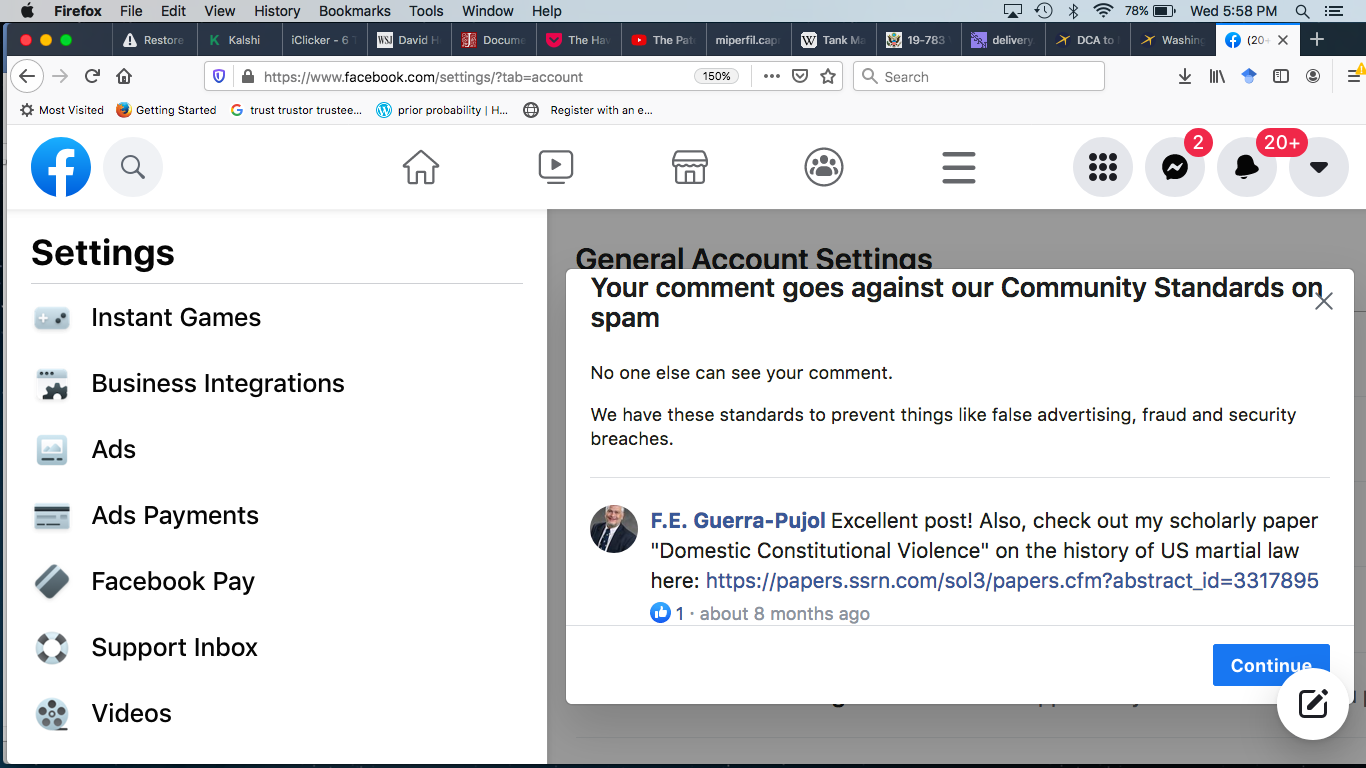
I was on the verge of deleting my Facebook account again, but to paraphrase Michael Corleone in The Godfather: just when I thought I was out, Day 1 of the Meltwater Champions Chess Tour has pulled me back in! #ChessChamps #FacebookLive (On another note, I will begin my review of Ryan Patrick Hanley’s beautiful new book on Adam Smith’s moral philosophy on Monday.)

Screen Shot 2021-02-06 at 11.29.56 AM

Screen Shot 2021-02-06 at 11.26.34 AM

Posted in Uncategorized | Leave a comment