
What a cool creation by @Duiker101; create yours here, via chirpty.com.

What a cool creation by @Duiker101; create yours here, via chirpty.com.
… and perhaps the most beautiful one!
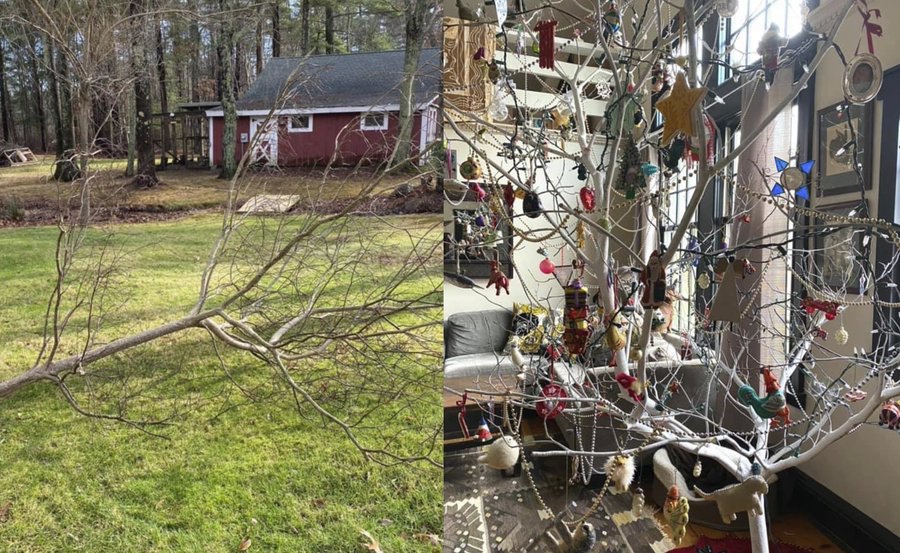
Check out this selection of creative book covers via Emily Temple/LitHub. Hat tip: Kottke.

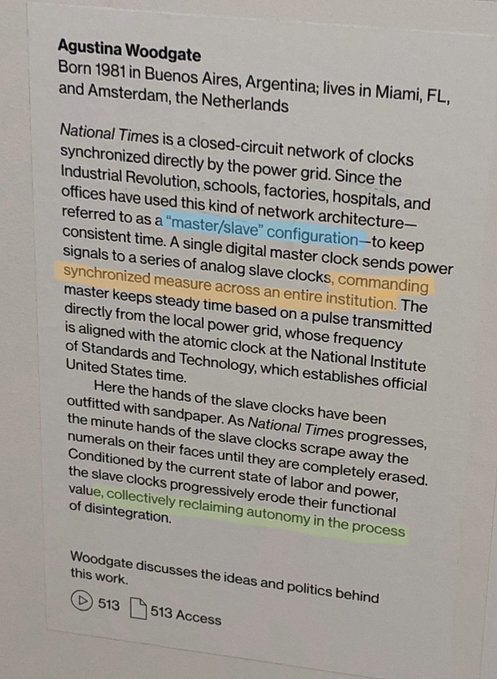
Check out the recent art exhibit pictured below at the Whitney Musuem. If we are going to rail against modern master/slave relationships, however, I would start off with email, not clocks, as I have always thought of clocks as helpful coordination devices, but I am not a conceptual artist! (Hat tips: @david_perell & @jeremygiffon.)


Update (8/17/21): I have since made substantial revisions to the paper mentioned below and have re-titled it “Lockdowns as Takings.”
With the recent rash of oppressive and exemption-riddled lockdown orders being imposed across the United States again, I thought I would re-post my paper “A Nozickian or natural rights approach to the coronavirus pandemic.” Note: I am not second-guessing the wisdom of these measures; I am just saying that business owners are legally entitled under the Constitution to “just compensation” (i.e. lost revenues) whenever the government orders them to close down their business firms in the name of public health.
Smith v. Rapid Transit, y’all! As you may have heard by now, SCOTUS threw out, by a vote of 7 to 2, Texas’s last-ditch effort to derail the election of former Vice President Joe Biden, but what you may not have heard of is the obscure but important case of Smith v. Rapid Transit. In brief, this case stands for the proposition that probabilistic proof, standing alone, i.e. without any corroborating or direct evidence of misconduct, is not enough to prove a fact. Before proceeding, can you already see why this case explains the result in the Texas case?
Instead of rehashing the merits of the Texas case, however, I will take a closer look at the Smith case. In summary, the plaintiff, Betty Smith, was driving down Main Street in the City of Winthrop, Massachusetts at about 1:00 a.m. on February 6, 1941. She saw a bus coming toward her at high speed and, to avoid a direct collision with the bus, she swerved and crashed into a parked car, but she did not actually see whose bus ran her off the road. Nevertheless, the plaintiff’s attorney later discovered that the defendant operated a bus line in the City of Winthrop and had an exclusive license to operate a bus route on Main Street, and according to the defendant’s timetable, the defendant’s buses were scheduled to travel down Main Street at 12:10 a.m., 12:45 a.m., 1:15 a.m., and 2:15 a.m. (A second bus company had a license to operate a bus line in the City of Winthrop but not on Main Street.)
Since this was a civil case, the plaintiff was required prove her case by “a preponderance of the evidence.” Stated in probabilistic terms, it must be more likely than not that the defendant’s bus caused the plaintiff to swerve into the parked car. The problem in the Smith case, however, was that the only evidence linking the defendant’s bus line to the scene of the accident is probabilistic in nature. That is, since by the plaintiff’s own admission she did not actually see which bus was going down Main Street at the time of the accident, the only evidence linking the defendant’s bus to the scene of the accident was the defendant’s published timetable or schedule.
This simple case thus presents a controversial legal issue, one that is relevant to the allegations of voter fraud in the 2020 presidential election. Stated simply, the issue is whether probabilistic proof alone is enough to prove an allegation. The trial judge in the Smith case ruled that probabilistic proof is not enough as a matter of law and entered a directed verdict in favor of the defendant bus line, and the Massachusetts Supreme Court then affirmed the trial court’s decision, holding that probabilistic proof, by itself, is not sufficient to prove one’s case. The Massachusetts Supreme Court explained its reasoning that “[t]he most that can be said of the evidence in the instant case is that perhaps the mathematical chances somewhat favor the proposition that a bus of the defendant caused the accident. This [is] not enough.” (Since then, most U.S. courts, State and federal, have followed this reasoning in subsequent cases.)
As it happens, I wrote about this case a few years ago in my paper “Visualizing Probabilistic Proof,” and for my part, I would ask, Does it make sense to draw this line between direct evidence and mere probabilistic proof? Specifically, isn’t all evidence, even direct proof like eyewitness testimony, ultimately probabilistic in nature?

Today (12 December) is the Feast Day of the Virgen of Guadalupe, a national holiday in Mexico and one of my favorite feast days of the year! More details here, in Spanish.








Welcome to the online home of the IASS
Hopefully It’s Interesting.
In Conversation with Legal and Moral Philosophers
Relitigating Our Favorite Disputes
PhD, Jagiellonian University
Inquiry and opinion
Life is all about being curious, asking questions, and discovering your passion. And it can be fun!
Books, papers, and other jurisprudential things
Ramblings of a retiree in France
BY GRACE THROUGH FAITH
Natalia's space
hoping we know we're living the dream
Lover of math. Bad at drawing.
We hike, bike, and discover Central Florida and beyond
Making it big in business after age 40
Reasoning about reasoning, mathematically.
I don't mean to sound critical, but I am; so that's how it comes across
remember the good old days...
"Let me live, love and say it well in good sentences." - Sylvia Plath
a personal view of the theory of computation
Submitted For Your Perusal is a weblog wherein Matt Thomas shares and writes about things he thinks are interesting.
Logic at Columbia University
Just like the Thesis Whisperer - but with more money
the sky is no longer the limit
Technology, Culture, and Ethics
Just like the horse whisperer - but with more pages
Poetry, Other Words, and Cats


 prior probability