Putting aside porn sites and the dark web, are we not living in an Internet “golden age” of ideas and information? Here are just a few of the excellent essays and Wikipedia entries that I randomly stumbled upon this semester:
According to the map pictured below (hat tip: u/TrollBond), 43 States (in blue) have a smaller population than Los Angeles County (in red). So, why did it take some of these “blue” States, like Arizona, Georgia, and Nevada, so long to count the votes of their citizens and to certify their election results?
At the same time, even though these “blue” States had fewer votes to count than L.A. County had, the outcome of the presidential election in these States was much closer, but this fact poses an additional question. Specifically, did these States need the extra vote-counting time to carefully and individually verify the legality of each mail-in ballot, or did they use the extra time to find new and creative ways to rig the election?
As promised, I have carefully reviewed the intriguing Appendix in the court filings with SCOTUS (pp. 20-29) in the case of Texas v. Georgia, et al. (specifically, the “Declaration of Charles J. Cicchetti, Ph.D.”) as well as David Post’s critique of Dr Cicchetti’s statistical analysis, and below are my tentative thoughts on this matter. (For brevity, I will limit my comments to Cicchetti’s analysis of the election results in Georgia.)
In summary, Cicchetti makes two claims: one regarding the election results in Georgia overall (let’s call this “Claim A”); the other specifically about the mail-in ballots (“Claim B”). (Also, for the reasons I will give below, I agree with David Post’s critique of Claim A, but disagree with Post’s critique of Claim B.) Let’s start with the weaker claim, shall we? Claim A is simply that, holding voter preferences from 2016 constant, it is extremely unlikely that Joe Biden could have won the Georgia contest in 2020 by honest means. Alas, this claim is total bullshit. Why? Because holding voter preferences constant makes absolutely no sense in the context of an election contest. The whole purpose of an election is to measure voter preferences, and voter preferences may change from one year to the next. That is the whole point of holding elections!
Let’s now turn to Claim B, which is the stronger of the two claims. Claim B is that the mail-in ballots are suspect and probably rigged because the final results of the mail-in ballots diverge greatly from the final results of the early-voting ballots and the in-person ballots. Specifically, Cicchetti states in Paragraph 14 of his Declaration (emphasis added by me):
“At 3:10 AM EST on November 4 the Georgia reported tabulations were 51.09% for Trump and 48.91% for Biden (eliminating third-party candidates). On November 18 at 2 PM EST, the reported percentages were Trump 49.86% and Biden at 50.14%…. For this turnaround to occur, the subsequent “late” [i.e. mail-in] ballots totaling 268,204 votes (5.4% of the votes reported on November 18) had to split 71.60% for Biden and 28.40 for Trump.”
Here, Post is wrong to dismiss the substance of this claim. Although Post is correct to conclude that we can’t hold constant voter preferences from one election to the next, we can certainly do so with randomly selected subsamples of voters in the same election. The key question, then, is whether the population of voters who voted by mail is in any relevant respect different than the population of all voters, or early voters, or in-person voters? For my part (unlike Prof Post), I remain agnostic on this question.
Addendum (12/11): I have been informed via Twitter and by some of my followers that the mail-in ballots were expected to lean toward Joe Biden because Trump told his voters to vote in person. But if that is the case (that most mail-in ballots were submitted by Democrats or left-leaning voters), why did Trump apparently hold his own with early voters? Also, either way, how could we “test” or try to prove this assertion? I wish the secretary of states of GA, PI, MI, and WI would tell us the number of “mail-in” ballots that were received and counted as well as as the number of “early ballots” and “in-person/election day” ballots.
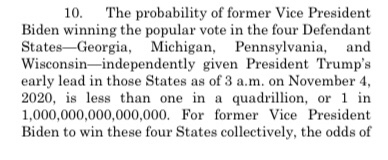
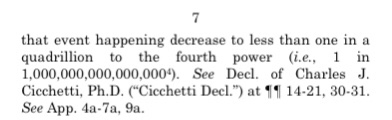
(My most sincere apologies to William Shakespeare!) Earlier today, I requested a copy of the Appendix mentioned in Paragraph 10 on pp. 6-7 of the Texas’s Attorney General’s “Motion for Leave to File Bill of Complaint.” (See screenshots below.) As soon as I obtain this Appendix, I will conduct my own analysis of the matter and report back soon!
Update #1 (12/8, 9:32PM): I was able to track down the Appendix–it is available here, see pp. 20-29. Due to other commitments, I hope to report back by the end of this week.
Update #2 (12/9, 8:53PM): My colleague David Post has written up a strongly-worded critique of the statistical analysis in the aforementioned Appendix. I agree with most of Professor Post’s critique but disagree with one part of his analysis regarding the distribution of voter preferences on mail-in ballots. Alas, because I am currently bogged down with…
Update: I have revised one of my conjectures about Adam Smith’s lost loves as follows:
Based on the evidence presented in the first part of this paper, it is more likely than not that Doctor Smith did fall in love on several occasions in his life. To begin with, Professor Dugald Stewart (1980, Note K), the only biographer who knew Adam Smith when he was alive, reports from his personal knowledge that it was “well-known to [Smith’s] friends that he was for several years attached to a young lady of great beauty and accomplishment,” that this attachment occurred “in the early part of [Smith’s] life,” and that he (meaning Professor Stewart) had once met this mysterious maiden in person “when she was turned of eighty.” Given these facts and the reputable source from which they come, I conjecture that this lost love, Smith’s first romantic attachment, most likely may have occurred during the years 1746 to 1748, when the young Adam Smith returned to his hometown, the small coastal community of Kirkcaldy, and lived with his mother for two years after having completed his formal studies at Oxford.[1] Smith would have been between 23 and 25 years old at the time.
Also, given the small population in Kirkcaldy during Smith’s lifetime as well as the existence of detailed Church records for this small parish, it is my belief that historians should be able to identify Adam Smith’s first love interest.[2] As an aside, Dugald Stewart himself (1980, Note K) mentions that he had the pleasure of meeting this mysterious maiden when she was advanced in age (“when she turned of eighty”), but when exactly did this meeting occur? At the latest, it must have occurred in 1792, since Professor Stewart first read his account of Smith’s life to the members of the Royal Society of Edinburgh in January and March of 1793. If this guess is correct, then the Lady of Fife would have been 34 years of age in 1746 or about 11 years older than Adam Smith at the time!
[1] In the alternative, it is also possible–but in my view less likely–that Adam Smith’s first love may have been a Glaswegian, a resident of the port city of Glasgow, where Smith lived for over 15 years–first from 1737 to 1740, when he was a student at the University of Glasgow, and then from 1751 to 1763, when he held a prestigious professorship there. (For a visual outline of Adam Smith’s biography, see Appendix 5. See also Wright 2002, App. A, 267-269.) I say, however, “less likely” because Adam Smith would have been very young during his first residency at the University of Glasgow (1737-40). Also, during the extended period of his second residency in Glasgow (1751-63), Smith would have been financially independent and thus less dependent on his mother. Nevertheless, we cannot rule out the remote possibility of a lost love in Glasgow. Towards the end of his life, for example, Smith himself once referred to his years in Glasgow “as by far the happiest and most honourable period of my life.” See Letter 274 in Mossner & Ross 1987. This letter is dated November 16, 1787. (See also Alcouffe & Massot-Bordenave 2020, 4 & 12.)
[2] According to Heilbroner (1999, 46), Kirkcaldy boasted a population of only 1500 See also Jacob (2019, 124), who notes that Edinburgh, the largest city in Scotland during Adam Smith’s lifetime, only had about 40,000 residents.
(My most sincere apologies to William Shakespeare!) Earlier today, I requested a copy of the Appendix mentioned in Paragraph 10 on pp. 6-7 of the Texas’s Attorney General’s “Motion for Leave to File Bill of Complaint.” (See screenshots below.) As soon as I obtain this Appendix, I will conduct my own analysis of the matter and report back soon!
Update #1 (12/8, 9:32PM): I was able to track down the Appendix–it is available here, see pp. 20-29. Due to other commitments, I hope to report back by the end of this week.
Update #2 (12/9, 8:53PM): My colleague David Post has written up a strongly-worded critique of the statistical analysis in the aforementioned Appendix. I agree with most of Professor Post’s critique but disagree with one part of his analysis regarding the distribution of voter preferences on mail-in ballots. Alas, because I am currently bogged down with grading and other time-sensitive commitments, I will discuss these issues in greater detail in the next day or two.
Would you give your sweetheart plastic roses on Valentine’s Day? So, why do so many people buy fake Christmas trees? Via Zachary Crockett’s excellent essay on “The economics of Christmas trees,” which was published in The Hustle on Dec. 5, 2020 (link in the original): “Today, 81% of the 96m Christmas trees Americans display each year are artificial. Only 19% are real. While roughly the same number of real (26m) and fake (25m) trees were sold last year, the cumulative purchasing of fake trees has encroached on real trees’ market share.” Am I right or wrong?





 Hat tip: AJgloe







 prior probability