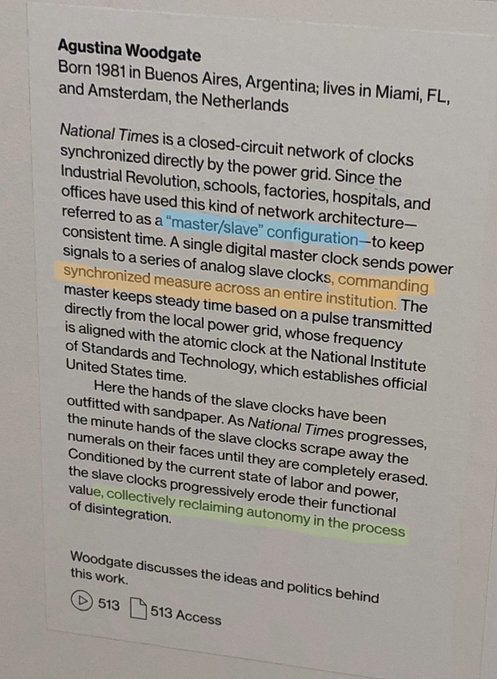
Check out the recent art exhibit pictured below at the Whitney Musuem. If we are going to rail against modern master/slave relationships, however, I would start off with email, not clocks, as I have always thought of clocks as helpful coordination devices, but I am not a conceptual artist! (Hat tips: @david_perell & @jeremygiffon.)
Update (8/17/21): I have since made substantial revisions to the paper mentioned below and have re-titled it “Lockdowns as Takings.”
With the recent rash of oppressive and exemption-riddled lockdown orders being imposed across the United States again, I thought I would re-post my paper “A Nozickian or natural rights approach to the coronavirus pandemic.” Note: I am not second-guessing the wisdom of these measures; I am just saying that business owners are legally entitled under the Constitution to “just compensation” (i.e. lost revenues) whenever the government orders them to close down their business firms in the name of public health.
Instead of rehashing the merits of the Texas case, however, I will take a closer look at the Smith case. In summary, the plaintiff, Betty Smith, was driving down Main Street in the City of Winthrop, Massachusetts at about 1:00 a.m. on February 6, 1941. She saw a bus coming toward her at high speed and, to avoid a direct collision with the bus, she swerved and crashed into a parked car, but she did not actually see whose bus ran her off the road. Nevertheless, the plaintiff’s attorney later discovered that the defendant operated a bus line in the City of Winthrop and had an exclusive license to operate a bus route on Main Street, and according to the defendant’s timetable, the defendant’s buses were scheduled to travel down Main Street at 12:10 a.m., 12:45 a.m., 1:15 a.m., and 2:15 a.m. (A second bus company had a license to operate a bus line in the City of Winthrop but not on Main Street.)
Since this was a civil case, the plaintiff was required prove her case by “a preponderance of the evidence.” Stated in probabilistic terms, it must be more likely than not that the defendant’s bus caused the plaintiff to swerve into the parked car. The problem in the Smith case, however, was that the only evidence linking the defendant’s bus line to the scene of the accident is probabilistic in nature. That is, since by the plaintiff’s own admission she did not actually see which bus was going down Main Street at the time of the accident, the only evidence linking the defendant’s bus to the scene of the accident was the defendant’s published timetable or schedule.
This simple case thus presents a controversial legal issue, one that is relevant to the allegations of voter fraud in the 2020 presidential election. Stated simply, the issue is whether probabilistic proof alone is enough to prove an allegation. The trial judge in the Smith case ruled that probabilistic proof is not enough as a matter of law and entered a directed verdict in favor of the defendant bus line, and the Massachusetts Supreme Court then affirmed the trial court’s decision, holding that probabilistic proof, by itself, is not sufficient to prove one’s case. The Massachusetts Supreme Court explained its reasoning that “[t]he most that can be said of the evidence in the instant case is that perhaps the mathematical chances somewhat favor the proposition that a bus of the defendant caused the accident. This [is] not enough.” (Since then, most U.S. courts, State and federal, have followed this reasoning in subsequent cases.)
As it happens, I wrote about this case a few years ago in my paper “Visualizing Probabilistic Proof,” and for my part, I would ask, Does it make sense to draw this line between direct evidence and mere probabilistic proof? Specifically, isn’t all evidence, even direct proof like eyewitness testimony, ultimately probabilistic in nature?
Today (12 December) is the Feast Day of the Virgen of Guadalupe, a national holiday in Mexico and one of my favorite feast days of the year! More details here, in Spanish.
Putting aside porn sites and the dark web, are we not living in an Internet “golden age” of ideas and information? Here are just a few of the excellent essays and Wikipedia entries that I randomly stumbled upon this semester:
According to the map pictured below (hat tip: u/TrollBond), 43 States (in blue) have a smaller population than Los Angeles County (in red). So, why did it take some of these “blue” States, like Arizona, Georgia, and Nevada, so long to count the votes of their citizens and to certify their election results?
At the same time, even though these “blue” States had fewer votes to count than L.A. County had, the outcome of the presidential election in these States was much closer, but this fact poses an additional question. Specifically, did these States need the extra vote-counting time to carefully and individually verify the legality of each mail-in ballot, or did they use the extra time to find new and creative ways to rig the election?
As promised, I have carefully reviewed the intriguing Appendix in the court filings with SCOTUS (pp. 20-29) in the case of Texas v. Georgia, et al. (specifically, the “Declaration of Charles J. Cicchetti, Ph.D.”) as well as David Post’s critique of Dr Cicchetti’s statistical analysis, and below are my tentative thoughts on this matter. (For brevity, I will limit my comments to Cicchetti’s analysis of the election results in Georgia.)
In summary, Cicchetti makes two claims: one regarding the election results in Georgia overall (let’s call this “Claim A”); the other specifically about the mail-in ballots (“Claim B”). (Also, for the reasons I will give below, I agree with David Post’s critique of Claim A, but disagree with Post’s critique of Claim B.) Let’s start with the weaker claim, shall we? Claim A is simply that, holding voter preferences from 2016 constant, it is extremely unlikely that Joe Biden could have won the Georgia contest in 2020 by honest means. Alas, this claim is total bullshit. Why? Because holding voter preferences constant makes absolutely no sense in the context of an election contest. The whole purpose of an election is to measure voter preferences, and voter preferences may change from one year to the next. That is the whole point of holding elections!
Let’s now turn to Claim B, which is the stronger of the two claims. Claim B is that the mail-in ballots are suspect and probably rigged because the final results of the mail-in ballots diverge greatly from the final results of the early-voting ballots and the in-person ballots. Specifically, Cicchetti states in Paragraph 14 of his Declaration (emphasis added by me):
“At 3:10 AM EST on November 4 the Georgia reported tabulations were 51.09% for Trump and 48.91% for Biden (eliminating third-party candidates). On November 18 at 2 PM EST, the reported percentages were Trump 49.86% and Biden at 50.14%…. For this turnaround to occur, the subsequent “late” [i.e. mail-in] ballots totaling 268,204 votes (5.4% of the votes reported on November 18) had to split 71.60% for Biden and 28.40 for Trump.”
Here, Post is wrong to dismiss the substance of this claim. Although Post is correct to conclude that we can’t hold constant voter preferences from one election to the next, we can certainly do so with randomly selected subsamples of voters in the same election. The key question, then, is whether the population of voters who voted by mail is in any relevant respect different than the population of all voters, or early voters, or in-person voters? For my part (unlike Prof Post), I remain agnostic on this question.
Addendum (12/11): I have been informed via Twitter and by some of my followers that the mail-in ballots were expected to lean toward Joe Biden because Trump told his voters to vote in person. But if that is the case (that most mail-in ballots were submitted by Democrats or left-leaning voters), why did Trump apparently hold his own with early voters? Also, either way, how could we “test” or try to prove this assertion? I wish the secretary of states of GA, PI, MI, and WI would tell us the number of “mail-in” ballots that were received and counted as well as as the number of “early ballots” and “in-person/election day” ballots.
(My most sincere apologies to William Shakespeare!) Earlier today, I requested a copy of the Appendix mentioned in Paragraph 10 on pp. 6-7 of the Texas’s Attorney General’s “Motion for Leave to File Bill of Complaint.” (See screenshots below.) As soon as I obtain this Appendix, I will conduct my own analysis of the matter and report back soon!
Update #1 (12/8, 9:32PM): I was able to track down the Appendix–it is available here, see pp. 20-29. Due to other commitments, I hope to report back by the end of this week.
Update #2 (12/9, 8:53PM): My colleague David Post has written up a strongly-worded critique of the statistical analysis in the aforementioned Appendix. I agree with most of Professor Post’s critique but disagree with one part of his analysis regarding the distribution of voter preferences on mail-in ballots. Alas, because I am currently bogged down with…

















 prior probability