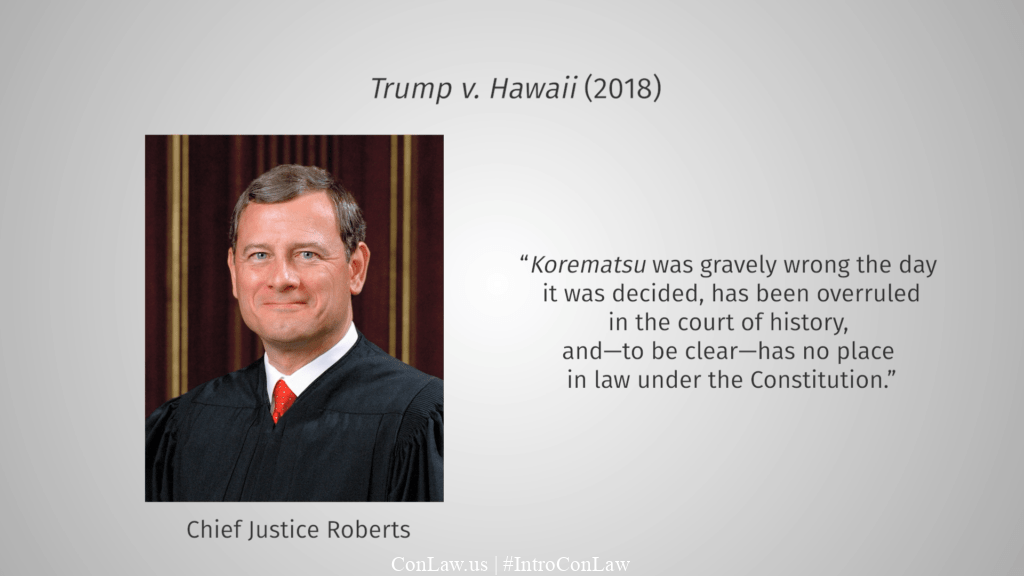
… to paraphrase FDR’s famous remark in response to Japan’s attack of Pearl Harbor. On this day in history, two months after Pearl Harbor and fearing the threat of military invasion on the West Coast, FDR signed Executive Order 9066 into law, a modern-day “removal act” creating a legal framework for the internment of all persons of Japanese ancestry in the U.S. More details about E.O. 9066 are available here, via Josh Blackman & Randy Barnett.
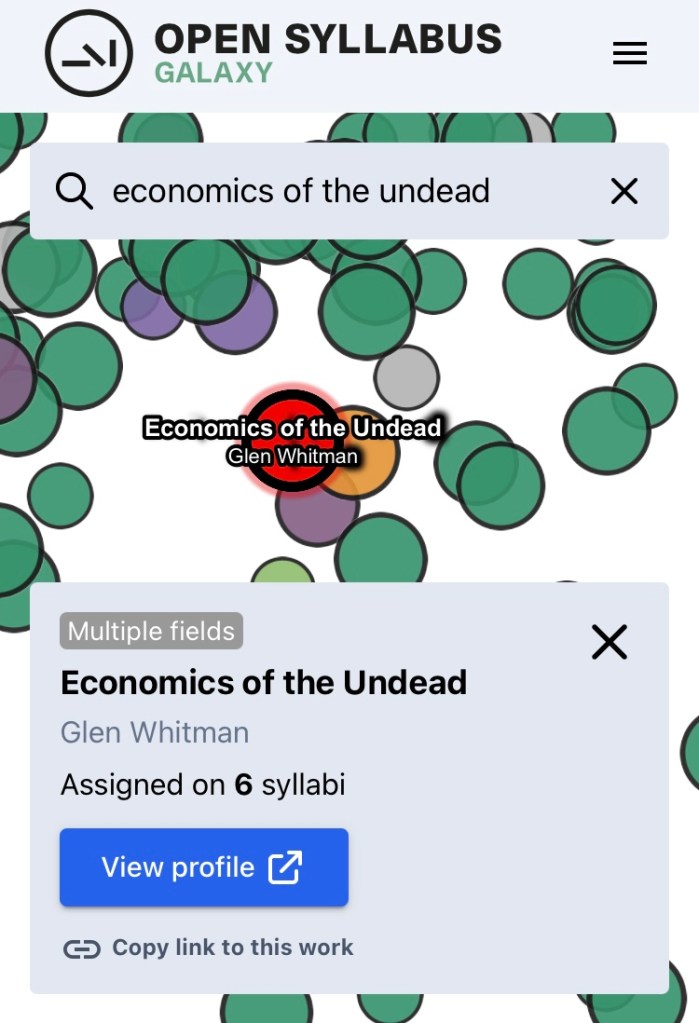
Check out this amazing tool from the Open Culture Syllabus Project, which contains a database of 7,292,573 college course syllabi and 1,138,841 of the most frequently assigned books and scholarly papers on those syllabi. (#1 is Strunk & White; “The Economics of the Undead,” to which I contributed a chapter, is assigned in six courses!) This database is presented visually on a searchable, user-friendly, Google Maps-style interface. More details about this fantastic project are available here. Hat tip: Christine Corcos (@LpcProf).
Last night, my wife Sydjia and I saw the movie “Judas and the Black Messiah,” which tells the story of how the FBI and Chicago police assassinated Fred Hampton, the charismatic leader of the Chicago chapter of the Black Panther Party. This movie left me stunned … and extremely angry. (Check out Elizabeth Hinton’s review of the movie here.)
“The personal library of retired John Hopkins University Humanities professor Richard A. Macksey, housed in his home.” Check out the full thread here, via Twitter. Hat tip: @DrLindseyFitz. Also, thanks to Sheree, whose ViewFromTheBack blog is one of my faves, for the “Wordless Wednesday” blog post concept.
What if Texas were to split up into five smaller States? This scenario, though it may sound strange–outlandish even–, is not that far-fetched; see, for example, this thought-provoking paper “Let’s Mess with Texas” by Vasan Kesavan (an independent scholar) and Michael Stokes Paulson (a law professor at the University of Minnesota). As an aside, this paper was the subject of one of Malcolm Gladwell’s “Revisionist History” podcasts (see here).
Remember Brady Sluder? He was the spring breaker from Ohio who famously said, “If I get corona, I get corona. At the end of the day, I’m not going to let it stop me from partying …” Sluder was lambasted by the lamestream media at the time, but the virus certainly didn’t stop the massive anti-police protests last summer or the Super Bowl earlier this month. Maybe he was right, after all.
Thus far, I have devoted several blog posts (seven separate posts in all!) to the substance of Ryan Patrick Hanley’s new book on Adam Smith: Our Great Purpose: Adam Smith on Living a Better Life (Princeton U Press, 2019). I now want to conclude my review of his book by saying a few words about its beautiful style. Instead of a dense or dry scholarly tome, Hanley’s chapters are crisp and short, and he has kept his citation notes to a minimum. [Memo to the editors at Princeton U Press: what is preventing you from replacing the end notes with footnotes?] In addition, Hanley begins each chapter with a direct quotation from the works of Adam Smith. (Note: Although most of the chapter quotations are from the sixth edition of The Theory of Moral Sentiments, some are from The Wealth of Nations, showing us the essential unity of Smith’s world view.)
For my part, although I found Hanley’s approach to be appealing (starting off each chapter with a direct quotation from Smith), as it invites us to focus on the immortal words of Adam Smith, I want to respectfully point out a danger with this strategy, the danger of selection bias, of taking Smith’s words out of their proper context. To his credit, Hanley does an excellent job of presenting Smith’s main philosophical ideas. Nevertheless, although Hanley resolves the apparent contradiction in Smith’s works between self-regarding and other-regarding behavior, many other tensions and problems are left unanswered or unresolved. (See some of my previous posts, for example.) Hanley himself concedes (pp. 61-62, internal quotation marks omitted), when reading Smith “it often feels like Smith giveth on one page, and taketh away on another,” and that one of the challenges of reading Adam Smith’s works today “consists in figuring out how all of his claims go together, even (and maybe especially) when they don’t seem to match perfectly on their face.” What if we took a different approach, then? Specifically, what if were to point out the many apparent contradictions and inconsistencies in Smith’s works instead of trying harmonize Smith’s ideas into a coherent whole? That, of course, would be the subject of another book; perhaps the next generation of Smith scholars will write that book soon …
In honor of Saint Valentine’s Day and Adam Smith, I am re-posting a link to my paper “Adam Smith in Love.” (See here.) I will be uploading a significantly-revised version of the paper soon, but in the meantime, immediately below you will find one of the most beautiful love ballads ever-recorded, the original version of “Sabor a mi” by the legendary Trio los Panchos, followed by an Andean-inspired rendition of the same song, as well as a third bonus version with Manoella Torres. (P.S.: Sydjia, you will forever be the love of my life!)
Alternative title: Are Smith’s “impartial spectator” and his “wise and virtuous man” the same person?
In my previous post, I summarized Ryan Patrick Hanley’s portrait of Smith’s wise and virtuous man, and I also criticized Hanley’s portrait as implausible and unattractive: the wise and virtuous man does not aspire to absolute perfection (an impossible goal, in any case); nor is he an officious intermeddler. But as we say in the academy, it takes a theory to beat a theory, so here I want to offer a new interpretation of Smith’s wise/virtuous man.
As we have seen, Smith’s theory of virtue is personified by an archetype, “the wise and virtuous man,” but what does it mean for a person to be wise or virtuous or to act in a wise and virtuous manner? Let’s start with wisdom. Hanley defines wisdom in terms of “the appreciation of perfection” (p. 109), but this view is implausible at best. Smith is not Rousseau; Smith does not believe in the perfectability of man. As I read Smith, a person is wise in the Socratic sense of intellectual humility; he is aware of how little he knows. Also, this Socratic interpretation of wisdom has the additional bonus of being consistent with Smith’s praise of humility. What about virtue? As Hanley himself shows, Smith views virtue in several senses: magnanimity, self-command, charity, and Christian love. Simply put, Smith’s ideal man is intellectually humble; he is magnanimous; he has a high degree of self-command; and he is charitable to boot, full of Christian love.
Smith’s concept of virtue, however, poses a potential problem: what happens when the values of the wise and virtuous man (i.e. magnanimity, self-command, charity, and Christian love) collide or come into conflict. By way of example, how would Smith’s wise and virtuous man respond to the trolley problem? I would love to hear how Hanley and other Smith scholars would respond to this question, but in the meantime, I want to sketch out a different interpretation of Smith’s wise and virtuous man. When Smith is writing about this remarkable man–painting his portrait in words, so to speak–is it possible that he is referring to the imaginary spectator and not to any flesh-and-blood person in particular? Or in the words of Hanley (p. 110): “A wise and virtuous man strives to become an impartial spectator of himself ….” Would it be more correct to say that the impartial spectator–“the man within the breast” we are supposed to consult in cases of doubt–that this imaginary man himself should also strive to be wise and virtuous?
After all, as I read Smith, the wise and virtuous man is a fictional figure, every bit as imaginary as Smith’s “impartial spectator.” [*] We ourselves should aspire to become wise and virtuous in the various senses described above (intellectual humility, magnanimity, self-command, etc.), but how could we ever hope to pull off such an impressive, if not impossible, feat unless our respective “impartial spectators” themselves were wise and virtuous. Furthermore, this interpretation of Smith has the additional benefit that it resolves the many questions I posed to Hanley in a previous post.
What is the ontological status of the impartial spectator? Even if this imaginary being is not a human creation, even if he is somehow “hardwired” by natural or sexual selection into every human brain, Smith is inviting us to model our respective impartial spectators along the lines of the wise and virtuous man.
Timing and logistics: when does the impartial spectator come into play?Which of our decisions does he review? If my interpretation of Smith is correct, he comes into play whenever we make a decision that is not consistent with intellectual humility or not consistent with the virtues of magnanimity, self-command, charity, and Christian love.
What is the normative status and reliability of the impartial spectator’s moral judgements? Again, if my interpretation of Smith is correct, then the impartial spectator’s moral judgements are normatively valid and epistemically reliable only to the extent they are consistent with what Smith’s wise and virtuous man would decide.
Is the impartial spectator a superfluous entity? The answer to this question depends on the wisdom and virtue of the impartial spectator. Simply put, Smith’s imaginary spectator is not superfluous, but only to the extent his verdicts emulate or embody the values of the wise and virtuous man.
I will conclude my review of Hanley with some final though tentative thoughts about his book (the cover of which is pictured below) on Monday.
[*] I would make the following point in support of this proposition: Adam Smith himself is only able to identify but one flesh-and-blood person “as approaching as nearly to the idea of a perfectly wise and virtuous man, as perhaps the nature of human frailty will admit” (quoted in Hanley, p. 125). I will not give away the identity of this remarkable human being. Read Hanley’s book and find out for yourself!