
Here is another extended excerpt from my forthcoming research article “Adam Smith in Love“:

Creative Commons
Blogs I Follow









Here is another extended excerpt from my forthcoming research article “Adam Smith in Love“:
Why did Adam Smith remain a bachelor his entire life? Did he at least have any love affairs? Here is a catalogue of my three most recent “Adam Smith in Love” blog posts:
(Also, here is a complete catalogue of my first set of “Adam Smith in Love” blog posts.)

I am sooo late to this party, but here it goes. On the left: Sydjia and I in July 2011 in Amsterdam. On the right: us in July 2020 in Tarpon Springs, Fla.


Hat tip: @pickover
My next “advanced topics in law” lecture will explore what Harvard Law Professor Charles Fried (pictured below) refers to as “the promise principle.”[1] In brief, the proposition that “promises ought to be kept”[2] is one of the most important normative ideals or value judgements in daily life.[3] The promise principle is so pervasive that it informs such diverse domains as business deals,[4] politics,[5] and personal relationships.[6] But why?
Broadly speaking, there are three major theories of promising. Autonomy-based or “normative power” or “will” theories of promises are premised on the idea that promises are self-imposed obligations. Broadly, speaking, all these variants of the will theory of promises generally focus on the promisor’s subjective intentions when she make a promise. Although no one is required to make a promise, once you do, you are under a self-imposed obligation to keep your word. The main problem with the will theory, however, is that it is self-refuting. If the source of a promissory obligation is the promisor’s sincere intention or will to make a binding promise on herself, then the promisor’s subsequent intention to break her promise should have the effect of producing a self-release from her original promissory obligation. That is, if one can will into existence a binding promise on oneself, then one should be able to undo a promise via one’s will as well.
Since the will theory is self-refuting, some scholars have embraced an alternative “expectations” theory of promissory obligations. In brief, this theory views the making of promises as an “expectation-producing mechanism.” That is, when a person (the promisor) makes a promise, he is making a promise to another person (the promisee), and by making a promise, the promisor is creating an expectation in the promisee that he (the promisor) will not later break his promise. To break a promise, then, is to deceive the promisee.[7] The problem with this theory, however, is that it is open to exploitation and manipulation by the promisee. (Can you see why, or do I have to spell it out for you?)
Yet another theory is the consequentialist view of promissory obligations. Generally speaking, consequentialist or pragmatic theories take a forward-looking or probabilistic view towards promises: when deciding whether to keep or break a promise, what matters are the probable consequences of one’s promise-keeping or promise-breaking behavior.[8] In other words, the goodness or badness of a given promise (e.g. a promise to do X) depends entirely on the consequences resulting from keeping or breaking the promise to do X. Alas, it is the forward-looking nature of consequentialist theories that prove to be their ultimate undoing, for how does one go about figuring out or guessing what these probable promissory consequences will be?[9] At the “micro” level or in the aggregate?[10]
The common law, however, takes a different approach to the promise principle. As I shall explain in my next lecture, only a small subset of promises are legally enforceable–namely, those backed by “bargained-for consideration” …

[1] See Charles Fried, Contract as Promise (Harvard Univ. Press, 1981).
[2] See, e.g., Book 3, Part 2, §5 of David Hume, A Treatise on Human Nature (David Fate Norton & Mary J. Norton, eds.) (Oxford Univ. Press, 2000). See also Allen Habib, Promises, in Edward N. Zalta, ed., The Stanford Encyclopedia of Philosophy (2018).
[2] Cf. Mary Midgley, “The Game Game,” Philosophy, Vol. 49 (1974), p. 235 (“[P]romising is everywhere a kingpin of human culture.”).
[4] See, e.g., Stewart Macaulay, “Non-contractual Relations in Business: A Preliminary Study,” American Sociological Review, Vol. 28 (1963), p. 58 (“Businessmen often prefer to rely on ‘a man’s word’ in a brief letter, a handshake, or ‘common honesty and decency’–even when the transaction involves exposure to serious risks.”).
[5] See, e.g., Ed Kilgore, “2020 Candidates Begin Signing Unity Pledge, with Sanders Taking the Lead,” New York Magazine (Apr. 26, 2019). See also Gregory Krieg, GOP Candidates Back Off Pledge to Support Nominee, CNN (Mar. 30, 2016).
[6] See, e.g., Johanna Peetz & Lara Kammrath, “Only Because I Love You: Why People Make and Why They Break Promises in Romantic Relationships,” Journal of Personality and Social Psychology, Vol. 100 (2011).
[7] See, e.g., Páll S. Ardal, “And that’s a Promise,” Philosophical Quarterly, Vol. 18 (1968), p. 234.
[8] See, e.g., Simon Blackburn, Oxford Dictionary of Philosophy, pp. 74-75 (Oxford Univ. Press, 2d ed., 2005).
[9] There is also the problem of “utility monsters,” i.e. individuals who derive large amounts of utility from their bad acts. See Robert Nozick, Anarchy, State, and Utopia, p. 41 (Basic Books, 1974). That is, consequentialist theories (both micro and macro) are problematic to the extent they are unable to provide an agreed-upon or universal definition of “utility” or offer guidance on how to measure such “utility.”
[10] For reference, the “micro” approach is usually referred to as act utilitarianism. By contrast, the aggregate or “macro” approach is generally referred to as rule utilitarianism or indirect utilitarianism.
Note: I made significant revisions to this part of my “Adam Smith in Love” series of blog posts. (Check out my blog post of November 10, 2020.)
When Adam Smith first arrived in Paris in early 1764, little did he know that a tumultuous and world-changing Revolution would sweep over the City of Lights in just a few years. The Kingdom of France that Smith visited and lived in for two years–from February 1764 through October 1766–was the France of the Ancien Régime, an Old World domain in which Catholicism was the official state religion, a feudal and autocratic kingdom composed of three great estates–the clergy, the nobility, and the common people.
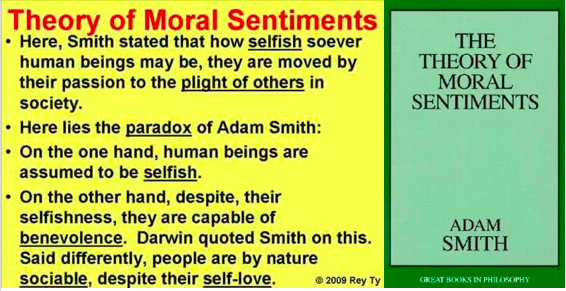
I have been researching and writing about Adam Smith’s enigmatic love life and have thus titled my latest work-in-progress “Adam Smith in Love.” But Adam Smith also wrote about love. In fact, Smith made several philosophical observations about love and romance in his first major published work The Theory of Moral Sentiments, an intellectual masterpiece that deserves a place of honor in our Western philosophical canon, along with the works of Plato and Aristotle, Hume and Kant. By way of background, Smith first presents his now-influential theory of virtue, a theory based on the notion of “mutual sympathy” or fellow feeling. (See summary, bottom left.) To see the spirit of Smith’s moral theory, there is no better place to begin than with the famous opening sentence of The Theory of Moral Sentiments (hereinafter “TMS“), which begins as follows:
| “How selfish soever man may be supposed, there are evidently some principles in his nature which interest him in the fortune of others, and render their happiness [the happiness of others] necessary to him, though he deserves nothing from it except the pleasure of seeing it.” |
For Smith, then, our ability to feel “mutual sympathy” with others–i.e., feelings of anger, happiness, gratitude, pain, etc. depending on the circumstances–is the source of morality. For example, in the first paragraph of the TMS chapter titled “Of the Passions which take their origin from the body,” Smith illustrates his theory of mutual sympathy with the following graphic illustration of physical pain:
| “There is, however, a good deal of sympathy even with bodily pain. If … I see a [whip] aimed, and just ready to fall upon the leg, or arm, of another person, I naturally shrink and draw back my own leg, or my own arm: and when it does fall, I feel it in some measure, and am hurt by it as well as the sufferer.” |
But then, in the very next paragraph, Smith proceeds to compare and contrast “passions which take their origin from the body” (such as physical pain) with “those passions which take their origin from the imagination” (such as love). More to the point, in what could be described as a tender and auto-biographical reference to his first failed love affair–i.e. the early romantic liaison described by Smith’s first biographer Dugald Stewart in Note K; see here for more details–, Smith observes that “[a] disappointment in love, or ambition, will, upon this account, call forth more sympathy than the greatest bodily evil.” Below is the complete quote for the reader’s reference. After describing the sympathy elicited by physical pain, Smith specifically states:
| “It is quite otherwise with those passions which take their origin from the imagination. The frame of my body can be but little affected by the alterations which are brought about upon that of my companion: but my imagination is more ductile, and more readily assumes, if I may say so, the shape and configuration of the imaginations of those with whom I am familiar. A disappointment in love, or ambition, will, upon this account, call forth more sympathy than the greatest bodily evil.” |
Smith even goes onto say:
| “The loss of a leg may generally be regarded as a more real calamity than the loss of a mistress. It would be a ridiculous tragedy, however, of which the catastrophe was to turn upon a loss of that kind. A misfortune of the other kind, how frivolous soever it may appear to be, has given occasion to many a fine one.” |
What is Adam Smith trying to tell us with these passages about disappointed love and lost mistresses? Specifically, when Smith is writing about a “disappointment in love” or the “loss of a mistress,” is he referring to his own lost love–i.e. to the “Fife lady whom he had loved very much,” to the “young lady of great beauty and accomplishment” to whom Adam Smith was “for several years attached.” (Stewart, Note K.) Yet, Smith himself will conclude that romantic love is a “ridiculous” passion. We will see why soon …
I will resume my series on “Adam Smith in Love” soon; in the meantime, here is Bailey Sok’s stupefying choreography of one my favorite English-language songs of 2020. Added bonus: here is Miss Sok’s Instagram.
Where is the consumer harm, y’all? I finally got around to reading the Government’s official Complaint against Google. (You can read it for yourself here.) In summary, the Feds are alleging that Google’s agreements and exclusive deals with Apple are somehow anti-competitive and that Google has shut down search-engine competition on the open-source Android platform. For my part, based on my initial reading of the Government’s Complaint, I am totally unpersuaded that any of Google’s agreements or policies are illegal. To win an anti-trust case, it is simply not enough to show that a business firm has monopoly power in a given market; the government must also show that the firm has used its dominant position in such a way as to harm consumers. Here, the Government specifically alleges that “Google’s conduct has harmed consumers by reducing the quality of general search services (including dimensions such as privacy, data protection, and use of consumer data), lessening choice in general search services, and impeding innovation.” But this key allegation is buried in Paragraph 167 of the Government’s Complaint, and it remains to be seen whether there is any merit to this allegation. For now, my money is on Google, not the Feds. Bonus material: Here is a helpful thread containing Sam Bowman’s economic analysis of the Google case.
Talk about an October surprise; this is a huge development! Is Facebook next? We’ll update this post in the hours ahead ….

Talk about an October surprise; this is a huge development! Is Facebook next? We’ll update this post in the hours ahead ….


Welcome to the online home of the IASS
Hopefully It’s Interesting.
In Conversation with Legal and Moral Philosophers
Relitigating Our Favorite Disputes
PhD, Jagiellonian University
Inquiry and opinion
Life is all about being curious, asking questions, and discovering your passion. And it can be fun!
Books, papers, and other jurisprudential things
Ramblings of a retiree in France
BY GRACE THROUGH FAITH
Natalia's space
hoping we know we're living the dream
Lover of math. Bad at drawing.
We hike, bike, and discover Central Florida and beyond
Making it big in business after age 40
Reasoning about reasoning, mathematically.
I don't mean to sound critical, but I am; so that's how it comes across
remember the good old days...
"Let me live, love and say it well in good sentences." - Sylvia Plath
a personal view of the theory of computation
Submitted For Your Perusal is a weblog wherein Matt Thomas shares and writes about things he thinks are interesting.
Logic at Columbia University
Just like the Thesis Whisperer - but with more money
the sky is no longer the limit
Technology, Culture, and Ethics
Just like the horse whisperer - but with more pages
Poetry, Other Words, and Cats

 prior probability