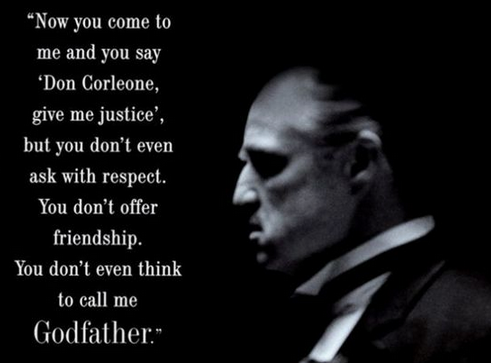
My next “Advanced Topics in Law” class is devoted to illicit promises, such as the informal agreement between Don Corleone and the undertaker in the opening scene of The Godfather (Part 1) or the illegal partnership agreements so memorably depicted in the hit TV show Breaking Bad. Although the idea of an illegal or immoral agreement may sound esoteric, exotic even, illicit promises are everywhere. Consider, for example, the usurious payday loans in the case of Buckeye Check Cashing, Inc. v. Cardegna, or Shylock’s pound-of-flesh pact in Shakespeare’s immortal comedy The Merchant of Venice, or if you prefer vampire fiction, what about human-vampire agreements for the purchase and sale of blood?, or how about a modified version of the famous prisoner’s dilemma model in which the prisoners promise to obstruct justice? Simply put, many forms of wrongdoing often involve immoral promises and illegal agreements, especially given the expansion of federal regulatory crimes as well as our evolving and expanding conceptions of morality.
To the point: What is the legal and moral status of such illicit promises? Common law courts have developed a sophisticated body of legal principles and judicial doctrines in this area. In brief, courts have generally classified illicit agreements into two broad categories: those that are immoral or mala in se and those that are merely illegal or mala prohibita. Promises involving some form of moral turpitude are said to be mala in se and are void ab initio, while illicit agreements in violation of a commercial statute or an economic regulation are said to be merely mala prohibita and are often treated as “voidable” by the innocent party. Either way, illicit promises should be of theoretical interest to philosophers and legal theorists because such promises may help us delimit the outer boundaries of promissory obligations. These types of promises also exemplify the uncertain relation between ethics and law.
Here is yet another extended excerpt from my work-in-progress “Adam Smith in Love” (update: this excerpt was revised on 10/31):
Ian Simpson Ross, who has written the definitive biography of Adam Smith’s life, provides the most comprehensive picture to date of Smith’s amorous interludes.[1] Alas, Ross concludes that “the biographer can do little more with the topic of Adam Smith’s sex life than contribute a footnote to the history of sublimation.”[2] Nevertheless, despite its erudition, careful research, and scholarly attention to detail, Ross’s biography of Smith neglects several additional hypotheses about Adam Smith’s sexuality and love life. One intriguing hypothesis, for example, is that Adam Smith was just not attracted to women, that he was what we would call today a “closet homosexual.”[3]
Another intriguing hypothesis, perhaps the simplest and most plausible one, is that Adam Smith was involved in a secret, long-term affair with his unmarried cousin Janet Douglas (b. *?*, d. 1788), who lived in the same household all her adult life with Smith and Smith’s mother Margaret Douglas. (See, e.g., Kennedy, 2005, p. 5.) According to one source (Özler, 2012, p. 348), Janet Douglas had moved into the Smith household as early as 1754, where she remained for four decades–until her death in 1788. Given their close proximity and the number of years–nay, decades–that they lived under the same roof, this conjecture is not that far-fetched.[4] Nevertheless, such types of incestuous relationships were not only strictly forbidden by the Church of Scotland (see generally Hardy, 1978); during Adam Smith’s lifetime the sex lives of Scots were strictly monitored by the local “kirk sessions” or ecclesiastical courts of each parish. (See generally Mitchison & Leneman, 1998.) Also, how much older (or younger) was Adam Smith than his cousin?[5]
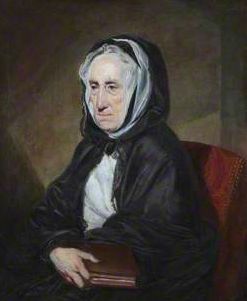
This Article will propose yet another hypothesis–a third theory, and perhaps the most plausible one. In summary, it is more likely than not that Doctor Smith did fall in love at least once, possibly twice. His first serious romantic attachment most likely occurred upon his return to his hometown of Kirkaldy in 1746 at the age of 23, i.e. after having completed his formal studies at Glasgow (1737 to 1740) and Oxford (1740 to 1746).[6] Additionally, I further conjecture that Margaret Douglas (pictured below), his strong-willed and dominating mother, must have objected to Adam Smith’s proposed union and that the young Smith acquiesced to his mother’s demands.
Although these conjectures do not appear in the literature on Adam Smith–and may sound completely far-fetched–they provide the best explanation of Smith’s early love life, especially given the available evidence (see part 3) and also given what we know about early modern Scottish society (see part 5) and Smith’s lifelong devotion to his mother. For starters, Smith’s mother, Margaret Douglas Smith, descended from a powerful, landowning family, while his father (also named Adam Smith) died a fairly rich man, leaving a large income and considerable property behind. (See Özler, 2012, pp. 346-347.) Also, Smith’s dependence on family income continued through his teen years and young adulthood (ibid., p. 346), i.e. until his initial appointment as Professor of Logic at the University of Glasgow in 1951.
Furthermore, although parental consent was not a legal requirement (see, e.g., Leneman, 1999, p. 673; see also Leneman & Mitchison, 1993, p. 845, p. 847), in early modern Scotland it was expected that “children should have the consent of their parents, or those ‘in loco parentis’, to their marriage.” (Hardy, 1978, p. 531. Cf. Leneman, 1999, p. 675, explaining why some Scottish couples resorted to clandestine marriages: “usually because the man was (or said he was) financially dependent on relations who would not approve of marrying at that stage in his life, or of his choice of wife.”) This parental consent norm was so pervasive that it “could vary from marriages arranged by parents without consideration being given to the personal wishes of their children to marriages where the child made the selection of marriage partner and the parents were expected to accede to their choice.” (Ibid., p. 531.) Moreover, this informal norm makes all the more sense given the structure of Scottish society during Adam Smith’s lifetime, a neo-feudal and deeply religious (Calvinist) society in which property, especially property in land, was held on a family basis. (Ibid., p. 528.)
Lastly, I also conjecture that Adam Smith may have fallen in love a second time at some point during his three-year Grand Tour of France (1764 to 1766), most likely during the last year of his overseas sojourn. Although the sexual aspect of European Grand Tours during this era has gone mostly unnoticed (but see Alcouffe & Massot-Bordenave, 2020, pp. 57-58), one piece of evidence in particular, a letter addressed to Adam Smith and dated 18 September 1766, appears to support both of my conjectures.
[2]Ibid., p. 228. Accord Harkin (2013, p. 502), who refers to a “complete dearth of information” about Adam Smith’s love life.
[3] Cf. Kennedy, 2005, p. 4: “Not surprisingly, in the absence of definite evidence occasional speculation emerges that Smith’s sexuality varied from him having an Oedipus complex to his being in a homosexual relationship with David Hume ….” See also this fascinating and thoughtful Reddit thread via r/AskHistorian, n.d.
[4] Or in the euphemistic words of one Smith scholar, Miss Douglas and Adam Smith were “quite close.” Weinstein, 2001, p. 10.
[5] Alas, I have been unable to confirm Janet Douglas’s year of birth.
[6] For a visual outline of Adam Smith’s biography, see timeline in the Online Library of Liberty, 2016. See also Wright, 2002, pp. 267-269, App. A.
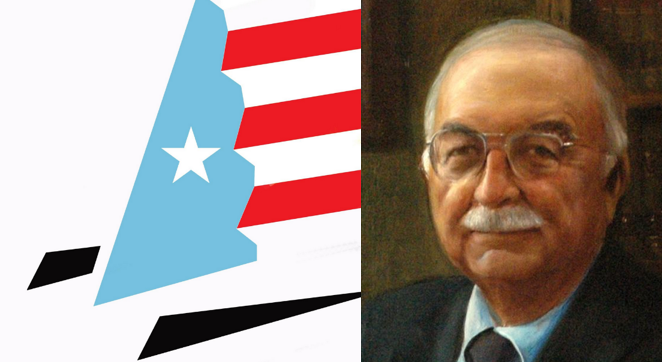
Following up on my previous post in praise of Juan R. Torruella, the first federal appellate judge from the Island of Puerto Rico who died on Monday, Oct. 26 at the age of 87, I forgot to mention that Judge Torruella was also an Olympian (more details here, via @ZoeTillman), competing in four different Olympic Games with The Puerto Rico Sailing Team (whose logo is pictured below), as well as a prolific scholar–the Puerto Rican version of another hero of mine, Richard Posner. By way of example, here is what pops up when you type “Juan Torruella” into Google Scholar. Rest in Peace …
I made significant revisions to one of the subsections of my “Adam Smith in Smith in Love” paper. In particular, I recently stumbled upon a well-researched and detailed book by Alain Alcouffe and Philippe Massot-Bordenave with the title “Adam Smith in Toulouse and Occitania: The Unknown Years,” which was published earlier this year. Their research sheds a lot of new light on one of the pieces of evidence I review in my paper. For more details, see updated blog post below.
Update (10/28): I made significant revisions to this part of my “Adam Smith in Love” paper.
Previously, I described three pieces of evidence regarding Adam Smith’s love life: (i) an obscure but intriguing footnote in Dugald Stewart’s 1793 biography of Smith’s life and writings (Exhibit A), (ii) a letter dated July 14, 1784 addressed to Professor Stewart (Exhibit B), and (iii) a brief anecdote by Henry Mackenzie, a prominent Scottish lawyer and writer (Exhibit C). I recently stumbled upon a fourth piece of evidence, a possible “smoking gun” consisting of a long letter dated 18 September 1766. Unlike the first few proofs we have introduced into evidence thus far, this correspondence is not only from Adam Smith’s own lifetime; it is addressed to Adam Smith himself and to his pupil, Henry Scott, the future Third Duke of Buccleuch! (At the time this contemporaneous…
My beloved and enchanted Island of Puerto Rico, where I taught Roman Law and Constitutional Theory from 1998 to 2009, has lost another larger-than-life legend: Judge Juan Torruella (pictured below), who died at the age of 87 on Monday, October 26. Here is a short bio. Judge Torruella was not only a federal judge–the first Puerto Rican to sit on a federal appeals court–he was also an eloquent and vocal critic of Puerto Rico’s second-class, semi-colonial constitutional status. His book The Supreme Court and Puerto Rico: The Doctrine of Separate and Unequal (Editorial UPR, 1985) is still one of my all-time favorite legal history books of all time. I still remember reading it for the first time while I was in law school (shout out to my friend and law school classmate Carlos Soltero, who first recommended this book to me). It was Torruella’s learned book that brought “The Insular Cases” to my attention–a set of cases decided between 1901 and 1921 enshrining Puerto Rico’s second-class constitutional status and a dreadful judicial wrong that has still not been rectified after over a century.
I am interrupting my extended series on the enigma of Adam Smith’s love life to re-post my September 2, 2020 blog post titled “Is Thiel in or out?” (See below.) Now, with just one week to go before Election Day, our friend and fellow libertarian colleague Peter Thiel is still on the political sidelines, or so it seems, refusing to publicly endorse Donald J. Trump. (In 2016, by contrast, Thiel openly endorsed Trump.) Also, where is the anti-anti-Trump “Flight 93 Election” faction? Do you even remember them?
As you may or may not recall, Peter Thiel–the crypto-libertarian tech billionaire who made his massive fortune via PayPal, Facebook, and other startup ventures–publicly supported candidate Donald J. Trump during the previous presidential election cycle. (See, for example, these remarks he made at the National Press Club in Washington, D.C. in 2016, remarks that I found very persuasive at the time.) But Mr Thiel has been awfully quiet lately! My Google search for “Thiel Trump 2020” yields some inconclusive results …
Update (10/28): I made significant revisions to this part of my “Adam Smith in Love” paper.
Previously, I described three pieces of evidence regarding Adam Smith’s love life: (i) an obscure but intriguing footnote in Dugald Stewart’s 1793 biography of Smith’s life and writings (Exhibit A), (ii) a letter dated July 14, 1784 addressed to Professor Stewart (Exhibit B), and (iii) a brief anecdote by Henry Mackenzie, a prominent Scottish lawyer and writer (Exhibit C). I recently stumbled upon a fourth piece of evidence, a possible “smoking gun” consisting of a long letter dated 18 September 1766. Unlike the first few proofs we have introduced into evidence thus far, this correspondence is not only from Adam Smith’s own lifetime; it is addressed to Adam Smith himself and to his pupil, Henry Scott, the future Third Duke of Buccleuch! (At the time this contemporaneous letter was composed, Adam Smith was the Duke’s private tutor and chaperone, supervising the Duke’s Grand Tour in France from early to 1764 through the fall of 1766.) To the point, in one passage of this intimate letter, which is composed entirely in French, the author refers in jest to Adam Smith’s romantic attachments:















 prior probability