
Source: Remember Singapore (9/21)

When wealthy Indian cattle merchant Moona Kadir (Kader) Sultan (1863-1937) built his mansion Karikal Mahal at East Coast Road in 1917, it was one of …
The Story of “The Cattle King” and his Karikal Mahal Palace
Source: Remember Singapore (9/21)
When wealthy Indian cattle merchant Moona Kadir (Kader) Sultan (1863-1937) built his mansion Karikal Mahal at East Coast Road in 1917, it was one of …
The Story of “The Cattle King” and his Karikal Mahal Palace
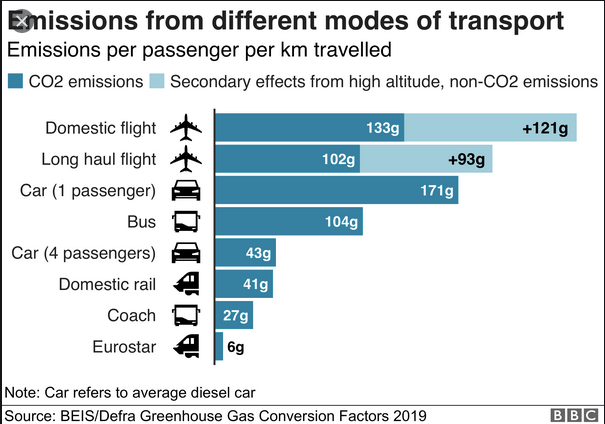
I described the game theory logic of “social dilemmas” or multi-player prisoners’ dilemmas in a previous post. In this follow-up post, let’s consider a specific example of a social dilemma: the problem of “climate change” or global warming. As the chart above shows, aviation is a significant source of greenhouse gas (GHG) emissions.[1] Commercial jets emit enormous amounts of carbon into the atmosphere. A single round-trip flight from London to New York, for instance, generates roughly the same level of emissions as the average person does by heating their home for a whole year.[2]
Imagine you are the CEO of American Airlines and that you are committed to protecting the environment. Also, assume there are no applicable U.S. or international laws regulating the levels of GHG emissions in the aviation industry. Lastly, let’s assume that you can reduce your emission levels in half if you reduce the number of long-haul flights or replace your airline’s fleet with smaller, more fuel-efficient aircraft or some combination of both strategies.
Unfortunately, when everyone else’s jets are emitting large amounts of greenhouse gases into the atmosphere, it is (in theory) a best response for you not to reduce your level of emissions as well because your airline’s lone decision to “go green” will only increase your costs of production and won’t save the environment, since everyone else in your industry is polluting anyways.
But even if everyone else in the airline industry has decided to “go green” and take costly steps to reduce carbon emissions (say, by reducing the number of flights or using smaller aircraft), it is still (in theory) a best response for you to defect, since you can gain a competitive advantage by doing so. Also, if you’re the only airline defecting, your airline’s carbon emissions alone won’t most likely create any catastrophic effects on the Earth’s temperature.
Alas, if too many people and firms behave selfishly–trying to maximize their own individual outcomes, for example–then everyone as a whole eventually suffers and we are all left with dirty air. Environmental law, however, might be able to promote cooperation in this domain by nudging every firm in the industry to reduce their emissions. Broadly speaking, there are three possible regulatory approaches when we confront a large-scale Prisoner’s Dilemma or social dilemma like aircraft GHG emissions. One approach is no regulation. Another approach involves direct regulation by imposing strict limits on the amount of emissions generated by each airline. Yet another possible approach is self-regulation via “cap-and-trade.” Let’s examine each approach in turn:
No Regulation
Although no regulation may seem absurd given the potential gravity of global warming, at the present time there is no direct federal regulation of aircraft emissions in the United States. In fact, no regulation is usually the default “solution” until Congress acts by enacting a law to address a given environmental problem.
Direct Regulation (“Command & Control”)
The standard proactive regulatory approach to a social dilemma, however, is “command and control” or direct regulation of the people and firms creating the problem. The EPA, for example, recently initiated a formal rulemaking process to “make a final determination on whether aircraft GHG emissions cause or contribute to air pollution which may reasonably be anticipated to endanger public health or welfare.”
If the EPA finds that aircraft emissions threaten public health, the EPA could decide to regulate aircraft emissions by imposing strict limits on the level of such emissions in much the same way that emissions from passenger cars and light trucks are regulated. In response to several oil price shocks in the early 1970s, for example, Congress enacted a law in 1975 authorizing the National Highway Traffic Safety Administration (NHTSA) to set fuel-economy levels or “Corporate Average Fuel Economy” standards for passenger automobiles and light trucks. The 1975 law called for a doubling of passenger-vehicle efficiency—to 27.5 miles per gallon (mpg)—within 10 years.[3]
Self-Regulation (“Cap and Trade”)
The European Union (EU), by contrast, has adopted a “cap-and-trade” or market approach to the aviation emission problem. The EU approach–which operates in the 28 EU countries as well as Iceland, Liechtenstein, and Norway–is called the Emissions Trading System or “ETS.” Under the cap-and-trade approach, the regulator first sets a maximum level or “cap” on the total amount of greenhouse gases or CO2 that airlines are allowed to emit from their flights per year. The regulator then allocates “pollution permits” or “allowances” to the airlines, granting each airline the legal right to emit a certain level of CO2 emissions per year. The total number of permits cannot exceed the cap, thus limiting total allowable CO2 emissions to the overall cap.[4]
An important feature of this system is that the pollution permits are tradeable. This means that an airline that reduces its emissions below its allowable level can sell its spare allowances to other airlines. Thus, if an airline’s emissions exceed the amount specified in its allocated allowance, it must either pay a substantial fine to the regulator or purchase a spare allowance from another airline to cover its emissions. Conversely, if an airline’s emissions are less than the amount specified in its allowance–that is, if an airlines ends the year with spare allowances–it can keep the spare allowances to cover its future needs or sell them to another airline that is short of allowances.
Conclusion
To sum up, whenever individuals or firms are trapped in a socially-destructive Prisoner’s Dilemma, legal rules backed by enforcement mechanisms or market devices can help us escape the dilemma by requiring (law) or encouraging (markets) the players to “do the right thing.” Of the major approaches we have discussed in this section, which one do you prefer and why?
End Notes
[1] See also Ian Waitz, et al., “Aviation and the Environment,” Report to the United States Congress (Dec., 2004).
[2] Source: http://ec.europa.eu/clima/policies/transport/aviation/index_en.htm.
[3] Recently, the EPA and DOT released a joint notice of intent to formulate enhanced CAFE standards for cars and light trucks in model years 2017 to 2025. The EPA is currently considering a range of 47 to 62 mpg by 2025, or an annual fuel-economy increase of 3 to 6 percent. See EPA and DOT, Notice of Upcoming Joint Rulemaking to Establish 2017 and Later Model Year Light Duty Vehicle GHG Emissions and CAFE Standards, Notice of Intent (Washington, DC: EPA and DOT, Sept. 30, 2010).
[4] For an overview of the cap and trade approach to emissions control, see the EPA’s website: URL = http://www.epa.gov/captrade/basic-info.html.
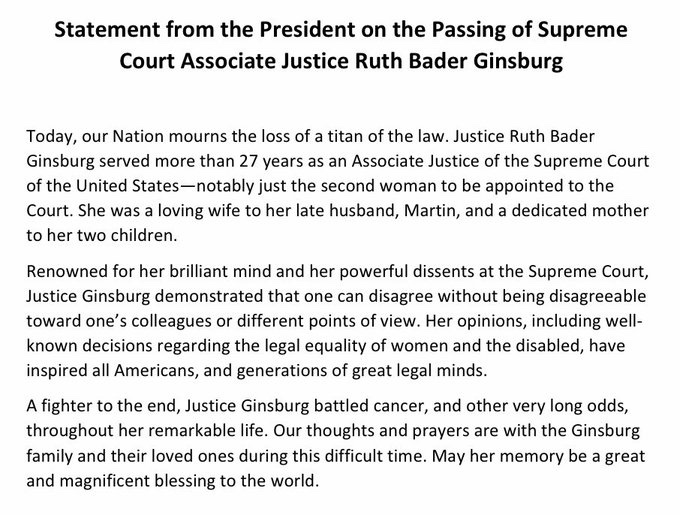
I had the great honor of meeting Ruth Bader Ginsburg on 29 May 2007, the day on which I officially joined the bar of the Supreme Court of the United States (SCOTUS). Some background: I was part of a small group of attorneys from Puerto Rico and from across several of the States who had applied to join the SCOTUS bar that year. Our bar membership applications had already been approved by the clerk, and so my colleagues and I were in Washington, D.C. to attend our swearing-in ceremony in open court.
Alas, I don’t remember if it was before or after the formal oath ceremony, but Chief Justice John Roberts and Justice Ginsburg both took the time out of their busy schedules to meet with us. Yet even more memorable than meeting two justices was having the opportunity to hear RBG deliver one of her famous dissents on that same day! You see, that was also the day in which SCOTUS would announce its nefarious decision in the controversial case of Ledbetter v. Goodyear Tire Company. (The court’s opinion is available here.) In summary, the majority in that case had relied on a technicality in the law to deny Lilly Ledbetter’s equal pay claim against the Goodyear Tire Company, but Justice Ginsburg was having none of it. She used the occasion to read out loud her dissenting opinion in open court, a dissent that I found both powerful and persuasive in spite of RBG’s gentle and soft-spoken nature. (Here is a link to her dissent.)
Indeed, RBG’s Ledbetter dissent would not only turn out to be one of her most influential dissents of all time; it also changed the way I see the law. Among other things, Justice Ginsburg scolded the majority for their narrow reading of federal anti-discrimination law, and she then invited Congress to take matters into their hands: “This is not the first time the Court has ordered a cramped interpretation of Title VII, incompatible with the statute’s broad remedial purpose. Once again, the ball is in Congress’s court …“
In other words, what struck me the most about RBG’s remarkable dissent is that SCOTUS does not have to have–and should not have–the last word in cases involving federal statutory interpretation. (In fact, later that same day, New York Senator Hillary Rodham Clinton introduced “The Lilly Ledbetter Equal Pay Act,” which was eventually enacted into the law.) Ever since that day, I have also asked, why should SCOTUS have the last word in matters of federal constitutional interpretation as well? SCOTUS is just one branch of our federal government, and it lacks both the power of the purse as well as the power of sword, to quote Hamliton’s immortal words in Federalist Paper No. 78. Be that as it may, may RBG rest in peace; we lost an iconic woman, a leading jurist, and a great American last night …

Imagine the following thought-experiment: suppose you are in my “Advanced Topics in Law” class and further suppose that I, your instructor, have posted the following “extra credit challenge” to the entire class:
You can each earn some extra credit on your term paper. You get to choose whether you want 2 points added to your grade, or 6 points. But there’s a catch: if more than 10% of the class selects 6 points, then no one gets any points. All selections are anonymous, and the course grades are not curved.[1]
So, do you choose 2 points or go for 6?
The Logic of Social Dilemmas
This ingenious example illustrates the logic of a strategic situation known as a “social dilemma.” Often, in strategic situations like these, there’s a public resource–an open-access area or “commons”–that people can freely use to benefit themselves. In my classroom example it’s points, but in the real world the public resource could be the air, water supplies, fish stocks, etc.
Also, notice that the logic of a social dilemma is the same logic as that of the Prisoner’s Dilemma–but with more than two players. If everyone limits their personal use of the public resource, the group will thrive, but if too many people behave selfishly (trying to maximize their own personal outcomes), then the group eventually suffers because everyone is left with nothing as the public resource is depleted.
Stated formally, a “social dilemma” is a multi-player Prisoner’s Dilemma, that is, a dilemma involving n number of players, when n > 2. In addition, notice that the number of players does not alter the strategic aspect of the situation because, broadly speaking, it feels good to be cooperative both from a strategic and an ethical perspective. After all, if every student chose 2 points, everyone would get the extra credit, thus making it a rational choice. Also, it’s the communal choice, based on an ethical imperative to do what’s best for everyone in the group.
The strategic problem, however, is that many students might choose the seemingly selfish option. Why? Perhaps to increase their own grades, or perhaps because they fear that they will be taken advantage of. In short, no one wants to be the chump who chooses fewer points when they could have had more. Furthermore, from a purely selfish perspective, the ideal scenario would be if everyone else was cooperative but you were selfish, thereby maximizing your reward while maintaining the overall health of the group. But it rarely works out that way, and people often find themselves in deadlocks of mistrust with others in their group.
I will discuss a real-world example of a social dilemma, one from the world of business (commercial aviation), in the next day or two …
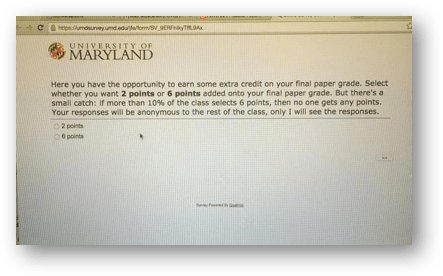
[1] As the screenshot pictured above shows, this is not a make-believe example. Some professors have actually given this “extra credit challenge” to their students. See, e.g., Dylan Selterman, “Why I give my students a ‘tragedy of the commons’ extra credit challenge,” The Washington Post (July 20, 2015).
Vote by mail at your own risk. According to this new empirical paper by Charles Stewart III, a professor of politics at MIT, approximately 1.4 million votes in 2016 were lost by mail or 4.0% of mail ballots cast and 1.0% of all ballots! Hat tip: Tyler Cowen.

The Cato Institute’s annual Constitution Day Symposium begins today at 10:45AM (Eastern Time). Here is a link to today’s program. It is an excellent program because, despite its misleading title, its focus is not exclusively on the oracles of the Supreme Court. Both in constitutional theory and practice, the roles of the other two branches of government in interpreting the Constitution are equally as important!

On this day in 1787, the Founding Fathers of our country signed the proposed U.S. Constitution. (I say proposed because the Constitution was not officially ratified and did not become law until mid-1788.) To celebrate Constitution Day, which should be a national holiday, I want to share this thought-provoking paper by Richard Albert with my loyal readers. His paper is titled “America’s Amoral Constitution” and it reveals “an important if shocking truth about Constitution: no principle is inviolable, no right is absolute, and no rule is un-amendable.” His thesis is that the moral and political legitimacy of the Constitution “is rooted in an amoral code structured around the peculiar value of outcome-neutrality.” In plain English: as long as the rules of Article V are followed, anything goes! (Article V is the part of the Constitution that sets forth the rules for amending or changing the Constitution; see image below for a visualization of these amendment rules.) Alas, Professor Albert’s paper does not discuss whether Article V itself can be amended. Thankfully, however, I address that very question in my 2013 paper “Goedel’s Loophole.”
Update (9/23): I reached out to Professor Albert, and he recently replied back to me, so I will be blogging about Article V again–and about our exchange of ideas–soon!

As I mentioned in my previous post, I have posted 56 scholarly works to SSRN since 2006. Most of these works consist of published papers (38 in all), but some (18, to be exact) are unpublished works-in-progress. Of this corpus, two thirds of my papers (37 out of 56) are relatively short by law review standards: 20 pages or less! Below is a complete frequency distribution of the page lengths of my SSRN papers. Notice the lopsided bell-shaped curve of this distribution.
| 1-10 pp. | 11-20 pp. | 21-30 pp. | 31-40 pp. | 41-50 pp. |
| 13 | 24 | 9 | 6 | 4 |
As I have mentioned in my previous two posts, I have posted a total of 57 papers (actually, 56; see note below) on SSRN since 2006. Thirty-eight of these papers are published works, while the remaining 18 papers are works-in-progress. I now want to examine my scholarly production from a quantitative perspective, beginning with page lengths. It turns out that I have written over 1000 pages during this span of time (2006 to the present). My shortest scholarly paper is just one page long–my letter “Kant on Evidence,” which was published in the Green Bag last summer–, while my longest paper is 49 pages–“Clones and the Coase Theorem,” which was published in The Journal of Law & Social Deviance. The average length of my works is 19 1/3 pages. For your reference, the table below indicates the page length of each one of my 57 papers:
| Page Length | |
| 1 | 37 |
| 2 | 10 |
| 3 | 11 |
| 4 | 42 |
| 5 | 18 |
| 6 | 10 |
| 7 | 16 |
| 8 | 24 |
| 9 | 37 |
| 10 | 17 |
| 11 | 25 |
| 12 | 19 |
| 13 | 31 |
| 14 | 49 |
| 15 | 13 |
| 16 | 4 |
| 17 | 20 |
| 18 | 14 |
| 19 | 45 |
| 20 | 18 |
| 21 | 7 |
| 22 | 10 |
| 23 | 10 |
| 24 | 13 |
| 25 | 17 |
| 26 | 22 |
| 27 | 46 |
| 28 | 16 |
| 29 | 39 |
| 30 | 21 |
| 31 | 11 |
| 32 | 18 |
| 33 | 1 |
| 34 | 39 |
| 35 | 18 |
| 36 | 11 |
| 37 | 19 |
| 38 | 7 |
| 39 | 15 |
| 40 | 21 |
| 41 | 8 |
| 42 | 27 |
| 43 | 17 |
| 44 | 26 |
| 45 | 12 |
| 46 | 17 |
| 47 | 29 |
| 48 | 7 |
| 49 | 8 |
| 50 | 18 |
| 51 | 5 |
| 52 | 18 |
| 53 | 16 |
| 54 | 9 |
| 55 | 19 |
| 56 | 33 |
| 57 | 2 |
| Total: | 1085* |
*Note: The actual total is 1092, but I just realized that one of my papers–my seven-page contribution to the anthology of “Best & Worst of Contracts Decisions”–was posted twice. (See papers #21 and #48. What happened was this: I had initially posted a draft of my contribution in 2017; the editor of the anthology posted the final version in 2019. Both versions of this paper thus appear on my SSRN homepage.) This particular paper is just seven pages, so I subtracted 7 from the total to arrive at 1085. Since 1085 divided by 56 is 19.375, I am reporting the average length of my papers to be 19 and one-third pages.










Welcome to the online home of the IASS
Hopefully It’s Interesting.
In Conversation with Legal and Moral Philosophers
Relitigating Our Favorite Disputes
PhD, Jagiellonian University
Inquiry and opinion
Life is all about being curious, asking questions, and discovering your passion. And it can be fun!
Books, papers, and other jurisprudential things
Ramblings of a retiree in France
BY GRACE THROUGH FAITH
Natalia's space
hoping we know we're living the dream
Lover of math. Bad at drawing.
We hike, bike, and discover Central Florida and beyond
Making it big in business after age 40
Reasoning about reasoning, mathematically.
I don't mean to sound critical, but I am; so that's how it comes across
remember the good old days...
"Let me live, love and say it well in good sentences." - Sylvia Plath
a personal view of the theory of computation
Submitted For Your Perusal is a weblog wherein Matt Thomas shares and writes about things he thinks are interesting.
Logic at Columbia University
Just like the Thesis Whisperer - but with more money
the sky is no longer the limit
Technology, Culture, and Ethics
Just like the horse whisperer - but with more pages
Poetry, Other Words, and Cats

 prior probability