As I mentioned in my previous post, I have posted a total of 57 scholarly papers on the Social Science Research Network since 2006. The table below shows the year in which I first posted a paper of mine to SSRN. (Again, here is a link to my SSRN homepage.) In summary, my most productive scholarly years were the even-numbered years of 2012, 2014, 2016, and 2020. Also, notice how my scholarly production fell off precipitously for three straight years, beginning in 2017. In my defense, during this three-year period of my scholarly life (2017, 2018, and 2019), I was co-authoring a new and comprehensive “Business Law & Strategy” textbook for McGraw Hill with my colleagues Sean Melvin and David Orozco–a massive endeavor that took up most of my free time during those years.
I have posted a total of 57 scholarly papers on the Social Science Research Network (SSRN) since 2006 and have subsequently revised 51 of these 57 papers. (Here is a link to my SSRN homepage.) The table below shows the months in which I first submitted each of my papers to SSRN as well as the months in which I submitted significantly revised versions of 51 of those papers. As you can see from the table below, October is my least productive scholarly month of the year, while the winter months of January/December and the summer months of June/July/August are my most productive scholarly months, i.e. the months in which I am not teaching. No surprise there!
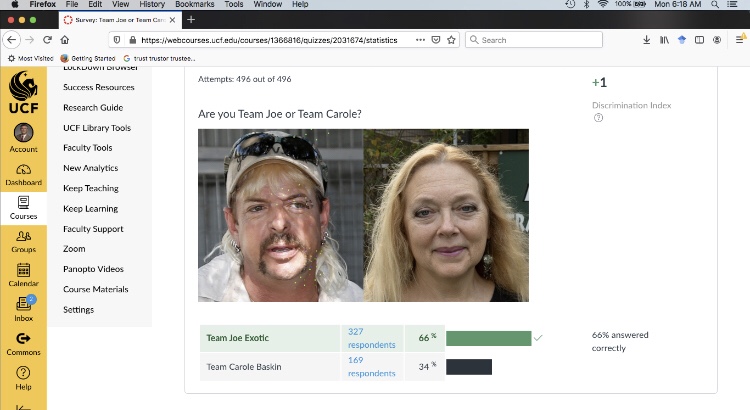
I asked my undergrad business law students to watch Tiger King and then choose whether they were “Team Joe” or “Team Carole.” Of those who voted, 327 students voted for Team Joe, while 169 students voted for Team Carole, but a greater number of students (376 in all) decided to abstain from voting! In other words, neither choice was an appealing one. Nevertheless, I wanted to conduct this survey at the start of the semester in order to make an important philosophical point about business law (and about life in general): sometimes we are faced with two bad choices. In such situations, the key is to choose the lesser evil. Of course, in the case of Tiger King, reasonable minds can disagree on who that lesser evil is…
Am I the only one who thinks that the fake crowd noise being played in the background during TV broadcasts of MLB, NBA, and NFL games is totally lame? Major League Soccer and professional tennis, for example, do not rely on this gimmick, allowing us to to actually hear the athletes’ cries, grunts, and shouts, authentic sounds of sport that I would prefer to hear a million times more than this lame fake crowd noise. Am I the only one?
For the benefit of my fall business law students, I am including here a complete set of general overviews of the contents of Module 2 of our legal and ethical environment of business course (BUL3130). In summary, Module 2 is devoted to the big picture–the main sources of law in the USA–and one way of visualizing this messy and massive picture is the legal historian F. W. Maitland’s metaphor of “law as a seamless web.” (For your reference, a portrait of the great Maitland is pictured below. The artist is Susan Beatrice Lock. You can learn more about her life and work here.) I therefore use Maitland’s beautiful metaphor as a unifying theme throughout Module 2. Enjoy!
Este pasado miércoles 9 de septiembre, mi ensayo jurídico “Guaranteed Income: Chronicle of a Political Death Foretold” (disponible aquí) fue otorgado el premio de mención honorífica en la categoría de ensayo libre por el Comité de Obra Jurídica del Año 2020 del Colegio de Abogados de Puerto Rico. Gracias a los miembros del comité, comenzando con su presidente, el Dr Daniel Nina, y sus demás miembros–el Dr Eduardo Villanueva, el Dr Hiram Lozada y la Sra María Zamparelli–por haberme otorgado este premio. Le dedico mi ensayo a la memoria del Dr Carlos del Valle Cruz, quien falleció en julio. #ColegioSiempre
(For my English-speaking readers, I am thanking the Colegio de Abogados de Puerto Rico, one of the oldest bar associations in the world, for recently awarding my 2020 paper “Guaranteed Income: Chronicle of a Political Death Foretold” (available here) an honorable mention in the category of best law essay of the year. As an aside, I have been a card-carrying member of the Colegio since 1994, the year I was authorized to practice law in the Commonwealth of Puerto Rico, and by the way, I also need to thank my colleague and friend Orlando I. Martinez-Garcia, who nominated my paper for this award, as well as my former student Hamed Santaella, who took the time to help me submit physical copies of my paper to the prize committee by the deadline. Lastly, I dedicate my paper to the memory of my colleague and friend, Carlitos del Valle Cruz.)
What should we make of the brouhaha depicted in the video below? Heckler’s Veto, anyone? In short, instead of protecting Kaitlin Bennett’s right to free speech, university police force her to leave campus. I don’t know who Ms Bennett is, but whatever happened to the right of free speech, especially on a college campus where the exchange of ideas is supposed to be sacrosanct?
“Left-wing terrorists at @UCF attacked my security & I, wished death on me, & forced me to need a police escort off campus, all because I support @realDonaldTrump…” https://t.co/YFTzVUIdHO
Hey, Mr Madison, what went wrong? The co-author of the famous Federalist Papers, James Madison, was also the Founding Father who was the Secretary of the Constitutional Convention of 1787 and who is often referred to as “the architect” of the United States Constitution. In Federalist Paper #45, he tells us that the federal government will be small relative to the governments of the States:
The number of individuals employed under the Constitution of the United States will be much smaller than the number employed under the particular States. There will consequently be less of personal influence on the side of the former than of the latter. The members of the legislative, executive, and judiciary departments of thirteen and more States, the justices of peace, officers of militia, ministerial officers of justice, with all the county, corporation, and town officers, for three millions and more of people, intermixed, and having particular acquaintance with every class and circle of people, must exceed, beyond all proportion, both in number and influence, those of every description who will be employed in the administration of the federal system.
In addition, Mr Madison also tells us that the powers of the federal government will be “few and defined” compared to the residual powers of the States:
The powers reserved to the several States will extend to all the objects which, in the ordinary course of affairs, concern the lives, liberties, and properties of the people, and the internal order, improvement, and prosperity of the State. The operations of the federal government will be most extensive and important in times of war and danger; those of the State governments, in times of peace and security. As the former periods will probably bear a small proportion to the latter, the State governments will here enjoy another advantage over the federal government.
Ironically, Mr Madison was wrong on both counts. At last count, there are now about two million federal employees, and today there are no real limits on the power of Congress to regulate the economy. (By comparison, here is a compilation of the total number of State employees.) So, why was Madison so wrong! (While you consider this question, below is a poorly-edited but entertaining audio montage of every James Madison intervention in the hit musical Hamilton.)
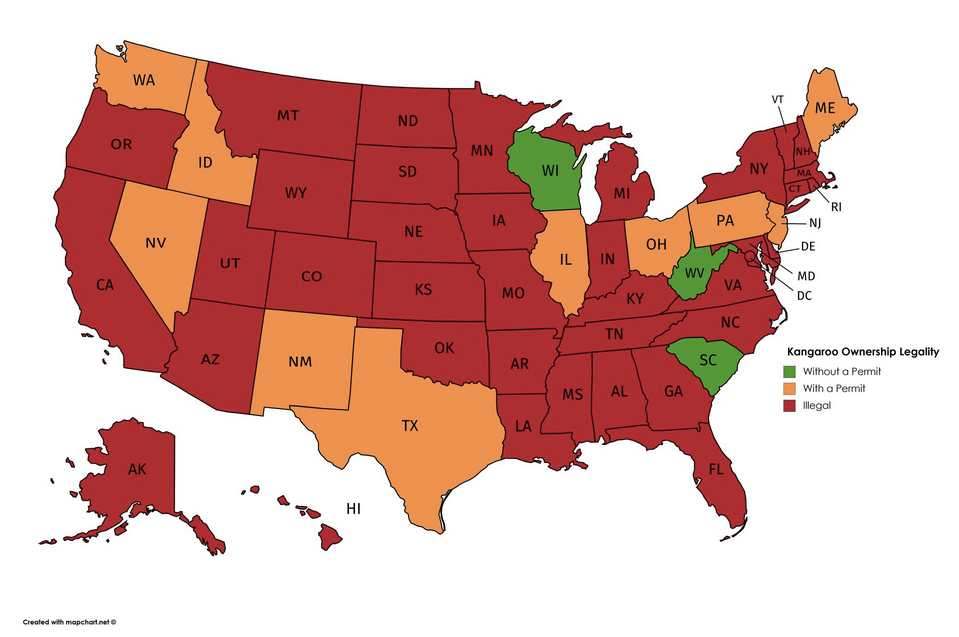
Say what? Although the reliability of the map pictured below has been called into question (see here and here, for example), the private ownership of kangaroos is illegal in some 37 States. But what about zoos?










 prior probability