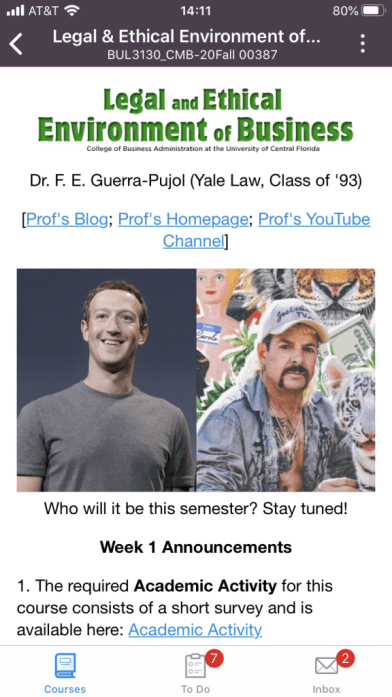
I forgot to post the final tally of my Tiger King vs. Social Network survey, which was incredibly close: see screenshot pictured below. In summary, out of a total of 868 votes cast (yes, I have almost 900 students distributed across three sections), Tiger King won with 444 votes, while The Social Network was close behind with 424 votes!
Updated (8/27, 9:30 PM): This semester, I am asking my students to choose the theme of their business law survey course: “Tiger King” or “The Social Netwtork”, Joe Exotic or Mark Zuckerberg, big cats or social media. So far, a total of 764 out of 866(!) enrolled students–88% of the entire class–has voted. I will post the final tally as soon as the survey closes on Friday. Pictured below is the homepage of my course (Canvas App version):
Here is the latest example of what I like to call “political junk science“–a paper published a few days ago in the prestigious Proceedings of the National Academy of Sciences (PNAS) and whose hyperbolic conclusion is that, and I quote, “substantial numbers of Republicans endorse statements contemplating violations of key democratic norms, including respect for the law and for the outcomes of elections …” blah, blah, blah. (For my readers overseas, the reference to “Republicans” in this paper is to the second-oldest political party in the United States–the one founded by Abraham Lincoln!) The author of this bullshit, Larry M. Bartels, holds the “May Werthan Shayne Chair of Public Policy and Social Science” at Vanderbilt University. We have but two words for you, Dr Bartels: OK, Boomer!
According to Wikipedia, the off-Broadway production of the hit musical “Rent” closed on this day (September 9) in 2012. As an aside, the song “Seasons of Love” from this popular production is one of my favorite musical numbers of all time. For your reference, below is the Glee version of this beautiful song:
Because of the Labor Day holiday, my Advanced Topics in Law class did not meet this week. Next week, however, we will resume full steam ahead with “the Commerce Clause problem.” But first things first: Why is the venerable Commerce Clause, which appears in Article I, Section 8 of the Constitution, a problem? I will tell you why! In brief, the powers of the Congress are supposed to be–in the immortal words of James Madison in Federalist Paper #45–“few and defined.” The problem is that one of Congress’s “few and defined” powers includes the power to regulate interstate commerce under the Commerce Clause, and almost every single human activity has an effect, however remote, on commerce. Accordingly, what real limits, if any, does the Commerce Clause impose on the Congress?
By way of example, does Congress have the power to prohibit the private ownership of dogs or cats? What about exotic animals like tigers and lions? If enacted into law, for example, the proposed “Big Cat Public Safety Act” would prohibit the sale, possession, and breeding of big cats–thus making it illegal to own a tiger or lion. (Look it up!) At the same time, this bill exempts certain wildlife sanctuaries like Harold and Carole Baskin’s Big Cat Rescue in Tampa, Florida–an exemption that potentially raises some “equal protection” concerns. Are big cats an article of commerce? Let’s assume for the sake of argument that Congress does have this power–that Congress can ban the private ownership of big cats. I now wish to pose the following second-order question: Why should the courts have the self-declared power to declare a democratically-enacted law unconstitutional?
Today (Sept. 8) is the feast day of Our Lady of Charity, the patron saint of my beloved Cuba. May my brothers and sisters on the Island be free one day soon!
I just discovered via Ms Megan Turner, a student journalist at my university, that the president of the university, without any prior notice or meaningful discussion, recently adopted an emergency “student behavior expectations policy.” (Here is a link to the nine-page emergency policy.) Putting aside its Orwellian-sounding title, this new policy purports to apply to student conduct off campus. Among other things, and I quote, “students must avoid hosting or attending gatherings or events of more than 12 people, either on or off campus, that a reasonable person would conclude demonstrate a woeful or willful disregard for university policy or expectations as it pertains to COVID-19 precautions ….” For my part, this utterly misguided and poorly-worded policy creates more problems than it solves. Why 12, for example, instead of 50? What is reasonable? What about public protests or campaign rallies? What about sporting events, including college football games? What about faculty? Etc., etc. Furthermore, emergency or no emergency, this policy is not only of doubtful legality; it is also deeply un-American. (Also, the supreme irony of prohibiting student gatherings of 12 or more and at the same time allowing 11,000 spectators to attend college football games at our university stadium is not lost on me!)
I am totally serious. In honor of the upcoming Labor Day Holiday Weekend, allow me to pose the following (non-rhetorical) question: Why do we still allow the federal government (and many State governments) to tax our physical and mental labor, which is what an “income tax” basically amounts to? Go ahead and tax my capital gains, or my leisure activities, or my property, or my inheritance, or my wholesale or retail purchases, but for goodness’ sake, stop taxing my labor! Simply put, I don’t need a bunch of fancy jargon to obfuscate the self-evident truth that taxing people’s work is regressive and unjust–the moral equivalent of theft or forced labor. At the very least, the first $100,000 of one’s earnings should be tax free. What am I missing here? (PS: If you Google the phrase “abolish the income tax,” some very interesting things will pop up!)
This map purports to show which presidential candidate is most likely to win a given State based on public opinion polling from the last two weeks. Let’s put aside the fact that these polls are pretty much worthless–just ask Hillary Rodham Clinton! What I like the most about this map is how the size of each State is weighted to reflect its number of Electoral College votes.
You may have already seen some variant or snippet of the video clip below in which Ander Christensen, a resident of Lincoln, Nebraska, asks his local city council to ban the misleading and deceptive term “boneless chicken wings.” Although Mr Christensen’s plea may sound trivial, I wholeheartedly agree with him, for as I see it, he is making a deeper philosphical point about truth and language. See here, for example. In brief, when we use a word or phrase to describe x, those words or that phrase should accurately reflect the contents of x, right?
Will the interstate highway system be the last major public works project to be built in the United States, or should we re-start the Cross Florida Barge Canal or the Big Cypress Swamp Jetport? I first learned about these two ambitious but ill-fated Florida public works projects in one of the books I was reading this summer: Drying Up: The Fresh Water Crisis in Florida (University Press of Florida, 2019) by John M. Dunn. The Cross Florida Canal would have connected the Gulf of Mexico and the Atlantic Ocean, while the Big Cypress Jetport would have been the largest and most modern airport in the world, capable of handling supersonic aircraft. Alas, both projects were eventually cancelled due to their environmental impacts. In any case, I finally found a map of the proposed canal and am posting it here.











 prior probability