I have blogged on a previous occasion about the potential existence of a travel diary that Adam Smith may or may not have kept during his Grand Tour of France (1764 to 1766), but this lost diary–even assuming it exists–may never be recovered. Here, I shall blog about Adam Smith’s lost letters and papers. The following passages are from the latest draft of my most recent work-in-progress “Adam Smith in Love“:
As the old Bayesian saying goes, “the absence of evidence is not evidence of absence” (see, e.g., Altman & Bland, 1995, p. 485; see also Sagan, 1997, p. 213), but toward the end of his life, Doctor Smith specifically instructed his literary executors, Joseph Black and James Hutton, to destroy his unpublished manuscripts, correspondence, and other private papers.[1] In fact, Adam Smith insisted on the destruction of his private papers and letters as early as 1773(!), when Smith had made his first will and had appointed his friend David Hume his executor.[2] Among the correspondence destroyed were any letters Adam Smith may have received from any of his lost loves.
So, why did Smith want to destroy his private letters and papers as early as 1773, only a few years after his 18-month sojourn in the South of France (1764 to 1765), his ten-month residency in Paris (1766), and his two-month stay at Dalkeith House (1767)? Did Smith ask his literary executors–first Hume, then Black and Hutton–to burn his manuscripts to hide or cover up any evidence of his lost loves? Nevertheless, despite Doctor Smith’s desire to have his papers and letters destroyed upon his death, a small sample of Smith’s correspondence still survives: 304 letters in all.[3] Among these 304 surviving letters are three addressed to Frances Scott Campbell (Lady Frances): Letter No. 97 dated October 15, 1766; Letter No. 98 dated October 19, 1766; and Letter No. 225 dated March 17, 1783. Why is there such a large gap of time between the first two letters (1766) and the third letter (1783)? Are these the only letters that Adam Smith ever wrote to Lady Frances? In the alternative, are there any additional Adam Smith letters in the possession of any of Lady Frances’ descendants?[4]
One of Smith’s leading biographers, Ian Simpson Ross (2010, p. 405), points to “Smith’s prudence” and “his concern for his literary reputation.”[5] In reality, what if Smith’s main concern was his own moral reputation?[6] After all, in addition to his contributions of jurisprudence, literary studies, and political economy, Doctor Smith was first and foremost a moral philosopher, the author of The Theory of Moral Sentiments, first published in 1759. Any evidence of Smith engaging in “antenuptial fornication” in Scotland or of carrying out secret love affairs in France or in Dalkeith House might tarnish his towering moral reputation.[7] Furthermore, it turns out that Adam Smith, the moral philosopher, had a lot to say to about the passion of romantic love and the problem of licentiousness. ****
[1] See, e.g., Ross, 2010, pp. 404-405. See also Phillipson, 2010, p. 209. Cf. Alcouffe & Massot-Bordenave, 2020, p. x: Doctor Smith “insisted to his faithful friends that all his paper be burned. Thus only 193 letters written by him and 129 addressed to him remain. The majority of them date from the latter part of his life, after the publication of The Wealth of Nations [in 1776] ….”
[2] See Phillipson, 2010, p. 279. Alas, Hume died on August 25, 1776, a full 14 years before Smith’s death in 1790.
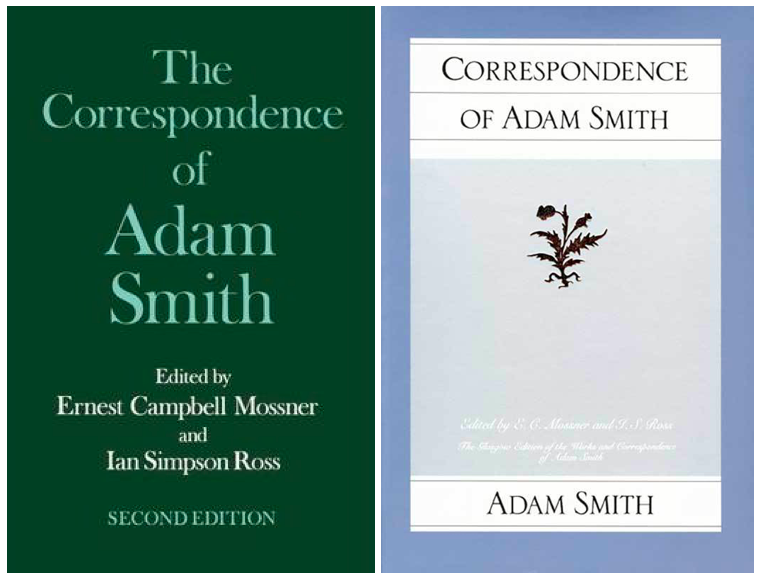
[3] These 304 letters were eventually assembled together into a single volume and reprinted in Mossner & Ross, 1987. Of these 304 letters, 131 are from Smith’s hand, while 98 are addressed to Smith, and the remaining 75 letters contain information about Adam Smith. See ibid., p. 12.
[4] Cf. W. R. Scott, 1940, p. 272: “[T]here is just a possibility that a large body of documents relating to Adam Smith may still be in existence.” Tracking down any new Adam Smith letters addressed to Lady Frances, however, will be a daunting task. Lady Frances, for example, eventually married Archibald Douglas in 1783, and the couple had six children. See Rubenstein, 1985.
[5] Ross, 2010, p. 405.
[6] Cf. Alcouffe & Massot-Bordenave, 2020, p. 133: “… it is important to underline also that the place ascribed to the judgement of posterity is found in the arrangements which he [Smith] to make prior to his death; to make his personal papers disappear and thus to control the image which posterity would later preserve of him.”
[7] Cf. Rashid, 1998, p. 173, who notes that Smith was an “assiduous cultivat[or] of patronage” and knew how “play[] the game.”