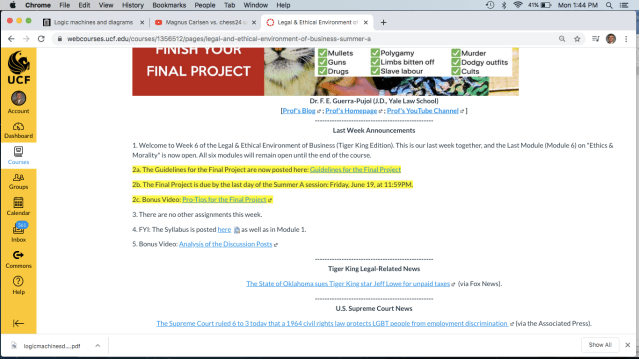
Roar! It’s the Last Week of Tiger Law!

Note: This is an overview of Week 6 of my Tiger Law course and the first of several blog posts devoted to Week 6/Module 6 of my business law summer course.

Thus far, my business law survey course has proceeded as follows: first, we watched Tiger King and picked a side: Team Joe or Team Carole (Week 1). Next, we identified the main sources of law–State, federal, and international–that could apply to a roadside zoo like Joe Exotic’s G.W. Exotic Animal Park or to a wildlife sanctuary like Harold and Carole Baskin’s Big Cat Rescue (Week 2). Later, we explored the common law, including torts, property, and contracts (Week 3), as well as the law of ideas, including trademark and copyright law (Week 4), and then we compared and contrasted the civil and criminal cases featured on Tiger King (Week 5). I have, however, saved the best for last. This week (the last week of the course!) is devoted to “Ethics & Morality”, including natural law, business ethics, and the moral status of animals.

But before I provide a general overview of Week 6 of the course and describe the contents of Module 6, you might be asking, Why devote an entire week to ethics? I will tell you why. Simply put, the official title of my course is “The Legal & Ethical Environment of Business,” so ethics is a key part of my survey course and deserves sustained attention. Specifically, my module on “Ethics & Morality” is divided into seven parts as follows:

  • Intro Video, Textbook Chapter, & Theme Song
  • The Natural Law Tradition
  • Theories of Ethics
  • The Moral Status of Animals
  • Business Ethics (CSR)
  • Bonus Section: The Legal Regulation of Sex
  • Final Project

In other words, we cover a lot of ground in this module, including not just “business ethics” or corporate social responsibility but also deeper questions like the relation between law and morality as well as some of the major theories of ethics, including consequentialism, Kantian duty ethics, and virtue ethics. Because of my Tiger King theme, we also explore the moral status of animals in light of these theories of ethics. Rest assured, we will delve into the details of the last module of my course in my next few blog posts. In the meantime, below are some screenshots of the homepage of my course for Week 6:

Desktop version (from top to middle):
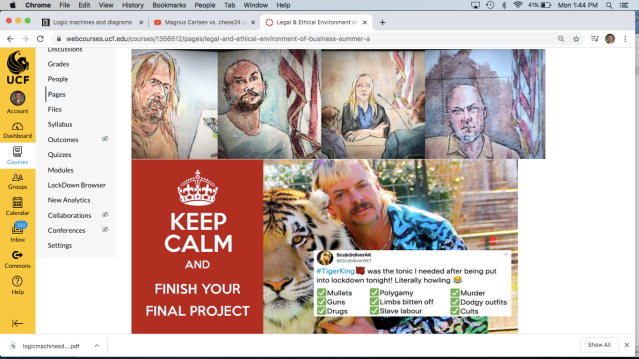
Screen Shot 2020-06-15 at 1.44.34 PMScreen Shot 2020-06-15 at 1.44.54 PM

Canvas App Version (from top to bottom):
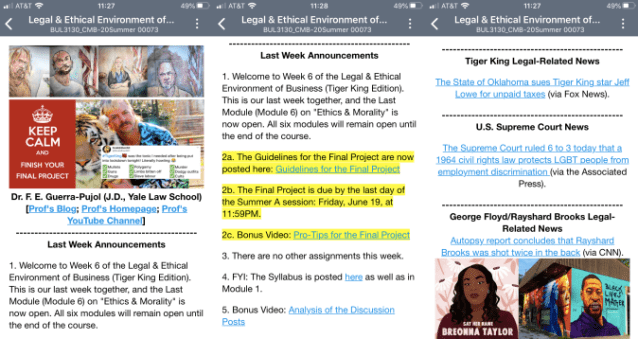
Screen Shot 2020-06-15 at 11.35.05 AM

Posted in Uncategorized | Leave a comment

What do I miss the most about our pre-pandemic times? It’s not sports or bars or restaurants. It’s the experience of going to the movies. Specifically, I miss going to Enzian, the fine arts cinema in Maitland, Florida (where years ago I photographed the above iconic still in the gentlemen’s washroom).

Posted in Uncategorized | Leave a comment

Let’s rename Flag Day …

… “Betsy Ross Day” in honor of a humble woman who helped changed the course of history. Here is her Wikipedia page.

Posted in Uncategorized | 2 Comments

Congratulations, Kleber Guerra

I can’t ask for a better son in the whole world! Kleber Enrique just graduated from Lake Mary H.S. and is going to attend college at the University of Florida (#GoGators) in the fall. May the Force be with you in your future endeavors!

Posted in Uncategorized | 3 Comments

Guaranteed Income: Chronicle of a Political Death Foretold

My Guaranteed Income paper now appears in print. It is part of a symposium issue of the Chapman Law Review devoted to the 91st Congress. (An electronic version of the paper is also available here free of charge via SSRN.)

Posted in Uncategorized | 2 Comments

Typology of lego computers

Photo by Present & Correct.
Posted in Uncategorized | Leave a comment

Vantage point

Hat tip: u/homesanto
Posted in Uncategorized | Leave a comment

Cowen’s aphorism

Note: This is the last of several blog posts reviewing Tyler Cowen’s book “Big Business: A Love Letter to an American Anti-Hero.”

Now that we have reviewed the first eight chapters of Tyler Cowen’s “Love Letter,” it’s time to conclude our extended review with Chapter 9, the last chapter of Professor Cowen’s ode to big business, but before proceeding any further, let me say that Cowen has saved the best for last, for in many ways his concluding chapter is the most intriguing and fascinating chapter in a book full of intriguing and fascinating chapters!

To begin with, Professor Cowen’s concluding chapter poses a paradoxical query: If big business is so great in so many different ways, why do people “hate on” (to use the popular expression) business so much? Although Cowen offers an intriguing conjecture, alas, it is totally wrong! Specifically, Cowen speculates (p. 184, emphasis in the original) that “we anthropomorphize corporations–we imbue them with human qualities,” instead of seeing business firms for what they really are: cold, impersonal, legal abstractions with “a legally binding responsibility” to maximize their profits (p. 197).

I call bullshit (again)! Maybe this is how Professor Cowen himself sees corporations (though I highly doubt it), but I don’t know of a single person who “thinks of corporations as people” (p. 184) or who sees business firms as their “friends” (p. 198). People are not that stupid, and an economist no less should know better. Yes, I will concede that most people are most likely unaware that the managers of a corporation owe a common law “fiduciary duty” to the shareholders, but most people already know that most companies, especially the big business firms that Cowen is writing about in his book, are cold, impersonal, legal abstractions whose main corporate mission is to maximize profits. That’s precisely why “we” hate on big business firms, engage in shoplifting, lie on our resumes, etc.! Because large corporations are seen as cold and impersonal and abstract entities!

In closing, let me end my extended review on a positive note. Tyler Cowen concludes Ch. 9 by asking, what is the social responsibility of business? Is it to just make profits, or is it something more? Professor Cowen’s pithy riposte to this question is (pp. 205-206, emphasis in the original), the social responsibility of business is to come up with new and better conceptions of the social responsibility of business. At a surface level, this response is pretty lame, but at a deeper level, Cowen’s aphorism blew me away. Markets are not limited to products and services. Maybe markets also extend to ethical paradigms and moral doctrines. In addition to providing us a wide array of products and services, perhaps business firms also provide us differing degrees of ethical dogmas and moral menus!

In my view, ethics and morality are not just about choosing between good and bad, right and wrong. After all, often in life we must choose between two or more bads, two or more wrongs! Fundamentally, ethics and morality are about how we treat and interact with other people (and with nonhuman animals), and that is one way of understanding what business firms do. Business firms are an agglomeration of stakeholders, and most of these stakeholders are people: owners, managers, employees, contractors, customers, etc. Moreover, business firms employ a wide variety of methods of treating or interacting with these sundry stakeholders, and these different ways are, at bottom, guided by different visions of ethics and morality …

Professor Cowen (with apologies to DJ Khaled, pictured below), maybe it is time for you to “make” another book!

DJ Khaled Another One | MAKE... ...ANOTHER ONE | image tagged in dj khaled another one | made w/ Imgflip meme maker
Posted in Uncategorized | Leave a comment

What happened to “save grandma”?

First, we were told not to wear masks. Next, we were told to stay home. And then, an exception was made for anti-police protestors. With apologies to my colleague and friend Alex Tabarrok, is the Wuhan coronavirus an existential threat to humanity, or is the so-called “lockdown” the biggest government farce since the bogus pretext for the invasion of Iraq? Either way, the lamestream media, our elected officials, and our so-called public health “experts” have lost whatever little credibility they had in the first place. More below the fold: Continue reading

Posted in Uncategorized | 4 Comments

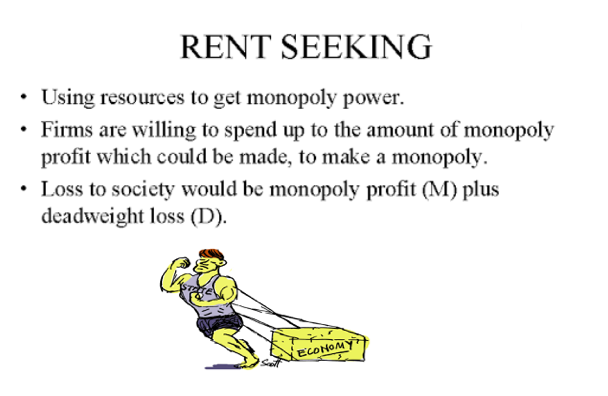
What is the optimal level of rent-seeking?

Note: This is the sixth of seven blog posts reviewing Tyler Cowen’s book “Big Business: A Love Letter to an American Anti-Hero.”

Let’s proceed into Chapters 7 & 8 of Tyler Cowen’s “Love Letter to Big Business.” Like the previous two chapters (Chs. 5 & 6, which I reviewed in my previous post), these two chapters do not appear to be related. Chapter 6 (“What is Wall Street good for, anyway?”) is devoted to the financial services industry, e.g. banks, brokers, credit card companies, insurance firms, payday lenders, etc., while Chapter 7 (“How much does big business control the American government?”) is about rent-seeking behavior or “crony capitalism.” Nevertheless, I am lumping these two chapters together because among the usual crony-capitalist suspects are big banks, especially the ones that are supposedly “too big too fail”!

First off, what is rent-seeking or “crony capitalism”? Professor Cowen provides the best definition of these terms that I have seen to date (p. 171): rent seekers and crony capitalists are business firms who “suck[] up to power and cultivat[e] the coercive power of the state to be on one’s side.” Whether it be bribing bureaucrats for government contracts, lobbying elected officials for favorable legislative treatment, or spending millions of dollars on TV ads to shape public opinion in one’s favor–all these things and more fall under the rubric of rent-seeking. Alas, as Cowen admits, all business firms engage in rent-seeking to a lesser or greater extent, if only to ensure their own survival; the real question, however, is how destructive are these pervasive rent-seeking activities to the overall economy?

Cowen makes a persuasive case that rent-seeking is not that big of a problem. Although corporations spend about $3 billion per year lobbying the federal government, they spend over $200 billion per year to advertise their products and services. (See note 3 on p. 224 of Cowen’s book.) Furthermore, if you were to scrutinize the yearly budgets of both State and federal governments, as Cowen does (pp. 173-175), the only real evidence of rent-seeking you will find are farm subsidies, but even this egregious example of rent seeking represents only $20 billion per year out of a total federal budget of $4.4 trillion. If anything, then, if Cowen is to be believed, non-agricultural business firms are not rent-seeking enough?

What about rent-seeking by big banks? Cowen employs a different strategy to defend big banks and the financial services industry writ large. He admits that the financial services industry in the U.S. is “relatively large” in terms of GDP or Gross Domestic Product, the standard method used by economists to measure the size of the economy, but Cowen argues that this growth in the financial sector is actually a good thing! To the point, Cowen’s argument is that a large financial sector reflects a healthy economy, or in Cowen’s own words (p. 153): “There may be specific parts of the financial sector that are too large …, but a large financial sector relative to GDP is frequently a sign of previous economic success and stability.”

For my part, although I am inclined to give Professor Cowen the benefit of the doubt (that rent-seeking is exaggerated), his complete loss of credibility in Chapters 3 & 4 of his big business book (where he simultaneously defends high CEO compensation and stagnant worker pay) gives me pause. At the same time, perhaps Cowen is right. That is, perhaps there is an “optimal level” of rent-seeking, and perhaps we are below or right at that optimal level. But rent-seeking, by definition, does not generate any new economic value (unlike trade), so why is the optimal level of rent-seeking not zero? Easy. Because efforts spent trying to eradicate or reduce rent-seeking behavior might be more costly than the inefficiencies generated by such rent-seeking in the first place! I will conclude my review of Professor Cowen’s “Love Letter to Big Business” in my next post.

Screen Shot 2020-06-10 at 12.42.18 PM

Posted in Uncategorized | Leave a comment