Congratulations to the Class of 2020! It’s time to celebrate the end of the college spring semester, even in these awful times, but good grief, the videos of professional entertainers performing old John Lennon or Charlie Chaplin songs at home during the pandemic have been pathetic. (You know who I am talking about!) I thus feel compelled to interrupt my series of posts on the takings clause to share some potential summer anthems and new dance moves with my loyal followers. Enjoy!
I concluded my previous blog post “Justice Holmes to the rescue” by mentioning the controversial Kelo case. This case involved a curious kind of taking that resulted in a terrible miscarriage of justice. In Kelo, a local government wanted to take 15 parcels of private property, some of which belonged to individual homeowners (like the little pink house pictured below), and transfer these private parcels to a greedy developer in order to gentrify a blighted neighborhood. Worse yet, the Supreme Court allowed this socialist-style redistribution to happen on the pretext that promoting economic development was a public use.
Legally speaking, then, the Kelo case addressed the question of whether “economic development” was a public use or not as required by the Takings Clause. Thus, as Professor Somin correctly notes in his critique of my Kelo op-ed: “If the courts had ruled that the purpose of the taking was not a public use (which would have been the correct decision, in my view), the government would have been forbidden to take the property even if it did pay compensation. On the other hand, the absence of a public use would be irrelevant if the government action in question was not a taking in the first place.”
But as I see it, the public use question and the taking issue are not so separate as my fellow libertarian legal scholar would like us to believe. Why not? Because if we are going to define what constitutes a “public use” or “public purpose” in broad terms, as Kelo controversially does, then such a broad definition will inevitably lead to an expansion of state governments’ police powers.
Furthermore, if state and local governments—as per Kelo—are allowed to take property to allow private developers to gentrify blighted neighborhoods, then governments are certainly allowed to shut business firms down and interfere with their private property rights in order to stop a pandemic or slow its spread. But does a government order shutting down a “non-essential” business firm really constitute a taking?
Although it would be an uphill battle (from a legal realist perspective: “the house always wins”), a strong case can be made that lockdown orders are constitutional takings under the “diminution in value” test set forth in the Pennsylvania Coal case (which was the subject of my previous blog post) and as further refined in the Penn Central case (which I already reviewed in one of my Mercatus Center op-eds). Simply put, if the owner can show that his business suffered a significant reduction in post-lockdown revenues, he should win. The closer to zero his revenues are, the stronger his takings case.
At this point, however, I must concede a potential fatal flaw with my argument. The problem is not so much the police power “carve out” that Somin keeps returning to. The main problem is that all of these coronavirus lockdown orders are supposed to be temporary measures, and some courts have made exceptions for temporary takings. Suffice it to say that this problem presents a potential difficulty, one that I shall dispose of in my next blog post …
Since existing “shelter in place” orders went into effect way back in March of this year, I have tried my level best to explain why non-essential business firms and employees should be entitled to just compensation under the Takings Clause of the Constitution. Among other things, I published some op-eds for the Mercatus Center and wrote up multiple blog posts on this subject.
Last week, my friend and colleague Ilya Somin took notice of my arguments and published a thoughtful critique of one of my op-eds. Although we both agree that morally speaking non-essential business firms and employees deserve compensation, since their property rights and liberties have been significantly curtailed and restricted, where we disagree is on “the law”. Does the Takings Clause require compensation as a matter of law?
The Federalist Society has invited us to discuss our competing views of the Takings Clause at an upcoming virtual panel on May 15; in the meantime, taking the most charitable view of Professor Somin’s strongest legal arguments, I will take this opportunity to respond.
First off, allow me to fast-forward all the way to the end of Professor Somin’s essay, where he points out that I mistakenly described him as a “conservative” legal scholar in my Kelo op-ed–when, in fact, he is a libertarian legal scholar. Although I happily concede this taxonomic error on my part, I am now even more astonished and, dare say, disappointed than ever. How can a fellow libertarian be so reluctant to see the legal merits of extending the Takings Clause to non-essential business firms as well as to non-essential employees?
Professor Somin keeps returning to the police power issue. According to Somin’s reading of the relevant caselaw, a taking does not occur when State governments are exercising their police powers. For Somin, this police power exemption is almost insurmountable: before a court can even decide whether a given governmental action is a regulatory taking, the plaintiff must first “get around” the police power issue.
But Professor Somin’s presentation of the relevant precedents is incomplete, for he fails to mention the single-most important takings case in our nation’s history: Justice Oliver Wendell Holmes’s landmark decision in Pennsylvania Coal v. Mahon. Before that case was decided, the Supreme Court had adopted a very narrow view of the Takings Clause: only physical acquisitions of private property could constitute a taking.
What Pennsylvania Coal did was change the entire landscape of our takings jurisprudence. Justice Holmes introduced a new test for so-called regulatory takings. Under this test, the government can interfere with property rights without having to provide just compensation unless the regulation, in Holmes’s own words, “goes too far” in diminishing the value of the property.
Admittedly, Holmes’s test is underspecified; after all, how much of a diminution in value is too much? The Supreme Court began to fill this gap when it decided the Penn Central case in 1978, but I won’t rehash my analysis of Penn Central here because I now want to make a more important point: the police power issue is a constitutional red herring. What matters is the diminution in value of the property rights of non-essential business firms.
To the extent many non-essential business firms are unable to earn any income during a government-ordered lockdown, they are entitled to just compensation under any reasonable reading of the leading cases of Pennsylvania Coal and Penn Central–not as a matter of charity but as a matter of constitutional law.
Lastly, but not leastly, Professor Somin and I also disagree about the controversial Kelo case. I conflate the threshold takings question (does action x constitute a taking?) with the public use issue in Kelo, (does x promote a public purpose?), while Somin wants to keep these issues separate. Admittedly, my interpretation of Kelo is a novel one, so I will return to Kelo in greater detail in my next blog post.
In honor of my wedding anniversary–Sydjia and I were married in Las Vegas on this day (Cinco de Mayo!) eight years ago–I am reposting one of my favorite songs of all time …
Growing up, the other Mr Rogers introduced me to Country Western music and thus changed my life forever. (The video above showcases one of my all-time favorite songs.) Rest in peace, Kenny Rogers …
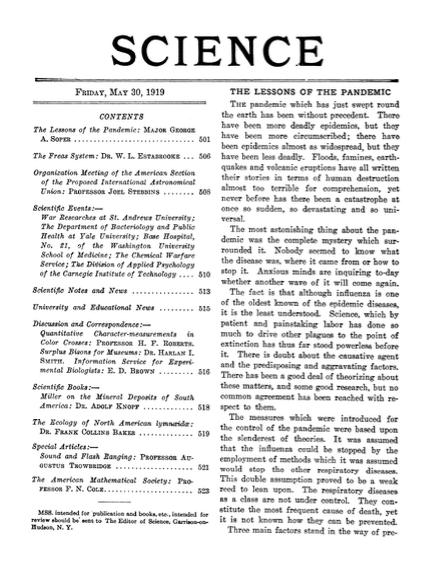
File under: The more things change, the more they stay the same: “The most astonishing thing about the pandemic was the complete mystery which surrounded it. *** Science, which by patient and painstaking labor has done so much to drive other plagues to the point of extinction, has thus far stood powerless before it. There is doubt about the causative agent and the predisposing and aggravating factors. There has been a good deal of theorizing about these matters, and some good research, but no common agreement has been reached with respect to them.”
That passage, which refers to the influenza pandemic of 1917-18, is from this scientific paper (the first page of which is pictured below) published in the journal Science on May 30, 1919–a paper that is just as relevant today as it was 101 years ago.
It’s Magnus’s world; we’re just lucky enough to live in it and watch him continue to win chess championships. Congratulations to Magnus Carlsen, who won the Magnus Invite on Sunday, May 3. Here is a recap of the decisive game 3 against Hikaru Nakamura.
One of the great rivalries in chess history, Magnus Carlsen and Hikaru Nakamura–who have battled it out many times before, most recently, in the title game of the 2019 King Salman World Blitz Championship–will face off again on Sunday, May 3!
I am reblogging my “Kelo and Coronavirus” post (see below) because my colleague and friend Ilya Somin recently wrote up a thoughtful reply and critique (available here) of my Kelo essay. Professor Somin and I will be discussing these issues at a virtual Federalist Society panel on May 15. The details of our upcoming panel are here; in the meantime, I will respond to Professor Somin’s post in the next day or two …
The Mercatus Center at George Mason University has published my latest op-ed explaining why “non-essential” employees and business firms must be paid just compensation–not loans or handouts. The logic of my argument relies on the leading case of Kelo v. City of New London, in which the Supreme Court interpreted the “public use” requirement of the takings clause very broadly. Although Kelo was a controversial decision when it was decided in 2005, it supports my argument that coronavirus lockdowns promote a public purpose and thus trigger the taking clause.
One of the great rivalries in chess history, Magnus Carlsen and Hikaru Nakamura–who have battled it out many times before, most recently, in the title game of the 2019 King Salman World Blitz Championship–will face off again on Sunday, May 3!
The second semi-final, which is between Magnus Carlsen and Ding Liren (both of whom are pictured below), will begin on Saturday, May 2, at 10:00 AM EDT. (Watch it here.) The winner of the Magnus-Ding semi-final match will face Hikaru Nakamura in the final, which is scheduled for Sunday. (Naka defeated Fabiano Caruana in the first semi-final on May 1.)













 prior probability