
What the heck? Is it just me, or do you dislike the new default “block” editor setting on WordPress as much as I do?

What the heck? Is it just me, or do you dislike the new default “block” editor setting on WordPress as much as I do?
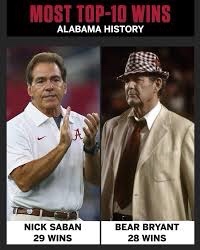
According to my colleague and friend Steven Lubet (via The Faculty Lounge), although college football coach Nick Saban’s contract does not (I repeat, NOT) include a force majeure clause, “he still stands to lose over $1 million in incentives if the season is canceled.” What would legendary ‘Bama coach Bear Bryant say?
Bonus question: If the SEC does cancel its fall college football season (like the Big Ten and the Pac 12 have done), could a force majeure clause be implied or otherwise read into Saban’s contract?
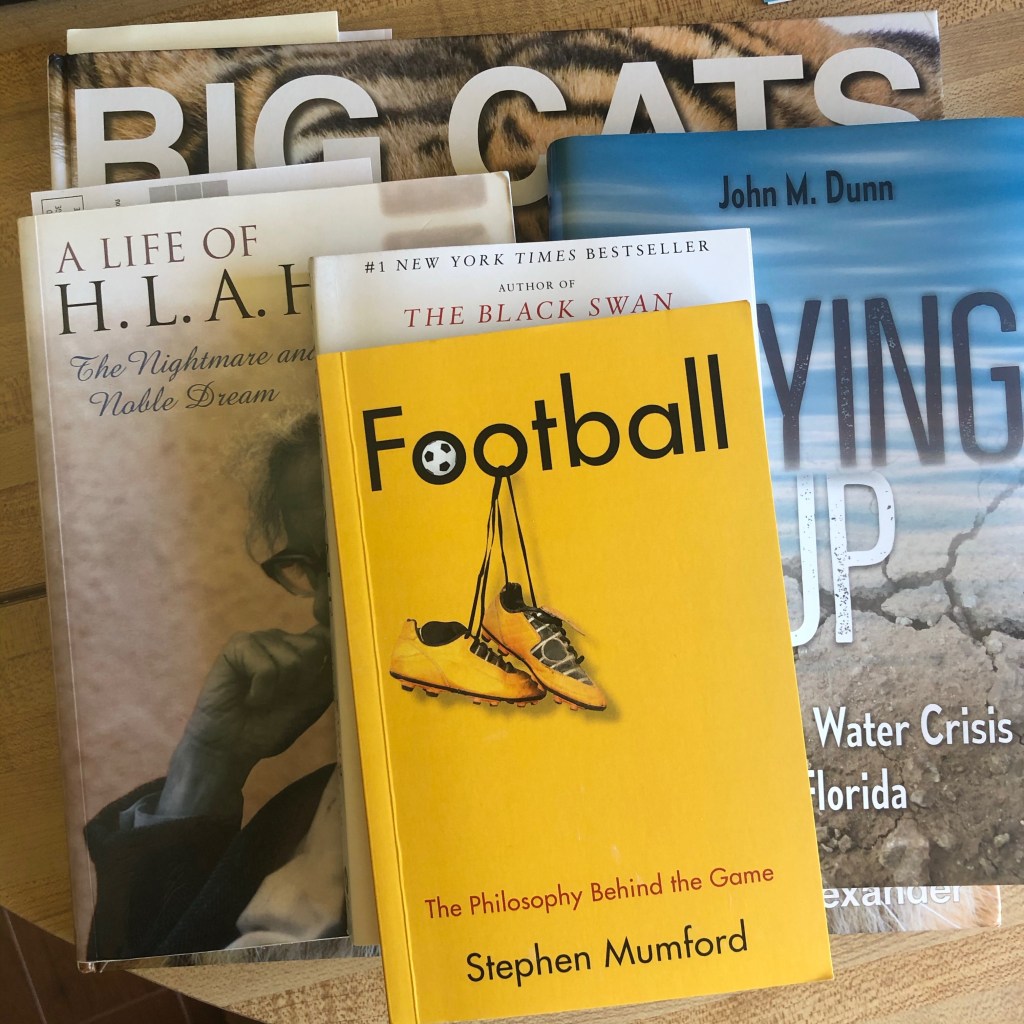
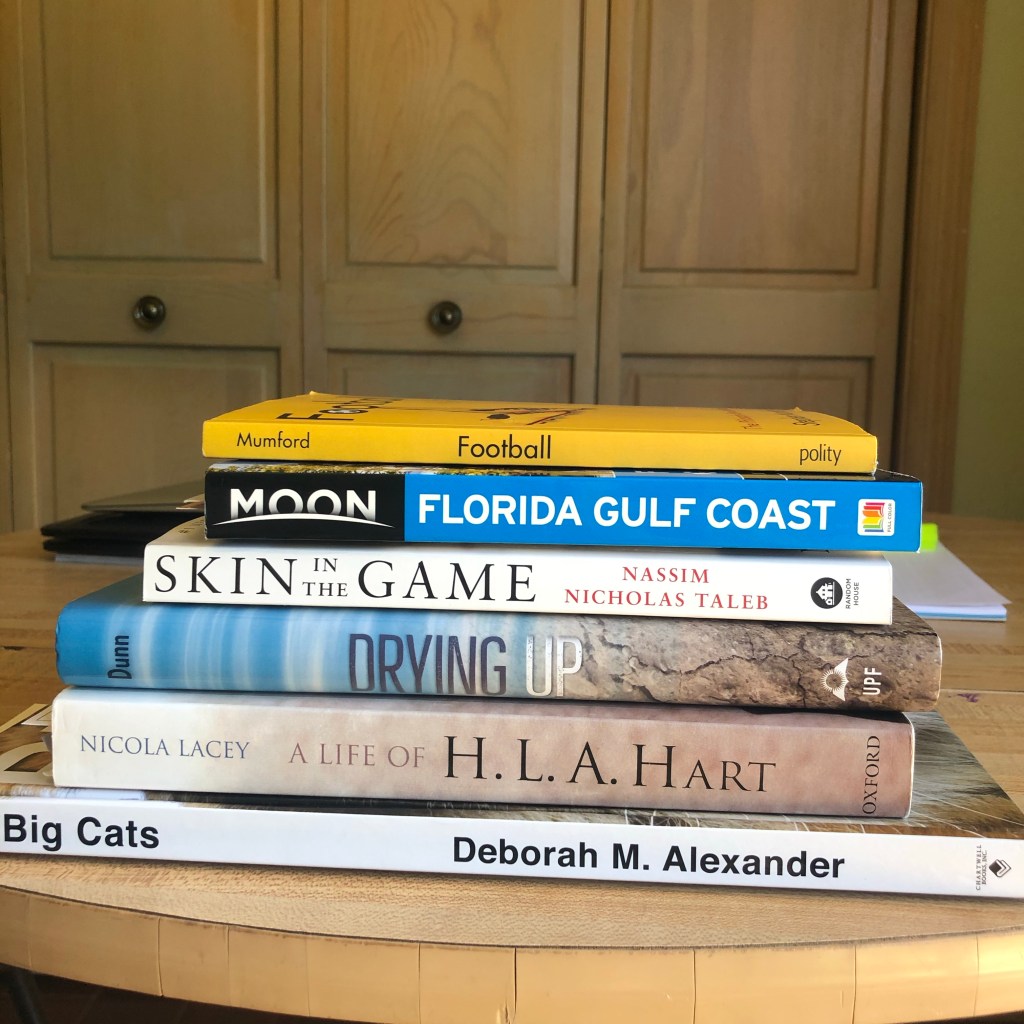
I still have two full weeks before I have to go back to teaching, so I am making the most of my time by catching up on my readings. Among the many things I have learned is that the great H.L.A. Hart did not have an advanced law or philosophy degree and did not begin teaching until he was almost 40! For his part, Nassim Nicholas Taleb is an insufferable bore, but his “Skin in the Game” book is very relevant to our current “cancel culture” troubles, while the coffee-table book on “Big Cats” not only contains many beautiful photographs of lions, leopards, tigers, etc.; it also describes their evolutionary history, mating practices, eating habits, and other forms of behavior. Lastly, the Moon “Florida Gulf Coast” travel book is for a family beach vacation I am planning for next week, and I will have more to say about the other books in my pile soon …
Given that most scholarly journals are now published in an online format, does the peer review process still serve a legitimate “quality control” function, or is peer review now all about crude “academic turf protection,” i.e. preventing new voices and new perspectives from being published in the most prestigious journals? What if it’s a little bit of both? In any case, it’s always fun to see what happens when you google the following question: “Does peer review actually work?”
Sunday fun-day, right? Below are two of my favorite songs from 2016, when this blog was just three years old. In the Anglo-American world, 2016 was also the year of Brexit and Trump and the amazing year all our asinine pundits were proved wrong, even the much-touted Nate Silver! As an aside, if these videos were made today (in our troubled coronavirus era), I am pretty sure all the beautiful models and artists would be more socially distanced! Also, as a further aside, while we are on the subject of 2016, check out my one and only published paper from that year “Probabilistic Interpretation.”
I nominate John Ioannidis, Gerg Gigerenzer, Jacob Cohen, and (now) @aubreyclayton! Somehow, I missed Aubrey Clayton’s powerful take-down of standard statistics and “statistical significance,” which was published in Issue #74 of Nautilus (August 1, 2019). Among other things, Clayton explains why probability without priors is impossible, and he presents three striking examples of bad statistical reasoning–the Sally Clark case, cancer screening, and a bullshit study that was published in the journal Science–and shows step-by-step why Bayesian reasoning outperforms so-called significance testing every time. I only wish to add that Bayesian reasoning also solves many so-called “proof paradoxes” in law, including Larry Tribe’s blue bus problem and the paradox of the gatecrasher. On the blue bus problem, check out my full-length law review article “Visualizing Probabilistic Proof,” and for the so-called paradox of the gatecrasher, check out my October 2014 blog post titled “The paradox of the gatecrasher is not a paradox.” Any questions?

How should we teach “business law” to undergraduate students? What topics should we cover and in what order? My colleague (and new friend!) Ralph Flick created a beautiful, color-coded visualization (pictured below) of his business law survey course. As an aside, I am huge fan of visualizations, as my Summer A Syllabus on Tiger King can attest to!
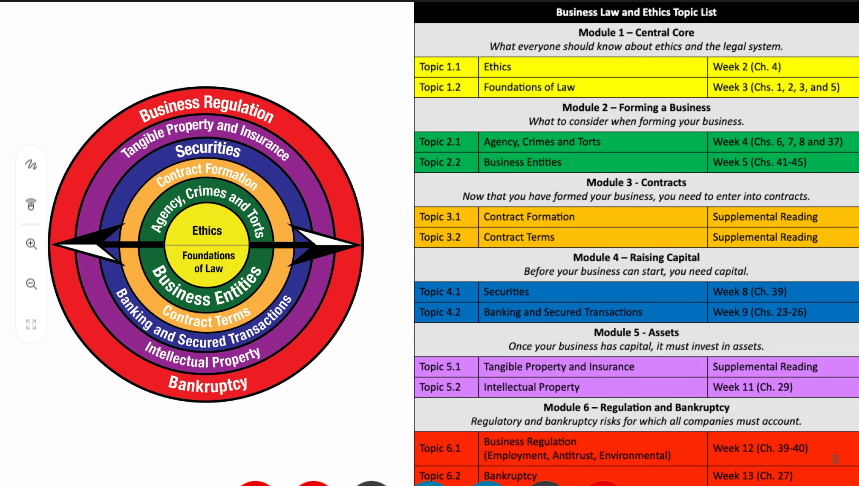
Image Credit: Ralph Flick
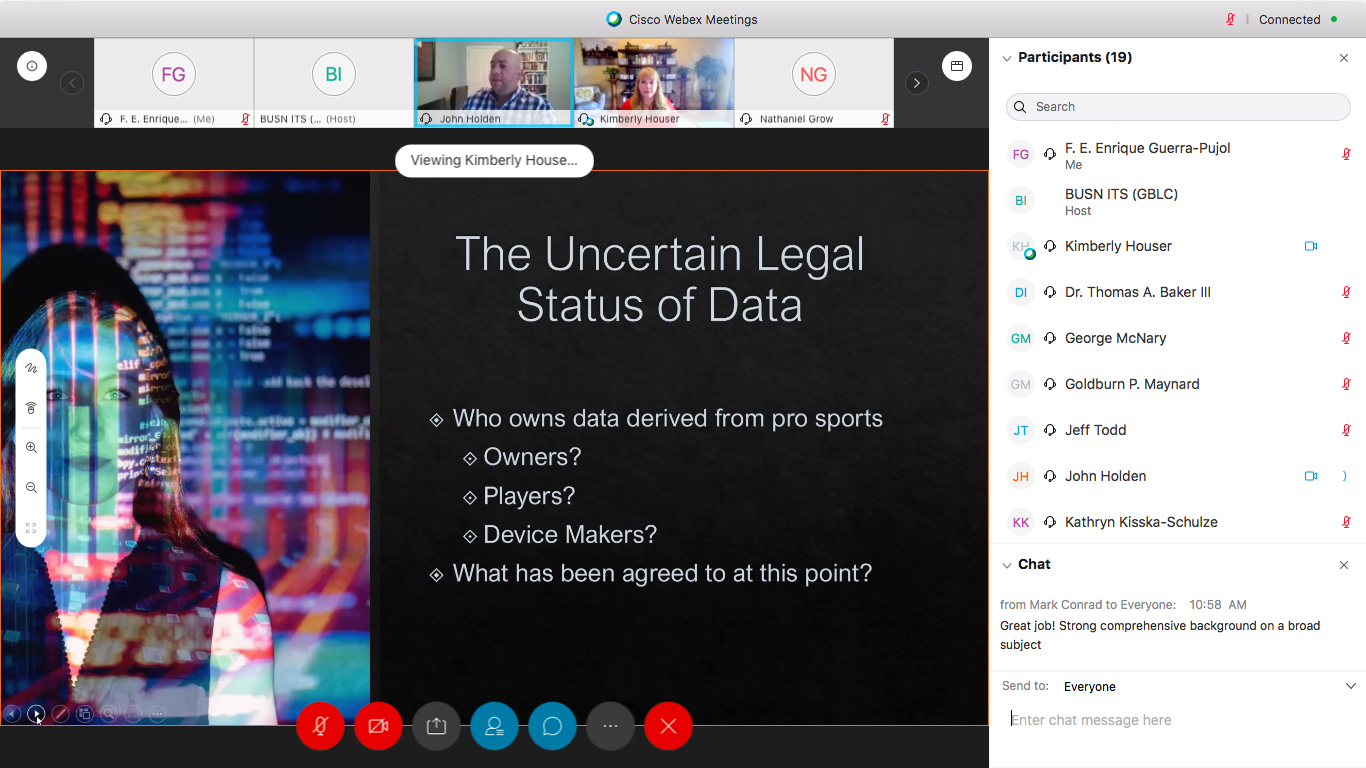
If you use a Fitbit or Apple Watch or other similar device to monitor your exercise, diet, or sleep routines, then you already know that those devices generate a lot of data about the state of your health, including weight/body fat percentage, heart rate, blood pressure, and sleep quality. But who owns that data? You? The manufacturer of the device? What about your employer, if you are a pro-athlete, for example? This is precisely the question that my colleagues John Holden and Kimberly Houser pose in their work in progress “Data Trusts, Betting & Biometrics” — my favorite (thus far) paper of the yearly ALSB conference that I have been attending this week. #ALSB2020
Today is Jamaica Independence Day 🇯🇲, and my youngest daughter Adys Ann turns seven today …


hat tip: u/munuzus, via reddit









Welcome to the online home of the IASS
Hopefully It’s Interesting.
In Conversation with Legal and Moral Philosophers
dr hab. prof. UJ, Jagiellonian University
Books, papers, and other jurisprudential things
Ramblings of a retiree in France
BY GRACE THROUGH FAITH
Natalia's space
hoping we know we're living the dream
Lover of math. Bad at drawing.
We hike, bike, and discover Central Florida and beyond
Making it big in business after age 40
Reasoning about reasoning, mathematically.
I don't mean to sound critical, but I am; so that's how it comes across
remember the good old days...
"Let me live, love and say it well in good sentences." - Sylvia Plath
a personal view of the theory of computation
Logic at Columbia University
Just like the Thesis Whisperer - but with more money
the sky is no longer the limit
Technology, Culture, and Ethics
Just like the horse whisperer - but with more pages
Poetry, Other Words, and Cats


