Do lions have moral rights?

Note: This is the third of several blog posts devoted to Week 6/Module 6 of my business law summer course.

In previous posts I introduced the last module of my business law survey course, which is devoted to “ethics and morality,” and after a brief digression on the relation between law and morality, I then described the “big three” schools of moral philosophy: (1) crude consequentialism, (2) hardcore Kantian moral duties, and (3) ancient Aristotelian virtue ethics. Because of my “Tiger King” theme, the next part of my ethics module contains reading materials and short videos that explore the moral status of animals in light of these various moral theories.

First, I consider the position that our moral duties (however defined) extend to non-human animals, and I attribute this view of “animal moral rights” to Kantian ethics–the idea that morality imposes obligations or duties on us. Although Kant himself did not extend his influential moral theory to the animal kingdom, there is no logical reason why we should exclude animals from Kant’s “categorical imperative.” This Kantian view, however, if taken to its logical conclusion, contains radical and perhaps untenable implications: entire industries like factory farming, medical research, horse racing, etc. would have to shut down!

Next, I present the more “pragmatic” and malleable multi-factored consequentialist perspective in which we consider the competing claims of animals and humans and try to weigh aggregate harms and benefits to all species of a particular course of action or of an entire industry like medical research. Alas, even if we could somehow measure or weigh these competing claims, all consequentialist theories must at some point confront the late Derek Parfit’s famous “repugnant conclusion.” Stated crudely, for example, which of the following is a more desirable (morally speaking) state of affairs:

  • State A. The existence of 1,000 lions, all of whom are free to roam in a large and protected wildlife preserve full of prey and most of whom live long, healthy lives (say, 10 years on average), or
  • State B. The existence of 100,000 lions, all of whom live in cramped cages and are fed subsistence diets and most of whom live short and brutish lives (say, 5 years on average).

To borrow Professor Parfit’s haunting phrase, a consequentialist would have to defend the “repugnant conclusion” that state B is a morally superior state of affairs to state A because 100,000 times five (500,000 lion years) is several orders of magnitude greater than 1,000 times 10 (10,000 lion years), even discounting for the low quality of life of the captive lions. A Kantian, by contrast, would have no trouble choosing state A over state B, since unjustified captivity itself deprives animals of their moral right to live in the wild. (But a Kantian would still have to ask, what about the rights of the unborn? What about the right to exist?)

Lastly, I discuss the moral status of animals from a virtue ethics perspective. Whereas a consequentialist must ask, What are the consequences of acting in a certain way or of following a certain rule, and whereas a Kantian must ask, What are our moral duties in a given situation, a virtue theorist asks a different question altogether: What would a morally virtuous person do in that same situation? In other words, consequentialism and duty ethics both focus on the acts and omissions of human actors, i.e. on the consequences of our acts or omissions or on our moral duties to act, or refrain from acting, in a specified way. Virtue ethics, by contrast, focuses on the actor himself, on his motivations and intentions, on his moral character.

Alas, one of the things that struck me the most about “Tiger King” is the utter lack of moral virtue of many of the protagonists in that docuseries. But at the same time, what exactly is “virtue,” and how do we know whether a particular act or person is virtuous? Alas, all theories of virtue ethics eventually slide into this tragicomic tautology. My point, however, is not to debunk virtue ethics or to champion any of the other “big three” moral theories; my point is simply to show how hard it is to apply general moral principles to a specific scenario like factory farming or medical research.

The bottom line, I believe, is this: most of us would agree that non-human animals, even dangerous and rapacious lions, have the capacity to suffer and that the infliction of unjustified harm (however defined) is morally wrong, but it’s not entirely clear which theory of morality is the best one for grounding this intuition. In any case, I will get around to discussing the business ethics portion of my moral module in my next post.

Posted in Uncategorized | Leave a comment

Bonae litterae and business law

Note: This is the second of several blog posts devoted to Week 6/Module 6 of my business law summer course.

I begin my ethics & morality module with the following legal philosophy question: What is the relation between law and morality? Specifically, are they two separate and distinct domains (the “legal positivist” view), or is law a branch of morality (the “natural law” view)? After I explore both sides of this deep legal philosophical question, I then identify a huge blind spot in the natural law tradition–one that hits close to home as I consider myself a classical natural lawyer in the tradition of St Thomas Aquinas. The blind spot is this: even if there is such a thing as a timeless or universal God-given higher law (cf. the Declaration of Independence of 1776 or MLK’s famous “letter from a Birmingham jail”), how do we go about discovering the actual content of this natural law?

In other words, natural lawyers like myself are still going to need a substantive theory of ethics to tell us the difference between right and wrong and thus help us figure out what man-made rules and behaviors are consistent with natural law. (For the record, legal positivists will also need to study ethics; the leading legal positivist, the late great H.L.A. Hart, for example, famously pictured the law from “the internal point of view”–i.e. the subjective viewpoint of judges and other public officials–and this internal POV therefore allows ethics and morality to slip into the positivist legal picture through the backdoor, so to speak.) Accordingly, the next part of my ethics & morality module explores several major theories of ethics (or, what I like to call collectively “The Big Three”), beginning with crude consequentialism and utility maximization, then proceeding with hardcore Kantian duties and categorical imperatives, and concluding with ancient Aristotelian virtue ethics. I not only introduce my students to these three major theories of ethics; I also discuss the main strengths and weaknesses of each moral theory.

Why do I introduce my students to the major theories of ethics? For two reasons. One is to show them the leading alternatives to consequentialism, but the other (more important) reason has to do with the way in which I conceive the role of a university as well as my role as a scholar. To the point, at a minimum my job as a professor and the role of universities generally should be to cultivate what the great Erasmus of Rotterdam (whose portrait is pictured below) referred to as the bonae litterae (or “good learning”) of our students, and what better way of imparting this good learning by spending time on two of the most important aspects of the liberal arts tradition: ethics and morality, right and wrong, good and bad.

With this liberal arts/bonae litterae background in mind, I will discuss the moral status of animals in my next blog post (a topic that is especially relevant to the Tiger King docuseries), then proceed into business ethics and say a few words about the legal regulation of sex (remember all that polygamy in Tiger King!), and conclude with my course’s final project.

File:Portrait of Boniface Amerbach, by Hans Holbein the Younger.jpg

Artist Credit: Hans Holbein the Younger

Posted in Uncategorized | Leave a comment

Tiger Law and Black Lives Matter

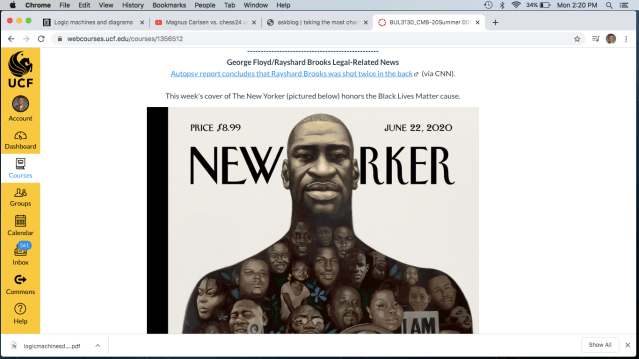
I am interrupting my series of blog posts on my “Summer A” business law survey course because–after I had finished updating the homepage of my course for this week, which happens to be the last week of my “Tiger Law” course–my Internet surfing led me to the poignant portrait pictured below on the cover of this week’s New Yorker magazine (check out the interactive version of the cover here), so I decided to update the bottom part of my homepage accordingly.

Screen Shot 2020-06-15 at 2.20.23 PM

Posted in Uncategorized | Leave a comment

Roar! It’s the Last Week of Tiger Law!

Note: This is an overview of Week 6 of my Tiger Law course and the first of several blog posts devoted to Week 6/Module 6 of my business law summer course.

Thus far, my business law survey course has proceeded as follows: first, we watched Tiger King and picked a side: Team Joe or Team Carole (Week 1). Next, we identified the main sources of law–State, federal, and international–that could apply to a roadside zoo like Joe Exotic’s G.W. Exotic Animal Park or to a wildlife sanctuary like Harold and Carole Baskin’s Big Cat Rescue (Week 2). Later, we explored the common law, including torts, property, and contracts (Week 3), as well as the law of ideas, including trademark and copyright law (Week 4), and then we compared and contrasted the civil and criminal cases featured on Tiger King (Week 5). I have, however, saved the best for last. This week (the last week of the course!) is devoted to “Ethics & Morality”, including natural law, business ethics, and the moral status of animals.

But before I provide a general overview of Week 6 of the course and describe the contents of Module 6, you might be asking, Why devote an entire week to ethics? I will tell you why. Simply put, the official title of my course is “The Legal & Ethical Environment of Business,” so ethics is a key part of my survey course and deserves sustained attention. Specifically, my module on “Ethics & Morality” is divided into seven parts as follows:

  • Intro Video, Textbook Chapter, & Theme Song
  • The Natural Law Tradition
  • Theories of Ethics
  • The Moral Status of Animals
  • Business Ethics (CSR)
  • Bonus Section: The Legal Regulation of Sex
  • Final Project

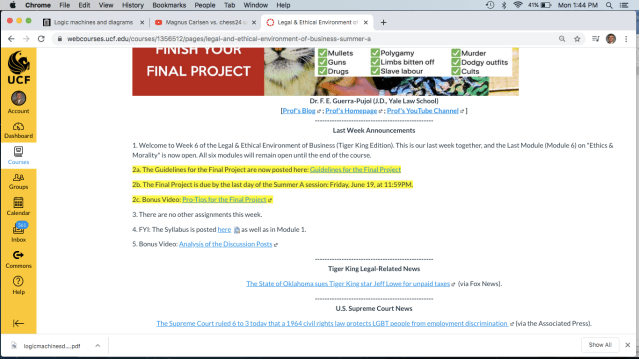
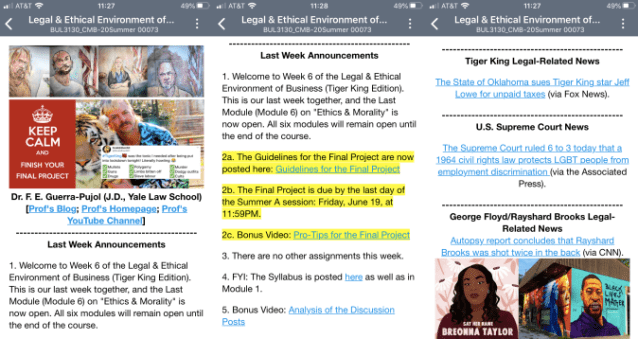
In other words, we cover a lot of ground in this module, including not just “business ethics” or corporate social responsibility but also deeper questions like the relation between law and morality as well as some of the major theories of ethics, including consequentialism, Kantian duty ethics, and virtue ethics. Because of my Tiger King theme, we also explore the moral status of animals in light of these theories of ethics. Rest assured, we will delve into the details of the last module of my course in my next few blog posts. In the meantime, below are some screenshots of the homepage of my course for Week 6:

Desktop version (from top to middle):

Screen Shot 2020-06-15 at 1.44.34 PMScreen Shot 2020-06-15 at 1.44.54 PM

Canvas App Version (from top to bottom):

Screen Shot 2020-06-15 at 11.35.05 AM

Posted in Uncategorized | Leave a comment

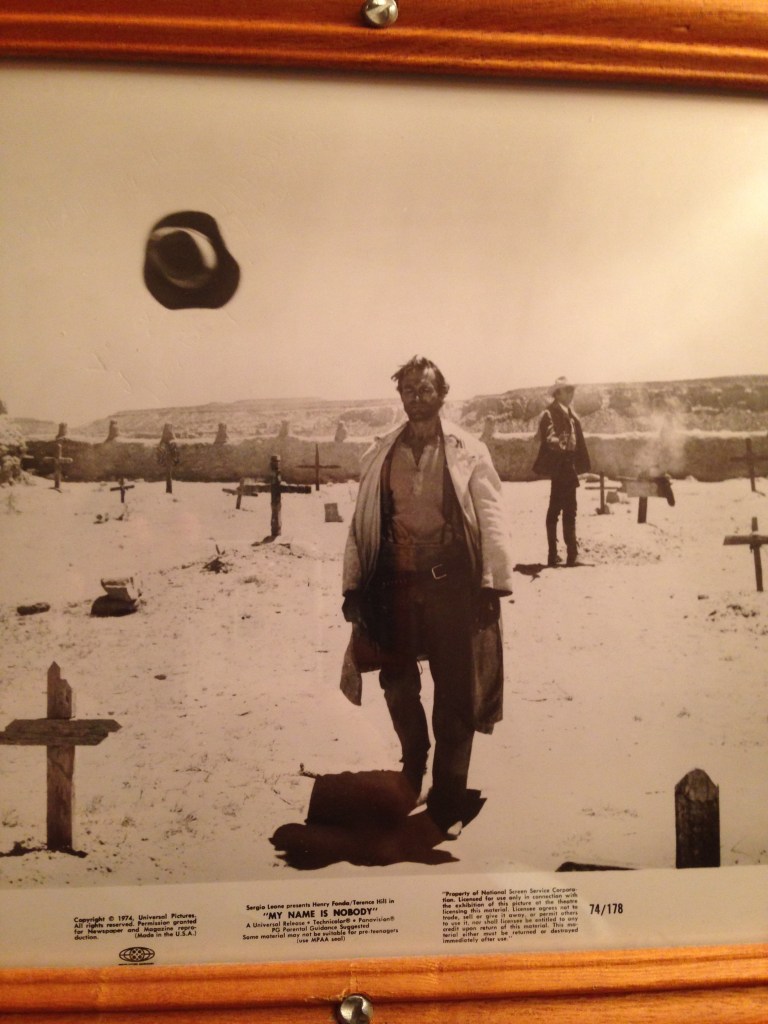
What do I miss the most about our pre-pandemic times? It’s not sports or bars or restaurants. It’s the experience of going to the movies. Specifically, I miss going to Enzian, the fine arts cinema in Maitland, Florida (where years ago I photographed the above iconic still in the gentlemen’s washroom).

Posted in Uncategorized | Leave a comment

Let’s rename Flag Day …

… “Betsy Ross Day” in honor of a humble woman who helped changed the course of history. Here is her Wikipedia page.

Posted in Uncategorized | 2 Comments

Congratulations, Kleber Guerra

I can’t ask for a better son in the whole world! Kleber Enrique just graduated from Lake Mary H.S. and is going to attend college at the University of Florida (#GoGators) in the fall. May the Force be with you in your future endeavors!

Posted in Uncategorized | 3 Comments

Guaranteed Income: Chronicle of a Political Death Foretold

My Guaranteed Income paper now appears in print. It is part of a symposium issue of the Chapman Law Review devoted to the 91st Congress. (An electronic version of the paper is also available here free of charge via SSRN.)

Posted in Uncategorized | 2 Comments

Typology of lego computers

Photo by Present & Correct.
Posted in Uncategorized | Leave a comment

Vantage point

Hat tip: u/homesanto
Posted in Uncategorized | Leave a comment