Defund the legislatures?

Via Arnold Kling: “From a liberty-coercion perspective, [the slogan ‘defund the police’ is] a misdirected effort. Excess coercion comes from unnecessary laws and unaccountable enforcement. For libertarians, reform would start with having fewer laws. Those who enforce the laws should be accountable for acting within the law themselves.” I could not agree more!

Posted in Uncategorized | 7 Comments

PSA: Let’s make Juneteenth a national holiday

What is “Juneteenth”? Via Kottke, here is a helpful introduction. According to Wikipedia, citing this excellent essay by Henry Louis Gates, Jr., Juneteenth originally began as an unofficial commemoration of a military order (issued on 19 June 1865 by Union General Gordon Granger) proclaiming that all enslaved persons in the State of Texas were now free. In other words, Juneteenth could also be called Freedom Day! Whatever its origins, let’s make Juneteenth a national holiday. (Postscript: My colleague and friend Alex Tabarrok agrees! For my part, I would be more than happy to give up Labor Day or Columbus Day in exchange for Freedom Day!)

Posted in Uncategorized | Leave a comment

Postcards from Orlando

This gallery contains 6 photos.

More Galleries | Leave a comment

The NBA snitch hotline is a terrible idea

As you may have heard by now, the NBA recently released a 113-page manual in anticipation of the resumption of the 2019-20 season. (Check out this summary of the manual by Ben Cohen for The Wall Street Journal.) The manual contains a whole host of health and safety protocols that basketball players (and coaches, I presume) must follow when the season resumes in Orlando, Florida next month. Among other things, the NBA is setting up a “snitch hotline” to allow anyone to anonymously report a player or coach who is breaking the guidelines. So, who will be the first player to call the new NBA snitch hotline? According to my fellow Gaucho Jim Rome (both of us went to UCSB in the 80s), it will be Chris Paul–check out Rome’s “hot take” below:

Screen Shot 2020-06-18 at 12.05.00 PM

Source: jimrome.com

In all seriousness, this anonymous snitch hotline is a terrible idea. Instead of building trust, the mere existence of this hotline will erode it. If I were the NBA Commissioner, I would allow each team to decide for itself how it will enforce the health and safety rules. After all, the possibility of losing an infected player for two weeks should be a sufficient incentive for each team to follow the guidelines. In any case, I don’t expect a player to “snitch” on a fellow player–even a player on a competing team, let alone a teammate–but what about hotel staff, NBA employees, and other potential officious intermeddlers? 

Posted in Uncategorized | 1 Comment

Tiger King Map

The closing credits of the popular Netflix docuseries “Tiger King” states that there are between 5,000 to 10,000 privately-owned tigers in the United States. But where do all of those privately-owned captive tigers live? Check out the screenshot below from “Tiger King” purporting to show the distribution of big cat owners and private roadside zoos in the United States. Two questions, however, leap out at me from a simple inspection of this map. One is, why are there so many big cat owners in the State of Florida? The other question is, how many tigers are represented by each of the red headpins on the map? That is, it would be nice if the size of each pinhead were proportional to the number of tigers housed in that location.

A screenshot of a big cat exhibtor map seen in “Tiger King.”Postscript: Earlier this week, my teaching assistants and I had the honor of speaking via Zoom with Harold Baskin, the advisory board chairman of Big Cat Rescue in Tampa, Florida. Mr Baskin gave generously of his time, patiently answering all of our questions. Among many other things, we discussed The Big Cat Public Safety Act. This bill (H.R. 1380), which is currently pending before the Congress, would prohibit the private ownership of big cats. One of the reasons animal rights groups like PETA, the WWF, and Big Cat Rescue support this bill is because of the large number of roadside zoos across the U.S. housing big cats. 

Posted in Uncategorized | Leave a comment

The End

Throughout my six-week survey course in business law I have asked my students to complete a wide variety of assignments. By way of example, first they had to watch “Tiger King” during Week 1 of the course and write up a short essay (500 words) describing the most salient ethical or legal issues in the docuseries. In addition, students were assigned a series of open-book quizzes, short discussion posts, and peer reviews during Week 2 through Week 5 of the course (one quiz, one discussion post, and one peer review per module, per week).

Now, for the last week of the course (Week 6), I have a assigned a comprehensive Final Project (see details below). In place of a final exam, I prefer to assign a take-home research report–the ominous sounding “Final Project”–because, as I explain further below, I want my students to start thinking about their career prospects, and I also want them to see the “big picture” of law and ethics instead of cramming for an exam. In summary, the Final Project is the last graded assignment of the course and is worth 1/3 of one’s final grade. (The weekly quizzes and discussion posts, combined, are worth the other 2/3 of one’s grade.) The report itself consists of eight parts, and each part is equally weighted as follows: Continue reading →

Posted in Uncategorized | Leave a comment

Team Joe or Team Carole?

To relieve some of the stress and anxiety of finals, I have just posted to the homepage of my “tiger law” survey course the following fun survey question: Now that the semester is almost over, are you “Team Joe” or “Team Carole”?

FYI: I will describe the final project in my next post and announce the results of our end-of-semester survey over the weekend.

Posted in Uncategorized | 1 Comment

Postscript: polygamy and the legal regulation of marriage

Note: This is the fifth of six blog posts devoted to Week 6/Module 6 of my business law summer course.

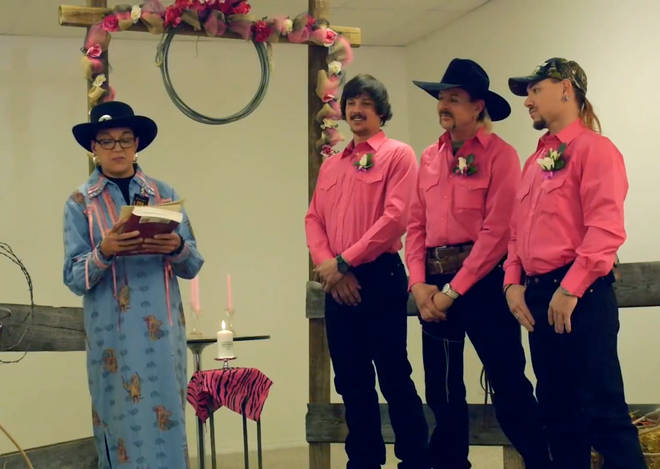
Hey, what’s up? Now that we have studied business ethics (or CSR) as well as normative ethics (or ethics qua ethics), we could call it a day and wrap up the course once and for all, but guess what, y’all? This is no ordinary business law survey course! After all, I have been using the docuseries “Tiger King” to introduce my students to the legal and ethical environments of business. So, in keeping with our “Tiger King” theme, I now want to say a few closing remarks about the legal regulation of sex. Specifically, the unorthodox marital arrangements depicted in Tiger King–Joe Exotic’s two husbands and Doc Antler’s three wives–pose a delicate legal and moral dilemma: Should “the law” continue to criminalize these unorthodox marital arrangements, or should it recognize them like it now does same-sex marriage?

Before proceeding any further, notice how the practice of polygamy, which is presented so memorably in “Tiger King,” brings us back full circle to where we began this last module on “Ethics & Morality”–to the relationship between law and morality. On the one hand, one could argue that law and morality are separate and distinct domains. If Doc Antler’s sexy wives or Joe Exotic’s dashing husbands have no problem with their unorthodox marital arrangements, then why should we enlist the coercive power of the state to break up or otherwise interfere with these private and consensual arrangements? (For my part, I find this libertarian argument highly persuasive given my classical liberal priors.)

On the other hand, my Catholic priors are less sympathetic to such licentiousness. If one believes that law is a branch of morality and that polygamy is immoral, then one might be justified in using the law to prohibit or discourage polygamy. So, which set of moral beliefs should prevail, my libertarian or religious preferences? Stated more generally, why should polygamy, if voluntary and consensual, ever be immoral, let alone illegal? Again, these questions also bring us back full circle to the “big three” theories of morality and the problem of ethics qua ethics.

To sum sum up, the Kantian libertarian in me agrees 100% with Robert Nozick that individuals have rights. But at the same time, the skeptical scholar in me is not satisfied at all with Nozick’s formulation. After all, what do these rights consist of? Do men have the right to take on as many wives (or husbands) as they want, and do women have the right to marry an already married man? In brief, polygamy, like the moral status of animals, forces us to reconsider our intuitions about morality and the law. Stay tuned. We have one more Tiger Law blog post to go!

Joe Exotic has been married several times

Image Credit: Netflix

Posted in Uncategorized | Leave a comment

Milton Friedman against the world

Note: This is the fourth of six blog posts devoted to Week 6/Module 6 of my business law summer course.

Thus far, we have gone back to Aristotle and Aquinas, so to speak–we have explored the relationship between law and morality and have studied ethics qua ethics in keeping with the best of our liberal arts tradition. Specifically, I introduced my students to the “big three” theories of morality (crude consequentialism, hardcore Kantian duties, and ancient Aristotelian virtues) and then used these classic theories to try to figure out the moral status of animals. With this foundational work in moral theory now out of the way, the next part of my last module is devoted to business ethics and CSR (“corporate social responsibility”). After all, the formal title of my course is “The Legal & Ethical Environment of Business,” so no such course would be truly complete without a segment on CSR.

I begin the CSR part of my module with the so-called “Friedman Doctrine,” the idea championed by the late great economist Milton Friedman that the social responsibility of corporations is to increase their profits (or to put it more euphemistically, to maximize shareholder value), a consequentialist-inspired theory that Professor Friedman first enunciated in his classic book on “Capitalism and Freedom” in the early 1960s. Because this thesis has now become so controversial and so roundly condemned by all respectable people in academia and in the business world, I spend a considerable amount of time defending the Friedman Doctrine!

To begin with, as a normative matter, the simple but powerful idea that “greed is good”–to quote the immortal words of Gordon Gekko, the villain in the classic 80s movie “Wall Street”–is the intellectual basis of Adam Smith’s “invisible hand” theorem, perhaps the single-most influential idea in the entire history of economics. Furthermore, whether you are a hardcore Communist or just a progressive do-gooder, if we examine what corporations actually do (and not what they say they do in their puffery-laden social ads and corporate mission statements), the Friedman Doctrine as a descriptive matter provides us with the most simple explanation of past corporate decisions as well as with the most accurate predictions of future business decisions.

But wait; there’s more! After mounting this rigorous defense of greed and invisible hands and cynical acid, I refute the Friedman Doctrine but with a single meme (pictured below):

Repugnant-cans

What is the “optimal level” of greed?

With this emotive refutation of the Friedman Doctrine, I then introduce the influential “stakeholder theory” of CSR. Under this theory of business ethics, a business should first identify all of its stakeholders, i.e. all groups or communities who might be impacted by a given business decision, and then take into account the competing interests of these various stakeholders. For example, remember back in 2016 when presidential candidate Donald J. Trump was calling out major companies like Carrier and Ford for shipping their factories overseas? I cannot think of a more dramatic illustration of the stakeholder theory in action! Nevertheless, the closer we inspect the stakeholder theory, the more it looks like window-dressing and empty rhetoric. (Check out the meme below the fold.) Why do I say this? For three reasons.

First off, as a simple descriptive matter, stakeholder theory is bullshit: no major U.S. corporations have any employee stakeholders–let alone consumer stakeholders–on their corporate boards. Secondly, stakeholder theory is underspecified, i.e. completely unhelpful, since it does not provide us any way of resolving conflicts among competing stakeholders. Consider, for example, Carrier’s decision not to manufacture its products in Mexico. That decision was good for those workers in Indiana whose jobs were saved but bad for consumers who ended up paying more for these products. Either way, the problem is that stakeholder theory, standing alone, does not specify who the stakeholders are or assign any concrete weights to the various stakeholders. And lastly, if the owners or shareholders are the stakeholders who are going to be assigned greatest weight, then stakeholder theory is, ironically enough, entirely superfluous; it simply collapses into the Friedman Doctrine!

Perhaps, then, we should be asking a different question. Perhaps we should be asking, What is the optimal level of greed? Whatever the answer, we will formally conclude these blog posts with two more topics: the legal regulation of sex and the final project. Continue reading →


Posted in Uncategorized | Leave a comment

Visualization of moral theory and philosophy writ large

Time out! While we are on the subject of normative ethics (consequentialism, duties, and virtue) and applied ethics (animal rights), check out this fragment on “Moral Theory” from the much larger “Map of Philosophy” (both of which are pictured below). Click here to see a larger version of the right-hand side of the map, via Open Culture. You’re welcome!

Posted in Uncategorized | Leave a comment