Note: This is the third of four blog posts devoted to Week 5/Module 5 of my business law summer course.
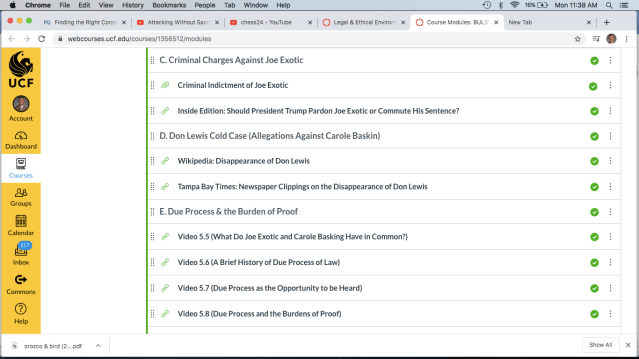
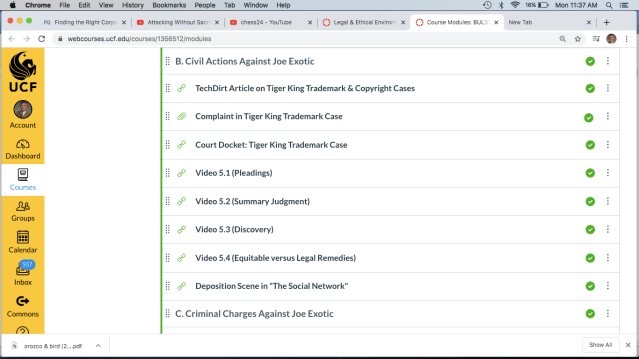
In my previous post, we saw why getting your “day in court” (i.e. a jury trial) in a civil case can take forever and be so damn expensive: “discovery.” By way of example, during the discovery phase of a civil case, the parties can send each other burdensome requests for the production of documents (including the production of electronic records like emails, texts, and social media posts) and take as many depositions (including depos of non-parties to the case) as they need or are able to afford! The next parts of Module 5 are devoted to criminal cases. (See the top image below.)
Tiger King is a veritable gold mine here. Among other things, my module contains the original criminal indictment against Joe Exotic as well as newspaper clippings about the Don Lewis cold case. In addition, I recorded a video in which I pose the following question, “What do Joe Exotic and Carole Basking have in common?” To the point, whether we are talking about Joe Exotic’s criminal conviction for murder-for-hire (check out his mugshot, bottom left) or the lingering allegations against Carole Baskin that she played a role in Mr Lewis’s mysterious disappearance (check out the cold case notice pictured below, bottom right), everyone is entitled to “due process of law.”
Ok, but what is due process of law, and why is this legal ideal worth studying in a business law survey course? Simply put, the concept of “due process of law” is the single-most important ideal of the Anglo-American legal tradition, so I spend a lot of time (four additional videos in all) exploring the historical origins (going back to the Magna Carta of 1215 A.D.) and the operational meaning of due process. In summary, due process means at the very least two things: (1) whenever someone is accused of misconduct (civil or criminal), he must be given a chance to defend himself, and (2) it is the party who is making the accusation (the plaintiff in a civil case or the prosecutor in a criminal one) who has the burden of proving the truth of those allegations.
Nevertheless, despite the ideal of due process, the fact remains that most criminal cases (like most civil cases) never go to trial; most criminal charges result in plea bargains. Accordingly, the last part of my Week 5 Module is devoted to the following question: Settle or Go to Trial? This is really a strategic question, not a legal one, and rest assured, we will explore this strategic choice in my next blog post.



/cdn.vox-cdn.com/uploads/chorus_asset/file/16677162/epi_ceo_pay.png)