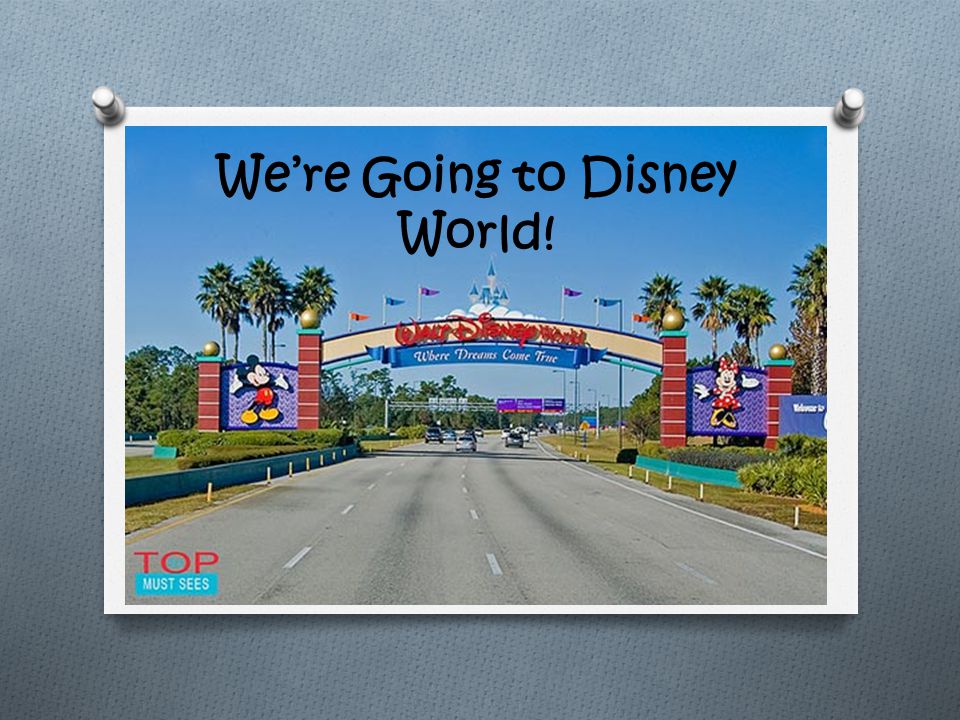
The NBA season will resume on July 31, 2020 at Disney World in Orlando, Florida! In the meantime, via ESPN, Romana Shelburne describes some of the behind-the-scenes negotiations that led to this remarkable turn of events. Here is one excerpt from Ms Shelburne’s report (links in the original):
At last week’s owners meeting, for example, [OKC] Thunder owner Clay Bennett made an impassioned speech for all 30 teams to be given a chance to resume their season to avoid going nine months without playing a game and without visibility in their home markets. Charlotte Hornets owner Michael Jordan, on the other hand, made an impassioned plea for the league to invite only the 16 teams currently in the playoff picture and keep as close as possible to the traditional format because of the increased risk of injury to players after such a long layoff, and the increased COVID-19 risk that comes with each additional person invited into the bubble.
So, was the final decision to invite “only” 22 teams the result of a compromise between both extremes? For my part, I am with MJ on this one. No one cares about the regular season anymore. Let’s just go directly into the playoffs!
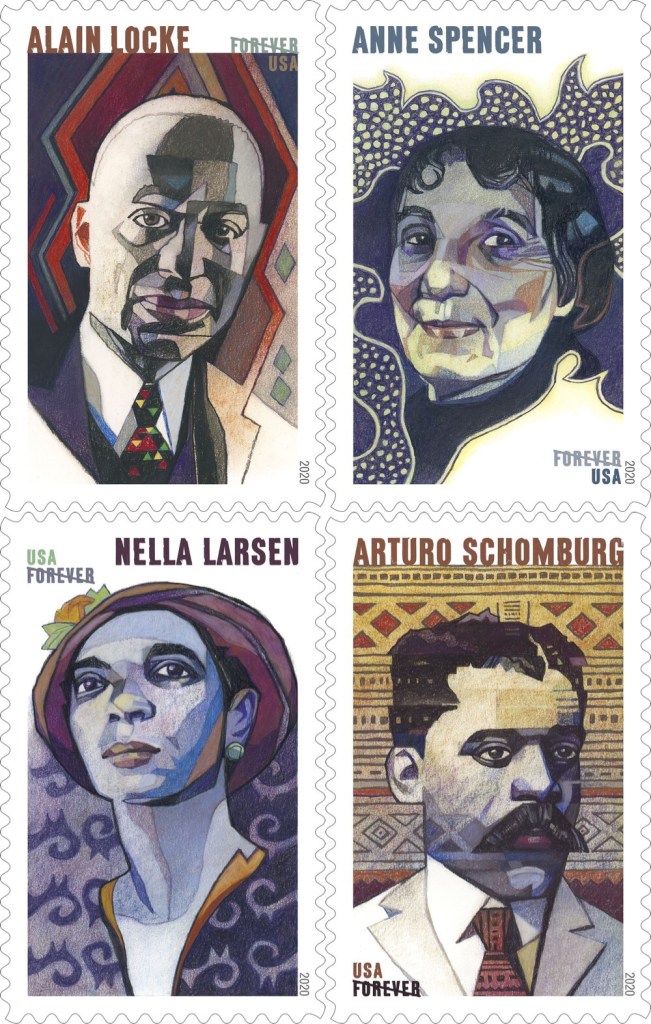
The Harlem Renaissance of the 1920s was one of the great artistic and literary movements in American history. As African-American writers and artists pushed the boundaries of their identities and their art, they created a diverse body of work that explored their shared history and experience, embodied the spirit of the times, and let new and distinctive voices be heard.
Note: This is the last of five blog posts devoted to Week 4/Module 4 of my business law course (Tiger King edition).
Let’s conclude my observations about Week 4 of my business law survey course with the fair use doctrine. To the point, fair use operates as a common law and statutory defense to copyright infringement, and I teach fair use for two reasons. To begin with, I want to impart an important lesson to my students. In brief, the lesson is this: even exclusive property rights are not absolute. To put it in the most stark and dramatic terms: fair use is not only about “fairness”; it is also about finding the optimal level of piracy or copyright theft, i.e. copyright infringement!
Now, before we proceed any further, you might well be asking: How can an illegal act like theft or piracy ever be optimal? To answer this counter-intuitive question, we must first realize that copyrights are not absolute. Instead, courts use the fair use doctrine to balance the interests of creators and copiers, of innovators and imitators, of intellectual owners and intellectual squatters. In other words, creators, innovators, and intellectual owners are not the only ones who are morally worthy or legally deserving of legal protection; so too are copiers, imitators, and intellectual squatters!
The other reason I teach fair use is to spotlight the idea of flexible standards. (You may recall that I introduced the fundamental distinction between bright-line rules and flexible standards in my Sources of Law Module.) Contrary to popular belief, fair use does not consist of a simple, clear-cut, bright-line rule, e.g. you may use up to 10% of another person’s work. Instead, fair use is a flexible standard consisting of four general guidelines (see also the image below):
How “transformative” (whatever that means!) is the alleged infringing use?
Is the alleged infringer stealing or borrowing (depending on your point of view) material from an original work of fiction (like a play or novel) or from an original work of non-fiction (like a biography), and in either case, has that original work been published yet?
How much material is the alleged infringer stealing or borrowing, as the case may be?
Does the alleged infringement help to increase or decrease sales of the original work?
What weights should be attached to each factor, i.e. which factor is the most important one? Or, if the factors are to be equally weighted, what happens when two of the factors point in one direction and the other two point in the other direction? Courts refuse to say! So, is this judicial reticence a good or bad thing? Next week, we will review the next-to-last module of my business law survey course, which will be devoted to criminal and civil cases. In the meantime, I will begin reviewing Tyler Cowen’s most recent book on “Big Business.”
I will be blogging about the fair use doctrine later today, but in the meantime, I just want to mention that my youngest daughter Adys Ann (age 6) and I went to a bookstore today. We both had to make some hard choices: I had to narrow down which book to read next, while my daughter had to decide which LOL doll she wanted as her first grade graduation gift. I chose Tyler Cowen’s book on “Big Business,” which I have been meaning to get around to since it was first published last year; Adys Ann finally chose “Dazzle.”
Note: This is the fourth of five blog posts devoted to Week 4/Module 4 of my business law course (Tiger King edition). Credit for the title of this particular blog post goes to the excellent Ed Timberlake (@TimberlakeLaw), a trademark and copyright lawyer who I follow on Twitter.
As I have explained in my last few posts, week 4 of my Tiger Law course is devoted to intellectual property rights, or what I prefer to call “the law of ideas.” Thus far, I have explained why this area of law should be included in any business law survey course, and we introduced the law of copyrights. The remainder of my week 4 IP module is devoted to trademark law. In summary, I decided to emphasize trademarks and copyrights for two reasons. One is that many marketing majors are enrolled in my course; the other reason has to do with Tiger King. It turns out that the legal battles between the two central characters in Tiger King–Carole Baskin and Joe Exotic–involve a copyrighted photo and a trademarked logo.
To make my trademark coverage more manageable, I broke my trademark section into three separate parts. The first part contains an infographic explaining how the trademark registration process works as well as a series of how-to videos by the excellent and entertaining Aiden Durham explaining various aspects of trademark law, including the difference between a trademark and a service mark and whether LeBron James can register the phrase “Taco Tuesday.”
The second part of the trademark section is devoted to USPTO v. Booking.com, a pending case that was argued before the U.S. Supreme Court last month. This case itself is not that important in the grand scheme of things, but I added this section in order to give my students a small sample of how the U.S. legal system really works. I also wanted to teach my students a larger lesson. Most law courses focus on cases that are already decided. But a live dispute shows us that the law is often contested and that it’s not always easy to predict the outcome of a live case.
The last part of my trademark section includes legal artifacts that are specific to the Tiger King docuseries, including the original trademark registration of the “Big Cat Rescue” logo as well as a new trademark application for a Joe Exotic Halloween costume set (pictured below). Since Module 5 of my course is devoted to criminal and civil cases, I will wait until week 5 to discuss the details of the Tiger King case between Carole Baskin and Joe Exotic. But before I move into week 5, there is one more aspect of intellectual property law that I wish to discuss before I conclude this series of blog posts: the fair use doctrine.
if somebody wanted to sell a similar costume with a generic name, what are some names they might use?
Note: This is the third of five blog posts devoted to Week 4/Module 4 of my business law course (Tiger King edition).
Last time, we explained why intellectual property rights are so important and deserve to be studied in depth in any business law survey course. Since my business law IP module focuses on copyrights and trademarks, let’s jump right in with copyright law. I always like to begin my analysis of copyright law by asking my students whether they have ever created any intellectual property, like a musical recording, a painting, a business logo, etc. Before we proceed, let me ask you a modified version of the same question, Have you created any intellectual property today?
It turns out that almost everyone in the world has created some form of IP in the last day or two alone! If you have ever written a love letter, drawn a doodle, or taken a selfie on your phone, then yes, you too have created intellectual property! And this observation is precisely why I like to begin to copyright law. Under the common law, any original work that can be expressed in a tangible means of expression (i.e. printed or drawn on a piece of paper) automatically belongs to the creator of the work. And that is why I like to begin with copyright law–to show my students that every single one of them has the brain power and creativity to create IP! Any questions?
We will proceed into trademark law in my next post …
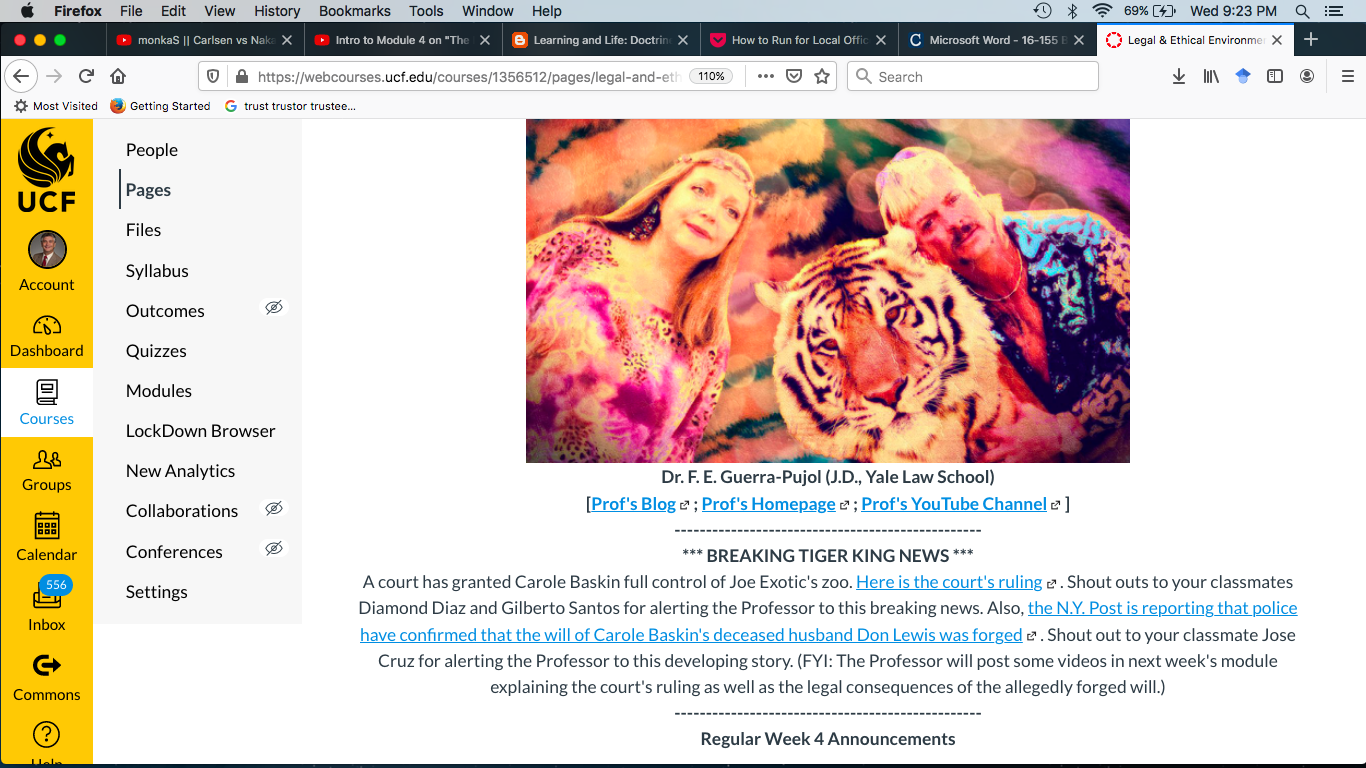
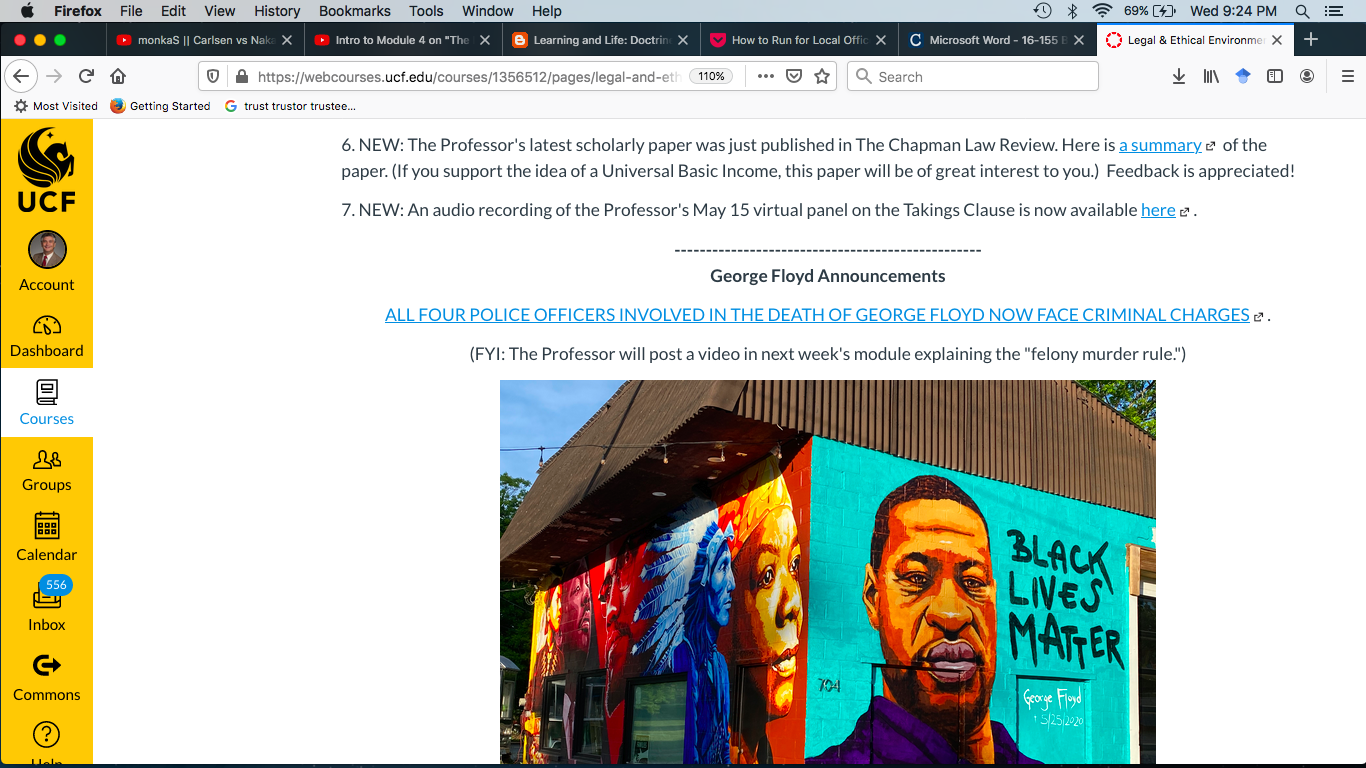
I am interrupting my series of blog posts on Week 4 of my Tiger Law course because, in the last 24 hours, major newsworthy events have occurred in both the Tiger King saga and in the George Floyd case. Among other things, a court granted Carole Baskin’s Big Cat Rescue full control of Joe Exotic’s roadside zoo, giving Jeff Lowe (the current owner of Joe Exotic’s zoo) 120 days to vacate the premises! In addition, as you may have already heard, all four police officers involved in the death of George Floyd have now been charged in Mr Floyd’s murder. I am in the process of recording some videos to explain the legal aspects of these new developments (e.g. the law of fraudulent transfers and the felony murder rule); in the meantime, I took the extraordinary step of updating my course homepage as follows:
Note: This is the second of several blog posts devoted to Week 4/Module 4 of my business law course (Tiger King edition).
In my previous post, I provided an overview of Module 4 of my business law survey course. Module 4 is devoted to intellectual property rights, or what I like to call the “Law of Ideas.” I begin this module by painting the big picture with the help of Aiden Durham, a business lawyer in Denver, Colorado, whose YouTube channel (“All Up in Yo’ Business”) contains an accessible and absorbing series of videos on various aspects of business law, including intellectual property law. (FYI: Here is a link to her excellent YouTube channel.) Most law videos on YouTube are horrible, beginning with my own! Ms Durham’s videos, by contrast, are a refreshing change of pace. By way of example, here is her highly entertaining and engaging IP law explainer video:
The remainder of this module delves into the details of copyrights and trademarks, but in the remainder of this post, I want to further explain why IP law should be an essential part of any business law survey course. To see why, check out the first 90 seconds of these remarks made by Peter Thiel in 2015:
In brief, Peter Thiel makes two really important points in that video. First off, he says that, in order to succeed in the world of business, you have to have a good idea. That is, you have come up with a product or service that people would want to use. Alas, a good idea alone is not enough to succeed in business. In addition to having a good idea, you also have to figure out a way of capturing some of the value of your idea, or in Mr Thiel’s own words: “you have to create X dollars of value for the world, and you have to capture Y percent of X.” The problem, however, as Mr Thiel makes clear, is that X and Y are completely independent variables!
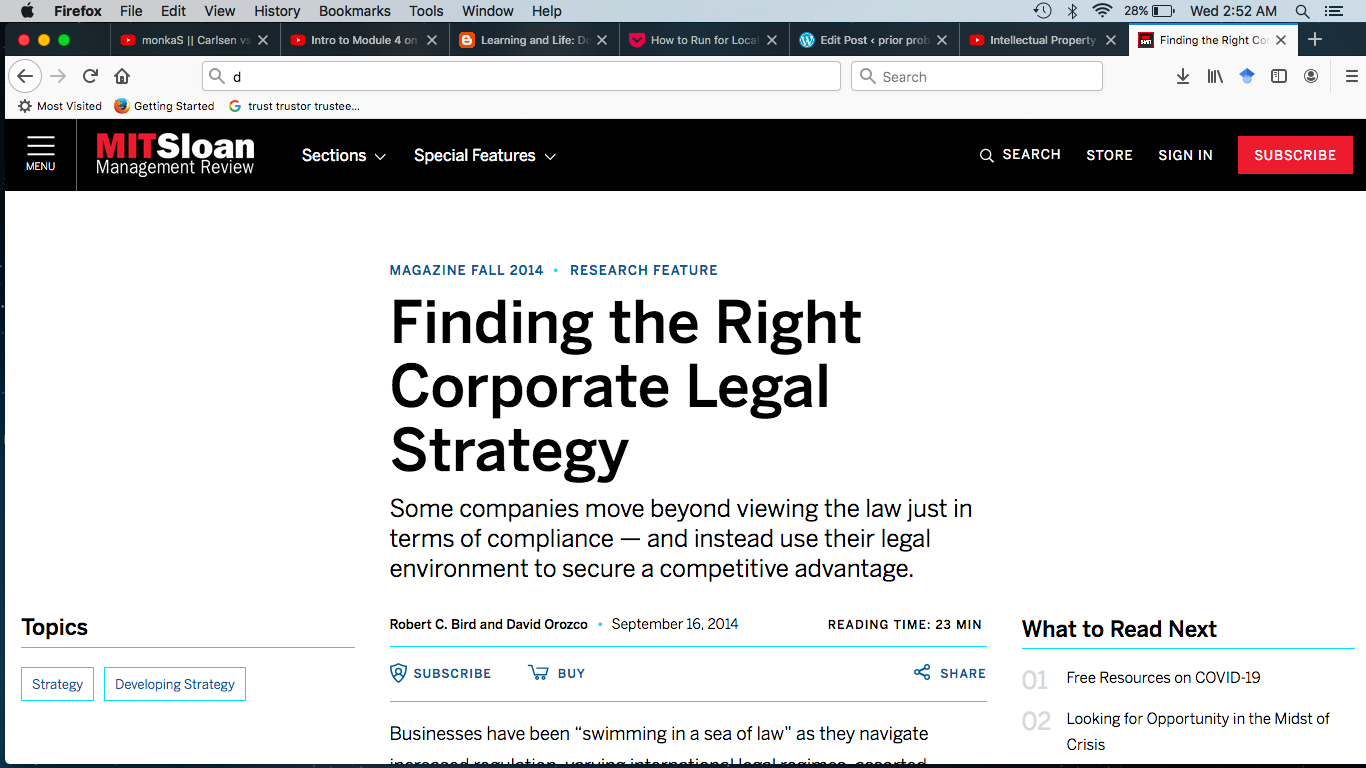
Here is where the Law of Ideas comes into play. Whether it be trade secrets, design patents or utility patents, copyrights, or trademarks or service marks, this area of law is what allows inventors and business firms to capture some of the value generated by their ideas. In plain English, if you want to succeed in business, you first have to come up with an original idea, but once you do this, you still need to find a way of protecting your ownership of that idea (or of the expression of that idea), and this is what the Law of Ideas allows you to do. Although Mr Thiel does not discuss intellectual property rights in his remarks (in the video clip above), I drew this crucial connection one day after reading this remarkable essay by my colleagues David Orozco and Robert Bird. (Below is a screenshot of the cover page of their paper. Also, shout out to my friend and co-author Sean P. Melvin, who brought this beautiful paper to my attention many years ago.)
With this background in mind, I will describe the rest of my week 4 IP module in the next day or two …
Note: This is the first of several blog posts devoted to Week 4/Module 4 of my business law summer course (Tiger King edition).
I have been teaching a survey course in business law this summer. This course is entirely online (as my university moved to remote instruction until further notice), so to capture my students’ attention, I assigned my students to watch the surprise hit Netflix show Tiger King during the first week of the course (May 11-15). Two weeks ago (May 18-22), I introduced my students to the main sources of law (State, federal, and international law), and last week (May 26-29), we surveyed three major areas of the Common Law: property, torts and contracts. In this post, I will provide a general overview of Week 4 of the course and describe the contents of Module 4.
The fourth week of the course is devoted to intellectual property rights like trademarks and copyrights, or what I like to call “The Law of Ideas“. But why spend an entire week to this area of law in such a short six-week course? Why are intellectual property rights so important? In brief, business firms provide a wide variety of products and services, but ask yourself, what do all these products and services have in common? Simply put, all products and all services embody a set of ideas, and it is intellectual property law that makes it possible for persons and business firms to own their ideas or the expression of their ideas. (In plain English, if you have a good idea, intellectual property law is the area of law that allows you to legally protect your idea and make money off it. So, yeah, we are going to spend a lot of time on this area of law!)
Specifically, my module on the Law of Ideas is divided into seven parts as follows:
A. Intro Video, Textbook Chapter, & Theme Song
B. The Big Picture
C. Copyrights
D. Trademarks
E. The Fair Use Doctrine
F. Bonus Section: Tiger King-Related Trademarks & Copyrights
G. Quiz & Discussion Post
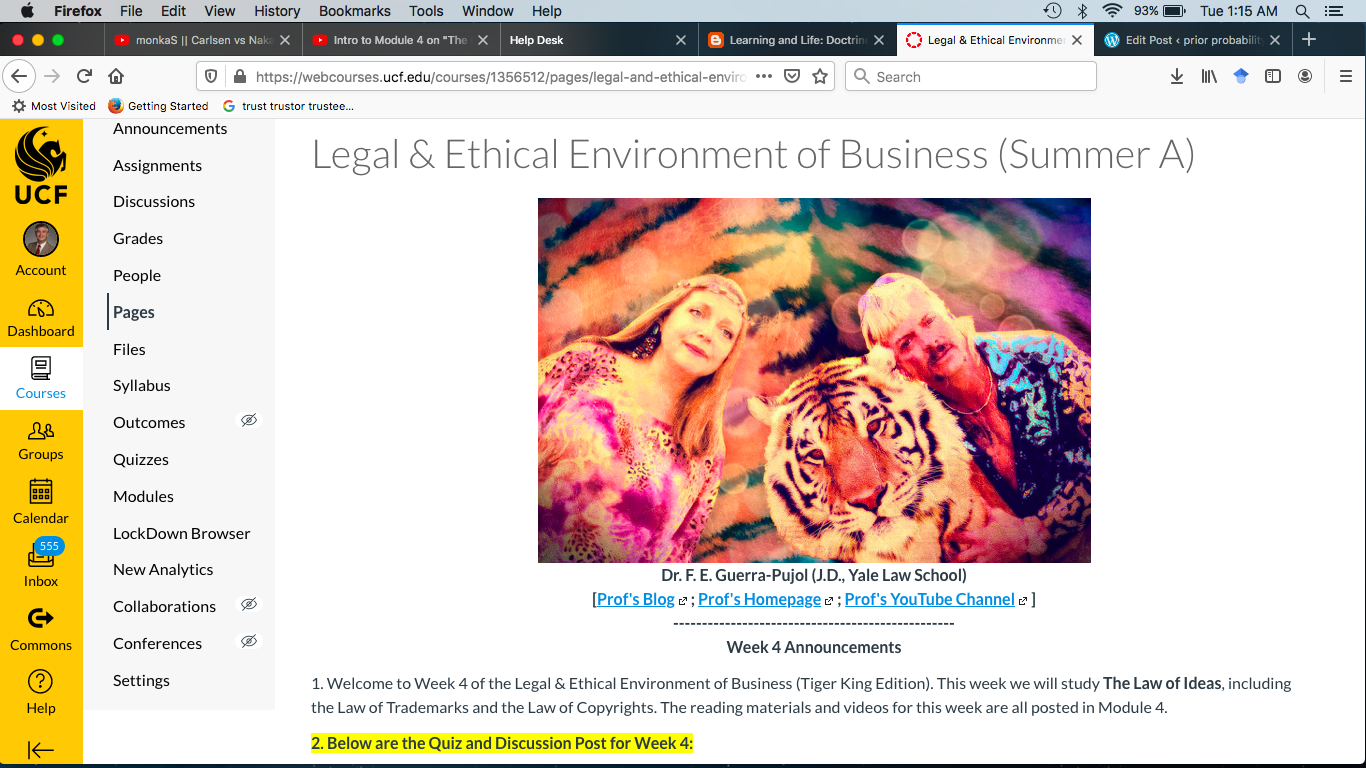
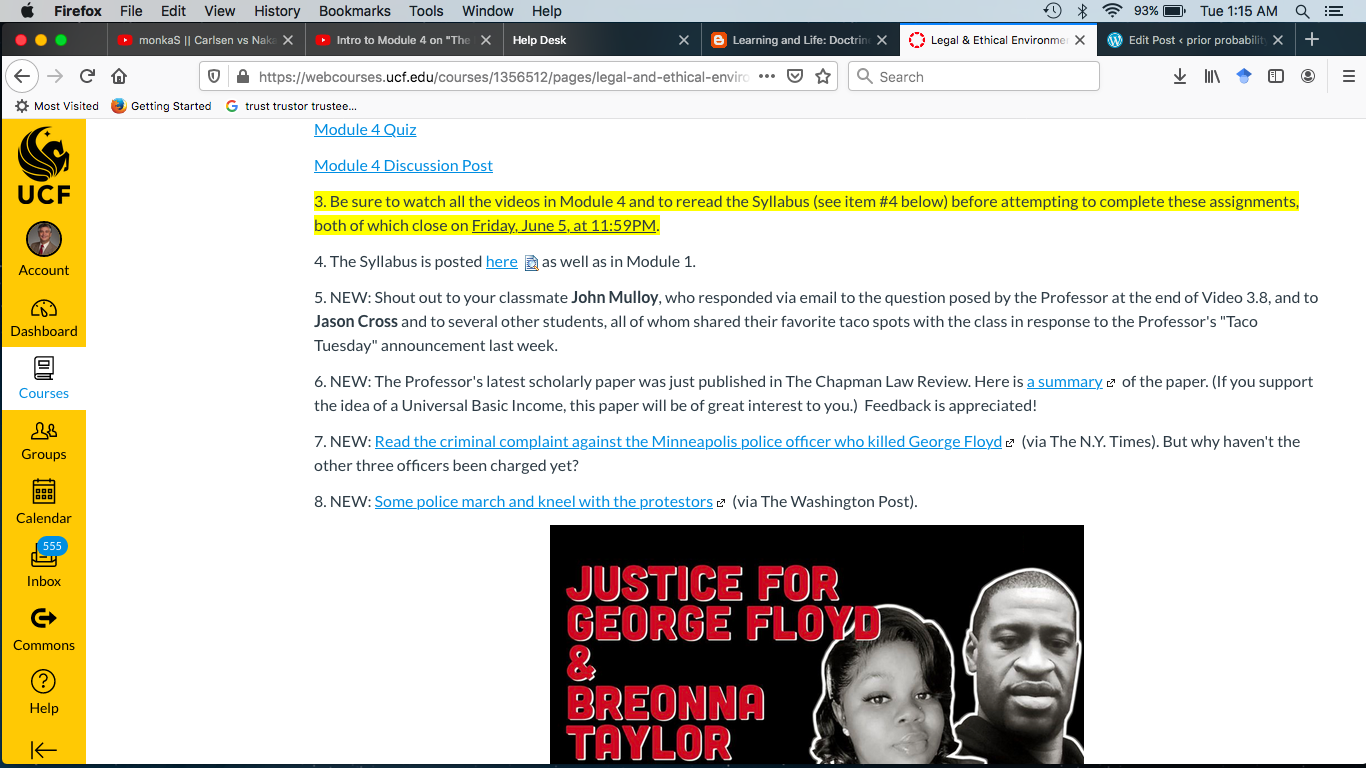
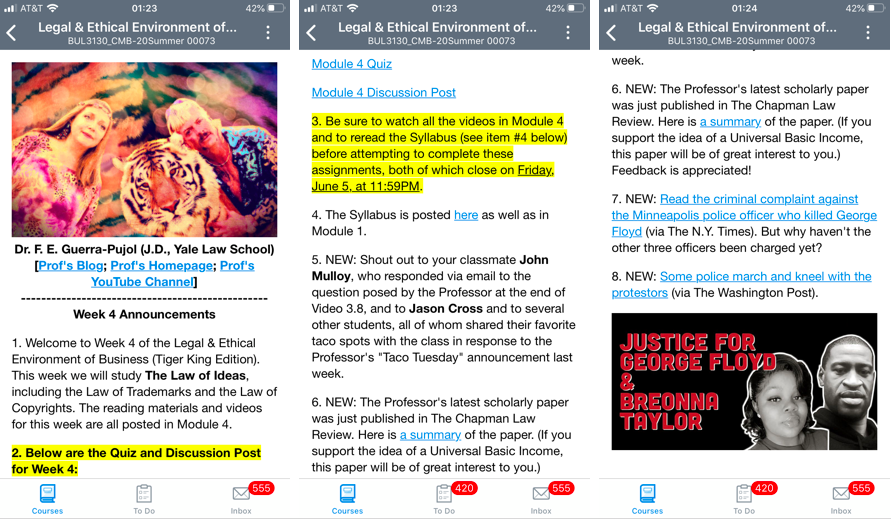
Because of my Tiger King theme, one of the sections of this module features materials that are specific to the Tiger King docuseries. Also, since this is a short, six-week summer course, I decided to narrow my coverage of intellectual property rights on copyrights and trademarks, and even with this limited focus, I still had to cram a lot of information into this module. But let’s not get too far ahead of ourselves. We will delve into the details of Module 4 during the rest of this week; in the meantime, below are some screenshots of the homepage of my course for Week 4:
Desktop version:
Canvas App version:
Footnote: Notice that I added an image inspired by the “Black Lives Matter” movement on the bottom of my homepage as well as links to two news reports relating to the recent unrest following the death of George Floyd while in police custody. Part of me felt awkward doing this, as I am not a political person (I am a registered Independent, though I lean towards the libertarian side of things). But at the same time, another part of me is mad as hell that (as of today, June 2, one full week after Mr Floyd’s death), three of the four officers involved in his unlawful arrest have still not been charged by the authorities.