A new shrine for the father of utilitarian ethics

More details here, via Atlas Obscura.
Posted in Uncategorized | Leave a comment

Alternative visualizations of national flag colors

Hat tip: u/ozjimbob, via Reddit
Source: AllPosters
Posted in Uncategorized | 2 Comments

Frank Ramsey’s production function

Cheryl Misak (2020), p. 253.
Posted in Uncategorized | 1 Comment

Ramsey’s miracle month

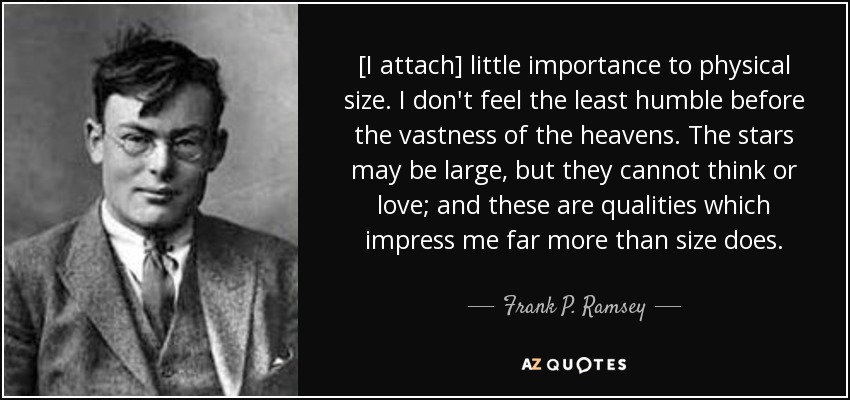
Having now finished the first half of Cheryl Misak’s intellectual biography of Frank Ramsey (“A Sheer Excess of Powers”), I am especially struck by what Ramsey (pictured below) accomplished before reaching his 19th birthday. In particular, in the space of one month (January of 1922), Ramsey published a devastating critique of left-wing “social credit” proposals, akin to the “universal basic income” schemes of our times; he published a detailed review of John Maynard Keynes’s Treatise on Probability, a review that demolished Keynes’s approach to probability; and he not only translated Ludwig Wittgenstein’s now-famous Tractatus–which is considered to be one of the most important works of modern philosophy–his translation was approved by the demanding and ornery Wittgenstein himself!

Image result for frank ramsey

Posted in Uncategorized | Leave a comment

Ten year challenge: Bayesian probability edition

Over a century ago, the legal giant Oliver Wendell Holmes invited us to look at the law through the lens of probability theory, or in Holmes’s own immortal words: “The prophecies of what the courts will do in fact, and nothing more pretentious, are what I mean by the law.” Ironically, few legal scholars have taken up Holmes’s intriguing invitation. During the last ten years (2011-2020), however, I authored the following papers in which I applied Bayesian probability to various aspects of law and culture:

  1. A Bayesian Model of the Litigation Game (2011), in which I develop a Bayesian model of litigation.
  2. Visualizing Probabilistic Proof (2013), in which I use Bayesian methods to solve the “blue bus problem” in evidence law.
  3. Finding Santiago (2015), in which I focus on Hemingway’s hero in “The Old Man and the Sea” and explore the inner workings of the old man’s mind through a probabilistic or Bayesian lens.
  4. Judge Hercules or Judge Bayes? (2016), in which I use Bayesian methods to solve Newcomb’s Problem.
  5. Probabilistic Interpretation II: The Case of the Speluncean Explorers (2017), in which I examine Lon Fuller’s famous fictional case from a Bayesian perspective.
  6. A Bayesian Analysis of the Hadley Rule (2019), one of the papers in this fine collection of essays, in which I examine the rule of Hadley v. Baxendale from a Bayesian perspective.
  7. The Case for Bayesian Judges: Putting Posner and Vermeule into Practice (in press), in which I develop a simple Bayesian model of adjudication.
Image result for rev bayes
Image credit: xkcd
Posted in Uncategorized | Leave a comment

Reverse entropy

Posted in Uncategorized | 1 Comment

Paper clip art

“Total Eclipse” was created by Zachary Abel and consists of a hollow sphere containing 720 interwoven paperclips in the shape of a soccer ball. I featured this whimsical work of art on my blog a few years ago (see here); more details about this project are available here (hat tip: @pickover).

Posted in Uncategorized | Leave a comment

Dreaming of Florida

This gallery contains 2 photos.

Originally posted on prior probability:
If you are in the Orlando area, skip Disney and visit the Orlando Museum of Art instead. OMA is featuring a special exhibit on The Florida Highwaymen, a remarkable group of Afro-American painters from Ft…

More Galleries | 2 Comments

In praise of brevity (proof by contradiction edition)

Screen Shot 2020-02-28 at 12.05.31 PM

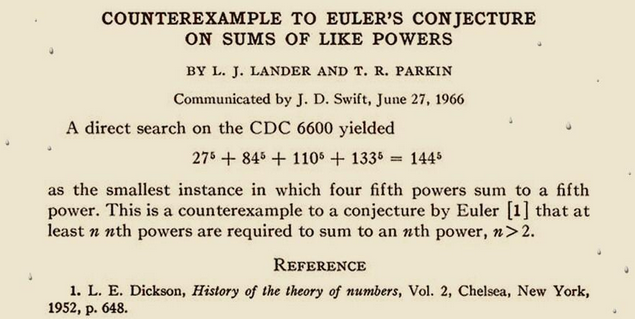
The formal paper pictured above consists of two succinct sentences and is the shortest-known paper published in a serious math journal; more details are available here. File under: proof by contradiction (hat tip: @pickover).

Posted in Uncategorized | Leave a comment

Some virtues of Bayesian voting

We presented the basic mechanics of Bayesian voting in one of our previous posts and showed how this simple and intuitive method of voting combines the best of both worlds: the ability of voters to express the intensity of their preferences along with the simplicity of one-man, one-vote. In this post, I want identify and discuss several additional virtues of Bayesian voting. Since Warren Smith has already compiled a comprehensive list of the advantages of Bayesian or “score” voting here, I will limit this particular blog post to the following three virtues:

1. The virtue of resistance to strategic voting. One of the most important lessons in the literature on voting methods is that all systems of voting, no matter how exotic or how complex, can be gamed or manipulated; the problem of strategic voting plagues all voting rules. Bayesian voting, by contrast, is not only simple and easy to use; as long as each voter is allocated only one ballot, it is also immune to most forms of strategic voting, or in the words of Warren Smith, “Your score for candidate C in no way affects the battle between A vs. B. Hence, you can give your honest opinion of C without fear of ‘wasting your vote’ or hurting A. You never have an incentive to betray your favorite candidate by giving a higher score to a candidate you like less.” (This is such an important point in favor of Bayesian voting that I will devote a future blog post to it.)

2. The virtue of familiarity. Furthermore, unlike quadratic voting and other exotic or complex forms of voting, such as Borda counts, Condorcet ranked pairs, instant runoffs, etc. (as an aside, for an excellent overview of different voting methods check out this helpful entry in the Stanford Encyclopedia of Philosophy), most people are already familiar with and have ample experience in Bayesian voting. Think of Yelp reviews for restaurants and TripAdvisor reviews for hotels, or Rotten Tomatoes reviews for movies or Amazon reviews for products and books (see example pictured below), just to name a few.

3. The virtues of flexibility and adaptability. Bayesian voting is so simple and easy to use that it can be used in a wide variety of settings–not just political elections but also jury trials (questions of fact) and appellate cases (questions of law). For the sake of brevity, I won’t describe these possible novel applications of Bayesian voting in this post, but for more information about these possibilities, check out my discussion of “Bayesian verdicts” [here] and my description of Bayesian judges [here].

4. The virtue of intellectual cross-fertilization. Last but not least, for me the chief virtue of Bayesian voting is that it makes explicit the intellectual link between degrees of belief and intensity of preferences. This point is such an important one for me that I will devote a separate blog post (my next one) to it …
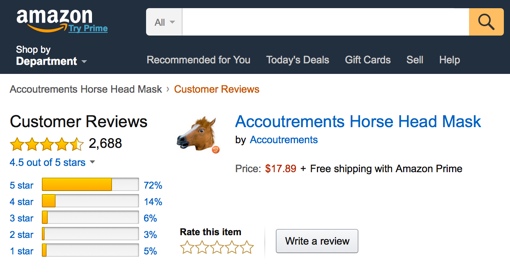
Image result for amazon ratings

Posted in Uncategorized | Leave a comment