
It’s Sunday, so I am interrupting my series of blog posts on the “social construction of legal progress” to share this creative end-of-year “movie trailer mashup” (hat tip: Kottke). I will resume my review of progress in law on Monday …
It’s Sunday, so I am interrupting my series of blog posts on the “social construction of legal progress” to share this creative end-of-year “movie trailer mashup” (hat tip: Kottke). I will resume my review of progress in law on Monday …
In my previous post, I shared a wide variety of law review articles and scholarly papers on the theme of legal progress. The larger question I care about, however, is this: is it possible to objectively measure progress in any particular domain of the law, such as torts or property or whatever, or is legal progress a “socially-constructed” or subjective ideal? For their part, Tilmann Altwicker (University of Basel) and Oliver Diggelmann (University of Zurich) identify four ways in which progress is “socially-constructed” in the field of international law. I will thus review and restate these techniques in my next few posts, starting with a crude historical method that Altwicker & Diggelmann call “ascending periodization.” (You can read their excellent paper for yourself here.)
In summary, the “ascending periodization” method of measuring legal progress consists of dividing some aspect of legal history into two or more periods and then assigning the most recent period a positive or flattering label, or in the words of Altwicker & Diggelmann themselves (pp. 432-433, footnote omitted): “Progress narratives [in international law] can be created by cutting [history] into two or more periods and giving the most recent period the most favourable label. The technique sounds simple. The operation of interest here–the creation of a progress narrative – is not always made explicit. It often remains hidden, typically behind the use of ‘established’ periods which tend to appear as ‘objective’ units. Established periods seem to reflect the ‘reality’ of international law’s development. Periodizations such as ‘the era of the Westphalian state system’ or the ‘interwar-period’, for example, may serve as examples.”
This crude method of measuring legal progress in the field of international law might also be generalizable to other areas of law. Richard A. Epstein, by way of example, traces the history of strict liability and the fault principle in his classic casebook on Torts–now in its 11th edition and co-edited with Catherine Sharkey, pictured below along with Epstein. In chapter 2 of their casebook, Professors Epstein and Sharkey divide the history of tort law into four periods and assigns each period the following labels: (1) the formative cases, (2) the forms of action [at common law], (3) the second half of the Nineteenth Century, and (4) modern times. Although it is still an open question whether strict liability or the fault principle (i.e. negligence) is the more economically efficient or wealth-maximizing method of assigning tort liability (i.e. it is still an open question whether Anglo-American law has made progress in the area of tort law), one could argue that use of the favorable label “modern times” might implicitly pre-dispose students of Epstein’s casebook in favor of contemporary approaches to tort liability. Clearly, this crude method won’t do, so I will review additional methods of measuring legal progress in my next few posts …

One of the puzzles that has long captivated me is this: how should we measure “progress” in such normative or value-laden fields as law, art, and ethics? Aren’t such first-order values as justice, beauty, and right vs. wrong supposed to be timeless and universal? Along come Tyler Cowen and Patrick Collison, who propose a new interdisciplinary field of progress studies. (See Cowen & Collison, “We need a new science of progress.”) To this end, I recently conducted a preliminary literature review on the subject of “legal progress” in Google Scholar. (Along with business ethics, my professional training and scholarly area of expertise is the philosophy of law, with a special interest in natural law.) Here is a small sampling of what I found in reverse chronological order:
In other words, there are multiple perspectives and many different ways of studying legal progress: progress in how an industry is regulated by law, progress in women’s rights, progress in the protection of property rights, progress in how lawyers and judges reason about law, etc. These multiple conceptions of legal progress thus pose a larger question: how should legal progress be defined or measured? Stay tuned: I will explore that question in my next few posts …

“Lady Justice Awakens” by Odin
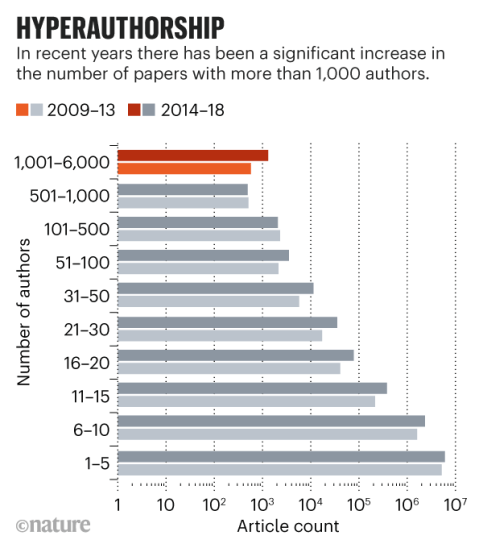
According to Coasian economic theory, “transaction costs” are supposed to determine whether people will work as individuals or collectively as firms. But does this insight apply to science research? Via Nature: “Between 2009 and 2013, 573 manuscripts listing 1,000 co-authors or more were published, according to a report released on 4 December by the Institute for Scientific Information …. But that figure has risen to 1,315 papers over the past 5 years.” (Hat tip: Marginal Revolution.)
Update (11:45am): Upon further reflection, to the extent scientific papers with hundreds or even thousands of co-authors are led by science labs such as CERN, maybe those types of projects can be compared to Coasian or centralized “firms.”
Check out this thoughtful essay/blog post by Jason Crawford, which is provocatively titled “Progress studies [is] a moral imperative.” Although I am generally skeptical of “moral imperatives” (after all, moral claims are hard, if not impossible, to test or falsify, and the time and resources devoted to studying progress–or any other subject, for that matter–could be devoted to any number of other socially-valuable and morally-salient projects), there are nevertheless many aspects of Jason’s short essay that I found useful and worth sharing. Among other things, Jason raises many important questions about the nature of progress and offers several specific yardsticks for measuring human progress (see chart below, for example). At the same time, this book review by Jessica Riskin contains a powerful critique of the chart pictured below. Enjoy!
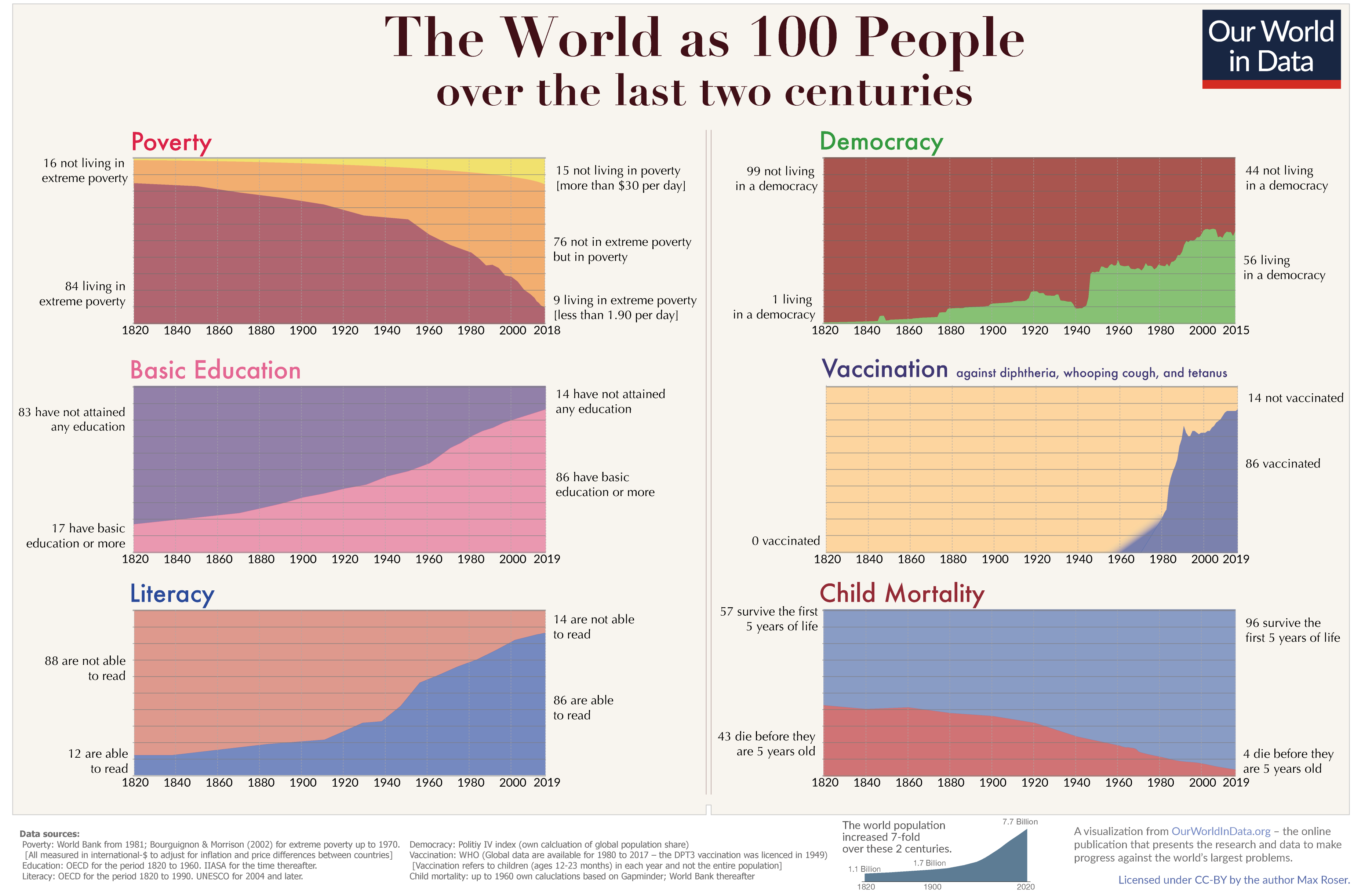
Credit: Max Roser (hat tip: @jasoncrawford)
… or the primacy of methodology. One team of scientists (led by David Kroodsma) published a study in the journal Science that concluded 55 percent of the world’s oceans are affected by fishing. Another group (led by Ricardo Amoroso), using the same underlying data (!), reached a drastically different conclusion: the actual value is closer to 4 percent. Ed Yong thus poses the salient following question in this excellent essay in The Atlantic: “How could two groups [of data scientists] have produced such wildly different answers using the same set of data?” In a word: methodology.
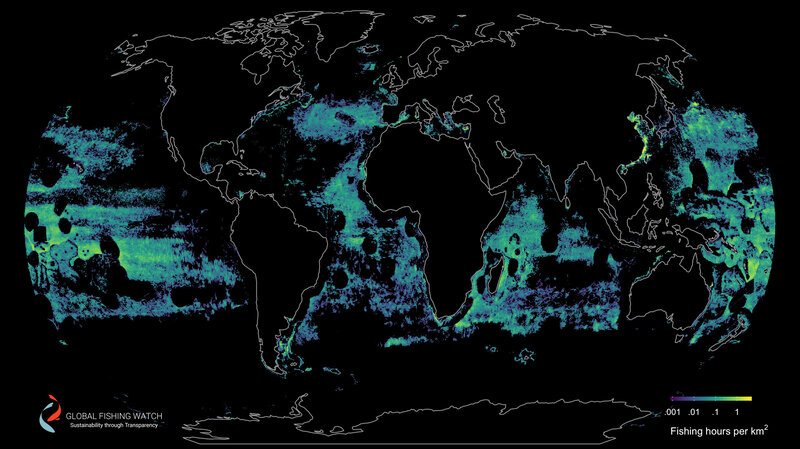
Image Credit: Global Fishing Watch
In keeping with our last few posts, where we have featured a diverse group of remarkable women artists, we are now reblogging our Banksy query from five years ago (6 Nov. 2014).
We have always assumed that Banksy, our favorite mystery graffiti artist, is a man. But what if she is a woman? Kriston Capps makes a persuasive case in this beautiful essay for why Banksy is probably a woman. Hat tip to kottke for the pointer.
Constance Grady (via Vox) explains how Mariah Carey’s “All I Want for Christmas,” which was released 25 years ago, finally reached #1 on Billboard’s official Hot 100 chart. (Here is the official announcement.) In brief, Mariah’s Christmas anthem was originally ineligible for the Hot 100 chart because it was first released as a noncommercial single, but then “a series of rule changes (older songs were ineligible until they weren’t; noncommercial singles were ineligible until they weren’t) pushed ‘All I Want’ on and off the Billboard charts every holiday season … until in 2017, it hit No. 9 on the Hot 100 and entered the top 10 for the first time. In 2018, it hit No. 3. Now, two years later and more acclaimed than ever thanks to its 25th anniversary, it’s finally reached No. 1 on the chart.” Enjoy … and Merry Christmas!
Mary Ann Carroll was one of the remarkable Florida Highwaymen artists–and the sole woman of this iconic group. Here is the official obituary. Below is one of her works:

Artist credit: M. A. Carroll
For your reference, this beautiful book (by Gary Monroe) is devoted to the life and work of Mary Ann Carroll. Here is an extended excerpt from Monroe’s book: Continue reading
I must confess that I am not a fan of superhero movies (I have yet to see a single Marvel movie, for example, nor do I plan to), but I might make an exception for “Wonder Woman 1984” (based on the trailer below). The release date of this film is scheduled for 5 June 2020 (hat tip: @kottke).










Welcome to the online home of the IASS
Hopefully It’s Interesting.
In Conversation with Legal and Moral Philosophers
Relitigating Our Favorite Disputes
PhD, Jagiellonian University
Inquiry and opinion
Life is all about being curious, asking questions, and discovering your passion. And it can be fun!
Books, papers, and other jurisprudential things
Ramblings of a retiree in France
BY GRACE THROUGH FAITH
Natalia's space
hoping we know we're living the dream
Lover of math. Bad at drawing.
We hike, bike, and discover Central Florida and beyond
Making it big in business after age 40
Reasoning about reasoning, mathematically.
I don't mean to sound critical, but I am; so that's how it comes across
remember the good old days...
"Let me live, love and say it well in good sentences." - Sylvia Plath
a personal view of the theory of computation
Submitted For Your Perusal is a weblog wherein Matt Thomas shares and writes about things he thinks are interesting.
Logic at Columbia University
Just like the Thesis Whisperer - but with more money
the sky is no longer the limit
Technology, Culture, and Ethics
Just like the horse whisperer - but with more pages
Poetry, Other Words, and Cats


 prior probability