An illicit Shakespearean promise

When is an illicit promise morally or legally binding? Perhaps the most famous fictional illicit promise of all time is the one that appears in William Shakespeare’s Merchant of Venice. (I am indebted to my friend and colleague Nate Oman, who has explored the historical and commercial  contexts of Shylock’s immortal pound-of-flesh pact at length in his book The Dignity of Commerce: Markets and the Moral Foundations of Contract Law (University of Chicago Press 2016). Also, as an important aside, although the character of Shylock the moneylender can be portrayed in a negative or stereotypical light, at the same time, Shylock’s motives and actions can also be seen in a more sympathetic light. In the words of the great Jewish actor Jacob Adler, who played the role of Shylock on the stage, Antonio is “far from the chivalrous gentleman he is made to appear. He has insulted [Shylock] and spat on him, yet he comes with hypocritical politeness to borrow money of him.” Jacob Adler, A Life on the Stage (Applause Books 1999), p. 345. Also, Portia’s plea for mercy can be seen as empty cheap talk. After all, she herself shows little mercy toward Shylock and ends up resorting to trickery and deception in court to defeat Shylock’s contract. Worse yet, from a due process perspective, the procedures used in Shylock’s case at the end of the play are a mockery of justice, with Portia, a party with an interest in the outcome of the case, acting as Shylock’s judge.)

In Shakespeare’s Elizabethan morality tale, which is set in the Republic of Venice during the Late Middle Ages, the character of Shylock agrees to loan a large sum of ducats to Bassanio without interest in exchange for the legal right to take a pound of Antonio’s flesh in the event of default. Assuming Shakespeare’s Shylock was acting immorally when he insisted on this dramatic penalty clause, the immortal pound-of-flesh pact in The Merchant of Venice illustrates the internal tension between our deep moral intuitions and the mercenary mercantile logic of the Rialto in Shakespeare’s play. As Nate Oman has noted, our moral intuitions and sense of fair play tell us Shylock’s pound-of-flesh pact should not be enforced in the interest of individual justice, but at the same time, the free flow of commerce and the greater good–the integrity of Venetian trade in future deals–demands that all voluntary bargains be enforced. To paraphrase Prince Hamlet: to enforce or not to enforce, that is the question! Simply put, although this fictional agreement was the product of one playwright’s literary imagination, it dramatically illustrates the problem of illicit promises. Specifically, what is the moral and legal status of such a monstrous promise? After all, the parties voluntarily and knowingly consented to these terms, however heinous. Now, what if Shylock and Bassanio had inserted an arbitration clause into their loan agreement? I will consider that very possibility in my next blog post.
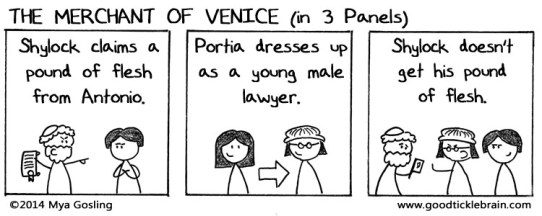
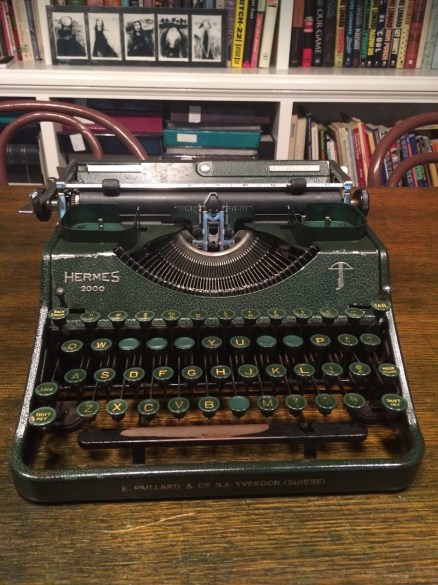
Image result for merchant of venice
Posted in Uncategorized | 3 Comments

Promises to obstruct justice

In a previous post, I posed the following moral paradox: when is an illicit promise morally binding? In my next few posts, I will present three concrete examples of illicit promises: (1) usurious payday loans in the case of Buckeye Check Cashing, Inc. v. Cardegna, (2) Shylock’s pound-of-flesh pact in Shakespeare’s Merchant of Venice, and (3) a modified version of the prisoner’s dilemma in which the prisoners promise to obstruct justice. This third example of an illicit promise is inspired by the famous prisoner’s dilemma, a simple mathematical model that has been used by game theorists and others to model a wide variety of situations involving conflict and cooperation. (See e.g., Robert Axelrod, The Evolution of Cooperation, revised edition, Basic Books, 2006.) The first published account of the prisoner’s dilemma appears in Duncan Luce and Howard Raiffa’s 1957 game-theory treatise Games and Decisions. In their treatise, Professors Luce and Raiffa present the now standard one-shot version of the Prisoner’s Dilemma as follows: Continue reading

Posted in Uncategorized | 2 Comments

Vintage 1927 Hermes model 2000 portable typewriter

As per this tweet, William Gibson wrote his 1984 science fiction novel Neuromancer on this vintage typewriter. Generally speaking, which method of writing is better? Typewriters or word processors?

Image credit: @GreatDismal

Posted in Uncategorized | 1 Comment

Haitian vodou art

This gallery contains 2 photos.


More Galleries | Leave a comment

Time lapse of rare Yosemite Falls rainbow

More details here (hat tip @kottke).

Posted in Uncategorized | Leave a comment

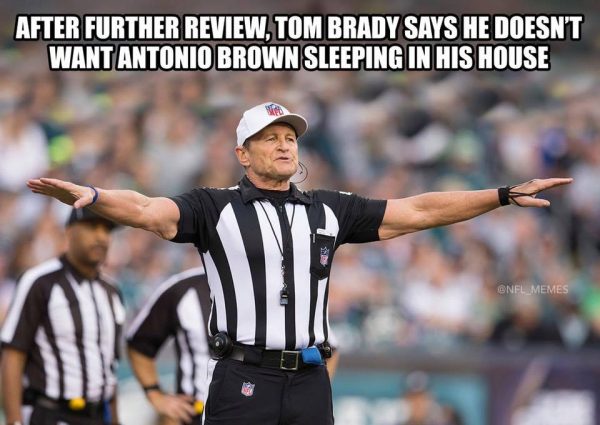
Do the Patriots still have to pay Antonio Brown?

Maybe. Although the Patriots finally cut Antonio Brown from the team, Kristian Dyer explains in this Fox Business report why Bob Kraft might still have to pay Brown the first part of his signing bonus ($5 million USD). Because this NFL contract poses so many fascinating moral and legal issues, we will update this blog post as more information becomes available.

Update (9/21): Mike Reiss, an ESPN staff writer, reports that the Patriots had agreed to pay Brown a $9 million signing bonus, and that the bonus was to be divided into two parts: $5 million to be paid on Sept. 23, 2019 (this Monday!) and $4 million to be paid on Jan. 15, 2020. (Here is Reiss’s report.) So will Brown get paid on Monday? According to Reiss, Brown “is unlikely to get any of the bonus because of a representation warranty clause that calls for a player to disclose any situations that might prevent continued availability.”

Image result for antonio brown memes
Posted in Uncategorized | Leave a comment

Breaking Bad Promises

That is the title of my latest work in progress, which is about the moral and legal status of illicit promises, defined broadly as promises to perform illegal or immoral acts. (Shout out to my colleague and friend Dan O’Gorman for suggesting this super-sexy title to me.) Among other things, illicit promises pose a fascinating moral paradox. On the one hand, we have a general duty to keep our promises, but on the other hand, we also have a general duty to obey the law and avoid immoral actions. So, what happens when we make a promise to do just that, to break a law or perform an immoral act? I began working on this paper a couple of years ago, but I made substantial revisions this summer, and the revised paper is now available here, via SSRN. Comments are welcome. I will be blogging about this paper next week; in the meantime, here is the abstract: Continue reading

Posted in Uncategorized | 1 Comment

Dreams do come true

I am happy to report that my short piece “Kant on Evidence: A Hypothetical Reply to Kerr” will finally be published in Volume 22, Issue #4 of The Green Bag (2d Series), which also happens to be my all-time favorite law journal, so this minor feat is a dream come true.

Image result for green bag 2d law review
Posted in Uncategorized | 1 Comment

The logic of adjectives

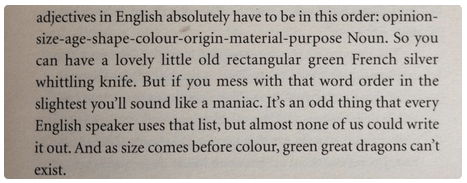
Check out this essay by Minda Zetlin explaining the ordering of adjectives. Among other things, her essay brought Mark Forsyth’s beautiful book The Elements of Eloquence to our attention. In his book (see screenshot below) Forsyth gives the following memorable example to illustrate the logic of adjectives: “a lovely little old rectangular green French silver whittling knife.” Simply put, one cannot move the order of any of those adjectives without having the sentence sound completely wrong. According to Forsyth, there are eight types of adjectives, and they should be used in the following order:

1. Opinion

2. Size

3. Age

4. Shape

5. Color

6. Origin

7. Material

8. Purpose

Screen Shot 2019-09-17 at 12.48.56 PM

Posted in Uncategorized | Leave a comment

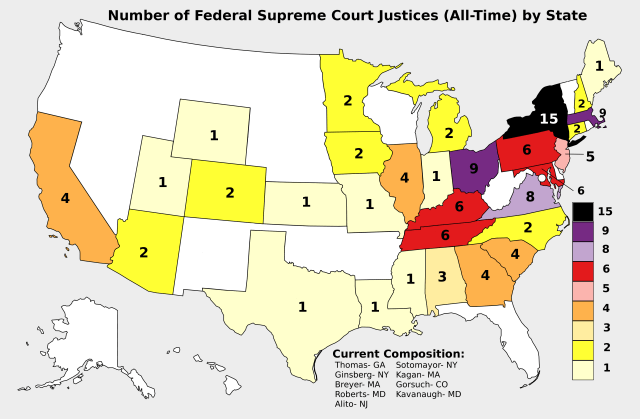
Geographic SCOTUS

Alternative title: “the least democratic branch”

Hat tip: u/BroIBeliveAtYou, via reddit

Posted in Uncategorized | 2 Comments