Taxonomy of duties (review of XI.1)

We now proceed to Chapter XI of “Natural Law and Natural Rights.” This chapter is titled “Obligation” and contains nine subsections. Since I like to emphasize duties and responsibilities instead of rights, and since this is my favorite chapter of Professor Finnis’s erudite tome, I will not speed through these pages as I have the previous ones. I will slow down my pace and review each subsection separately, beginning with subsection XI.1. Here, Prof Finnis identifies three ways in which the word “obligation” can be used:

  1. To refer to the general moral idea of duty or ought, i.e. “things, within our power either to do or not to do, which (whatever we desire) we have to do (but not because we are forced to), or must do, which it is our duty to do …, which one morally (or legally) ought to do …” (p. 297, emphasis in the original);
  2. To refer to the more specific idea of keeping one’s promises, both explicit promises and implied ones, i.e. “the ‘binding force’ (ligare, to bind) of promissory or quasi-promissory commitments” (ibid.); and
  3. To refer to the even more specific subset of relational commitments, presumably to one’s family and friends (again, Finnis is maddingly vague), i.e. obligations “deriving from particular roles, arrangements, or relationships” (ibid.).

In other words, the concept of “obligation” encompasses a wide range of diverse moral duties, promissory commitments, and relational responsibilities. (I shall hereafter use the simple word “duty” to refer to all three types of obligation.) Some of these duties are imposed by the dictates of morality or ethics or by one’s conscience. Others are self-imposed via voluntary promises. Still others are “relational” in nature, arising not out of an agreement or contract but out of one’s family relations and friendships. For his part, Prof Finnis will set aside the first and third categories of duties and probe the second category (“promissory obligation”) in the next subsection of Chapter XI, so we will proceed to XI.2 in our next post.

Related image

Posted in Uncategorized | Leave a comment

Fairness versus accuracy (review of Chapter X)

We shall now review Chapter X of “Natural Law and Natural Rights.” Among other things, Professor Finnis explores the relation between law and coercion (pp. 260-264), identifies the main features of a legal order (pp. 266-270), and presents a “multi-faceted” conception of law (pp. 276-281). Alas, this chapter is hard to take seriously. Why? Because Finnis’s premises are built on theoretical quicksand. In the words of Finnis, “The authority of the law depends … on its justice or at least its ability to secure to justice.” But what is justice? For Finnis, “the objective of justice is … the common good” (p. 174). Now, before proceeding, recall that Finnis defines the common good in terms of our ability to promote cooperation and solve collective action problems. Alas, for any polity with a large enough number of members, that polity is going to consist of groups or factions favoring competing and conflicting solutions to such collective active problems, so putting aside such crude general measures as GDP or life satisfaction/happiness surveys, it’s not clear whether we can identify a master “common good” as opposed to the individual interests or individual goods of each member.

Nevertheless, there is at least one aspect of Chapter X that we can try to salvage: Finnis’s analysis of the rule of law on pp. 270-276 of his book. Finnis identifies eight separate “desiderata” or requirements of the rule of law, including (i) prospectivity, (2) ease of compliance, (3) public promulgation, (4) clarity, (5) coherence, (6) stability, (7) generality, and (8) accountability. Again, in the words of Finnis (pp. 270-271):

A legal system exemplifies the Rule of Law to the extent (it is a matter of degree in respect of each item of the list) that (i) its rules are prospective, not retroactive, and (ii) are not in any other way impossible to comply with; that (iii) its rules are promulgated, (iv) clear, and (v) coherent one with another; that (vi) its rules are sufficiently stable to allow people to be guided by their knowledge of the content of the rules; that (vii) the making of decrees and orders applicable to relatively limited situations is guided by rules that are promulgated, clear, stable, and relatively general; and that (viii) those people who have authority to make, administer, and apply the rules in an official capacity (a) are accountable for their compliance with rules applicable to their performance and (b) do actually administer the law consistently and in accordance with its tenor.

Notice what all these sundry and maddingly vague desiderata have in common: they are all procedural in nature. For Finnis, the rule of law is not about the substantive content of law; rather, it’s about how the law (whatever its content) is made and applied. (By the way, this focus on procedural natural law or the “inner morality of law” is not Finnis’s idea. It is an idea that can be traced back to the great Lon Fuller.) The essential ideas here boil down to notice and universality: people must be able to find out what the law is, and these same laws must also apply to the rulers themselves. But there is something missing in both Finnis and Fuller’s work on the rule of law: what about the value of accuracy? Why do so many legal philosophers or “jurisprudes” omit this key variable in their explorations of the rule of law?

I have covered this ground before, for as I noted in a previous post–back when I was reviewing the breathtaking work and ideas of my hero Robert Nozick: “any procedure is going to be imperfect to a greater or lesser degree. An innocent man might be found guilty with some positive probability, and a guilty man might be declared innocent with some probability, and furthermore, the choice of procedural rules will produce trade-offs [between accuracy and justice].” (To quantify this tragic trade off, consider the famous Blackstonian legal maxim below.) To my mind, then, the key question in the domain of procedural fairness is this: which procedural probabilities and which trade-offs are morally required or morally acceptable? Alas, neither Finnis nor Fuller has anything to say about these legal and moral probabilities. For now, it suffices to say that I am deeply dissatisfied with Finnis’s (and Fuller’s, for that matter) procedural approach to the rule of law. That said, I will proceed to the next chapter of “Natural Law and Natural Rights” (Chapter XI) and begin wrapping up my review of Finnis in my next few posts …

Image result for better that ten guilty go free

Why 10? Why not 20, 50, or 100?

Posted in Uncategorized | 1 Comment

Authority, the nirvana fallacy, and the costs and benefits of co-ordination (review of IX)

We now proceed to Chapter IX of “Natural Law and Natural Rights.” This chapter contains five subsections and is devoted to the theme of authority. By “authority,” Professor Finnis means coercion or the power “to require one to choose what one would not otherwise have chosen” (p. 231), and he offers the following insight: authority or coercion are not just necessary evils; they are necessary goods (!),* for without some kind of centralized authority (alas, Finnis is too aloof to delve into the details of actual governance), men would be unable to solve the many types of co-ordination problems that afflict any group, among which are:

  1. How to reconcile conflicting rights;
  2. How children should be educated;
  3. How natural resources should be allocated and used;
  4. How the use of force should be regulated; and
  5. How speech should be regulated.

While we agree with Finnis about the ubiquity of co-ordination problems, his sanguine analysis of authority is fallacious on multiple levels: theoretical and empirical. To begin with, the creation and maintenance of a centralized authority is itself a co-ordination problem! So, how does this meta-coordination problem get solved in the absence of some pre-existing meta-authority? In addition to this regress problem, the remaining problems with Professor Finnis’s analysis of authority are entirely empirical. Although Prof Finnis’s armchair theorizing might be persuasive to some scholarly souls, Finnis fails to compare both the benefits and the costs of authority. By way of example, what about “forced riders,” i.e. individuals who are required to contribute against their will to the costs of goods or services they do not want? (See item C in the chart below.)

Moreover, we don’t always need a centralized authority to solve our co-ordination problems. As such influential scholars as Elinor Ostrom and Robert Sugden have shown (look them up!), bottom-up solutions to collective action problems and other forms of “spontaneous order” are often more effective–and perhaps more morally legitimate to boot!–than centralized solutions. (See item B below.) Lastly, Finnis commits what Harold Demsetz has called the nirvana fallacy: the fallacy of comparing actual coordination problems (such as the set of co-ordination problems listed above) with unrealistic or ideal solutions to these problems (some authority capable of providing ideal or perfect solutions to our co-ordination problems). More simply put, just because a co-ordination problem exists doesn’t mean it needs to be solved; sometimes it’s better to leave a problem alone; sometimes the solutions are worse than the problem itself! (See item A below.)

Screen Shot 2019-05-09 at 10.58.39 AM

Continue reading

Posted in Uncategorized | Leave a comment

Rainy day readings

My wife and I are in the Atlanta area this weekend, but the forecast calls for lots of rain. Perfect weather for reading! (We will return to “Natural Law and Natural Rights” on Monday.)

Posted in Uncategorized | Leave a comment

Critique of rights-talk: three key points

Before we wrap up our review of “Natural Law and Natural Rights” (NLNR), I want to take a moment to sum up my protracted two-part Coasean critique of rights-talk (here is part one and here is part two) by making three key points:

  • Key Point #1: To assert a moral or legal right is to pose a series of challenging questions: what is the scope of that right, and how will or should it be enforced (if at all)? Also, who is the obligor of that right, and who is its beneficiary?
  • Key Point #2: The assertion or exercise of a right will almost always generate a new set of conflicts at many different levels, including (1) conflicts with other rights; (2) conflicts with other rights-holders; and (3) conflicts with public officials about the proper interpretation and application of the right.
  • Key Point #3: My Coasean critique of rights-talk not only applies to Finnis’s work. It also applies to Robert Nozick’s major premise in Anarchy, state, and utopia (1974, p. ix): “Individuals have rights, and there are things no person or group may do to them (without violating their rights).”

For all of these reasons, my personal preference is to focus on duties first (i.e. on the cost-side of the reciprocal rights-duties equation), rather than on rights. As it happens, Professor Finnis devotes an entire chapter of NLNR to the topic of “obligation” (Chapter XI), so will I will proceed with my review of Finnis on Monday.

Related image

What about duties?

Posted in Uncategorized | Leave a comment

A Coasean critique of rights-talk, part 2

In response to Professor Finnis’s analysis of rights in Chapter VIII of his book on “Natural Law and Natural Rights,” we began to present a general critique of rights-talk in our previous post. Specifically, we surveyed Ronald Coase’s economic analysis of the problem of harmful effects, using his classic example of cattle trespass. In this post, I will now explain the connection between Coase’s economic analysis of harms and the logic of rights. Simply put, the connection is this: Continue reading

Posted in Uncategorized | 1 Comment

A Coasean critique of rights-talk (review of Chapter VIII, part 1)

We now proceed to Chapter VIII of “Natural Law and Natural Rights.” Among other things, Professor Finnis revisits W. N. Hohfeld’s classic taxonomy of rights (see pp. 199-205), delves into the history of the language of rights (pp. 206-210), and even scrutinizes the finer points of the Universal Declaration of Human Rights (pp. 211-218). In the course of this erudite exploration of the logic and history of rights, Finnis makes a number of insightful observations, but Professor Finnis’s “specification of rights” in the last part of Chapter VIII (pp. 218-226) is unsatisfactory, to put it mildly. Why? Because Finnis is operating under the fundamental or axiomatic assumptions that “there are absolute human rights” (p. 225) and that “the maintenance of human rights is a fundamental component of the common good” (p, 218). But these axioms invite certain questions that Finnis himself refuses to answer. What are these absolute rights? How do we define the “common good”? Continue reading

Posted in Uncategorized | 2 Comments

Finnis versus Nozick (partial review of Chapter VII)

We now proceed to Chapter VII of “Natural law and natural rights,” the chapter on justice. Alas, Professor Finnis’s beautiful theory of justice is built on theoretical quicksand, for it is premised on his view of the common good, and we have already demolished Prof Finnis’s circular and vacuous theory of the common good in our previous post. To the extent “the objective of justice is … the common good” (p. 174), to quote Finnis’s own words, and to the extent the concept of the common good is just meaningless babble, we don’t have much more to say about Finnis’s conception of justice in Chapter VII. Why beat a dead theoretical horse? That said, there is one part of Chapter VII that I will discuss in more detail in this post: Professor Finnis’s moralistic critique of Robert Nozick’s critique of taxation. Continue reading

Posted in Uncategorized | Leave a comment

Good common goods and bad common goods (review of Chapter VI)

Note: This part of our review of “Natural law and natural rights” (NLNR) was revised on 17 May 2019. (In fairness to Finnis we added an important clarification below the cartoon.)

We now proceed to Chapter VI of NLNR, though, recall from the previous chapter Professor Finnis’s master list of moral criteria–criteria for evaluating the morality of our choices. Among other things, Finnis asserts morality requires that one’s choices must not only be consistent with “the common good of one’s communities” (p. 125), but must also “foster[] and favor[]” this common good. Finnis, however, doesn’t have much to say (only 47 words!) about this common good criterion in Chapter V; instead, he devotes all of Chapter VI to it. Although Finnis makes a number of excellent points in this chapter, here is where Professor Finnis’s natural law theory will begin to unravel. I shall limit myself to pointing out the good, the bad, and the ugly (theoretically-speaking) aspects of this chapter:

1. The Good. The best part of Chapter VI is Finnis’s attempt to define the concepts of “society” and “community”, two notoriously loose and slippery concepts. According to Finnis (p. 152, footnote omitted), it is the “sharing of aim rather than multiplicity of interaction [that] is constitutive of human groups, communities, societies.” In other words, a group can be said to exist when two or more people work, play, plan a heist, or whatever “with a view toward a shared objective” (p. 153). I would only add that groups thus defined might have more than one “shared objective” and that such multiple objectives might conflict with each other.

2. The Bad. Professor Finnis spends most of Chapter VI propounding a master taxonomy of groups. In particular, Finnis identifies four major types of group or community, depending on the group’s shared objectives. Some groups’ purpose is to promote play. Other groups are motivated by business profit. And still other groups are grounded in friendship. But according to Finnis, the most all-encompassing or “complete” group is that of the polis or the political community (see VI.6). Ok, fine, but is it just me, or is there a gaping hole in Finnis’s taxonomy? Where is the family, however defined?

3. The Ugly. Putting aside the problem of groups and polities with multiple and conflicting objectives (cf. James Madison in Federalist #10), we still have the problem of defining what we mean when we talk about the “common good.” This is a huge problem for Finnis because a group’s shared objective might be a nefarious one, like planning a heist or a murder, so we are going to need some additional criterion to distinguish good common goods from bad common goods. But alas, Finnis is unable to provide such an impossible criterion. In the end, Finnis succumbs to the most circular and lame-ass possible definition of the common good (p. 156): “The common good in [my] sense is a frequent or at least a justified meaning of the phrases ‘the general welfare’ or ‘the public interest’.” Have we come all this way–156 pages of the most dense and esoteric moral philosophizing–only to arrive at a circular truism?*

Let’s see whether Finnis can break out of this logical circle when we proceed to Chapter VII of NLNR, the chapter devoted to justice, in our next post …

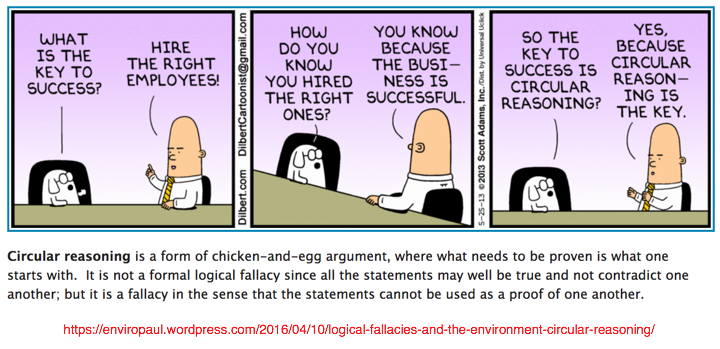
Image result for circular reasoning
*Later (especially in Chs. IX, X, and XI), Finnis will provide a much better and more workable definition of “the common good”; in particular, he will define the common good in terms of our ability to promote human cooperation and solve collective action problems. Still, our third objection (see point #3) above still stands, since men may cooperate in order to pursue selfish or evil ends, so we will still need some higher-level theory to help us distinguish between good common goods and bad common goods, but generally speaking, we agree with Finnis that one of the main purposes of laws and norms is to promote human cooperation and solve collective action problems.
Posted in Uncategorized | 2 Comments

The morality of choice (review of Chapter V, or exercises in mental masturbation)

Let’s now turn to Chapter V of “Natural law and natural rights,” the most important chapter in Professor Finnis’s beautiful book. This chapter is a must-read because Professor Finnis does three big things in this chapter: (1) he presents a powerful critique of consequentialism; (2) he locates the source of morality; and (3) he sets forth specific criteria for deciding when a choice is consistent or not with morality. We shall discuss each one of these themes in turn: Continue reading

Posted in Uncategorized | 2 Comments