

This gallery contains 2 photos.
More details here (hat tip @kottke).
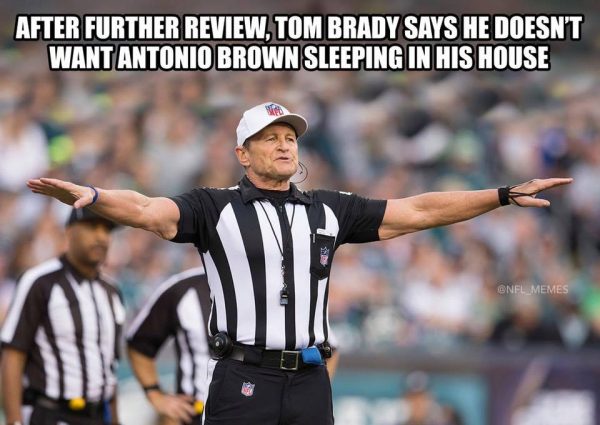
Maybe. Although the Patriots finally cut Antonio Brown from the team, Kristian Dyer explains in this Fox Business report why Bob Kraft might still have to pay Brown the first part of his signing bonus ($5 million USD). Because this NFL contract poses so many fascinating moral and legal issues, we will update this blog post as more information becomes available.
Update (9/21): Mike Reiss, an ESPN staff writer, reports that the Patriots had agreed to pay Brown a $9 million signing bonus, and that the bonus was to be divided into two parts: $5 million to be paid on Sept. 23, 2019 (this Monday!) and $4 million to be paid on Jan. 15, 2020. (Here is Reiss’s report.) So will Brown get paid on Monday? According to Reiss, Brown “is unlikely to get any of the bonus because of a representation warranty clause that calls for a player to disclose any situations that might prevent continued availability.”
That is the title of my latest work in progress, which is about the moral and legal status of illicit promises, defined broadly as promises to perform illegal or immoral acts. (Shout out to my colleague and friend Dan O’Gorman for suggesting this super-sexy title to me.) Among other things, illicit promises pose a fascinating moral paradox. On the one hand, we have a general duty to keep our promises, but on the other hand, we also have a general duty to obey the law and avoid immoral actions. So, what happens when we make a promise to do just that, to break a law or perform an immoral act? I began working on this paper a couple of years ago, but I made substantial revisions this summer, and the revised paper is now available here, via SSRN. Comments are welcome. I will be blogging about this paper next week; in the meantime, here is the abstract: Continue reading
I am happy to report that my short piece “Kant on Evidence: A Hypothetical Reply to Kerr” will finally be published in Volume 22, Issue #4 of The Green Bag (2d Series), which also happens to be my all-time favorite law journal, so this minor feat is a dream come true.

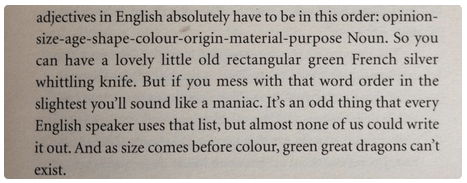
Check out this essay by Minda Zetlin explaining the ordering of adjectives. Among other things, her essay brought Mark Forsyth’s beautiful book The Elements of Eloquence to our attention. In his book (see screenshot below) Forsyth gives the following memorable example to illustrate the logic of adjectives: “a lovely little old rectangular green French silver whittling knife.” Simply put, one cannot move the order of any of those adjectives without having the sentence sound completely wrong. According to Forsyth, there are eight types of adjectives, and they should be used in the following order:
1. Opinion
2. Size
3. Age
4. Shape
5. Color
6. Origin
7. Material
8. Purpose
Hat tip: u/BroIBeliveAtYou, via reddit
You tell me! Aside from the government, what with the unethical practices of many Departments of Motor Vehicles and the proliferation of license plate readers, not to mention the mass surveillance programs of the so-called National Security Agency, Facebook and Mark Zuckerberg are the personification of evil, but who wins silver and bronze? The case against Microsoft is here. The case against Google, here.

Although Puerto Rico and the District of Columbia have petitioned for Statehood multiple times, neither the House nor the Senate has acted on these petitions. Why not? In Senator Mitch McConnell’s case, the reason is probably some combination of racism and politics: Senator McConnell is a member of the Republican Party, so he might reasonably fear that Puerto Rico and D.C. would tilt the balance of political power in the U.S. Senate by electing a cohort of four racial and ethnic minorities–two of them Spanish-speaking and all of them Democrats–to that august body. Still, this theory does not explain Nancy Pelosi’s inaction. (Also, the case of D.C. might require a constitutional amendment, since it is a federal enclave under Article I, Section 8 of the U.S. Constitution.)









Welcome to the online home of the IASS
Hopefully It’s Interesting.
In Conversation with Legal and Moral Philosophers
PhD, Jagiellonian University
Books, papers, and other jurisprudential things
Ramblings of a retiree in France
BY GRACE THROUGH FAITH
Natalia's space
hoping we know we're living the dream
Lover of math. Bad at drawing.
We hike, bike, and discover Central Florida and beyond
Making it big in business after age 40
Reasoning about reasoning, mathematically.
I don't mean to sound critical, but I am; so that's how it comes across
remember the good old days...
"Let me live, love and say it well in good sentences." - Sylvia Plath
a personal view of the theory of computation
Logic at Columbia University
Just like the Thesis Whisperer - but with more money
the sky is no longer the limit
Technology, Culture, and Ethics
Just like the horse whisperer - but with more pages
Poetry, Other Words, and Cats


