Visualization of data (W. E. B. Du Bois edition)

Did you know that the great North American activist, author, and scholar W. E. B. Du Bois was also a pioneer in the field of data visualization? Whitney Battle-Baptiste and Britt Rusert have collected Du Bois’s beautiful data portraits, including the one pictured below, in their new book W.E.B. Du Bois’s Data Portraits: Visualizing Black America. (Hat tip: kottke.)

Web Du Bois Infoviz

Posted in Uncategorized | 1 Comment

Evidence in support of the Baumol effect?

Bayesian Update (6 June 2019): I have changed the title of this blog post to reflect a more likely explanation for the pattern of price changes pictured below. For more information about William Baumol and the so-called “Baumol effect”, see here.

Economics professor Mark Perry (@Mark_J_Perry) recently posted an updated chart (pictured above) of price changes of certain consumer goods and services in the U.S. In summary, his chart shows falling prices for free-market goods like TV sets and toys as well as rising prices for such publicly-subsidized services as health care and higher education.

Posted in Uncategorized | 1 Comment

Who wore it best? (MAGA hat versus BLM button edition)

In case you are visiting from another planet, Make America Great Again” (#MAGA) was one of Donald J. Trump’s slogans during the 2016 presidential campaign, while Black Lives Matter” (#BLM) refers to a grassroots movement in support of people of color. Yet for some strange reason, many heavy-handed judges and school administrators want to ban these expressive articles of clothing from their courthouses and schools. Geesh! Whatever happened to the live-and-let-live rule?

Posted in Uncategorized | 2 Comments

Battle of the brands

https://twitter.com/ndimichino/status/1098621012990664705

Posted in Uncategorized | 1 Comment

In praise of Twitter and SSRN

As we approach the end of the month, here’s a partial list of what we’re reading these days:

  1. Carissa Byrne Hessick on “Vagueness Principles.”
  2. Daniel B. Klein on “Adam Smith’s 1759 Rebuke of the Slave Trade.”
  3. Jonathan R. Macey & Joshua Mitts on “The Three Justifications for Piercing the Corporate Veil.”
  4. Michael Risch’s provocatively-titled paper “Sue First, Negotiate Later.”
  5. Larry Solum on “Artificially Intelligent Law.”
  6. D. A. Jeremy Telman on “John Marshall’s Constitution.”

Two notes: I stumbled upon these sundry scholarly papers via my Twitter feed. (Your Twitter feed is only as good as the persons you follow!) Also, all of these fascinating research papers may be downloaded free of charge via the Social Science Research Network (SSRN), though SSRN now makes you log into their platform in order to access their database of free papers.

Image result for ssrn twitterImage result for twitter logo

Posted in Uncategorized | Leave a comment

A modest proposal (email ceasefire edition)

How much time do you spend responding to emails? Is this “email time tax” worth it? (Or does email bring you joy?) We recently stumbled upon this critique of email by Cal Newport, a computer science professor at Georgetown University. Below the fold is an excerpt from his excellent essay in which email is aptly described as a form of digital water torture: Continue reading

Posted in Uncategorized | Leave a comment

Communism: the greater evil

Their forceful ideas inspired countless crimes against humanity and massive amounts of human suffering (here is a partial list): Karl Marx and Friedrich Engels published “The Communist Manifesto” in London on this day in 1848. File under: Garbage In, Garbage Out.

Related image
Posted in Uncategorized | 1 Comment

Road trips

If you could take only one road trip in your life (assume a fixed budget of $2000 USD or 2000 euros for either trip), which one would you prefer: (a) Seattle to Boston or (b) Lisbon to Moscow?

https://i.redd.it/an6wp6eouih21.jpg

Hat tip: u/ttoxicite

Posted in Uncategorized | 9 Comments

Coase to the rescue!

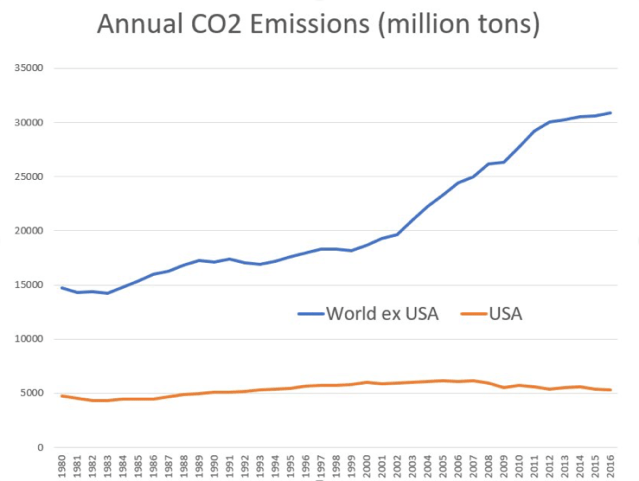
As my friend and colleague Alex Tabarrok (@ATabarrok), an economics professor at George Mason University, recently pointed out (see chart below), CO2 emissions in the USA are actually falling, but alas they are rising in the rest of the world, especially in fast-growing countries like China and India. Professor Tabarrok thus proposes a novel (?) Coasean solution to climate change: instead of Pigovian carbon taxes, what if rich countries (and rich men like Bill Gates, I would add) were to buy out or lease the legal rights to coal fields in China and India and then shut those fields down or convert them into parks? Here is an excerpt from Tabarrok’s ingenious proposal:

Coal use in China is very high and increasing. India has been canceling coal plants as solar becomes cheaper but coal is still by far the largest source of power in India. Thus, there is plenty of opportunity to buy out, high-cost coal mines in China and India. It might seem odd to buy Chinese and Indian coal mines but we buy Chinese and Indian labor, why not a coal mine? Moreover, it’s important to understand that the policy is to buy only up to the point that it benefits both parties. Buying coal isn’t foreign aid, it’s a pollution reduction plan just like a carbon tax or R&D investment and because we can buy barely-profitable coal mines and avoid the problem of leakage this is a low-cost method to reduce CO2 emissions.

Posted in Uncategorized | 2 Comments

Happy holiday?

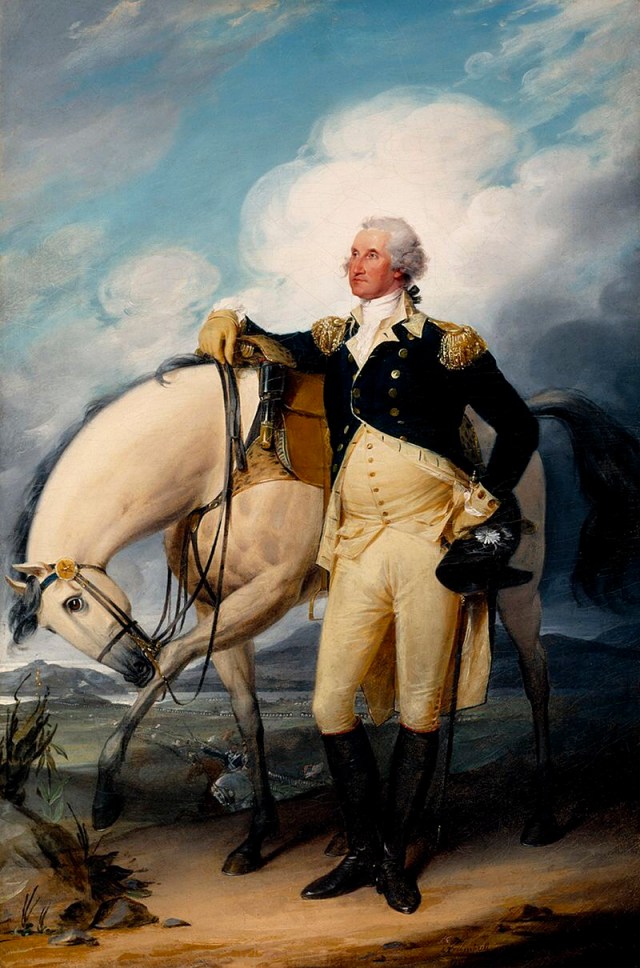
Do you have the day off? The third Monday of February is a federal holiday, but what should we call it? Read about the history of Washington’s Birthday here, via Wikipedia. Below is a portrait of George Washington by John Trumpbull.

Posted in Uncategorized | Leave a comment