Borges’ paradox

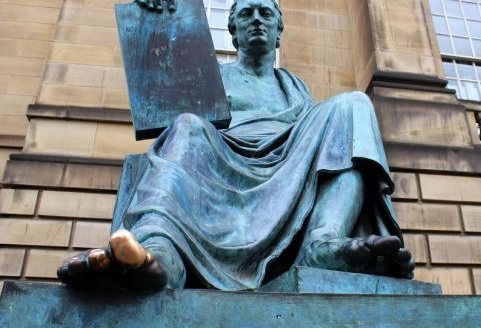
Act II, scene ii of David Hume in the Library of Babel

paradox

In my previous post, I surveyed the abstract axioms of Borges’ imaginary library. The next paragraph of the story (Para. 8) contains a paradox: the Universal Library contains all possible books, but the probability of finding any particular book is close to zero:

When it was announced that the Library contained all books, the first reaction was unbounded joy. All men felt themselves the possessors of an intact and secret treasure. There was no personal problem, no world problem, whose eloquent solution did not exist—somewhere in some hexagon. The universe was justified; the universe suddenly became congruent with the unlimited width and breadth of humankind’s hope. At that period there was much talk of The Vindications—books of apologiæ and prophecies that would vindicate for all time the actions of every person in the universe and that held wondrous arcana for men’s futures. Thousands of greedy individuals abandoned their sweet native hexagons and rushed downstairs, upstairs, spurred by the vain desire to find their Vindication. These pilgrims squabbled in the narrow corridors, muttered dark imprecations, strangled one another on the divine staircases, threw deceiving volumes down ventilation shafts, were themselves hurled to their deaths by men of distant regions. Others went insane. . . . The Vindications do exist (I have seen two of them, which refer to persons in the future, persons perhaps not imaginary), but those who went in quest of them failed to recall that the chance of a man’s finding his own Vindication, or some perfidious version of his own, can be calculated to be zero. [ellipsis and emphasis in the original]

On the one hand, the Universal Library must contain so-called books of “Vindication” — i.e. “books of apologiæ and prophecies that would vindicate for all time the actions of every person in the universe and that held wondrous arcana for men’s futures” — but at the same time, given the unimaginable astronomical scale of the library, the probability of finding any of these magical books is zero for all practical purposes.

In other words, even though individualized Vindication books must exist in theory — after all, Borges’ Universal Library is a “total” library, since it contains all possible books (past, present, and future) that could be written — in the absence of a catalog or index of all the books in the Library of Babel, the probability of any given person finding his own specific Vindication book during his own lifetime is virtually nil.

Moreover, this demoralizing paradox will give rise to several different factions and a wide range of responses. In short, the search for truth will be transformed into empty inquiries and formalistic rituals; hope and optimism will mutate into blasphemous pursuits and destructive pogroms. I will survey these responses in my next post. To be continued

Posted in Uncategorized | Leave a comment

The axioms of Borges’ Library of Babel

Act II, scene i of “David Hume in the Library of Babel”

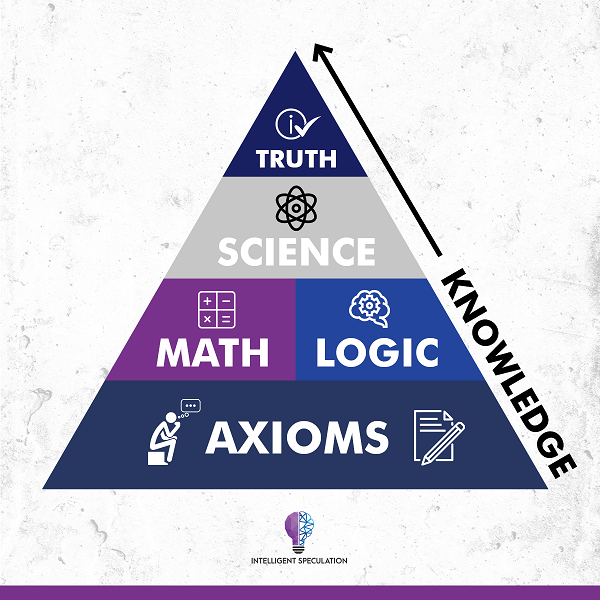
The Foundations of Logic — Critical Thinking | Intelligent Speculation

In my previous three posts (see here, here, and here), we revisited the first three paragraphs of Jorge Luis Borges’ The Library of Babel. Today, I will turn to the middle part of Borges’ story, or “Act II” of my retelling of this tale (paragraphs 4 to 11).

In summary, our Humean narrator begins Act II by describing the fundamental “axioms” or basic laws, so to speak, that govern the meta-logic of the Universal Library:

1st: “The Library has existed ab æternitate.” (Para. 4, emphasis in the original)

2nd: “There are twenty-five orthographic symbols.” (Para. 5, emphasis in the original)

3rd: “In all the Library, there are no two identical books.” (Para. 7, emphasis in the original)

From these premises, our unnamed narrator concludes that “the Library is ‘total’—perfect, complete, and whole—and that its bookshelves contain all possible combinations of the twenty-two orthographic symbols (a number which, though unimaginably vast, is not infinite)—that is, all that is able to be expressed, in every language.” (Para. 7, emphasis added, parenthetical in the original) But given that the books in the Universal Library consist of a random distribution of 25 symbols, how does one find meaning in any of these enigmatic texts? Stay tuned: I will proceed to Act II of “David Hume in the Library of Babel” in my next post …

Mathematics and Certainty - ppt download
Image credit: Mae Gregory, “Mathematics and Certainty
Posted in Uncategorized | 1 Comment

Sunday song: Summer of ’69

I will resume my series on “David Hume in the Library of Babel” tomorrow. In the meantime, below is one of my all-time favorite 80s hit songs as well as two bonus links:

Posted in Uncategorized | Leave a comment

The logic of Borges’ Universal Library

Act I, scene iii of “David Hume in the Library of Babel”

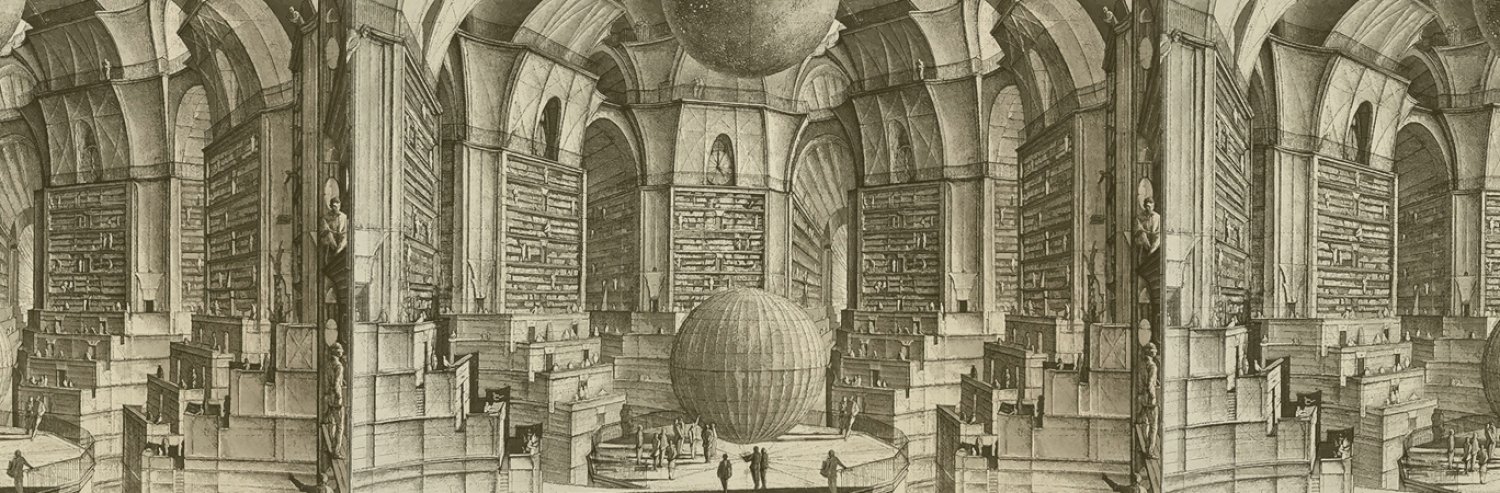
The Approach to J.L. Borges | THR Web Features | Web Features | The  Hedgehog Review

My previous two posts have revisited the first two paragraphs of Jorge Luis Borges’ The Library of Babel. Today, I will go over the third paragraph of the story, where the narrator, who in my retelling could be David Hume, describes the logic of the Universal Library:

Continue reading
Posted in Uncategorized | 2 Comments

Parallels between Borges’ narrator in The Library of Babel and David Hume

Act I, scene ii of “David Hume in the Library of Babel”

My previous post went over the first paragraph of Jorge Luis Borges’ The Library of Babel, which describes the setting of the story: an “infinite” library consisting of an indefinite number of interlocking hexagons. The second paragraph of the story introduces our narrator:

Continue reading
Posted in Uncategorized | 2 Comments

A bibliophile’s dream or nightmare?

Act I, scene i of “Hume in the Library of Babel”

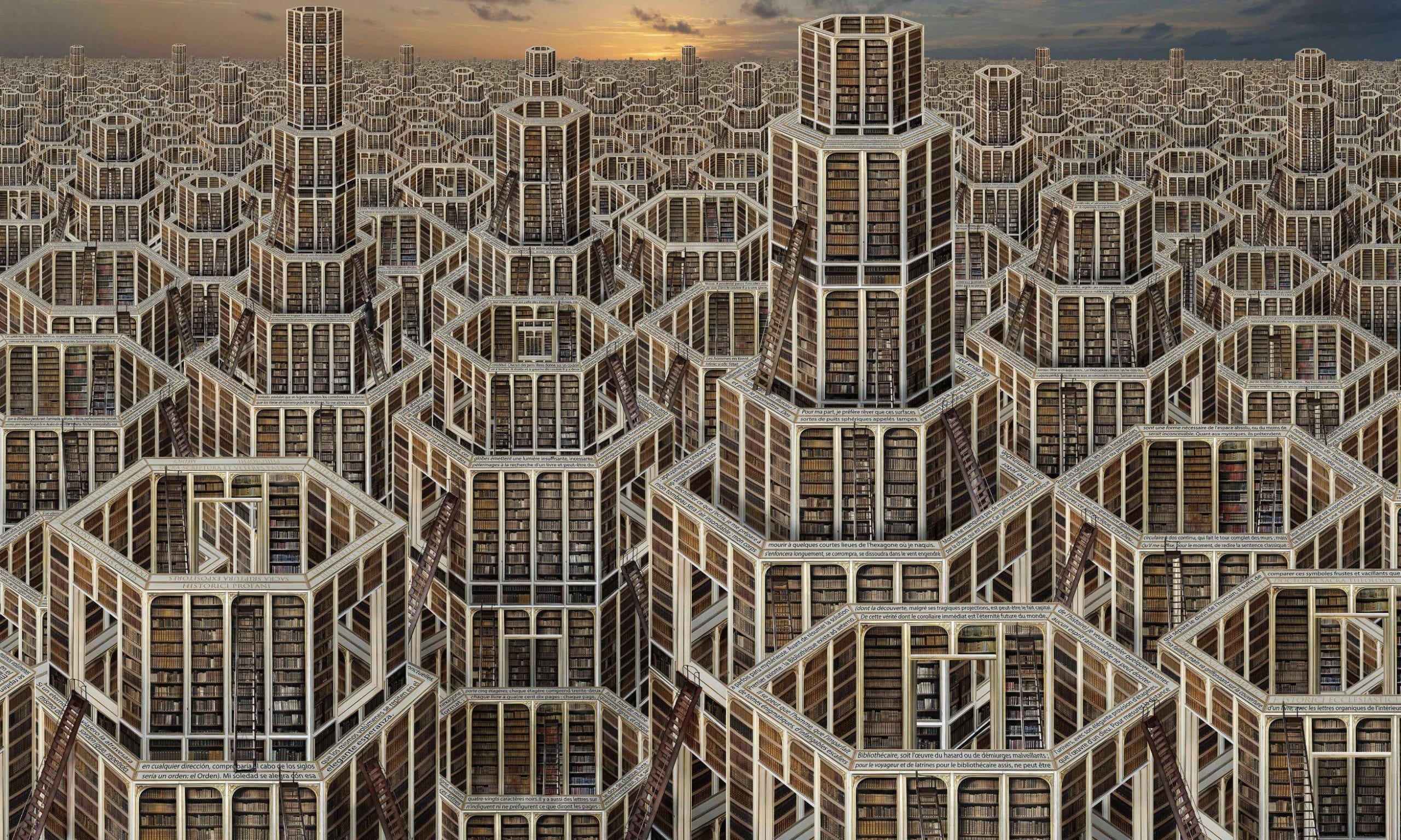
Browse the Hexes

In my previous post, I posed a crazy thought-experiment: What if David Hume were to find himself in Jorge Luis Borges’ imaginary “Library of Babel”? But what does this imaginary world look like? Here is the first paragraph of Borges’ short story The Library of Babel:

Continue reading
Posted in Uncategorized | 2 Comments

David Hume in Borges’ Library of Babel: prologue

I have been busy working on a new whimsical literary project this week and will be sharing the fruits of my intellectual labors here starting today. My prologue is below the fold:

Continue reading
Posted in Uncategorized | Leave a comment

Requiescat in pace

According to Linda Bordoni (via Vatican News), Pope Francis, the first Latin American pontiff, visited some 68 countries during his 12-year pontificate. Here is a link to his official testament, and here are his Reflections on Old Age.

Posted in Uncategorized | Leave a comment

Easter Monday Music

Posted in Uncategorized | Leave a comment

Happy Easter!

To commemorate this joyous rite, check out the oil painting Les Disciples by Swiss artist Eugène Burnand:

Is this not one of the greatest Easter paintings of all time? Via Mike Frost:

Continue reading
Posted in Uncategorized | Leave a comment