We are still reviewing Milton Friedman’s 1970 essay on business ethics. Previously, Friedman had argued that CSR initiatives operate as a kind of stealth tax on shareholders and that taxes should be imposed via ordinary political processes. To his credit, Friedman finally identifies (and then responds to) a potential objection to his “CSR as taxation” argument in paragraphs 20 to 23 of his essay. He formulates the objection to his argument this way: “[some] problems are too urgent to wait on the slow course of political processes [;] … the exercise of social responsibility by businessmen is a quicker and surer way to solve pressing current problems.” But instead of weighing the relative merits of politics versus markets, Friedman dogmatically asserts that the above consequentialist type of argument “must be rejected on grounds of principle.” Why? Because it is not the role of businessmen to promote the public good. After all, their role, according to Friedman, is to maximize their profits! This argument, however, is circular, for it begs the question, what should the “social responsibility” of business be? (As an aside, Friedman does make an exception for sole proprietors, since such individuals are acting on their own behalf when they are making business decisions.) Continue reading
Review of Friedman (part 9): ethics and epistemology
As we mentioned at the end of our previous post, we have now completed our review of the first half of Milton Friedman’s classic essay on business ethics. To sum up our review thus far, Professor Friedman is probably right to challenge CSR’s “analytical looseness and lack of rigor,” but at the same time, Friedman’s own arguments against CSR are either fallacious or pedantic. For those of us (especially my fellow libertarians) who support the “greed is good” school of business ethics, Friedman has dropped the proverbial ball. Can he recover from this intellectual fumble? Continue reading
Friedman and the art of sophistry (part 8)
We reviewed in our previous post the logic of Professor Friedman’s “principal-agent argument” in his classic critique of CSR (corporate social responsibility). To sum up, although the structure of his principal-agent argument appears to be sound (corporate managers must act as faithful agents), Friedman commits an egregious fallacy: he presents a false choice between corporate interests and social interests. In plain English: yes, these interests can collide, but sometimes the most effective way to maximize profits is by acting in a socially responsible way! Continue reading
Milton Friedman’s fallacy (part 7)
We shall now proceed with our review of Milton Friedman’s 1970 essay on business ethics. Professor Friedman returns to his principal-agent argument in paragraphs 7 to 10 of his essay, where he draws a fundamental distinction between (a) the social responsibilities of a private individual, i.e. a person acting on his own behalf, and (b) the social responsibilities of a businessman, i.e. a person acting on behalf of the corporation where he is employed. The logic of Friedman’s principal-agent argument can be summed up follows: When a person is acting on his own behalf, he may voluntarily assume many social responsibilities toward a wide variety of private and public groups or causes, such as his family, his church, his clubs, his city, his country, just to name a few. In all these cases, when deciding what causes to support or what organizations to join, an individual is acting on his own behalf as a principal, not as an agent of someone else. A businessman, however, will find himself in a different legal position. When a businessman is making decisions in his capacity as a businessman, he is acting as an agent of the corporation where he is employed. A businessman must therefore act in the best interests of his corporation. Continue reading
Review of Friedman (part 6): theory choice
We now proceed to paragraph six of Milton Friedman’s 1970 essay on business ethics. Whatever theory of business ethics you subscribe to (profit-maximization or stakeholder theory), this short paragraph is perhaps the most important one of the entire essay, so it deserves to be quoted in full:
Needless to say, this [the principal-agent nature of the relationship between shareholders and managers] does not mean that it is easy to judge how well he [a corporate manager] is performing his task [i.e. maximizing profits]. But at least the [profit-max] criterion of performance is straight-forward, and the persons among whom a voluntary contractual arrangement exists are clearly defined.
In other words, to be useful, a theory of business ethics should satisfy the following two criteria: (1) the scope of the theory should be well-defined, i.e. we should be able to tell to whom does the theory apply; and (2) compliance with the theory should be easy to measure, i.e. we should be able to tell when a corporate manager is acting in a way that is consistent or not with the theory. Continue reading
Review of Friedman (part 5): interlude
Thus far, we have reviewed in great detail the first five paragraphs of Professor Friedman’s classic essay on business ethics. In the court of popular opinion, these first few paragraphs constitute Friedman’s “opening statement” about the proper role of business in society. Now, before we proceed any further, we want to pause to make some additional observations about Friedman’s opening statement. One of our observations is somewhat trivial. The other, however, is more weighty. Continue reading
Review of Friedman (part 4): corporate managers vs. sole proprietors
[Update (10/22): We have revised the second paragraph of this post.]
Thus far, we have revisited the first two paragraphs of Professor Friedman’s scathing critique of corporate social responsibility or CSR. (To sum up: we dismissed the opening paragraph as pure hyperbole, but at the same time, we concluded that the criticisms set forth in the second paragraph must be reckoned with.) Prof Friedman concludes the second paragraph by asking, to whom does CSR apply? Do all business firms and businessmen have a moral duty to act in a socially responsible way? Having now set the stage, so to speak, Milton Friedman devotes the remainder of his essay to this key question. In particular, he defines the scope of his inquiry in the third paragraph of his classic essay as follows: “Most of the discussion of [CSR] is directed at corporations, so … I shall mostly neglect the individual proprietor and speak of corporate executives.” Continue reading
Friedman’s critique of CSR (part 3)
Now that we have brushed off the outlandish first paragraph of Professor Friedman’s classic essay on business ethics (see our previous post), let’s turn to the second paragraph. Unlike the ad hominem nature of the first paragraph, this second paragraph does contain some strong opening salvos against corporate social responsibility or CSR. Continue reading
Friedman on business ethics (part 2)
Now that we have introduced Milton Friedman’s classic essay on business ethics (see our previous post), let’s jump right in, shall we? Professor Friedman’s first paragraph is by far his weakest one, for it contains some outlandish and sensational claims. In particular, he begins his 1970 essay by claiming that proponents of corporate citizenship or corporate social responsibility (CSR) are “preaching pure and unadulterated socialism” and that such CSR proponents are “unwitting puppets of intellectual forces that have been undermining the basis of a free society these past decades.”
Such claims, however, are irresponsible, if not just plain wrong! After all, a socialist system is one in which business firms are strictly regulated or owned by the government outright, and as I noted in my previous work, the concept of a “free society” is a fuzzy one, since all societies have rules, and since such rules by definition impose limits on our freedom to do as we please. Nevertheless, in fairness to Friedman, we should put his essay into its proper historical context. At the time he published his essay in 1970 (almost fifty years ago!), the world was divided into two great ideological camps – the free world (led by the USA) and the socialist bloc (led by the USSR) – and both sides were engaged in a fierce and worldwide struggle of heroic proportions. The idea of free markets was under siege and in retreat across the globe. In fact, within a year after publishing his essay, President Richard Nixon, a Republican (!), would issue a draconian executive order (Number 11615) on 13 August 1971, imposing a 90-day freeze on wages and prices, the first time the U.S. government had enacted wage and price controls since World War II!
Given this historical context, it’s possible that Milton Friedman made his melodramatic claims about CSR simply to grab the attention of his readers. That said, however, Friedman did himself no favors by equating CSR with socialism and as incompatible with freedom. As a result, we are going to overlook this first paragraph and focus instead on the remainder of his essay in our next few blog posts …

Review of Milton Friedman (part 1)
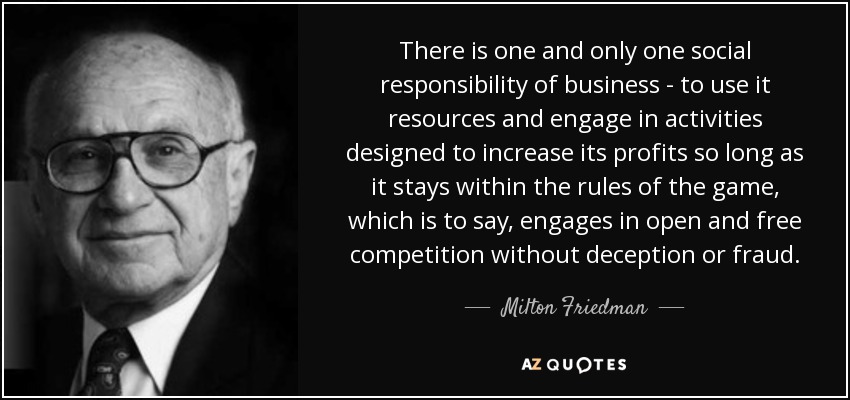
Milton Friedman (1912-2006) made one of the most provocative arguments on the role of business firms in society almost 50 years ago. In a now-famous essay published on 13 September 1970 in The New York Times Magazine, Professor Friedman (pictured below) argued that a firm’s sole purpose is to maximize its profits. His short (3000-word) essay expands on a brief digression he made in his 1962 book Capitalism and Freedom (Friedman, 1962, pp. 133-136), where the late economist wrote: “There is one and only one social responsibility of business: to use its resources and engage in activities designed to increase its profits so long as it stays within the rules of the game, which is to say, engages in open and free competition without deception or fraud.”
Is Professor Friedman’s “Smithian” view of business ethics correct? In light of such recent events as the introduction by Senator Elizabeth Warren of “The Accountable Capitalism Act” (S. 3348) as well as the recent amendment (SB826) to California’s General Corporation Law requiring women to be included on companies’ boards of directors, today is an ideal moment to revisit Friedman’s classic essay and explore anew the strengths and weaknesses of his arguments. Although I have been highly critical of Professor Friedman’s normative and empirical assertions in Capitalism and Freedom in some of my previous work, I will review Friedman’s 1970 essay and defend his profit-maximization theory of business ethics in my upcoming posts.