
Reddit has an entire thread devoted to “desire paths,” like the one pictured below. (hat tip: @pickover)

Credit: u/Phoenixed
Reddit has an entire thread devoted to “desire paths,” like the one pictured below. (hat tip: @pickover)
Credit: u/Phoenixed
What if national borders were redrawn along latitude and longitude lines?

Source: u/Luciantang, via Reddit
A large group of my law professor colleagues (now over 2,400 of them!!!) have signed an “Open Letter” addressed to the U.S. Senate stating their opposition to Judge Brett Kavanaugh (BK). The crux of their sanctimonious argument is that BK lacks the judicial temperament to sit on the U.S. Supreme Court:
… [BK] exhibited a lack of commitment to judicious inquiry. Instead of being open to the necessary search for accuracy, [BK] was repeatedly aggressive with questioners. Even in his prepared remarks, [BK] located the hearing as a partisan question, referring to it as “a calculated and orchestrated political hit,” rather than acknowledging the need for the Senate, faced with new information, to try to understand what had transpired. Instead of trying to sort out with reason and care the allegations that were raised, [BK] responded in an intemperate, inflammatory, and partial manner, as he interrupted and, at times, was discourteous to questioners.
Is this letter right? Does BK lack judicial temperament? This law professor letter is misguided on multiple levels. Specifically, in addition to the counter-arguments made here, I dissent from this letter for the following three reasons:

Or: Why are Article III judges above the law? According to Stacy N. Cammarano (via the Washington Post): “Title VII of the Civil Rights Act of 1964 prohibits workplace discrimination on the basis of sex, but it does not apply to the 30,000 employees who work for the federal court system. Though Congress, which originally exempted itself from the law, passed legislation in 1995 that covers congressional employees, it has not done so for the judiciary.”

Disclaimer: does not apply to federal judges
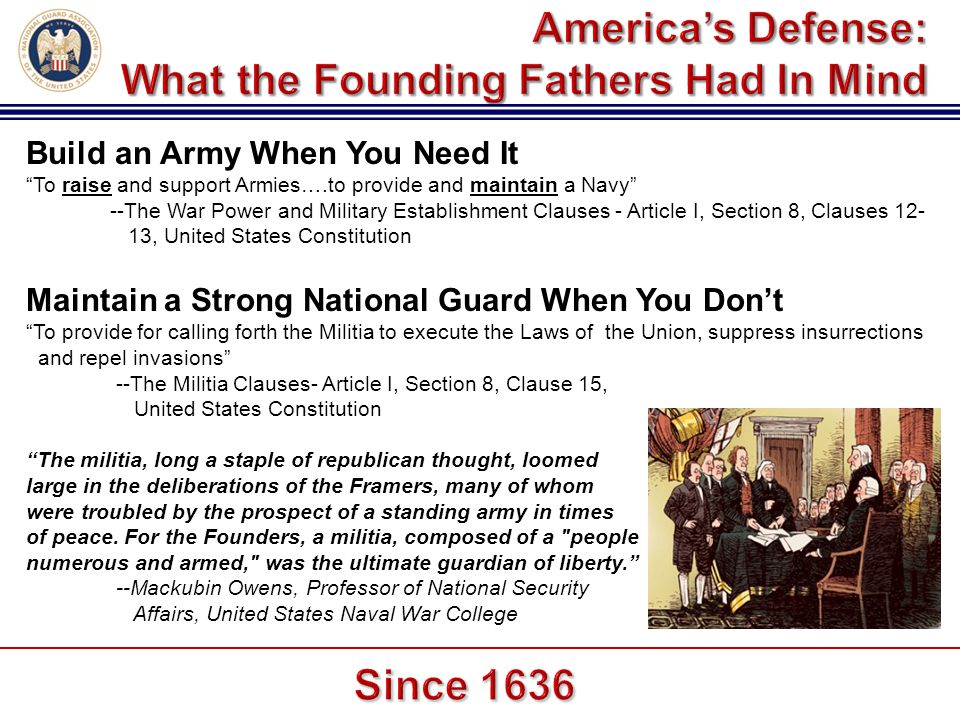
In our previous post, we summarized the main constitutional arguments challenging the legality of Executive Order 10730, the historic decree by which President Dwight D. Eisenhower sent the 101st Airborne Division into Little Rock, Arkansas to restore order in the fall of 1957. To evaluate the merits of these various arguments, we must now ask a different question. We must ask, how much military power can the Congress delegate to the president? It turns out that Congress has the authority to delegate to the president the power to call out State militias under Article I of the Constitution. Specifically, the first of two Militia Clauses (Article I, Section 8, Clause 15) in the Constitution allocates to Congress the power “to provide for calling forth the Militia to execute the Laws of the Union, suppress Insurrections, and repel Invasions….”
The first Militia Clause, however, poses a big problem if you favor an “originalist” or “textualist” interpretation of the Constitution, for this clause contains no reference to regular federal troops or the U.S. armed forces! Thus, an originalist or textualist argument can be made that Congress may have exceeded its constitutional authority when it enacted the Insurrection Act of 1807, the Suppression of Rebellion Act of 1861, and the Ku Klux Klan Act of 1871, all of which authorized the president to use regular troops to combat internal insurrections and obstructions of federal law. By contrast, if you favor a “Living Constitution” approach, this omission is no big deal, since the Constitution also allocates to Congress the power “to raise and support armies,” and since the U.S. armed forces have over time grown stronger relative to the State militias. So, which interpretation is the right one? Alas, can there be a “right answer” to this second-order question?
Credit: Tristian Darrington
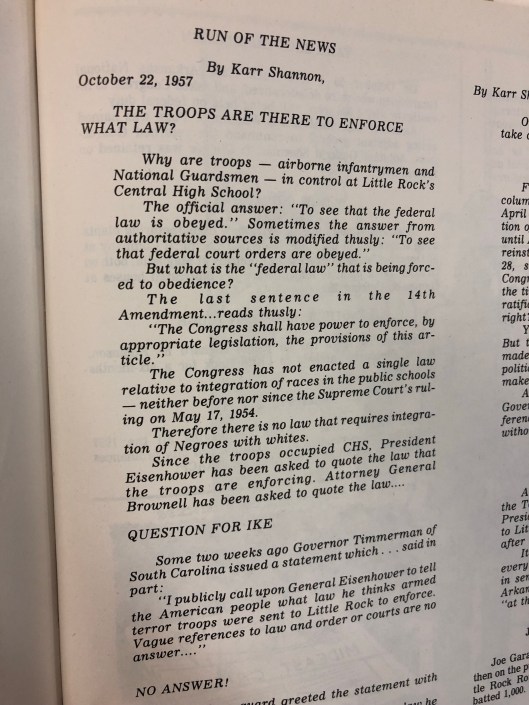
We now return to our analysis of President Eisenhower’s fateful decision to use military force to desegregate Central High School in Little Rock, Arkansas in the fall of 1957. One of the best constitutional arguments against the legality of Executive Order 10730 (and thus against Eisenhower’s use of force in Little Rock) is to focus on the meaning of the word “law.” Although Eisenhower ostensibly sent troops into Little Rock to enforce a federal court order, and although that court order was based on the Supreme Court’s reinterpretation of the 14th Amendment in Brown v. Board I and Brown II, the actual text of the 14th Amendment grants to Congress (not to the federal courts) the power to enact legislation to enforce the provisions of that amendment.
Likewise, one could also argue that the term “law” encompasses only formal enactments of Congress and not the Supreme Court’s interpretation of the Constitution, since all three branches of the federal government have the ability (and perhaps the duty) to interpret the Constitution as they see fit. Nevertheless, even if these arguments are persuasive in a technical or legalistic sense, from a practical perspective neither Congress nor the federal courts have “the power of the sword,” to borrow Alexander Hamilton’s apt phrase in Federalist Paper 78.
So, if the president’s military decisions are for all practical purposes unreviewable by the courts, we must turn our attention to Congress, and as we have noted in one of our previous posts, Congress has delegated limited authority to the president to use military force in the United States. But are those laws themselves constitutional? We shall consider this question in our next post.
Source: Faubus (1980), p. 339
We love used bookstores. During our visit to Little Rock, Arkansas this week we patronized “The Bookstore at Library Square.” One of the books we purchased there was published in 1989 and contained the following notice (pictured below) on a loose sheet of paper inside the book: “Your only obligation … is that you agree within a 30-day period to read it and decide whether you want to keep it or not. If you decide to keep the book, you will remit $6.00 to “Books,” 1960 Union National Bank Building, Little Rock, Arkansans 72201. If you elect not to keep the book, then you should pass [it] around in your community as a sharing gift.” Bonus question: is this a valid unilateral contract?

We interrupt our series of posts on the Little Rock Crisis of 1957 to share this fascinating thought-experiment. (Hat tip: kottke.)
Like the Duncan case in our previous post, the case of Jackson v. Kuhn presented a direct challenge to the legality of President Dwight D. Eisenhower’s fateful decision to send the “Screaming Eagles” of the 101st Airborne Division into Little Rock. But unlike the Duncan or Thomason cases, which were State court cases, Jackson v. Kuhn was commenced in federal court.
The plaintiff in this case was Mrs. Margaret Jackson, who was a vocal member of the Mothers’ League of Central High School. The attorney for Mrs. Jackson’s was Kenneth Coffelt. (Mr Coffelt would run for Governor of Arkansas in 1962, but he garnered only 2% of the popular vote in the primary.) Mr. Coffelt brought this case in the Federal District Court for Eastern Arkansas on 2 October 1957, naming as defendants Colonel William Kuhn, the Commanding Officer of the 101st Airborne Division in Little Rock, and Major General Edwin A. Walker, Commanding Officer of the Arkansas Military District of the U.S. Army.
In her federal complaint dated 2 October 1958, Mrs. Jackson petitions the court for a declaratory judgment, one declaring unconstitutional Sections 332, 333, and 334 of Title 10 of the U.S. Code, the statutes that President Eisenhower invoked when he authorized the use of military force in Little Rock. When the district court dismissed the case, she appealed to the U.S. Court of Appeals for the Eighth Circuit. The Circuit Court, however, affirmed the district court’s dismissal, holding that it lacked jurisdiction to decide the case. (At that time, a federal question case–i.e. a case brought under 28 U.S.C. Section 1331–had to meet an amount-in-controversy requirement of $3,000.00.) As an aside, this case was decided on the very same day as Thomason v. Cooper, and the opinions in both cases were written by the same federal judge, John B. Sanborn, Jr.
But what if the court had decided to decide this case on the merits? Could a case be made that President Eisenhower had exceeded his constitutional authority to use military force? This is not an idle question, as the tweet below shows, and we will consider it in our next post.
Duncan v. Kirby was a state court case decided in March of 1958 arising out of the 1957 Little Rock Crisis. The moving party in this case, one Vernon Duncan, a pro-segregation protestor, was arrested in front of Central High School on 3 October 1957 for “Disturbing the Peace” and for “Refusing to Obey a Lawful Order of an Officer of the U.S. Army.” Although the Little Rock Municipal Court acquitted Mr. Duncan of the disturbing the peace charge, it convicted him of the refusing to obey charge. Mr Duncan then appealed his conviction to a State Circuit Court, arguing that his conviction should be dismissed because President Eisenhower had exceeded his legal authority to send U.S. troops into Little Rock in the first place. After the Circuit Court denied his appeal, Mr Duncan took his case up to the Arkansas Supreme Court, seeking a petition for a writ of prohibition to prevent the Circuit Court from punishing him on the refusing to obey charge. The Arkansas Supreme Court ruled 4 to 3 in favor of Mr Duncan (the dissenting justices would have denied Mr Duncan’s petition out of hand), but the majority did not pass judgment on the legality of President Eisenhower’s use of military force in Little Rock. Instead, the majority of the justices decided this case on more narrow grounds: that at the time of Mr Duncan’s arrest it was not a crime in Arkansas to refuse to obey a federal military order.
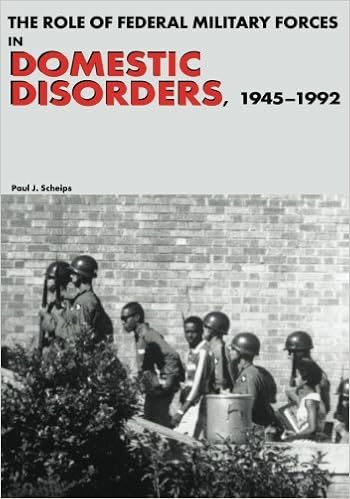
Although Duncan v. Kirby avoided the fundamental constitutional question regarding the legality of President Eisenhower’s military action in Little Rock, this obscure case is still worth mentioning, for it symbolizes the overall deferential and lenient treatment that pro-segregation protestors received during the troubles in Little Rock in the fall of 1957. According to one historian of the Little Rock Crisis (Scheips, 2012, pp. 62-63), by the end of October of 1957 “some fifty-six persons had been arrested on various State law charges connected with disorders at the school, but the local police court had deferred the cases,” and of these 56 protestors, only seven received a fine, and six of the seven had their fines suspended. Moreover, not a single federal prosecution was brought against any of the protestors! In any case (pun intended), Duncan v. Kirby was not the only case to challenge the legality of President Eisenhower’s use of force in Little Rock. We will review our third Little Rock case, Jackson v. Kuhn, in our next post. (Source cited (pictured below): Paul J. Scheips, The role of federal military forces in domestic disorders, 1945-1992, Center of Military History, U.S. Army, 2012.)







Welcome to the online home of the IASS
Hopefully It’s Interesting.
In Conversation with Legal and Moral Philosophers
Relitigating Our Favorite Disputes
PhD, Jagiellonian University
Inquiry and opinion
Life is all about being curious, asking questions, and discovering your passion. And it can be fun!
Books, papers, and other jurisprudential things
Ramblings of a retiree in France
BY GRACE THROUGH FAITH
Natalia's space
hoping we know we're living the dream
Lover of math. Bad at drawing.
We hike, bike, and discover Central Florida and beyond
Making it big in business after age 40
Reasoning about reasoning, mathematically.
I don't mean to sound critical, but I am; so that's how it comes across
remember the good old days...
"Let me live, love and say it well in good sentences." - Sylvia Plath
a personal view of the theory of computation
Submitted For Your Perusal is a weblog wherein Matt Thomas shares and writes about things he thinks are interesting.
Logic at Columbia University
Just like the Thesis Whisperer - but with more money
the sky is no longer the limit
Technology, Culture, and Ethics
Just like the horse whisperer - but with more pages
Poetry, Other Words, and Cats

 prior probability