
After all, the perpetual conflict between India and Pakistan over the greater Kashmir area goes back to 1947. Also, check out this report, dated 8 July 2012, published in The Economist: Continue reading
Creative Commons
Blogs I Follow





After all, the perpetual conflict between India and Pakistan over the greater Kashmir area goes back to 1947. Also, check out this report, dated 8 July 2012, published in The Economist: Continue reading
Did you know that the great North American activist, author, and scholar W. E. B. Du Bois was also a pioneer in the field of data visualization? Whitney Battle-Baptiste and Britt Rusert have collected Du Bois’s beautiful data portraits, including the one pictured below, in their new book W.E.B. Du Bois’s Data Portraits: Visualizing Black America. (Hat tip: kottke.)

Bayesian Update (6 June 2019): I have changed the title of this blog post to reflect a more likely explanation for the pattern of price changes pictured below. For more information about William Baumol and the so-called “Baumol effect”, see here.

Economics professor Mark Perry (@Mark_J_Perry) recently posted an updated chart (pictured above) of price changes of certain consumer goods and services in the U.S. In summary, his chart shows falling prices for free-market goods like TV sets and toys as well as rising prices for such publicly-subsidized services as health care and higher education.
In case you are visiting from another planet, “Make America Great Again” (#MAGA) was one of Donald J. Trump’s slogans during the 2016 presidential campaign, while “Black Lives Matter” (#BLM) refers to a grassroots movement in support of people of color. Yet for some strange reason, many heavy-handed judges and school administrators want to ban these expressive articles of clothing from their courthouses and schools. Geesh! Whatever happened to the live-and-let-live rule?
As we approach the end of the month, here’s a partial list of what we’re reading these days:
Two notes: I stumbled upon these sundry scholarly papers via my Twitter feed. (Your Twitter feed is only as good as the persons you follow!) Also, all of these fascinating research papers may be downloaded free of charge via the Social Science Research Network (SSRN), though SSRN now makes you log into their platform in order to access their database of free papers.


How much time do you spend responding to emails? Is this “email time tax” worth it? (Or does email bring you joy?) We recently stumbled upon this critique of email by Cal Newport, a computer science professor at Georgetown University. Below the fold is an excerpt from his excellent essay in which email is aptly described as a form of digital water torture: Continue reading
Their forceful ideas inspired countless crimes against humanity and massive amounts of human suffering (here is a partial list): Karl Marx and Friedrich Engels published “The Communist Manifesto” in London on this day in 1848. File under: Garbage In, Garbage Out.

If you could take only one road trip in your life (assume a fixed budget of $2000 USD or 2000 euros for either trip), which one would you prefer: (a) Seattle to Boston or (b) Lisbon to Moscow?

Hat tip: u/ttoxicite
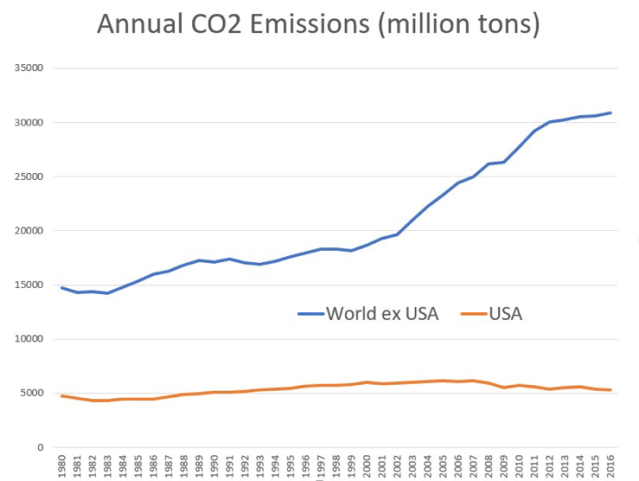
As my friend and colleague Alex Tabarrok (@ATabarrok), an economics professor at George Mason University, recently pointed out (see chart below), CO2 emissions in the USA are actually falling, but alas they are rising in the rest of the world, especially in fast-growing countries like China and India. Professor Tabarrok thus proposes a novel (?) Coasean solution to climate change: instead of Pigovian carbon taxes, what if rich countries (and rich men like Bill Gates, I would add) were to buy out or lease the legal rights to coal fields in China and India and then shut those fields down or convert them into parks? Here is an excerpt from Tabarrok’s ingenious proposal:
Coal use in China is very high and increasing. India has been canceling coal plants as solar becomes cheaper but coal is still by far the largest source of power in India. Thus, there is plenty of opportunity to buy out, high-cost coal mines in China and India. It might seem odd to buy Chinese and Indian coal mines but we buy Chinese and Indian labor, why not a coal mine? Moreover, it’s important to understand that the policy is to buy only up to the point that it benefits both parties. Buying coal isn’t foreign aid, it’s a pollution reduction plan just like a carbon tax or R&D investment and because we can buy barely-profitable coal mines and avoid the problem of leakage this is a low-cost method to reduce CO2 emissions.


Welcome to the online home of the IASS
Hopefully It’s Interesting.
In Conversation with Legal and Moral Philosophers
dr hab. prof. UJ, Jagiellonian University
Books, papers, and other jurisprudential things
Ramblings of a retiree in France
BY GRACE THROUGH FAITH
Natalia's space
hoping we know we're living the dream
Lover of math. Bad at drawing.
We hike, bike, and discover Central Florida and beyond
Making it big in business after age 40
Reasoning about reasoning, mathematically.
I don't mean to sound critical, but I am; so that's how it comes across
remember the good old days...
"Let me live, love and say it well in good sentences." - Sylvia Plath
a personal view of the theory of computation
Logic at Columbia University
Just like the Thesis Whisperer - but with more money
the sky is no longer the limit
Technology, Culture, and Ethics
Just like the horse whisperer - but with more pages
Poetry, Other Words, and Cats


