Aretha forever

Posted in Uncategorized | Leave a comment

Summer readings (part two)

Here is what we are reading–or will be reading soon–as our blissful summer break comes to a close:

  1. On truth” by English philosopher Simon Blackburn. Truth is one of our most essential ordering principles, but how should we define such a concept? (In the future, we also hope to explore the relation between truth and beauty.)
  2. The age of questions” by historian Holly Case. The subtitle of this book is “Or, a first attempt at an aggregate history of the Eastern, social, woman, American, Jewish, Polish, bullion, tuberculosis, and many other questions over the 19th Century and beyond.” Suffice it to say we are going to read this book on the strength of Tyler Cowen’s glowing recommendation.
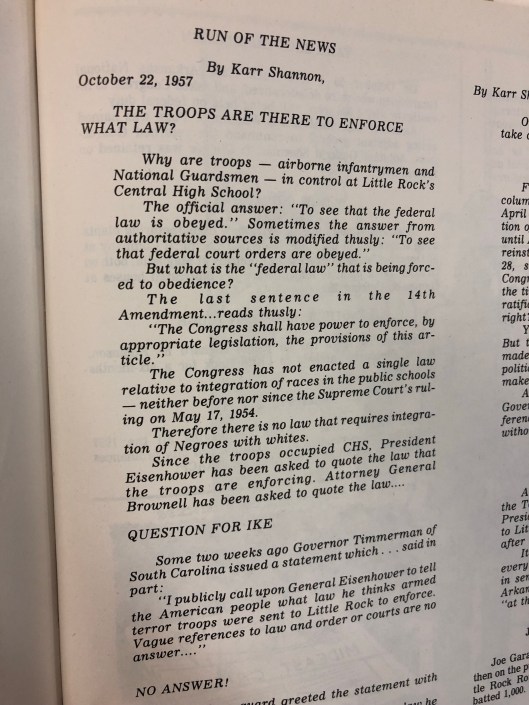
  3. A matter of justice: Eisenhower and the beginning of the civil rights revolution” by historian David A. Nichols. We are currently researching President Eisenhower’s pivotal decision (memorialized in Executive Order 10730) to send the U.S. Army into Little Rock in the fall of 1957 to enforce a federal court desegregation order, so Dr Nichols’s tome is a must-read for us.

Image result for holly casethe age of questions Image result for blackburn on truth

(The books by Holly Case and Simon Blackburn–both of which are pictured above–were published last month (July 2018), while David Nichols’s book was published in 2007. Also, we posted part one of our summer readings in this previous post.)

Posted in Uncategorized | Leave a comment

A modest proposal (Oxford comma edition)

Maybe the bride and groom should consider drafting a “grammar prenup” to address this question! (Bonus question: could the Coase Theorem apply here?)

Screen Shot 2018-08-16 at 10.53.46 AM

Hat tip to my former student: Andrew C. Sherwood (@Senator_Andy)

Posted in Uncategorized | 2 Comments

Fact or Fiction? (Rocky Mountain Hyperloop Edition)

https://i.redd.it/ebn9j18dbxf11.png

Hat tip: u/___Saudade___ (via reddit)

Posted in Uncategorized | 1 Comment

Syllabi hall of fame

As we begin the new academic year, it’s time for us to revisit the syllabus for our survey course in law and ethics. With this task in mind, we wish to link to this pithy tweet by Jeanne Dyche, reminding us that syllabi are texts too! In addition, we have assembled our previous posts featuring the following fun and innovative syllabi below:

  1. Kieran Healy: “Social Theory through Complaining.”
  2. Chia-Hua Li: “Genetic Engineering and Future Society.”
  3. Carl T. Bergstrom and Jevin West: “Calling Bullshit in the Age of Big Data.”

Lastly (for now), something new: Professor Elizabeth Sherowski explains the evolution of her Legal Analysis and Writing syllabus.

Image result for read the syllabus
Posted in Uncategorized | Leave a comment

Necessity

What is “the law of necessity”? In particular, is necessity an excuse or a justification? This post assembles our previous musings on this subject:

  1. Intro: Three theories of necessity.
  2. Part 1: Necessity as an ex post exception.
  3. Part 2: Necessity as a source of law.
  4. Part 3: Necessity: a third view.
  5. Conclusion: Necessity as a conjecture.

In brief, we can view necessity narrowly as an ex post exception to violations of law, or we can view necessity broadly as an ex ante independent source of law. In the alternative, we can take an intermediary position and view necessity as a legal gap filler, i.e. a concept that applies only when our sources of positive law (the law on the books) are silent, conflicting, or otherwise vague and ambiguous. The larger and more difficult question is this: how do we go about testing the truth value of a legal theory?

Image result for the law of necessity

Say what?

Posted in Uncategorized | Leave a comment

Lingua franca (circa 2013)

Source: Wikipedia (hat tip: @pickover)

Posted in Uncategorized | 6 Comments

Outer space cake

Source: reddit (hat tip: @pickover)

Posted in Uncategorized | Leave a comment

Notes on Pascal’s Wager

We have long been fascinated by a philosophical problem referred to as “Pascal’s Wager” (see payoff table below). By way of example, we blogged about this problem previously here. Today, as a public service to our fellow devotees of this problem, we have assembled the following set of insightful and original blog posts on Pascal’s famous wager:

1. “The problem at the heart of Pascal’s wager” by our friend and colleague Paul Gowder, via Overcoming Bias. Gowder draws a distinction between belief and action. Here is an excerpt: “This is a problem that’s very difficult, and I don’t purport to offer a solution. But we should think of it as a serious line of objection to the Pascal’s wager type of argument: if consequences are simply inadmissible in belief-formation processes, Pascal’s argument fails on the spot.”

2. “Where does Pascal’s wager fail?” by a person (or bot?) using the pseudonym “Utilitarian“, also via Overcoming Bias. The author of this post, whoever they are, concludes that Pascal’s wager is too computationally difficult to solve: “With vast amounts of data to process and an enormous space of possible religious hypotheses to search, Pascal’s wager (which is just an optimization problem) is computationally infeasible, especially for human minds.”

3. “Pascal’s mugging: tiny probabilities of vast utilities” by Eliezer Yudkowsky (@ESYudkowsky), via Less Wrong. Yudkowsky reformulates the wager as a threat problem: “Now suppose someone comes to [you] and says, ‘Give me five dollars, or I’ll use my magic powers from outside the Matrix to run a Turing machine that simulates and kills 3^^^^3 people.'” So, should you pay the five dollars?

Source: William Lane Craig

Posted in Uncategorized | 5 Comments

Notes on Erie v. Tompkins

Erie Railroad Co. v. Tompkins, decided in 1938, is required reading in every U.S. law school. In Erie, the U.S. Supreme Court concluded that the federal courts do not have the judicial power to create “general federal common law” when adjudicating State law claims. (See historical marker pictured below.) Over the summer, 80 years after Erie was decided, we stumbled upon three scholarly papers (•) exploring different aspects of this landmark case:

  1. Finding Law” by Stephen A. Sachs. Professor Sachs carefully questions two fundamental assumptions the Supreme Court relied on when it decided Erie, one regarding the ultimate source of law; the other regarding judges’ ability to find law when they decide close cases. (Note: we wrote up a three-part review of Sachs’s paper on this blog on 13-15 July.)
  2. Benjamin Cardozo and the Death of the Common Law” by John C. P. Goldberg. Among other things, Professor Goldberg revisits Justice Cardozo’s pivotal role in the early stages of the Erie case (before the Supreme Court agreed to hear the case) and explores some of the unintended consequences of the Erie decision. (Hat tip: Anthony Gaughan, via The Faculty Lounge.)
  3. The Ballad of Harry James Tompkins” by our friend and colleague Brian Frye. Professor Frye’s beautiful paper contains actual trial testimony as well as several photographs of the scene of the accident that were introduced into evidence at the trial. On the basis of this evidence, he not only questions the standard account of the facts in Erie; he also makes a compelling case that we’ve gotten the facts of Erie all wrong. According to Frye, the plaintiff in this case almost certainly was not walking innocently along a footpath when he was injured by an oncoming train. Instead, he was most likely attempting to jump onto the train as a trespasser. (Double hat tip: Anthony Gaughan, again via TFL.)
  • All three drafts were posted on SSRN (Social Science Research Network) earlier this year: Sachs’s in March; Goldberg’s in May; Frye’s in July.
  • Related image

    Source: Frye (2018), p. 32.

    Posted in Uncategorized | 1 Comment