Geographical distribution of Spanish-speaking populations

Hat tip: u/AddictedPlanet, via Reddit

Posted in Uncategorized | Leave a comment

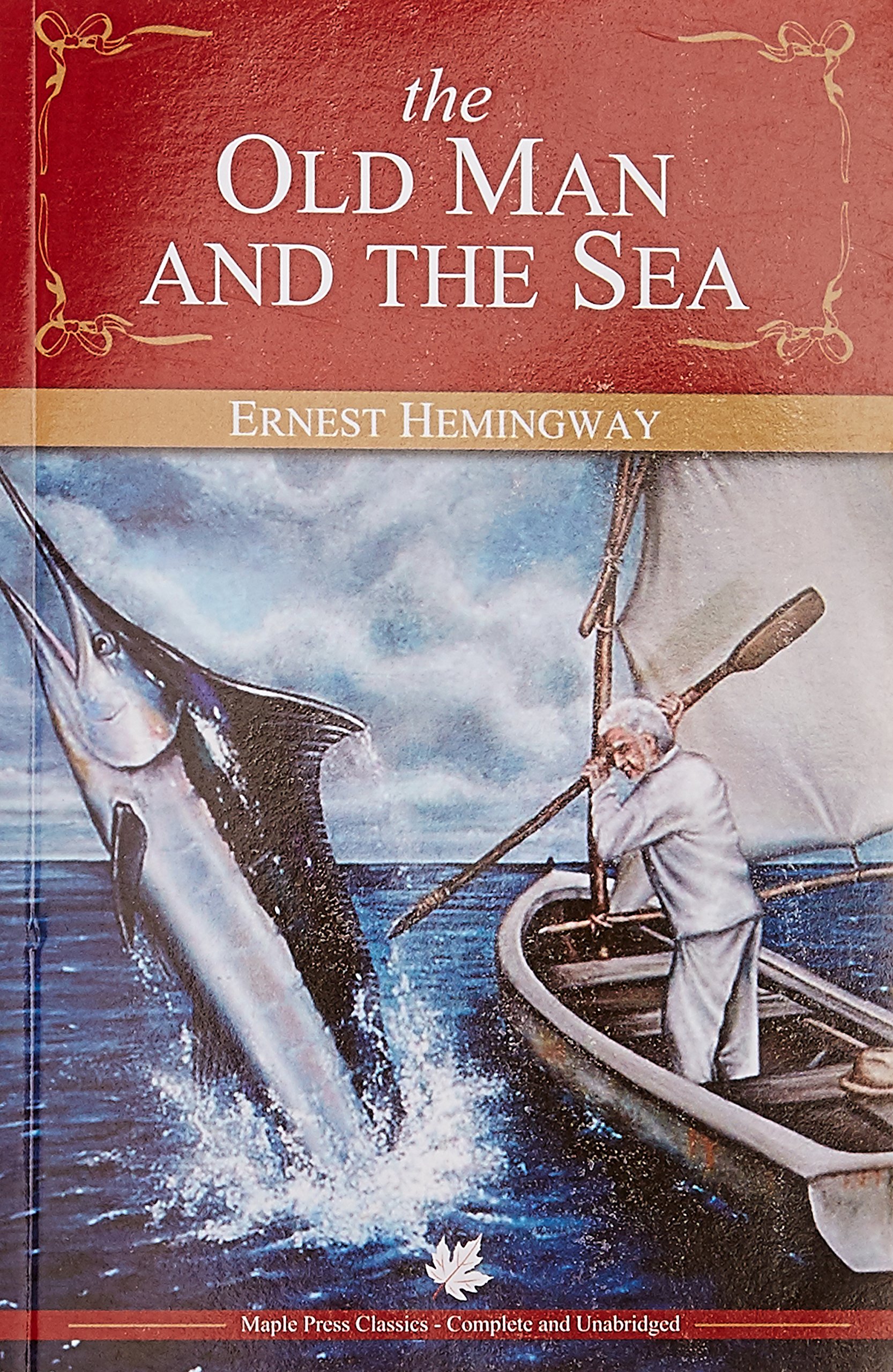
The old man and the Bayesian sea

That is the title of our most recent work in progress, available here via SSRN, and here is the abstract: “The Old Man and the Sea is a timeless classic. One of Ernest Hemingway’s most famous works, it tells the story of Santiago–a poor, proud, and aging Cuban fisherman–and his epic solitary battle with a giant marlin in the Gulf Stream. In a previous paper, we showed that the character of Santiago in Ernest Hemingway’s masterpiece was most likely a composite of three different Cuban fishermen. Here, we shall enter the littoral world of the story itself and explore the logic of Santiago’s ‘decision calculus’–i.e. his fateful decision to set sail after going 84 days without catching a single fish–through the lens of subjective probability. For in addition to its aesthetic, literary, and moral qualities, Hemingway’s beautiful novella may also offer a hidden tribute to subjective or Bayesian probability.”

Image result for old man and the sea
Posted in Uncategorized | 1 Comment

Happy Lighthouse Day!

Today should be a holiday in all our coastal States! Click on the image for more details.

Posted in Uncategorized | Leave a comment

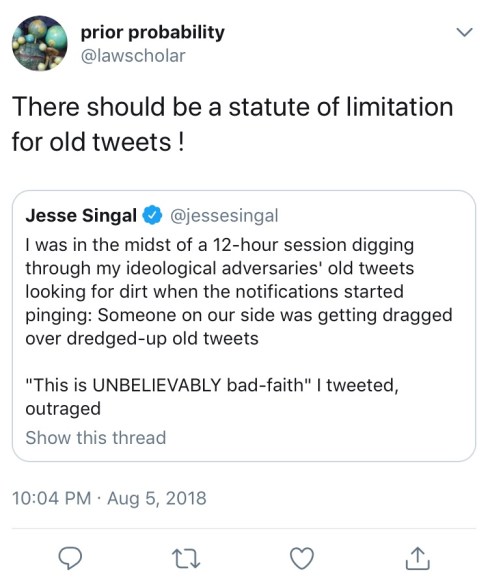
A modest proposal (Twitter edition)

Hat tip: Jesse Singal

Posted in Uncategorized | 2 Comments

Hiding in plain sight

Could the number of followers a candidate has on Twitter provide a better prediction of the outcome of an election than traditional polls?

Source: WSJ (hat tip: Leonard Baynes)

Posted in Uncategorized | 2 Comments

The answer is NO!

Happy Birthday, Adys! (hat tip: @KimKrawiec)

Posted in Uncategorized | 2 Comments

Conclusion of ASU

It’s time to conclude our review of Chapter 10, the last chapter of Anarchy, State, and Utopia. Nozick closes this chapter by restating his original vision of the dual nature of his conception of utopia (p. 332): “There is the framework of utopia, and there are the particular communities within the framework.” In addition, Nozick asserts that his vision “totally rejects planning in detail [and] in advance, one community in which everyone is to live …” (ibid.). While we certainly sympathize with Nozick’s libertarian vision, isn’t it somewhat disingenuous–to not say intellectually dishonest–for him to reject some amount of planning, since by his own admission (see our previous post), a “central authority” will still be necessary to police and protect the utopian framework? After all, once we introduce a state (or “central authority,” if for some silly reason you still prefer Nozick’s euphemism), then some level of design and planning will be necessary to ensure that Nozick’s minimal state is strong enough to do its job of resolving disputes and policing exit rights, but not so strong as to subvert the libertarian character of the framework. (In other words: Nozick, get back to us after you have finished reading Federalist Paper #51!)

But wait, there’s more! Nozick also restates his opening question (p. 333): “Recall now the question with which this chapter began. Is not the minimal state, the framework for utopia, an inspiring vision?” Alas, why not restate his question thus: Is not Rawls’s original position, or Lenin’s system of soviet socialist republics, an inspiring vision, at least on paper? Simply put, I could give two hoots whether Nozick’s vision is an inspiring one or not. What I do care about is whether his utopian framework is logically coherent and whether it will work out in practice. (Or to be more precise, what I care about is the probability whether it will work out or not.) On that score, however, judging by his own libertarian standards, Nozick fails miserably. Why? Because his framework will require a strong state or “central authority” to enforce contract and property rights and keep the peace. So like Maxine Nightingale’s vintage song (see below), 334 pages later we are right back where we started …

Related image
Posted in Uncategorized | 2 Comments

Paging Professor Nozick: C’mon man!

Thus far, we have reviewed the first eight (of eleven) subsections of Chapter 10 of ASU. Here, we review the ninth subsection (pp. 326-331), where Nozick finally gets around to addressing the elephant in the utopian room: who will resolve the inevitable disputes that will occur among the multiple utopias in Nozick’s imaginary world, and who will enforce exit rights in this world? Nozick thus acknowledges that two kinds of conflict will arise, even if we were to fully embrace and implement his utopian framework: (1) inter-utopia disputes, i.e. disputes between different communities, and (2) intra-utopia disputes, i.e. internal disputes within a particular community when members wish to leave in breach of their contractual or family obligations to that community.

It is here–well over 300 pages into his libertarian tome–that Nozick finally concedes that we will need a strong “central authority” (i.e. a state!!!) after all, thus refuting the central thesis of his book! (Frankly, to expect that this central authority will remain a “minimal state” begs belief.) Nevertheless, or perhaps because of this enormous and embarrassing internal contradiction, Nozick does not attempt to describe what this state or central authority would look like. He simply notes (p. 330): “What the best form of such a central authority is I would not wish to investigate here.” To this blatant cop out, all I can say is: c’mon man! In any case, we will review the last two subsections of Chapter 10–and thus conclude our review of ASU–in our next post.

Related image

Posted in Uncategorized | 4 Comments

Some problems with the utopian framework

Nozick spots several problems with his utopian framework in the middle sections of Chapter 10 of ASU (pp. 320-325). One problem is theoretical: his framework for utopia appears to be internally inconsistent. On the one hand, the overall framework is based libertarian principles, but on the other, the individual utopias within his framework are free to choose paternalistic principles for their internal governance. In the words of Nozick (p. 320):

“The operation of the framework has many of the virtues, and few of the defects, people find in the libertarian vision. For though there is great liberty to choose among communities, many particular communities internally may have many restrictions unjustifiable on libertarian grounds: that is, restrictions which libertarians would condemn if they were enforced by a central state apparatus. For example, paternalistic intervention into people’s lives, restrictions on the range of books which may circulate in the community, limitations on the kinds of sexual behavior, and so on.”

How do we resolve this paradox? How can local communities be paternalistic and the overall framework be libertarian at the same time? Among other moves, Nozick’s ties his solution to this paradox to property rights (p. 322): “A face-to-face community can exist on land jointly owned by its members …. The community will be entitled then, as a body, to determine what regulations are to be obeyed on its land ….” Nozick also notes that size matters. That is, to the extent that most communities within his framework will be small and local, most interactions within such communities will be face-to-face and in person. But why should the level of paternalism within a given community depend on its size? Because of the greater mental costs or psychic harms generated by deviant nonconformists in these small communities. (But what about Nozick’s axiom that individuals have inviolable rights? Why can those rights now be waived at the community level?)

Next, Nozick identifies two additional potential problems with his utopian framework: change and dictatorship. In particular, how should we deal with communities that change their internal rules against the wishes of some of its members, and how should we deal with totalitarian communities? As Nozick notes, the former scenario–involving a community whose rules change over time–might pose a big problem for some because of an asymmetry in the costs of voting with one’s feet: it is more costly for you to exit a community that you are already living in than it is for you to refuse to join a community you don’t like. But according to Nozick, this asymmetry problem is easily solvable via contracts (p. 324): “… individuals need only include in the explicit terms of an agreement (contract) with any community they enter the stipulation that any member (including themselves) will be so compensated for deviations from a specified structure (which need not be society’s preferred norm) in accordance with specified conditions.” This solution, however, presupposes a court or some other coercive system for enforcing contracts and resolving disputes over what types of structural deviations are large enough to trigger the compensation provision of the contract.

Okay, so what about totalitarian communities? This possibility is a problem because such a total community would be inconsistent with Nozick’s moral axiom that individuals have rights and that these rights cannot be violated without some form of compensation. Nozick, nevertheless, brushes this problem aside (p. 325): “It goes without saying that any persons may attempt to unite kindred spirits, but, whatever their hopes and longings, none have the right to impose their vision of unity upon the rest.” Everyone is thus free to join whatever community he wishes, even a totalitarian one, so long as he does not attempt to impose his choice of community on others. In short, Nozick’s framework for utopia is a libertarian one, but the individual utopias within this framework need not be. We are now almost done with Part III of Anarchy, State, and Utopia. We will conclude our review of ASU in our next two posts.

Image result for tread on me

Nozick: As long as the overall framework is free!

Posted in Uncategorized | Leave a comment

Nozick’s cavemen

Nozick compares and contrasts “design devices” with “filter devices” in the fourth and fifth subsections of Chapter 10 of ASU (pp. 312-320). (He also appears to take a parting shot at Rawls. More on that below.) Here, Nozick temporarily concedes, for the sake of argument, that there is a single universal utopia, that there is one kind of ideal society that is best for all men. If so, how would we go about discovering what this society is like? Nozick describes two methods of discovery: (1) a priori design and (2) ex post filtering. Continue reading

Posted in Uncategorized | Leave a comment